
water by day, apples by night

Day 3

Awakened by the metranome sound of our room’s ceiling fan , the early morning Accra traffic outside, and a light knocking on our door. I climbed out of bed to begin my third day in the same clothes and to greet the helper boy saying, “Your friends are calling, it is time for breakfast.” We had slept in just a bit. Roommate Kyle and I entered the bright morning courtyard to see our entire group already there and enjoying a meal of eggs, peppers, tomatoes, and chicken sausage. We barely finished eating before the bus arrived to take us to lecture.

Our first site of the campus was the welcome arches and sign for the University of Ghana. We drove directly to our seminar room in the School of Communication. Professor Tims gave us our welcome and first introduction to the University and then we left for lunch. We had lunch in Osu, where there are many good resturants and tourists. At the Country Market we were treated to a variety of delicious Ghanaian dishes: fried plantain (banana), beans & rice, gari foto (from cassava), fish, chicken, yams, spinach, and freshly squeezed mango juice – liquid heaven.

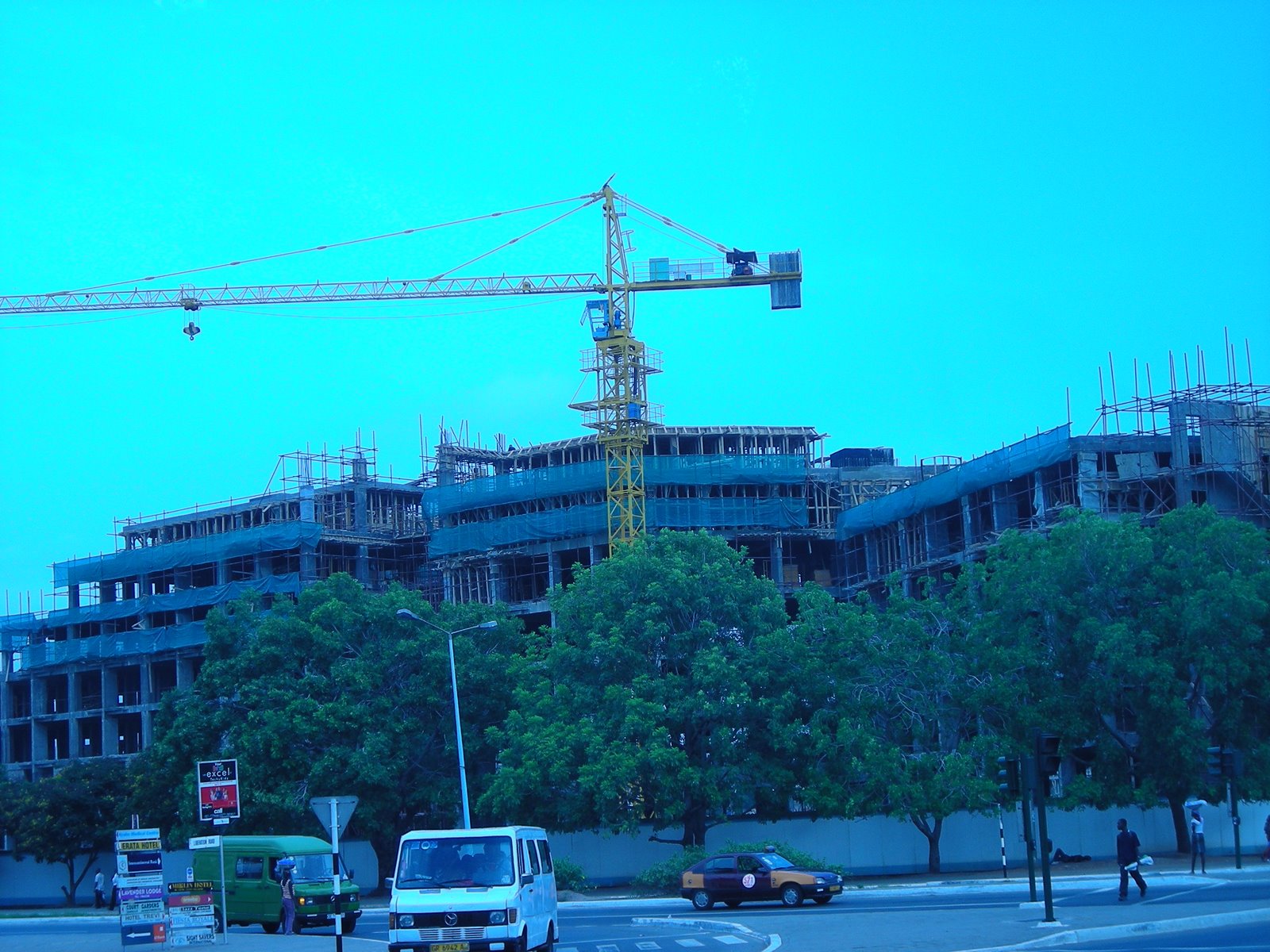
From our travels to the University and to lunch we were able to get our first views of the city of Accra. There is a lot of construction happening everywhere: hotels, apartments, shops, huge structures, a stadium, and more of which I have no idea what they will turn out to be. The economy must be doing very well in Ghana (global economy) from the boom in cocoa prices and the gold supply. As I have stated before it is much like Kampala, but there are is more developed buildings, road infrastructure, traffic lights, and no men with AK-47s at the store fronts. There are many skyscrapers and massive buildings built from foreign companies investing in the country. The traffic flows well, most of the time, because sometimes the stret lights do not work and it breaks down to the wanton driving that Accra’s taxis are known for. All over the place there are hawkers with anything and everything that you could want or need. From bags of water, plantain chips, fan-choco, toilet paper, pens, DVDs, posters, etc. – the list is really quite endless. These hawkers have made navigating the streets difficult and many accidents have occurred, but these hawkers also provide a walking grocery store for all the people on the move during the day. The majority of hawkers sell water during the day in bags, yes bags and it is safe. At night most hawkers are selling apples in bags of three or toilet paper rolls.
Our first lecture was from an ‘insider’ on Accra and Ghana. It was a bit boring and nothing that our amazing bus driver, Eric, had not already told us. After the first lecture we had a bus tour of campus. The University of Ghana, or Legon University as it is known to most Ghanaians is the best in the country. It is a very expansive campus and reminds me of MSU, but MSU is much more flat. Some of the buildings look nicer than those at MSU. There is now a threat of an exam boycott because the University is asking students to leave the University housing on campus to the more expensive hostels in Accra. On our tour we traveled all the way up the hill to the Vice-Chancellor’s house where we were met by an amazing view of Greater Accra below.

After the lecture and tour we went to the ‘art and culture market,’ or in better terms the Ghanaian way of saying tourist trap. It was an intense experience. As soon as the vendors saw a bus full of Obroonis they flocked and told of the wonders of their wares. It is customary for Ghanaians to ‘make a friend’ and so I had about 3 by the end of the experience. Every stall that you go past someone sticks out their hand to greet you, but you are not given your hand back and in return you receive an earful about a nice shirt, or cloth, or jewelry. After a while I met a very well spoken man who asked if I was looking for drums. Heck yes I was! So I followed him to his shop. He and his friends proceeded to bring over drum after drum and we worked on a price. Now in Ghana you have to bargain for everything. They give you the Obrooni price and we are told to cut that in sixths and offer that as a starting price. I bargained, probably not too well and not as far as I should have but we agreed on a price of 550,000 cedis, which is about $60 USD. I would say that is not bad for a handcrafted, quality drum from Ghana, when in other places you would be charged upwards of $300. Before we settled on the price I told him that before I bought the drum he had to teach me something, so we played a bit before finalizing the price. I was still a bit wary and told him that I did not have the full amount with me. No problem they would bring it to the hostel tonight and my new friend, Omar, would bring his group and we would play.

After dealing with all the ‘friends’ and sellors, I had to get away and join my friends who had already escaped and were watching a large football (soccer) game right next to the market. It was a great game, but the more interesting one was played by a group of players not in the larger game. They had tiny nets with nho goalie and used the area next to the market as well as the people in the market and the big football field as a game field. The were very skilled and cursed anyone who got in the way of the game, as it was a game that took away a major walking path.

Later that night as we sat chatting in the hallway, one of the students came up and said that there were visitors for me. Omar brought the drum and his drum teacher. We sat and drummed and hung out for a while. I learned a lot and it was great to be learning of the traditional music. Omar’s drum master was a great teacher. He has dreadlocks, and the local people call them the rasta. They see the rasta as people who they can learn something from, however others see the rasta as bad people looking to make trouble. At any rate they were nice and I learned a great deal. Here are some great quotes from the drum master about life and living, “It is nice to be nice, we have the same color eyes and we bleed the same color blood” and “Africa is about much experience.” When he said the last line we were talking about travel and education. He said that it is great to be taking something back, experience, but also culture and music. It will be as if I did not just travel to Africa, but I will be able to give my friends a good idea of what it is like and I can, in turn, teach them. I would say he had a sharp mind and they told me that they could come by every night to teach me more.

The bus showed up and I was finally able to get away from the rasta lectures on life and we ventured back to the airport to get our ‘lost’ luggage. It was a fun trip. There was a long line, because many people did not get all their luggage on the same night as us, and they beat us there.
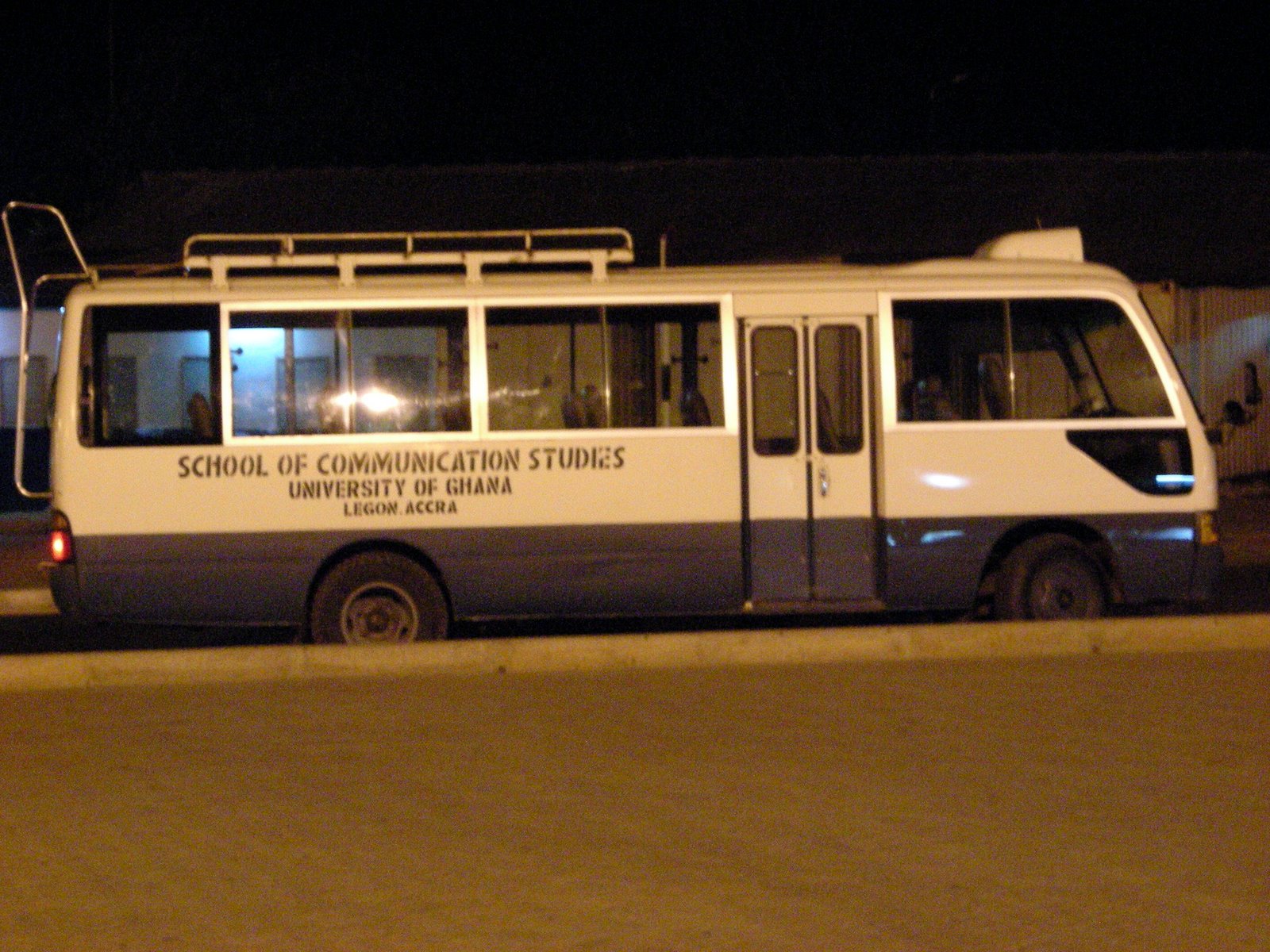
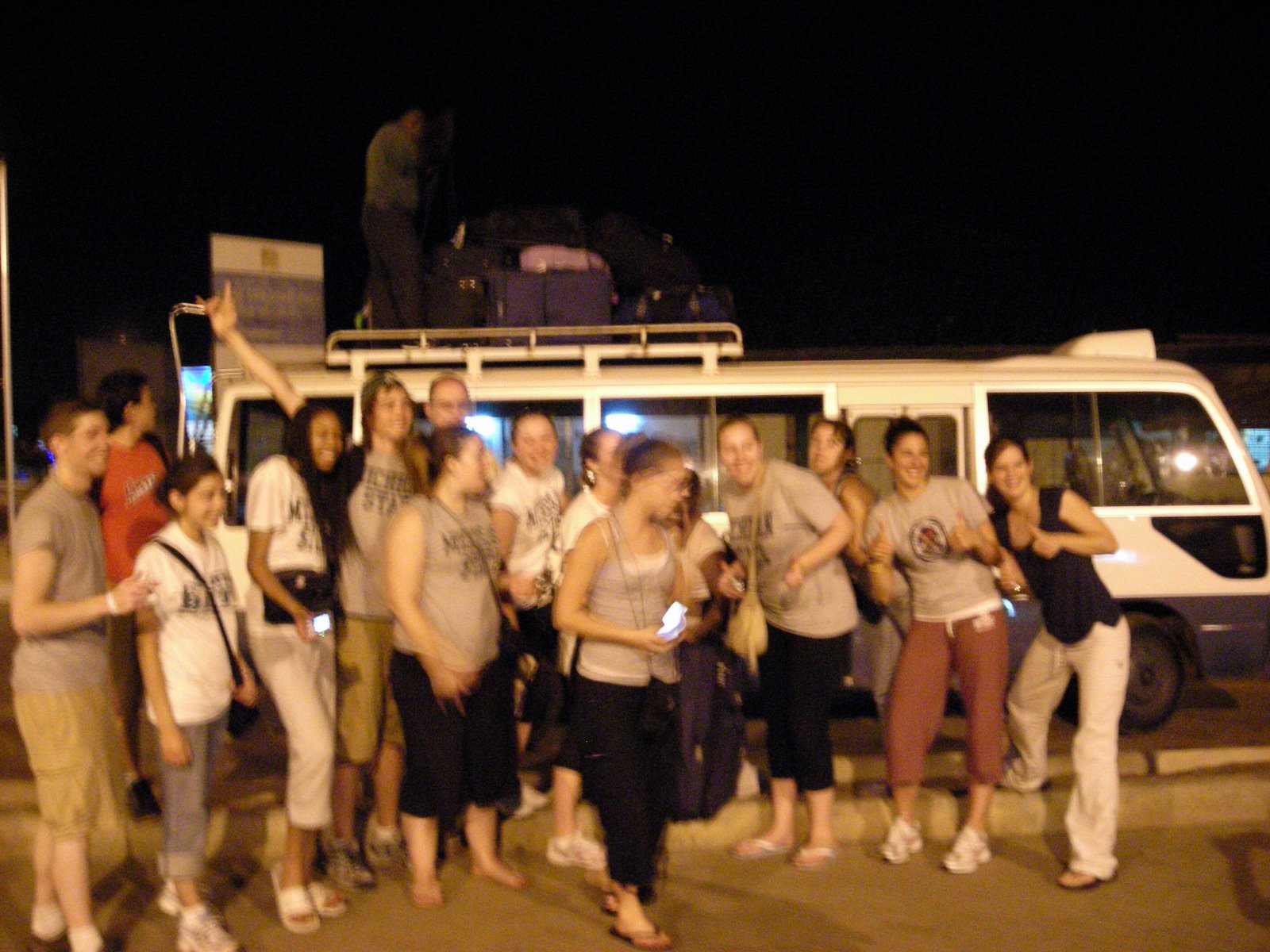
It was a tiny office where an man who exuded false importance sat to check your luggage and have you sign a large official book with your John Hancock, for what purpose? I have no idea, but it must have been important. There was a small room where all the luggage was crammed in. There was luggage dating back to last year still there as we rummaged to find our luggage. Some luggage was still missing and some people still had only one pair of clothes. Check out the bus before and after pictures:
Day 4
The next day began again with waking up late finishing my french toast just as the bus pulled up – no time to shower (day 4 no shower, gross). We went straight to the University and had lecture from Professor Passah, head of the History Department, on the history of Ghana and its people, colonialism and its impact, and its positives and negatives. For an African Studies major these were not very interesting lectures as I had heard them all before, but learning more specifically about Ghana was great.

Super Fast History Lesson on Ghana:
In the 15th Century, the Portuguese discovered the vast gold wealth of the Ga people. They had been searching to find a gold source that was not throught the Middle East, since the Arab states had a sort of monopoly on the gold trade and the Christian Portuguese did not want to trade with the Muslims. The Portuguese also knew that the gold from the Middle East did not originate there, and so there must be a source elsewhere. With their great sailing abilities and inventions such as the compass and magnet, the Portuguese found the Gold Coast. The Portuguese had the goal of spreading their religion as well as gaining wealth, so they built a great education system to teach and convert. This is part of the reason that Ghana has such a high rate of educated citizens. Their discovery of gold sparked a gold rush and the Dutch, British, French, German, and other nations rushed to set up fortresses and trading posts along the Gold Coast. This began the trade in slaves as well. Later in 1807 the British abolished the slave trade in paper, but not in practice. The slave trade was perpetrated worst by the British. The castles of Cape Coast and Elmina (La Mina – The Mine) were finally both controlled by the British and the British were able to claim Ghana as its colony in 1901, when all other imperial powers had left. The Btisih also gained control by working out an agreement with the Ashanti people, who fought hard for access to the coast to trade, for peace. It was signed by the chiefs on 6 March 1844 in Palaver hall at Cape Coast Castle, and is called the Bond of 1844. And so now today the greatest influence is Britian as Ghana is surrounded by all french speaking countries. The slave and other trades have relegated Ghana to being solely dependent on cocoa and gold as its wealth is focused on its resources. No industries for production were created because everything was exported to the imperal powers where industry had developed.

We learned about colonialism and its impacts which was nothing new to me. However, the professor claimed that there were positives of colonialism. Sue education was great, but forced and using unity as an argued positive will not work. Everyone here has a sense of being Ghanaian, but the imposed boundaries divided ethnic groups, increased tensions, and took no consideration for nations of people in the area which were already developed. Unity through division is not a positive. After the lectures we were let out for two hours to explore campus on foot. We headed down the main road,mostly lost, and found an internet cafe – I had to write to mom and let her know that I had indeed made it safely. As one could have guessed she had already emailed me with a slew of questions. I emailed back with not enough time to blog and we had to quickly find lunch. We stopped at a cafeteria and asked for some rice ‘to go.’ Our waiter thought that we wanted to eat outside or have food delivered. He finally understood and we briskly walked to the bus. We got some very cheap and delicious boxes of rice and chicken.

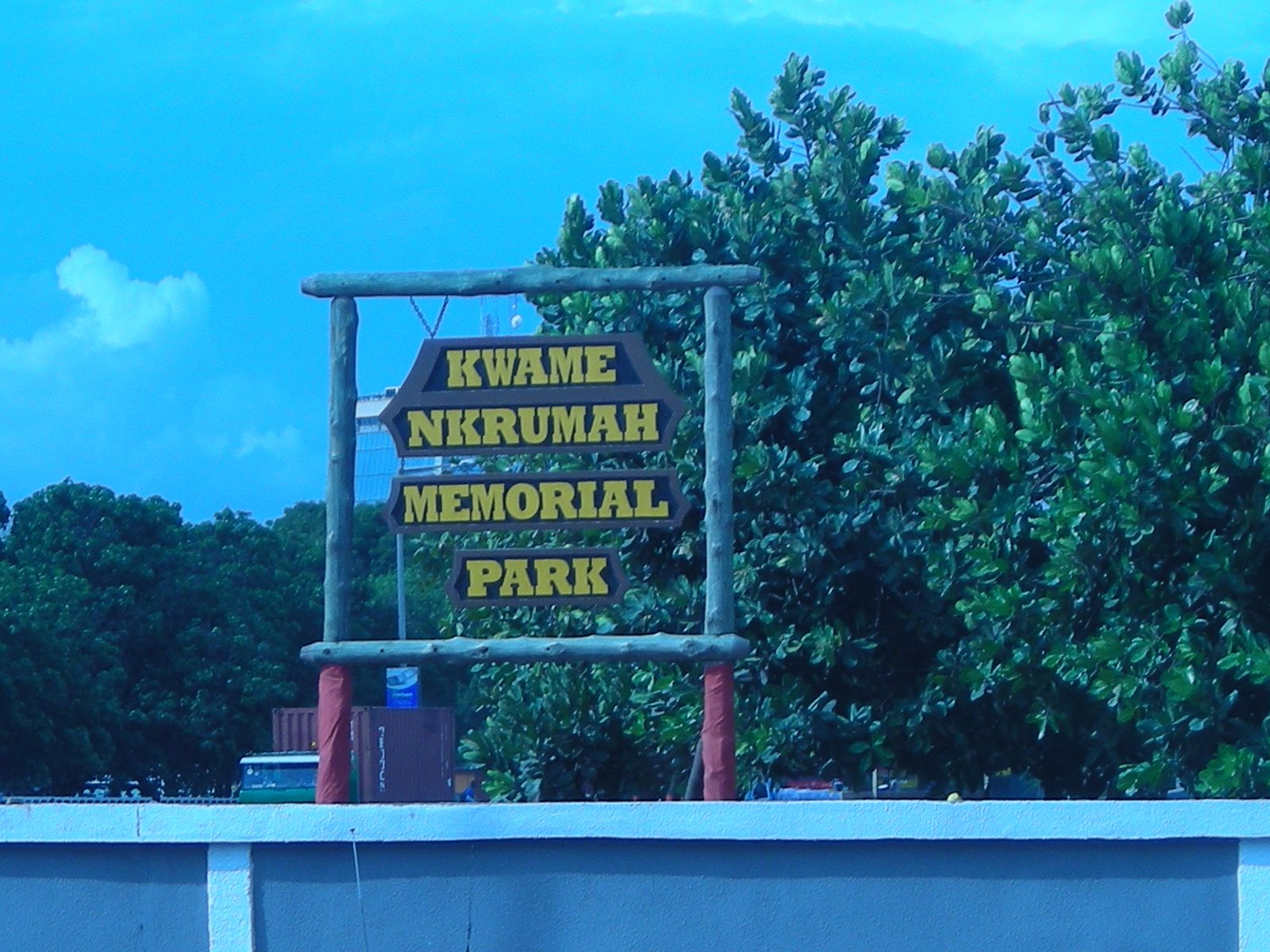
We reached the full bus and headed out to the Kwame Nkrumah memorial park. Many students had no idea who Nkrumah was or what he did for Ghana and Africa. So I was able to give a short history lesson to some. The park was an amazing place, with a great memorial structure representing the life of Nkrumah. There is a large statue of Nkrumah where he stood in 1957 to give his speech, which I had watched in history class at MSU, declaring Ghana’s independence and the moving forward of Africa from colonialism. The structure represented a tree trunk, with aspects of the Taj Mahal, the Eiffel Tower,and other famous monuments. Africa is supposed to have built upon that tree trunk, but it seems we have yet to see this tree blossom. Does Africa still realize this goal of Nkrumah? As you can imagine outside the park hawkers followed us everywhere. We then headed to the W.E.B. DuBois museum and toured his former house and work. At 93 he immigrated to Ghana to help with Nkrumah’s efforts, he also left the States because of his displeasure with the american people missing his message.
We headed back to the hostel after the museums and were on our own again until our 3rd trip to the airport to get the remaining luggage. We took our first solo adventures in Accra. Calling a taxi is very easy being Obrooni and because all you have to do is point your finger down to signal that you want a drop ride. Five of us crammed in a taxi for Osu. I sat in the front. I can tell you from that ride that this was the real Accra experience. Flying down the streets, honking the horn in short bursts, with exhaust and trash fire smoke in your face – This is Accra.

In Osu we ate at Frankie’s which is the hangout for the wealthy Ghanaians and Obroonis. We ordered a delicious pizza. After everyone ate some of us ventured to the streets (dangerous?, maybe) to find an internet cafe and phone cards. Stopping at a gas station to ask we finally located internet. We passed many Obroonis in the street, but none smiled – which is very odd in a city where everyone wants to be your friend. An hour spent online and we easily hailed a taxi to our hostel. We were hanging out and the drummers showed up again. They brought more drums to sell and more people played. It was a lot of fun, but I am still a bit wary of them as they are definitely looking for something. I learned more rhythms and perfected some skills. One of them told me, afterhearing me play, “this is a drummer,it is in your fingers, you can feel it.” What a great compliment.

Index of blog post series on Ghana.

something you can taste

Hello All from Ghana! I first have to send out a Happy Mother’s Day to my mom back home!

I have arrived safely and soundly in Ghana. The journey was long and tiring, but nothing I am not used to. My mom thought that my absent-mindedness might kill me, but now that I am here there is nothing more to worry about. (That’s for you mom) The reason that mom was worried was that I happened to forget after reading my flight departure that I was to leave in the PM and not the AM. The evening before planning to leave at 7AM the whole family went out to dinner to celebrate mother’s day and send me off to Ghana. We went to a great Chinese restaurant and my fortune interestingly read: “You are about to embark on a most delightful journey!” A good sign. When we arrived home it happened that we discovered that my flight was to leave at 7PM and I still had a whole day ahead of me in the States. Oops.

I have to begin my first post from Ghana with a disclaimer: There is no way that I can completely or even remotely express and capture the full Ghanaian experience. There is no way that I could even claim to have the ability to write in such a way.

Day 1 & 2
At the airport all the study abroad students met up to check in. We all were quite excited and began awkwardly talking about our hopes and fears of traveling to Africa. Many students had said their friends made jokes and asked, “Why Africa?” There really is no answer one answer for everyone and I wonder how many just played along with the joke. We made it through security and boarded our flight across the Atlantic. Many students had never crossed the Atlantic, this will build their waiting ability in Africa. British Airways is a very nice airline (or so we thought) with jovial stewards serving food and libations in their beautiful british accents. Each seat was outfitted with a screen and high-tech options for movies, music, news, etc. I watched the ‘Freedom Writers’ and ‘Last King of Scotland’. I will share my review of those movies later.

Arriving in London, the only way you could tell it was London was because of the constant rain and the small british cars. The airport Terminal 4 was not too exciting and there was a lot of sitting and learning Twi, the main language of Accra. In the airport I had my first real world test of french as a man asked me where I he could go to smoke. I fully understood him and had to reply that I had no idea. After sitting around for a long while, we then boarded our plane to head to Ghana. The flight was delayed I found out later. I had fallen asleep as we sat in the plane waiting to take off. Our first greeting from the African continent was a blazing red sunset – absolutely beautiful. Many studetns commented taht they would not believe that they were going to Africa yet, until they were actually there.

After much rest and a long plane ride we arrived in Accra, Ghana to the Kotoko Inernational Airport. We were welcomed by a slight drizzle.The green, red, and yellow colors of the Twi saying: “Akwaaba” (meaning welcome or ‘you have gone and come back)shone brightly as our first glimpse off of the tarmac. It was roughly 10PM and as soon as you stepped off the plane there was a heat and humidity that you couls almost taste because it was so thick. We enter the country and passed immigration with no problem, but our luggage did not arrive with our plane. For some reason British Airways decided not to send it along. Kotoko Airport is like many in Africa – a hint of colonialism in decay with many people walking around in official uniforms. After waiting in long lines for tickets to claim our luggage the next night, we boarded our University of Ghana bus and headed out into the nearly empty night. The bus was nice and air-conditioned, but had an odd smell of human sweat circulating. Accra looks much like Kampala, Uganda. However, I would say that they should call Uganda the Ghana of the East, not vice versa. The similarities are frightening, but I will touch more on the city later. One big difference is the bill boards celebrating 60 years of independence of Ghana.

The hostel is not far from the airport and is quite nice. It is definitely a luxury in Accra. There is AC, a television, a mini-fridge, private bathroom, and a type of bellboy. The Ghanaian music on Music Africa is great and we watch football (soccer) before bed. It is a very nice place to stay for a few months in Ghana.

I am a bit behind in my writing, but be sure to check back for Days 3 & 4 and more pictures.

Index of blog post series on Ghana.

writing about africa. . . a simple exercise or a skill?

When writing about Africa many times it is difficult to bring the proper perspective or ‘view’. So often people write about Africa with the view, that many of us have come to know, from the myths of Africa. The old myths of a ‘dark’ continent, Heart of Darkness, uncivilized, and savage to the new myths of a continent wrought with poverty, disease, and conflict, these are all too often emphasized in writings about Africa. That, I would say, is a poor representation of Africa, its many countries, and its many peoples. In her blog, Acumen Fund Fellow Jocelyn Wyatt, writes about her training in writing about Africa before being stationed in Kenya for eight months. She tells us of three views often evident in writings about Africa. I will allow her writing to continue this message. And I hope, that I can write about Africa with a critical eye and not with a jaded or an overly simplistic mindset. I hope to understand the intricacies of Africa and not look too far past the idea that all people are more alike than they are different.

From My Year as an Acumen Fellow – 3 Views on Africa:

The Acumen Fund Fellows have been fortunate to meet many inspiring leaders and engage in plenty of thought-provoking discussions over the past four weeks. The question about how to write and talk about Africa has been raised several times. In April, Jacqueline referenced “How to Write About Africa” on this blog and discussed it with the fellows during the first week of orientation. This piece exposes the simplicity of how most people write about Africa and inspired us to think about how to do it in a different way.

View 1 – The Outsider Who Gets It: Gayle Smith, currently a Senior Fellow at the Center for American Progress, and former journalist and senior staff member of the National Security Council and USAID, spoke to the Acumen Fund fellows about her work in Africa and as a member of the U.S. government. Many people don’t understand the appeal of living in the developing world, and I often have trouble articulating it. After living in East Africa for 20 years, Gayle explained it well, It was easier and more satisfying to live there than in the U.S. There’s a sense there’s something bigger than you there. In D.C., there is nothing bigger than any of us. While working for various NGOs in Africa, Gayle saw that there were stories that needed to be told and insisted that the media print them. Gayle’s unique combination as an outsider with extensive experience in East Africa provided her an honest view of the culture, people, politics, and economy and her understanding of the complexities led to her success as a journalist.

View 2 – The Insider Who Exposes It: The book Things Fall Apart by Chinua Achebe is a powerful reflection on the introduction of western culture and colonization to a Nigerian village. When it was published in 1959, it was probably the first book written by an African that most Americans read. Achebe’s novel is honest and extremely critical of the colonial forces who he recognized did not see anything in Africa that was larger than themselves. As an insider, Achebe delivers us well-rounded and real characters and aptly describes the complex forces that pulled Nigerian villages apart.

View 3 – The Outsider Who Simplifies It: In the recently released movie, The Last King of Scotland, a young doctor from Scotland moves to Uganda to work in a rural health clinic. He becomes Idi Amin’s personal physician and gets caught up in the ruthless dictatorship. The film begins with colorful, stereotypical footage of Africa, people singing and dancing on the side of the road, a beautiful African woman seducing a young westerner, and an older white doctor and his wife “saving” a village of Africans at their rural clinic. As the movie goes on, Uganda becomes a much darker, more corrupt, and violent place as Amin’s rule becomes harsher. Even in a ‘flat,’ globalized world, we are frequently exposed to such stereotypical portrayals of Africa: one that is simple, happy and colorful, and the other that is dark, corrupt and violent. While an interesting story with strong characters, in an effort to simplify the context, the film does little to accurately showcase Uganda.

off to the continent of my dreams

It crowds my thoughts; it accompanies my dreams; it wrenches my heart; I am so close to arriving on its glorious soil: Africa. In less than three days I am going to travel back to the continent that stole my heart. Six years ago I was captivated and moved by my travels in Uganda and now I will be headed to Ghana to continue my journey. This summer I am going as part of an official study abroad through my university, Michigan State University’s study abroad program in Ghana: A Multidisciplinary Perspective. And so this blog’s title is about to become a bit oxymoronic, however regardless of title this blog will cover my experiences in Africa this summer and will continue to chroncile my work in and for Africa.

From the MSU Ghana Program Handbook:

Introduction to Ghana
The Republic of Ghana, the first country in colonial Africa to gain its independence in 1957, is roughly the size of the state of Oregon and lies about four degrees north of the equator in West Africa. Formerly the Gold Coast, Ghana bordered by Togo to the east, Côte d’Ivoire (Ivory Coast) to the west, Burkina Faso to the north and the Atlantic Ocean to the south. The country is divided into ten administrative regions, each with a capital city, and the capital of the country is Accra, a port city. English is the official language, and at least seventy-five African languages and dialects are spoken, generally divided into Akan, Mole-Dagbani, Ewe and Ga language groups. Twi is the main Akan language, it is the first language to approximately half of the population, including both the Ashanti and Fante, and is widely spoken in the central and southern parts of the country.

The current population of Ghana is approximately 20.7 million, 63% of Ghanaians are Christians, 16% are Muslim, and 21% practice indigenous beliefs. Christianity dominates the south and Islam is the predominant faith in the northern part of the country. Most Ghanaians maintain some traditional beliefs and customs no matter what their professed religion.

Politically Ghana is a constitutional democracy – John Kufuor is the current president, elected January 7, 2001. The currency is the cedi, $1 = 9,445 cedis.

Climate
Ghana’s climate is tropical. In the south it’s usually hot and humid (average daily temperature is 86 degrees F). There are two rainy seasons, from April to July and from September to November. The heaviest rains usually fall in May and June. The Harmattan, a dry desert wind, blows from the northeast from December to March, lowering the humidity and creating hot days and cool nights in the north. In the south the effect of the Harmattan is felt in January. In most areas the highest temperatures occur in March, the lowest in August.

University of Ghana
You will be spending much of your time on the University of Ghana at Legon campus, about 14 km outside of Accra. The University of Ghana began in 1948 as an affiliate college of the University of London. In 1961, however, the University of Ghana was, by an Act of Parliment, reorganizaed as the University of Ghana to award its own degrees. The University has over 20,000 students, including many international students. The campus is large with many buildings, dorms, cafeterias, a botanical garden, bookshop and library.

Field Trips
Elmina Castle in Cape Coast
Kumasi, capital of the Ashanti Region, home of the Ashanti, the richest and most powerful people in Ghana, with the largest open-air market in West Africa
– Bonwire to observe the kente cloth weavers
Volta Lake, the world’s largest artificial lake created by the Akpspmbo Dam in 1964
Kakum National Park

Be prepared to read of some great adventures and be sure to check back often for updates! I would say Africa awaits, but Africa does not wait for me, I am waiting for Africa.

Index of blog post series on Ghana.

the impact of conflict on health

The correlation between violent conflicts and health may seem to be very obvious, but there is more to the issue than what crosses the mind. Everyone can make the simple connection that there is direct impact of conflict on being unbenefittal for the betterment of health. For example it is easy to read this <a href="http://news.bbc.co.uk/2/hi/africa/6590965.stm
“>article and see the obvious connection to artillery shells hitting a hospital in Mogadishu. Internal clashes and conflict creates a more difficult situation for humanitarian operations all over Africa.

Africa represents the highest rates of internal conflict and disease, especially HIV/AIDS. This disease has been used as a weapon in conflict. Many times infected soldiers are sent to the front lines to spread disease and infect the opposition, which generally turns out to be the innocent population. Populations affected by armed internal conflicts end up experiencing severe public health consequences from food insecurity, displacement, and combat. All this ends in a collapse of basic health services which are essential to the survival of the population.

I could not find the article again, but the BBC had reported on the difficulties faced by those bringing humanitarian aid to Darfur, Sudan. They constantly faced issues with the government shutting areas down or denying them entrance. infrastructures for basic health, or created systems for basic health become neglected or destroyed. In many cases the impact of conflict can be felt at the very lowest levels of a population; women are unable to protect their families, fathers just might not be present anymore, children have no access to schooling, and everyone suffers from an absence of basic health – no food, no medications, no stable doctors, and no way to deal with the injury inflicted by the violence of conflict.

With the renewed peace talks for Uganda, the twenty year civil war seems to be coming to a close and the health of the northern Ugandan population may be improving. The rebuilding effort is going to be long and difficult, but there is hope. Many organizations are beginning efforts to improve the health situation and support hospitals and health centers that have been impacted by the conflict.

There are so many topics that can be covered as a result of conflict in a country and its correlation to health. However, I am not here to expound all of the information available, but know that it is out there: sexual violence, psychological impact on children, and especially the toll on health workers. Conflict impacts health plain and simple, but there is so much more as the impact trickles down to the population, the families, and the children. The future of a country in conflict lies in its ability to rebuild and provide aid to their populations after conflict.

are the MDGs credible?

The ‘bright idea’ of the West very often comes under scrutiny from the rest of the world. In Tanzania the Millennium Development Goals (MDGs) are seen as the ‘hidden agenda’ of the West that is impossible for African countries to achieve. Many see South Africa’s ability to achieve the MDGs as an obvious reference to the Western powers’ foreign policy towards ‘developing states.’ Is it because South Africa is most Western and developed that it has achieved so much?

The MDGs can certainly be seen as worrisome, however I would not go so far to state that they are a tool for Western powers to control African countries or ‘underdeveloped’ countries. The ‘developed’ and Western powers do hold the power in the UN, but I know a good number of people who work for the UN and are dedicated to reducing poverty and providing access to the necessities that all people need to survive. I am not a proponent of big plans, such as the MDGs. As I have come to understand and know by way of William Easterly – big plans do not work, big plans do not succeed and there is a large cynical backlash when the big plans fail.

Many professionals say that the MDGs are unachieveable by African countries but the institutions say otherwise and claims that African countries are actually achieveing the goals. The UN newsletter on Africa, African Renewal, has facts and figures from the 2005 MDG report that outline how Africa is doing at achieveing the MDGs. Many of the goals are very far off track from the actual goal, but in the area of access to a clean water source and primary school education there is improvement.

Since the 1960s numerous, ambitious development goals have been set for the world to achieve. Every time that goals are set their deadlines for achievement are passed and new goals are drafted. Most recently we reached the new millennium and the most ambitious goals were set.

They are the most broadly supported, comprehensive, and specific reduction objectives the world has ever established. (UN Millennium Project)

The deadline is fast approaching and achievement is far off for many ‘developing’ countries. The first ‘decades of development’ (1960, 1970, 1980, 1990) focused on economic growth. Beginning in the 1990s, development started to focus on the need to create “macroeconomic stability, strong institutions and governance, enforce the rule of law, control corruption, and provide greater social justice.” From those aspects, the new MDGs reflected the emerging role of human rights in the international community, focusing on the economic, social and cultural rights enumerated in the Universal Declaration of Human Rights (rights to food, education, health care, and decent standard of living). Throughout the ‘decades of development,’ conferences upon conferences, meetings and more meetings were held to build the best plan for development in our world. Yet as this happened goals failed, new goals were created, and millions lost their lives. This is where I will end with a very important quote:

“Meetings are indispensable when you don’t want to do anything.” – John Kenneth Galbraith

brand of global health: gates

The new major player on the global health scene is the Bill & Melinda Gates Foundation, but is it possible for two people to become a brand of global health? Is the Gates Foundation really providing aid and investment in the best possible way with their power and influence as a global health ‘brand?’

The Gates Foundation has already become one of the top players in global public health. And with last year’s gift from Warren Buffet, the Foundation is set to double its giving this year. Last year the Gates’ invested $1.36 billion in many different areas of public health, from providing childhood immunizations to agricultural research in developing countries. One of the major priorities is HIV/AIDS prevention and treatment, with over $350 million given in grants.

In June of 2006, on NPR’s All Things Considered, Thomas Quinn, director of the Johns Hopkins Center for Global Health, and Gerald Keusch, Associate Dean for Global Health at Boston University’s School of Public Health, answer questions about the practices and abilities of the Gates Foundation. They answer questions such as the Foundation’s role with the WHO and UNAIDS, its ability to make a difference, fears of responsibility and being a private foundation, and what the Foundation can do with its billions. I highly suggest checking out the link.

The two simple core values of the foundation’s work are one, that all lives—no matter where they are being led—have equal value, and two, to whom much is given, much is expected. Great values, with which great hope rests upon. Some people do not have as much hope in the Foundation as much of their practices and investment policies are out of date. I will not attempt to try and voice all of the concerns (check out the entry from‘My social life’ on 16 January 2007 Open Letter to the Gates Foundation). Has the Foundation inherited too many of the corporate practices from Mr. Gates to run effectively? Is the Foundation too big to be accountable to the people?

malaria awareness day

April 25th, the first US Malaria Awareness Day. An award winning photographer, Chien-Chi Chang, traveled to Uganda to give image to the story that is very often never heard, to give a face to the people who are never seen. This is not just another award winning privileged person traveling to get pictures or a story because these images and story are accompanied by a call for action. The images were used to raise awareness and promote involvement with Malaria No More. This is an organization that is fueled by celebrity involvement and received great attention from American Idol, but this is an issue and conflict that does not require you to be a celebrity to make a difference. Everyone is a celebrity in their own right.

On the <a href="http://newsforums.bbc.co.uk/nol/thread.jspa?threadID=6178&&edition=2&ttl=20070426013440
“>BBC’s news forum where people can write in their thoughts, many people called for a change in government actions and in people’s actions. Governments need to provide more funding for their health sectors and people need to depend less on their governments. I would add that we here need to understand that governments are not the ones who will make the greatest impact, when individuals support other individuals more lives will be saved.

In her blog, Acumen Fund Fellow, Keely Stevenson, writes about a socially responsible company in Tanzania working to provide bed nets. AtoZ uses a simplified, cheaper manufactoring process to make more bed nets for less. The company then charges a nominal fee to get the bed nets to people who will actually use them. Many times when organizations just hand out bed nets they end up as fishing nets or table cloths, but when there is a small fee – people who actually want them to use them will be supplied with them. This has been credited with bringing malaria deaths down in Tanzania.

Malaria is a preventable disease that claims the lives of over <a href="http://news.bbc.co.uk/2/hi/africa/6591169.stm
“>one million people, 90% of them in Africa. Using a bed net is said to reduce a pregnant woman’s birth complications and potential miscarriages by one third. A treated bed net costs about $4 and can save the lives of so many people is it is used. There have been numerous studies on the impact of malaria on mothers, children, and others – but the simple and known truth is that using a treated bed net can save your life and your family’s. There is no reason that malaria should kill so many people each year, our government should be stepping up its efforts, governments in Africa need support so that they can support their health sectors, and we here need to step up our efforts. Making bed nets more available and more affordable is the answer to a preventable disease without a cure.

Read up on malaria here.

the quest for development; aid to the rescue in ghana

Poverty: a state of being extremely poor; inferior in quality or insufficient in amount; our generation’s greatest problem; the world’s worst disease; a trap. The definition of poverty is one that is not difficult to grasp, yet so many do not understand how or why it plagues our world of riches. Our world is plagued by poverty and, contestably, Africa is the hardest hit due to it’s historical status of being relegated to unimportance. While poverty continues to take lives day after day the power wielding countries, institutions, and agencies argue over a solution. That solution is called development. Leaders, institutions, philanthropists all argue as to how development should be facilitated, what the best facilitator is, and how aid should be implemented. Is aid the best facilitator of economic development to bring an end to poverty?

Almost two years after Ghana’s President received word from the Group of 8 that aid would be increased to Africa, Ghana will celebrate being the first independent African country. Ghana is an African country that was very near economic collapse, but through the process of reform, gained economic stability. The current President is expected to step down after serving two years and it looks as though Ghana’s days of coups and unrest will long be over. Ghana has become an economically stable country by way of economic reform, which brought in foreign aid from the institutions and investment from the rest of the world. This is seen as a limited success as far as African countries. Ghana has shown itself to be a good reformer and much of that success has been attributed to aid. But why is Ghana such an isolated case of the success of aid from institutions?

The Trap or A Missing Right?

Jeffrey Sachs, the director of the Earth Institute at Columbia University, claims that there is a poverty trap and that the only way to get out of it is by climbing up the ladder of development. He states that this is the greatest tragedy of our time; that one-sixth of the world is not even on the development ladder. The reason that one-sixth of the world is not on the ladder is because of the ‘poverty trap.’ They are trapped because of many reasons: disease, isolation, climate, etc., but why? Sachs tells us that this one-sixth is trapped because their families and governments lack the financial means to invest in their own development. The world’s poor need to get a foot up on that ladder, but how? How does one invest in themselves?

Capital is the answer to the poor’s problem – at least that is what Hernando de Soto believes. In his research on the ‘mystery of capital’ de Soto claims to have found that all the poor need is access or ability to use the land and property that they reside on. They have material things, but cannot use their land as a resource to create capital. De Soto says that, “Capital is the force that raises productivity of labor and creates the wealth of nations.” The problem here is that governments have to open up their property systems to the poor and many are not inclined to do so. The processes for land ownership are lengthy and difficult in many LEDCs, so for many people owning property is not worth their time. De Soto fights for an impractical approach to bringing the world’s poor out of poverty. Balaam and Veseth note that de Soto’s argument for property-rights reform could not alleviate LEDC poverty, however such as step may be necessary for the success of ‘the beautiful goal.’

De Soto’s argument is supported in a slightly more practical manner by C.K. Prahalad, who says that there must be a goal to ‘democratize commerce.’ He supports his claim by giving examples of the poor as micro-producers. Prahalad argues that, “We know aid is not the answer to that kind of mass poverty. Subsidies, grants, and philanthropy may have a role to play, but the real solution is local development of the private sector. That requires specific actions that take into account the historical background of the country at hand.” Prahalad makes an excellent point at that there needs to be an understanding of country situations. He tells us that aid has a place, but where is that place?

Property rights are seen by many to be central to investment and the economy of development. Like de Soto they argue for its quick implementation. In regards to property ownership and its use to become developed it seems that Ghana eased from communal to individually owned land system. In the Ghanaian culture property held high importance and even though Ghana had to move from a communal model to individualistic, it was smooth. Property rights were granted to those who had planted or cultivated certain sections of land. This changeover of property rights was facilitated by stable, well-defined laws and customs in regards to the governing of land. The courts also recognized the existence of ‘family land’ and land belonging to larger kinships. This preset tradition of land ownership allowed Ghana to easily transition and permit people to use land as a means of creating capital.

Whose Consensus Should We Use?

Governments can hinder development, people are restricted from development, and societal institutions push the criteria for development. The Washington Consensus is the list by which all must abide in order to receive foreign aid. The Consensus promotes a strong neo-liberal agenda to deregulate economy, privatize government enterprises, create low inflation, low government debt, and open to domestic and international markets. The institutions use the Consensus in a fair amount of disagreement in regards to implementation. The Washington Consensus was a form for economic development that pushed free trade and capital mobility. The issue of free trade versus fair trade is a complete other paper, but the for ‘free’ forces LEDCs to spend funds on making reforms as opposed to implementing programs to serve its people. This causes poverty to continue in LEDC and although the Consensus made an irresistible possibility within reach it also brought the possibility of devastating collapse and risk.

The International Monetary Fund and World Bank are very often criticized and reforms within the institutions are called for. However, outside the institutions stand NGOs who fill the gap and many times create longer-lasting and more effective results for the poor of the world. Easterly is a strong critic of the aid agencies and he makes a very strong and compelling argument against them. Ghana has received a large number of loans and aid from the institutions. Easterly notes that in many recent cases of heavy involvement by the aid agencies end in collapses into anarchy. Stiglitz tells us that the Washington Consensus assumes perfect information, perfect competition, and perfect risk markets – an idealization of reality has little relevance to LEDCs.

Sachs writes about Ghana’s poverty reduction strategy. He notes that the government of Ghana reached the conclusion that a major scaling up of the public investments in the social sector and infrastructure, which estimates a required donor aid around $8 million. The Ghana strategy was well designed and argued, but the donors dropped and rejected the plan. Sachs argues that there needs to be a harmonization of aid. The many bi-lateral aid groups need to work together for larger projects, but for smaller-scale projects a more specified aid is required.

The Downside of Backward

Aid has become a dangerous word in today’s globalized, polarized, prioritized world. Another problem is that aid, as a term, is a very broad topic. For the purposes here, aid refers to financial support to increase economic development. The ‘grandiose’ plan of making poverty history or ending poverty brings about the desire to create the ideal aid agencies, administrative plans, and financial resources. Over the past sixty years the West has pushed reform schemes, agencies, and numerous plans all to end poverty. This has created a massive $2.3 trillion failed push by the aid industry to meet this ‘beautiful goal.’ William Easterly has argued that, “this evidence points to an unpopular conclusion: Big Plans will always fail to reach ‘the beautiful goal.’ Easterly tells us that Planners will always fail and their plans will always fail because they ask the question of what does the end of poverty require of foreign aid? When instead we should be searchers and ask, “What can foreign aid do for poor people?”

Balaam and Veseth tell us that the nature of aid flows has drastically changed from the time of the Cold War until now. During that time less aid was given because of security reasons, but now multilateral aid is channeled through institutions such as the World Bank. In the 1990s the World Bank changed its priorities to “fill in the gaps” due to many projects being funded by the private market and non-governmental organizations (NGOs). This shift made less economically developed countries (LEDCs) more dependent on other sources of funding.

If a LEDC has to depend on another source of funding besides the established institutions, as flawed as they may be, they will most likely look for the easiest way to get that funding. Ghana recently received, in June of 2006, a $66 million loan from China to fund its development projects. This is an extremely different and what some would call ‘backward’ step for Ghana. The Ghanaian experience with foreign aid has been to adopt reforms and partner with the institutions. In this case Ghana has strayed from the accepted conventions of the foreign aid industry. China is seen as a rogue aider in that they are undermining the development policy of the foreign aid institutions. By not placing restrictions on aid usage or democratic reforms, China is taking the foreign aid market by storm, as the World Bank is put out of business. China is not the only supplier of rogue aid, but it is the most prolific. What does this all mean for the aid industry?

It can only mean one thing and that speaks to the effectiveness of the aid institutions and the aid suppliers of the West. Ghana the star of economic reform, democracy in Africa, and years of peaceful independence is seeking rogue aid – there is no place anymore for utopias and institutions and big plans.

Utopia is Not Possible?

If the big plans won’t work than what will? Easterly says that the big problem with foreign aid is that is aspires to a utopian blueprint to fix the world’s complex problems. This is where we must refer back to Easterly and his explanation of a ‘searcher.’ Easterly helps us to understand that, “A planner thinks he already knows the answers; he thinks poverty as a technical engineering problem that his answers will solve. A searcher admits he doesn’t know the answers in advance; he believes that poverty is a complicated tangle of political, social, historical, and technological factors. A searcher hopes to find answers to individual problems only by trial and error experimentation. A planner also believes outsiders know enough to impose solutions. A searcher believes only insiders have enough knowledge to find solutions, and that most solutions must be homegrown.” Easterly pushes for giving more assistance and aid to searchers and not planners because the utopian plan is not possible.

Sachs states that, “One of the weaknesses of development thinking is the relentless drive for a magic bullet.” This is very ironic because at the end of Sach’s book he argues for a big plan to end poverty, a magic bullet? Sachs outlines four main points for what a donor should do. However he seeks to create an overarching plan for all developing countries to escape the poverty trap. Sachs criticizes the aid agencies as well as promotes their reform and continuation. Easterly on the other hand calls for the West to build a willingness to aid individuals rather than governments. He tells us in his book that the ideas thought to be crazy are the ones that work best and reach the people in need of aid. He outlines a plan for how aid should be used for development starting with development vouchers, which the poor could turn in at any NGO or agency for a vaccine, food, health check-up, etc. Easterly strongly emphasizes getting feedback from the poor on development progress and pushes for aid groups to go back to the basics and be accountable for individual, feasible areas of action.

In her Foreign Policy article, Esther Duflo notes that a good many people have qualms about foreign aid, but that we need to fund what works. “Governments and citizens of poor countries resent the us of aid as a means of buying political support, their lack of control over it, the development fads to which it is subject, and the administrative burden that accompanies it.” This idea of funding what works makes sense and many in the development field advocate for a focus on people.

Many people would like to advocate for the big push, an increase in foreign aid, to eradicate poverty throughout the world, however unfortunately the track record of aid institutions and aid in general shows otherwise. If we are to be donors and fighters of poverty, then we need to understand poverty’s complexity and understand that a pragmatic and effective approach is needed. We need to adopt more the idea of Easterly and support the searchers in their quest to actually save lives.

What does this all mean for Ghana? The country will continue to receive large aid packages from the foreign aid institutions for its stability and rogue aid states for their economic successes. Ghana has become a stable economy and even though the Ghanaian people’s pride is very strong they remain chained to the aid institutions and donors when it would be better for sustainability for their development to have their searchers be supported. Aid funding needs to be linked to the implementation of a successful program to avoid waste by governments. Creating an accountability for foreign aid that provides results will justify the increase of aid to LEDC and Ghana. Today’s society has the access and ability to distribute effective aid that actually helps those in need. The greatest problem that we will face is if our government will have the political will to restore confidence in the abilities of foreign aid. Ghana is a success story of Africa as far as economic development and building a stable government, their success was backed by foreign aid from institutions, and yet many of their people remain unserved. The direction and continuation of poverty reduction in Ghana will depend on the country’s ability to recognize and support searchers with effectively implemented aid.

Bibliography:

Anonymous. “Chinese PM announces Ghana loan.” BBC News, 19 June 2006. . (accessed 3 May 2007).

Anonymous. “Proud Ghana still depends on aid.” BBC News, 15 June 2006. . (accessed 3 May 2007).

Balaam and Veseth. Introduction to International Political Economy. Pearson Education Inc, New Jersey: 2005.

Besley, Timothy. “Property Rights and Investment Incentives: Theory and Evidence from Ghana.” The Journal of Political Economy. The University of Chicago Press, 1995. . (JSTOR accessed on 3 May 2007).

De Soto, Hernando. The Mystery of Capital. Basic Books, New York: 2000.

Doyle, Mark. “Can aid bring an end to poverty?” BBC News, 4 October 2006. . (accessed 3 May 2007).

Duflo, Esther. “Fund What Works.” Foreign Policy Magazine, May/June 2007. 43

Easterly, William. The White Man’s Burden. The Penguin Press: 2006.

Naím, Moisés. “Rogue Aid.” Foreign Policy, March/April 2007. . (accessed 3 May 2007).

Sachs, Jeffrey. The End of Poverty. The Penguin Press, New York: 2005.

Stiglitz, Joseph E. Making Globalization Work. W.W. Norton & Company, New York: 2006.

Tsikata, Yvonne M. “Aid and Reform in Ghana.” World Bank. Preliminary Draft Working Paper, May 1999.

Prahalad, C.K. “The World for Sale.” Foreign Policy Magazine, May/June 2007. 50

Index of blog post series on Ghana.