the US policy on africa

What is the US’s policy on Africa? Do you know? Many people do not and now is your chance to find out. On the US government page on African Policy the first thing I notice is the picture displayed on the top, not just because it is a picture, but because it is President Bush and President Ellen Johnson-Sirleaf of Liberia at a ‘Partners in Democracy’ forum. As you can see Bush is pointing off into the distance and Ellen looks quite fed-up and dismayed. First, is this the US policy on Africa point to the distance and not involve the African leadership. Second, did we forget that Africa is not a country and that there are 54 countries within the continent. Africa as a whole does not have one policy on the US, each different country has a policy – why doesn’t the US have a policy for each country in Africa? Maybe it is just not strategic enough or worth the US’s time? Whatever the case I find the picture very telling of the US goverment approach to Africa. They then jump right into the Darfur conflict and the subsequent peace agreement in the works. This I find very disturbing as all the US government has done for the Darfur conflict is give it lip service and some nicely written statements. After scrolling down the page, to what is almost the bottom, you will find the outline of the US policy on Africa:

“In Africa, promise and opportunity sit side by side with disease, war, and desperate poverty. This threatens both a core value of the United States—preserving human dignity —and our strategic priority—combating global terror. American interests and American principles, therefore, lead in the same direction: we will work with others for an African continent that lives in liberty, peace, and growing prosperity. Together with our allies and friends, we must help strengthen Africa’s fragile states, help build indigenous capability to secure porous borders, and help build up the law enforcement and intelligence infrastructure to deny havens for terrorists. An ever more lethal environment exists in Africa as local civil wars spread beyond borders to create regional war zones. Forming coalitions of the willing and cooperative security arrangements are key to confronting these emerging transnational threats.”

Bush’s Africa policy has three pillars which mostly are comprised of holding lots of meeting with various groups and on different issues affecting African countries (ie: AU, malaria, HIV/ AIDS, growth and opportunity act, etc.) Meetings a indispensible when one does not want to act. I am afraid the US’s policy on Africa is just a bunch of words, no action.

Another great site that I found helpful in my search of US’s African policy was Africa Action. Each year they write a full report on the US policy for Africa. They critique and offer potentials and what needs to happen in years to come. Africa Action opens the report with this quote, “2006 will help clarify whether the compassionate concern for the African continent, worn like a badge by western leaders last year, is a true determinant of Africa policy, or whether it merely masked other, more ‘strategic’ and less ‘benevolent’ impulses and interests.” 2005 was a great year for more focus and interest in African issues. It was a year of more advocacy and awareness about Africa and thus there was more talk of doing something on the continent. I find this is a beautiful quote to begin critiquing the US African policy. What has 2006 shown? It seems that US policy is focused only on strategic advancement and leans no where to the benevolent side. Africa Action begins by outlining the year from Live 8 to Live X. Concerts which raised funds and awareness for Africa to US military sweeping into the continent to be sure America is secure. This comes with the development of the Africa Command as well. This military shift in Bush’s Africa policy obviously speaks to the ‘War on Terror’ focused on intelligence gathering and keeping al-Qaeda out of Africa. Yet even with this upswing of troops and US intelligence in Africa a genocide continues and conflicts spread, threatening regional security.

Another development to note in US policy is the potential of African oil. It is estimated that over $10 billion a year will be invested by the US in African oil activities. Many policy analysts say that the US needs to shift its oil dependence from the Persian Gulf to the Gulf of Guinea, however as many analysts fail to realize, African oil is a creates a great deal of conflict by itself without the US involvement. The US may only intensify conflicts and make themselves a target. Lastly, the Africa Action report notes the slim mention of security in the US Africa policy. With the growing threat to public health and differences on global issues, a great disparity is enlightened between African priorities and American interests. The report also highlights the hypocrisy of the current Administration focused on showing its humanitarian side and not its creeping military and strategic involvements. The US African policy is also not within in the lines of what most Americans would like to see as the US policy towards Africa. The US needs to adapt its policy to involve African leaders and to include the voice of the American people. I encourage you all to read the site on US Africa policy and the Africa Action report. After reading let your politicians know how you feel and what you want to see happening in Africa from the US.

africa’s long to-do list?

In a recent article posted on the BBC By Ofeibea Quist-Arcton, a National Public Radio reporter in Accra, the issues of Africa and challenges to face in the new year are highlighted. However I would say that it is nothing new or exciting to a person who follows the news of Africa daily. The article notes the conflicts across the continent from Niger Delta, to Somalia, to Darfur, to Northern Uganda. Quist-Arcton notes the coming elections in many countries and the worries of violence at the polls. The reporter does well to examine the challenges in the future and the causes of problems in the past. However, this African reporter seems to have very little hope for the new year, except for a few lines near the end hope is finally noted – the country of Ghana turns 50 and the 2010 South African World Cup is on its way. Is that the only hope for the continent? I think not. I hope that I have noted some positives for Africa in 2007. I do not wish to hide the realities and so the positives are accompanied with the negatives, but there is always hope. Check them out here:

finally, something good happens in that country

something new for the new year

interesting things to note in the new year for africa

a promise fulfilled, land rights deferred, the new UN, and spreading violence

young people for. . .

This year I have been awarded a fellowship through the Young People For the American Way. YP4 is a youth-driven and youth-led program that brings together young leaders and activists who are eager to ensure that their voices are heard on critical issues, such as civil liberties, the judiciary, free speech, the environment, and civil rights. The program is designed for serious people who are interested in becoming more effective leaders and making a difference. I am happy and honored to say that I have been chosen as one of those people. Coming up this month in roughly 6 days is the National Summit of all the progressive leaders chosen for the fellwoship. I am very excited to be headed to Washington D.C. and meet the outstanding student leaders from across the US.

“In every deliberation we must consider the impact on the seventh generation. . .”
– Great law of Peace of the Haudenosaunee (Six Nations Iroquois Confederacy)

As I have said before, I am an idealist – or that is how many people define me – I am a dreamer, but I keep the realities of the world close at hand. In my young age I have experienced so much, met so many inspiring people, seen so much suffering, and witnessed an incredible amount of hope. I dream, but I also see my dreams come to life, I hope and that hope becomes an embodied passion. I dream of a world where my children can live and have no fear. Fear is merely the term used when there is an absence of compassion. I dream of a world where peace is the norm, we will cooperate and coexist and accept one another for who he or she may be. I dream of a world where passion for life and the well-being of others drives the world and not lust for fame, fortune, or the frivolity of things. I dream and I hope. One of my favorite quotes: “Dreams do not meet the overhead, believers do.” A person who does not dream cannot be a believer, but a dreamer has to do more than just envision, a dreamer has to put their heart and soul into their dreams. What I see as the greatest problem in our country (USA) and in our world is the great lack of passion and compassion in society. Where there is a lack of passion there is a lack of purpose. Where there is a lack of compassion there is a lack of hopes and dreams. This all leads to what we are experiencing today – a government with little citizen participation, a society bent on getting more, a world caught up in greed, and a cynical base of societal leaders.

The most basic human emotion of compassion is neglected. People need to be relating to one another as equals. Our pain is the same yet in this world that seems to bring no gain. Broken and dying the poverty stricken are lying at society’s doorsteps. Who will it be who brings about the change in people’s attitudes? What will you do? Today people relate to one another through historical class structures that have somehow made it into the modern world. We go to the schools of our same class (private, public), we attend the same stores as our class, and we meet at the same community centers as our class. Capitalism has driven us apart, its drive for more profit at any cost and hierarchical divisons make us insensitive to the plights of others – because they are below us. Yes, you guessed it I am a socialist. No, not a communist – a socialist, there is a difference. I believe that when economics and class structures are leveled then we will live in a truly equal (and then free) world. When we do not rely on gaining for ourselves, but for our neighbors then we will be a free society. When we can work together to end poverty of all peoples then democracy will be true.

This can all be changed as the decision making power lies with the people. Right now the people do not realize this because those in power use fear to control and gain more power. War, terrorism, flu pandemics – be very afraid and give more power to your government to protect you. No, this is where people need to step up and be more involved democrats (as in a supporter of democracy – not political party)! If we truly live in a democracy then we the people need to be sure that the powerful know what is at stake. Democracy is more than just an idea and a great white building – democracy is a mindset of the people. Democracy is more than a building and less than a person. Democracy lives outside the great buildings of Washington D.C., but has more power than each man or woman gives to it. The decision making power seems to fearfully reside with the primp and proper politicians on the hill, but truly the power resides in the hands of the people – we only need more passion and compassion!

This is just a glance at what concepts and values are in the world I imagine for the future. I believe it to be a possibility. Even more than a possibility, a hope. When we embolden and embody our passions and compassion, when we realize career politicians have no place in America, when we recognize that we each hold the power to help one another and change the world, only then will my imagination be served no longer. The burning issues of passion and compassion live on my campus, in my community, and in our country. When a student refuses to listen to all sides and later decide on their own, when a community leader pushes for a ban of rights for underserved people, when a country bows to fear – this is when the burning issues of passion and compassion rule the day. I strongly believe that the youth of today hold the creativity and the answers to reverse this trend and change the world for the better of society. The youth are the future, we are the future, what do want to see in your future?

a promise fulfilled, land rights deferred, the new UN, and spreading violence

An election promise, a first for Africa, a hope for a better future. The Ugandan government in cooperation with private donors will begin offering free secondary schooling for high performing children. Yoweri Museveni, Uganda’s “President” of 20 years, made a promise in his re-election bid to offer free secondary schooling for needy students. The education ministry has said there has been a high demand for secondary school after universal primary education was introduced in 1997. Of the 350,000 primary school students only about 40% are absorbed into the secondary school system due to the need for help at home, lack of funds to attend, or a number of other reasons. Incredibly the Japenese government will be providing teaching expertise and a grant from the African Development Bank will allow for the construction on facilities. This is an amazing development in Africa with the role of advanced education moving to the forefront. I am glad that Mr. Museveni has recognized the importance of secondary schooling. I can see this as a great hope for Uganda’s future and Africa’s future. While I was in Uganda, in 2002, we traveled to so many schools. Schools which were small brick structures with open squares for windows and doors, schools which had maybe a few benches and possibly a black board, schools that were jam-packed with young children who had walked many miles (as far as 8 miles) without shoes, schools where one teacher had as many as 80 students. We visited so many schools and met so many inspiring and dedicated students. They really wanted to learn, when you compare that to students here in the US, there is a drastic difference in academic drive at such a young age. With all the schools we visited there was just one that continues to stand out in my mind. Near the end of our time in Uganda we visited an orphanage and montessori school for children affected by the HIV/AIDS epidemic. The children welcomed us excitedly, sang welcome songs, performed dances, and then demonstrated their academic poweress. These students could read, point out many countries on the map, and do simple math among many things – take note these students were only preschool age! Preschool and they already knew where they were in relation to the globe, where the US was, how to add 10 and 2, and how to sing and dance their traditions. And yet even with so much hope, there is a great despair. Being HIV/AIDS orphans means that more likely than not most of the students are also positive for HIV. These children have no access to medications or treatments, they do not possess great financial means to survive. And I wonder, are these inspiration little geniuses alive today? Did they make it past their fifth birthday as many do not? Will they be able to benefit from the free secondary schooling program?

Late last year there was great hope that people would cease to be exploited by their governments. That has now been called into question in Botswana. The San people, more wrongly referred to as the Bushmen, were granted the rights to their ancestral lands, which now reside on the Central Kgalagadi Game Reserve (CKGR), in the Kalahari Desert. However, even though the Botswana high court determined that the San were forcibly removed to make way for tourist and economic development, when the San went to begin rebuilding their community they were turned away at the gates being told that they did not have clearance. Governments will no longer exploit their people? There is hope and fear for the future. Another great hope for Africa is the appointment of Tanzanian Foreign Minister Asha-Rose Migiro as Deputy Secretary General of the UN. Today she became only the second woman in history to be appointed to the position. The AU special envy on Sudan welcomed the appointment as do I. There is hope that African issues will remain a top priority for the UN in the years to come.

In less hopeful news, there is increased violence in Chad due to the Janjaweed’s attempts to drive people from their homes. Spilling over from the Sudanese conflict in Darfur, this conflict is beginning to threaten the regional security of Central Africa. Is that not enough to intervene? In a recent poll (because they are so reliable, and I can’t remember the source) 64% of Americans support sending US troops into the Sudan to help qwell the violence. I agree, what a better use of our massive military budget – saving lives, repairing the US’s tattered image, and bringing peace to so many people. Behold, emerging on the US political scene. . . Barack Obama! An American born of a Kenyan father who was an immigrant and an American mother, Obama brings a beautifully refreshing and hopefully new approach to American politics. Besides speaking to the people, Obama also has a great place in his heart for Africa. With his father being from Kenya it makes sense. Just last year the Illinois Senator went on an African tour visiting South Africa, Kenya, Ethiopia, and Chad – discussing the issues of the HIV/AIDS epidemic, the growing violence in Darfur, refugees from the Sudan conflict, the Kibera slums, and Africa becoming a new haven for terrorists. I wonder if he is in favor of the Africa Command? Obama presents a great hope for American political reform and rebirth, but also Obama presents a great hope for Africa and bringing about a more focused and effective and involved US African Policy that is not afraid to invest in the continent.

is philanthropy good for africa?

The big question recently revisited, yet again, by the involvement of Oprah and Western celebrities conducting what some call “super-philanthropy”: is philanthropy good for Africa’s long-term development? My answer is yes, but a certain use of philanthropy. When the West tries to help the Rest (Africa) with a big fix or big plan there is most often failure and cynical backlash. Big plans do not work, as the economist William Easterly has helped me realize through his new book, The White Man’s Burden. He writes that the Planners need to give more power to the Searchers. Searchers being the people who look for the small-scale, community-based, effective projects that actually reach people in need. Searchers are the people on the ground implementing programs that actually get the $4 bed nets to families that need them and the easily accessable medicines for preventive diseases. I would categorize Oprah as a Planner, a celebrity Planner at that. She has heritage and roots in Africa and so she thinks she has a good reason to use her massive amounts of capital to shove solutions in the face of Africans.

On the BBC this question is asked and a dialogue has been opened to get the views of readers. One commenter thanks Oprah, but then says, “But you know what? Your deed is like throwing a gallon of water on the Sahara desert.” A beautiful metaphor for the Planners approach. What philanthropy needs is the opposite approach – pumping a gallon of water to the people in need of water in the Sahara desert. More effective investment philanthropy is needed if philanthropy in Africa is to get a better wrap. Many commenters expressed the thought that they would rather see no giving as opposed to seeing funds given to goverments. This takes us back to Searchers idea, give the funds to the people and organizations implementing effective programs that reach people.

This brings me back again to the work of the Acumen Fund supporting social entreprenuerial projects that are based in communities. Read one of the Acumen Fellows’ blog. Partners in Health implementing programs building health infrastructure in countries where the infrastructure is inadequate and in need of philanthropic support to reach people in need. As for the question, I believe that philanthropy is good for Africa’s long term development as long as it is directly aiding the people who truly need it. I cannot speak for a continent, but I would say Africa does not need celebrity Planners with big ideas to try misguided efforts. What Africa needs is a commitment by Planners to support searchers who are African and who are making sustainable advances for their communities. Likewise we need potential Western aid-givers, organizations, and foundations to work with African communities to invest in effective projects.

I highly recommend reading The White Man’s Burden by William Easterly to receive a great critique of Western aid agencies and efforts to aid. The book also gives a great presentation of what needs to be supported and implemented. It tells compelling stories of those who need the help and can benefit from the West’s effective philanthropy and engagement.

interesting things to note in the new year for africa

The $100 laptop computer project was launched this year. The goal is to put computers in the hands of people in the ‘developing’ world. The inventor, Nicholas Negroponte, says, “I’m 62 years old. I’ve seen massive changes in people’s lives through technology over the years.” In the next two weeks three more African countries are expected to sign on to the plan. The laptop has built in wireless capabilities. Maybe Mr. Negroponte can partner with American Millionaire, Greg Wyler, who is working to make Africa wireless starting with Rwanda. (post) Many note, as I do as well, that when you are starving and hungry, striken by disease, and have no clean water – what good is the internet or a laptop. I am not one to say that the internet does not hold great educational possibilities, but how many people will die before even accessing the webpage on wikipedia about their own country?

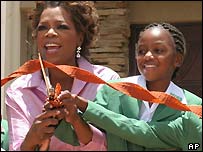
Keeping a promise to Nelson Mandela, Oprah has opened her ‘Leadership’ Academy for girls in South Africa. Girls are selected based on their potential from families with a monthly income less than $700. With a huge showing from Western celebrities I wonder if this initiative will be copied. The access to education in South Africa is the best of any African country being nearly universal, why is there a need for what some call an ‘elitist’ academy that cost over $40 million to build? A very good question as still thousands of African children do not even have books, pens, paper, classrooms, teachers, healthcare or security to become educated. “We have to change the way they think,” she said. Time out – we need to change the way we think? With a beauty salon shoving American materialist values at these 152 South African girls how can she believe that their minds are the ones needing change. We may need to help their minds develop with access to good education, but we do not need to change them. Yet another example of the Western mindset. Oprah is to open a school for 1000 boys later this month. I hope Oprah will begin to focus on reaching the unreached people in her next African venture.

Effective as of the new year, United Nations Secretary General Kofi Annan, a Ghanian native, is no longer the head man for the UN. Annan served two terms as Secretary General and many say he quietly and effectively brought Africa to the forefront. As an African he worked to raise issues in Africa without being too baised to one side (not giving too much to African leaders and not sucking up to the West). His tenure saw the creation of the Human Rights Council to take over human rights monitoring, the US’s diplomatically unilateral approach to the Iraq War, and the current test of Darfur, Sudan for the UN’s new powers to act, along with many reforms and calls for reform of the UN system. His tenure was not without scandal or missed opportunities, but I am sure no one during his term would have faced any different challenges. With Annan now gone I wonder if the UN will remain as focused on the Darfur genocide and other African and ‘developing’ world issues, such as the Millennium Development Goals. However, with hope, the new UN Secretary General, Ban Ki-Moon, has set the conflict in Darfur as a priority of his term. Kofi Annan will be greatly missed, and not missed by some, but I still feel he has much greatness to offer Africa.

Lastly, Somalia – the only true failed state? (Failed states are based on Western ideas and ideals, but Somalia seems trapped in conflict) What will come of the country as US military trained Ethiopian government forces supporting the ‘Somalian Government’ take control from the Islamic leaders? How will the peace be kept and how many refugees will flood surrounding countries? How will aid agencies and the UN respond? Be sure to read your news and from multiple sources to get the full view, which sadly is not possibly unless you are actually in Somalia, but at least be knowledgable. Here is the latest BBC article.

the new military frontlines – africa?

In an article written by a Washington Post blogger and later briefly analyzed and linked to on the Foreign Policy website, the new Africa Command, which has been created to supposedly focus on the globe’s most neglected region, approved by Donald Rumsfeld, will be operational within two months. Some say this mark an important change in US policy more focused on preventative measures rather than Cold War posturing. Currently there are five commands, three of those split the African region. It has been suggested that the creation of the Africa Command will allow a single organization for agencies like the State Department and CIA. Now stop, the State Dept. and CIA? The last time US military was based in Africa was during World War II. More recently the CIA has been involved on the continent throughout the Cold War and, I am fairly certain, currently. Through the US government the CIA did some ‘wonderful’ work: propping up numerous “democratic” dictators (Milton Obote and Idi Amin in Uganda) and assassinating a true democratic leader, Lumumba in Zaire (DRC), and setting another dictator, Mobutu. These are just a few examples of the track record of the US military and CIA on the African continent, not to mention the misguided attempts in Somalia and the fearful neglect of the Rwandan genocide. The US military has many links to rebel movements and the put-down of rebel movements in roughly six African countries since 1990.

The Washington Post blogger, William Arkin, is quoted in the Foreign Policy blog that he does not believe the new Africa Command will be a positive for the continent. The FP piece then asks: “Why?” The obvious answer to that question is just look at what the US government has done or attempted to do in Africa. With the US’s current actions and their ‘putting Africa on the back burner’ (or maybe its not even on the stovetop) I really do not think much has changed. A new command to place the US military and CIA present on the continent cannot be a positive change in policy. The US has provided military support to Sahel countries with known oil resources such as Chad and Ethiopia, but not Sudan. The US military is afraid of actual action on the African continent since the 1993 Somalia mission. A genocide is by far too much for the current administration to handle. Bush on genocide, “Not on my watch.” Try opening your eyes.

Interesting to take note of is China’s Africa Policy released last year. Last year I wrote a post, check it out, about the new African policy focused on helping to build infrastructure regardless of political regime type in exchange for natural resources. A policy without ethics some might say. Is this new Africa Command a front to the recent increase in Chinese aid and involvement on the continent? Keep your eyes on the lookout for US military actions in Africa. Also check out the Times article on the Africa Command.

why is the african dirt so red. . . blood spilled


Last night I finally made it out the the theater to see the latest of Hollywood’s Africa-related movies, Blood Diamond. I have to say I was a bit skeptical with Leonardo DiCaprio in the leading role. I have been very skeptical of the recent upswing in movies covering topics and issues around the African continent. Hollywood is running out of remakes and new material for movie production, maybe now they are deciding to open the world’s eyes to the harsh realities that our governments and media didn’t care to cover before. Blood is spilled on the African continent for many reasons, but none chains the West to the blood spilled more than conflicts over greed – gold, rubber, oil, and diamonds.

I was very impressed with the way the movie was produced. Bringing maps and information to the general public about conflict diamonds in Sierra Leone. Blood Diamond did not stray from bringing the suffering and blood shed to the big screen, it did not stray from highlighting the truths of such a conflict, it did not allow us to any longer duck and hide from the brutality that we fuel through our lust for shiny stones. It covered many important issues, more than just conflict or blood diamonds; it covered poverty, refugees, small arms, child soldiers, the West’s attempts to help, UN involvement, and the corruption that lies beneath it all. Blood Diamond some might say is too violent or too full of bang-bang shoot ’em up, but I would say the movie balanced the bloodshed with the storyline of a greedy diamond runner and a Sierra Leonenian (?) man and his family caught up in the profit-driven conflict.

As the movie came to a close with a heart wrenching end that nearly brings tears to the eyes, I hoped immensly that more people would not keep their ideas of Africa as just a conflict ridden land. The credits rolled and many were in awed silence, some had tears running down their cheeks, and some left with no reaction. Behind me there was a group of teenaged girls. “It was so sad, so sad,” said one. “It was horrible, I mean it was good, but horrible. I tried to hold it together, Stacy completely lost it, but I mean whatever.” I bit my lip so hard I am sure it almost bled. ‘Whatever!’ The movie, besides showing intense, bloody conflict and tear-producing situations also showed that if you really care and want to make a difference, you can. With the story line of an American journalist seeking the truth behind the diamond conflict and who runs it all, Blood Diamond showed that with passion anything can be possible. Along with telling viewers that it is their, our, responsibility to be sure that any diamond bought is ‘conflict-free’ or ‘clean’.

Foreign Policy magazine created a nice photo-essay about diamond conflicts, those affected, and the path of a conflict diamond from mine to storefront window. Foreign Policy interviewed the director, Edward Zwick about the movie. They noted that the new movie has the diamond industry worried about sales. Why is that an issue? They just might not make as exhorbitant an amount of profit as they once did. So sorry, your third Mercedes-Benz could save lives instead and supply a village with clean water and basic healthcare.


In additon National Geographic has a great article on blood diamonds and how to not buy illicit diamonds. I would recommend reading both articles by Foreign Policy and National Geographic. Likewise check out this website run by the World Diamond Council, an online source with a wealth of information on diamonds, conflict diamonds and the Kimberley Process, where the global diamond industry adopted a zero tolerance policy on conflict diamonds with the backing of the UN and many NGOs. They created the Kimberley Process is used by 71 goverments to certify that diamonds from their respective countries are conflict-free. The site also gives examples of how diamonds are helping people in Africa through healthcare, economy, and education.

This is really a great example of an African (over there) conflict that hits home and really affects us here in the West. I encourage and recommend that you all go and see Blood Diamond, read up on the issues, and learn about the positive uses and impacts that diamonds have for the people who usually suffer the consequences of conflict.

something new for the new year

A group that has really captivated my interest this year has been the Acumen Fund. They do amazing work towards creating change and sustainable solutions to global poverty issues with people at the center. Check out their work and what they do, I would encourage you all to get involved in the new year! Have a good one!

Acumen Fund Philosophy
Who we are and why we exist:
Acumen Fund is a non-profit venture fund that uses entrepreneurial approaches to solve the problems of global poverty. We build financially sustainable and scalable organizations that deliver affordable, critical goods and services that target the four billion people living on less than $4 a day. We adhere to a disciplined process in selecting and managing our philanthropic investments as well as in measuring the social and financial returns.

How we work:
We identify some of the world’s best entrepreneurs and organizations focused on delivering critical, affordable goods and services – such as water, healthcare, and housing – to improve livelihoods, health and opportunities for the poor.

Our investment process:
Using the skills of business, the flexible capital of philanthropy, and the rigor of the marketplace, we aim to develop and deliver systems-changing solutions to the world’s problems. Our investment approach focuses on organizational sustainability, strong leadership and scalability through managerial support and financial investment.

Measuring results:
Within each investment organization, we focus on the areas of design, pricing, distribution and marketing of critical goods and services to the poor. We measure and share both social and financial returns of our investments, as well as our own financial sustainability and the strength of our community. Our risk management aims to generate positive returns where possible and recover a substantial portion of their capital to reinvest in new philanthropic ventures.