america and the greatest humanitarian crisis of our time and our children’s?

HIV/AIDS – Part I:

A silent call from a distant land
Crying for a helping hand, so
How long will it go on?
Ignorance and vanity
Supercede humanity, so
How long will it go on?
I want to know, how long will it go on?

We can’t wait any longer
They’re crying out, doesn’t it matter
We can’t wait any longer
No, no. Too long in a slumber
Shake it up, wake it up now.
We can’t wait any longer. No, no.

Another child is laid to rest
Another day of hopelessness, so
How long will it go on?
And every day we’re on the fence brings
Another fatal consequence, so
How long will it go on?
I want to know, how long will it go on?

Yuko awezayo kusikia kilio chetu? (Can somebody hear us crying out?)
Twaomba msaada wenu (Somebody help us)
Aweko mwenye kttoka (Somebody save us)
Aweko mwenye kutupa uhuru (Somebody free us)

From all that I have done and all that I have read the one thing that creeps into my mind every time the issues are talked about are invisible people, exploited people, dying people I cannot help but have the above song, “We Can’t Wait Any Longer,” run through my head (Michael W. Smith, 2004). The most important theme that the HIV/AIDS pandemic highlights, I believe, is the theme, plain and simple, that people are dying! People are dying! I think Smith speaks to the crisis well in his song and this important theme is what will eventually save lives and prevent the HIV/AIDS pandemic by inspiring people to act. The HIV/AIDS crisis is not just another growing problem prevalent in Africa, it is not just a media game of growing numbers, it is not just another cause to shirk and say someone else will take care of it. This pandemic is a cause that affects us all whether we live in Asia, Africa, or the Americas. The major theme of why people are left to die is what I will focus on, which will draw on America’s actions, structural violence, the impact of the disease, and, most importantly, indifference. Bringing people together in activism should be our biggest concern now if we are to change the course of history.

America, as Greg Behrman writes, has slept through the greatest humanitarian catastrophe of our time. How can America, the supposed greatest nation, remove itself from such a world-altering event – which is still taking place? It took some time to actually determine what the HIV/AIDS disease was and what it does, but even after discovering, the response was a hand waggle at best. You cannot get to know someone just by waving to them. You have to stop, talk, and listen – three things that America neglected to do. At the meeting on the Potomac, four years after the CDC discovered the disease, the President of the US publicly acknowledged that AIDS even existed. Four years! How can that be! Four years, by today’s numbers (still not accurate) is 12 million people! 12 million dead people! Two years ago the World Health Organization (WHO) was supposed to accomplish their plan of 3 by 5 (to get at least 3 million people on ARVs by 2005). That initiative failed, but why – indifference, lack of support, lack of passion. These themes keep coming back over and over. “It is difficult to see what is happening, harder to measure, easiest to deny.” (Barnett & Whiteside, 5) This great indifference is all too evident in politics. Politicians and policy makers and the media are all too concerned with the past and can’t look to the immediate present. HIV/AIDS is a huge issue of the present, but it has been too often in the media and newspapers and they now go for the more exciting, flash-bang issues of everyday life. People are dying, but the media needs people to read their papers and politicians need to look good in office to get re-elected for another term without controversy.

Authors, Barnett and Whiteside, point out that the US could have stepped up and emerged as an international leader at the 1987 International AIDS conference, but instead later that year Bush (Sr.) adopted a policy to keep all people infected with HIV/AIDS from entering the US. This action goes beyond indifference and speaks to the great ignorance that America and the world had and has about HIV/AIDS. This was not the first time that the US failed to take critical action. In the second presidential debate in 2000, Bush (current) was asked about the role of the US intervening on the continent of Africa to prevent humanitarian catastrophe. His response, “Africa is important. . . but there’s got to be priorities.” (Behrman, 246) Priorities! How about saving lives, how about preventing death – is that not a priority for the US political system? In 2002 the pandemic reached the mainstream media in full force. Behrman quotes an opening editorial by Sebastian Mallaby of the Washington Post,

“[…] sometimes the obvious needs stating, because it is taken for granted and then quietly ignored. A century from now, when historians write about our era, one question will dwarf all others, and it won’t be about finance or politics or even terrorism. The question will be, simply, how could our rich and civilized society allow a known and beatable enemy to kill millions of people” (297)

This quote sums up the ultimate American attitude of indifference. We were too caught up in politics and money and terrorism to even see the murder standing at our doorstep. The US as Behrman says, slept through the AIDS pandemic. His words and quote have a great impact on how we, as Americans, should view our response and caring nature. The AIDS crisis really asks the painful question of how “we” value other human beings. Are human beings of no importance unless they are advancing or helping to advance our country or position? Are human beings just numbers? 130 people die each day in Ugandan IDP camps, 3800 people die each month in the violence in the Democratic Republic of the Congo, 3 million people die each year from AIDS – are we just supposed to take those numbers in their pure numerical value or should we delve deeper into the true impact of those numbers?

This brings about another underlying theme, the impact of the HIV/AIDS Pandemic. Each number has the face of a person, out of those three million people is a life, a life just like yours or mine, a life just as valuable and precious, a life so intricately linked to a family, a community, a city, a country, a world. AIDS was not just a health problem, it was a catastrophe that touches on every dimension of national and international society. (Behrman 173) This story is based on true events:

A father, seeking work in the transport industry since work is scarce in his villag in Africa, dies after contracting HIV/AIDS from a sex worker at a truck stop. He leaves behind a family with 6 children. After HIV/AIDS was contracted, the first child born afterwards most likely died from in vitro infection. That family is now without a “breadwinner” and provider (in the typical patriarchal system). With the father gone, the mother will have to find a way to make an income for the family to survive. The children may not be able to attend school anymore, most likely only a few were going to school to start, because they are now needed to work or cut costs. Now the children are helping work at home and the mother is trying to find work so that the family can get the basic things they need to survive. Many women faced in this situation of extreme poverty can find only sex work to earn money. This increases the chances of becoming infected with HIV/AIDS, if she was not already infected from her husband. The mother, now having the added responsibility of generating income, will very likely contract HIV/AIDS from her work, if that happens then it is only a matter of time until she will succumb to AIDS. Due to her impoverished situation and lack of income, receiving treatment is not an option. Now her 6 children have watched their father die and now they have lost their primary care giver – their mother. Children now are out on their own, without a family structure, trying to survive, can we even imagine?

The HIV/AIDS crisis has the face of a woman says Stephen Lewis. That statement is all too true. Women are the most affected, most vulnerable, and most impacted by the HIV/AIDS pandemic. Women are, for one, more biologically vulnerable, they are bound by traditional and societal practices, they are forced to sell their bodies when their poverty becomes too much, all this on top of caring for a family and having the responsibility of providing food, clothes, and health. Stephen Lewis’ statement should more accurately read ‘the HIV/AIDS crisis has the face of a dying woman.’ Why must one family have to witness so much death? Just in this one family story there have already been three deaths and now six orphaned children fending for themselves in one of the harshest environments to survive. That environment is of a developing country. The family forms one root of a community and now that community is weakened by so much loss. The orphaned children will be left to fend for themselves since the it will be too much of a burden on their own families. Largely those infected with HIV/AIDS are members of the workforce (age 15-49) and when the workforce is disappearing due to AIDS, the economic impact is severe. The economic impact starts at the family, then the village community, and eventually that impact reaches the national level. How is a community to dig itself out of the already present poverty with a rampant disease coursing through and killing its people? As Barnett and Whiteside write:

“Where people lack material resources and do not have access to institutions and organizations beyond their limited and poor locality, they cannot be expected to take on extra costs and responsibilities in the absence of outside support. The great challenge for those who would assist communities, households, clusters and ultimately individuals to deal with the awful consequences of the AIDS epidemic is to face realities – to develop interventions and methods of support that recognize these realities, which can be effective at the local level and can take full account of the forces of globalization which will otherwise only exacerbate the already established processes of poverty and exclusion.” (195)

This quote is the key to what we all can do to intervene in the AIDS pandemic. Although it does tell us directly what a single individual can do, it should help us to remember reality when we do intervene or urge others to intervene. It does not tell us how to act, but why. We must intervene for the sole reason of the reality of the pandemic – people are dying! The main reason that people are dying is because of the all too prevalent structural violence. This also speaks to the earlier posed questions of: What kind of people are we? And How do we value human beings? Paul Farmer brings clarity to the thoughts of all these authors in speaking about structural violence.

“But the experience of suffering, it’s often noted, is not effectively conveyed by statistics or graphs. In fact, the suffering of the world’s poor intrudes only rarely into the consciousness of the affluent, even when our affluence may be shown to have direct relation to their suffering.” (31)

How can we be so indifferent? How can our government know and not act? How can people die without a name, without a face, without so much as a moment of silence. The world marches on. We know that we are privileged here in the US, and we must know that we are satisfied by the exploitation of the poor. Our affluence is a product, not a privilege of our circumstance. How can we not realize that with our affluence we can change the world? Farmer throughout his book suggests that we can. Suffering cannot be compared, it cannot be measured, and it cannot be put into one image. At the root of suffering is structural violence, a violence that does not necessarily involve physical means. It is a violence that is perpetuated by the government and imposed institutions of the world. The effects of structural violence are all too evident in the HIV/AIDS pandemic. The lack of basic health care, the lack of basic rights to live, and the lack of affluence all contribute to the structure of violence present in the HIV/AIDS pandemic. Another important theme that is tied in with structural violence is that of human rights in regards to health. From the Universal Declaration of Human Rights, article 25:

“Everyone has the right to a standard of living adequate for the health and well-being himself and his family, including food, clothing, housing, medical care and necessary social services, and the right to security in the event of unemployment, sickness, disability, widowhood, old age, or other lack of livelihood in circumstances beyond his control.” (Farmer, 213)

There is one thing that I cannot stop thinking. Everything looks good on paper, but in reality, as Barnett and Whiteside remind us, we need to see the actual situation. In reality this declaration is not upheld and I cannot help but wonder how many of the countries who signed the declaration can actually provide these promises to its people. I am sure most cannot due to the violence of structure. Farmer says:

“Social inequalities based on race or ethnicity, gender, religious creed, and – above all – social class are the motor force behind most human rights violations. In other words, violence against individuals is usually embedded in entrenched structural violence.” (219)

By saying this Farmer means that people are affected by the relationship between structural violence and human rights. People are dying because the social classes do not line up with the basic human rights of health and right to life. We need to not only realize this relationship, but also come up with a positive intervention. Farmer presents his ideas with the term ‘pragmatic solidarity.’ By pragmatic solidarity he means that our plan needs to involve a rapid response using our tools and resources to remedy the inequality in health care and human rights.

People are dying! However I don’t think you need someone to tell you the reality. The message and knowledge needs to be out first before we can even begin to know where to start. Indifference, impact, and structural violence are all prevalent themes that explain why people are dying. How long will this crisis go on? How long will the indifference linger? How much longer will it be before structural violence is remedied? How many more people will die? We can’t wait any longer and neither can those most affected by HIV/AIDS. Can someone hear their cries before another so needlessly dies? I for one will be listening and acting.

a small bite can topple a giant; malaria


This first story takes me back six years when I first became involved in basic healthcare activism for Africa. This story comes from my mother’s first trip to Uganda in 2001. My family became very good friends with Fr. Joseph from Uganda in the summer of 2000. He dealt with many medical issues in his traveling from village to village fulfilling his priestly duties, but he did not have any medical background. He asked my mother, who is a registered nurse, medical questions when he was here and sometimes called from Uganda to ask the best medical procedure or prognosis. She had found it very difficult since we had such a limited knowledge of what conditions were like in Uganda. So, that following summer my mother made the journey across the ocean to see the medical situation first hand. While she was there the realities were painfully obvious. Fr. Joseph owned a donated Toyota pick-up truck and while my mom was there she traveled around with him on his day to day work. An important note to make is that the pick-up truck doubled as the area ambulance. On one particular day, at a village stop to give mass, a pregnant mother needed transportation to the hospital because there were some complications. The nearest health clinic was seven hours away on the red, dusty, hole ridden ‘roads’. I can only imagine the ride in the back of a pick-up truck, dust thrown about, bouncing along so that a child may have a better chance. En route the pregnant mother went into labor. Still hours from the hospital the mother gave birth to a healthy baby girl and then died. They decided to name the baby after my mother – Baby Elizabeth. A family from the village adopted baby Elizabeth and she seemed to have a good chance in the world. Later the next year we were told that baby Eilzabeth had died. She had contracted malaria and since she lived in such a remote village, she and her family had no access to the $1- $2 medication that could have saved her life. If the access had been there baby Elizabeth might have lived to her fifth birthday, a rare occurance in many African communities due to poverty and disease.

Malaria is a parasite that is carried from human to human by mosquito. Malaria is a very preventable disease, yet kills over a million people each year. Over 90% of malaria deaths occuring in Africa making it Africa’s leading cause of death for children under five. Just recently President George W. Bush has said eight more African countries have joined a $1.2 billion US program to fight malaria. The five-year program works to provide funds to limit malaria’s spread by using insecticides and anti-mosquito bed nets, and also to provide drugs to people already infected. The renewed enthusism for the program has brought the World Bank and billionaire philanthropist, Bill Gates on board. Also on the scene are recent scientific advances, such as progress towards a vaccine, which prove to offer great hope to defeating one of the world’s great killers. A new treatment developed by British scientists collaborating with Kenyan experts is based on a technique for fluid replacement for children ill with malaria. The problem is that intensive care methods, only available at pediatric units in developed countries, is needed to treat infected children.

It is estimated that through partnerships working in Uganda, Tanzania, and Angola – US taxpayers already have helped approximately 6 million people to treat and prevent malaria. There are great hopes for the future prevention and defeat of malaria, but it requires the continued support of people in the developed world. US taxpayers need to push the Bush administration and future adminstrations to remain dedicated to the mission of saving lives affected by preventable disease. President Bush also announced at the Washington Summit on Malaria that the US Volunteers for Prosperity program will be expanded to recruit skilled US volunteers, doctors, and nurses to travel to at-risk countries to train local health care workers. The Gates Foundation has also expanded the number of projects it funds to research new malaria treatments. Likewise, there is a large private sector effort, such as, Nothing But Nets and the Acumen Fund, among others. Check out the blog of an Acumen Fellow working with a mosquito net facotry in Tanzania. There are so many opportunites to donate, to get involved, to volunteer, and to save a life. Check out some of the links posted and make a difference today!

idealism, action, and reality

Through my personal mission to help save lives in Africa I have often been called an idealist. However I don’t think there is any other constructed term that can be used to describe me and my work. I am an idealist, some say I am a naive idealist, and that is where I tell them they are wrong. My ideals have become realities, my ideals have never been so naive and seemingly unattainable. I define myself by my chosen actions, that is, the choices I make embodied. Therefore I see a time where everyone acts on what they truly believe and not what the popular society tells them. A time where people are motivated solely by the most basic human emotion of compassion and that compassion is demonstrated through their actions to help others and change the world for the better. Your choices define you, your actions define you – how will you choose to act today? How will you show compassion to another person in need today? Your name means nothing, your clothes mean nothing, your amount of income means nothing, your body means nothing – meaning is created in how you dream, how you choose, and how you act. I have seen so many people fall victim to society and the newest pair of jeans wins out over a life in Africa, I have seen a pair of shoes take precedence over the medication for a dying child, I have seen ignorance defeat hope – yet, after all that I have seen so many people let go of their name, their material wants, and their incomes and become dedicated to saving lives in Africa. There is a long and terrible past of exploits and screw-ups in our nation’s name on the African continent, too many to name, too many to discuss because what is most important now is that as we are saving lives in Africa now, Africa is reciprocally saving our lives from a life without meaning. Add meaning to your life, choose to act and not to sit by idly, choose to stand up and create the new reality. Neither one can happen without the other. It may be difficult to see the direct impact of your choices and actions, but you must know and remember that people are being helped. Recognition is not the end to the means. Saving lives and making a difference is the means and the end. Some may get all of the recognition, but that does not discount anything that anyone else has done.

each day as we arise
thousands fall just outside
where good intentions
pave the streets they call home
and tomorrow never comes

the time is now
we are called to take a stand
we are a rallying cry for
the voiceless

(poem from Mathitis)

where are we going, health = security

This is a very exciting month for S.C.O.U.T. B.A.N.A.N.A.! We have taken on 4 new projects dealing with basic health care and we are that much closer to achieving official non-profit status. We have partnered with Blood: Water Mission to help train community workers to build wells for a sustainable clean water in Uganda, Kenya, and Sierra Leone. We have also joined to support the Partners in Health Rwanda Programs which include: recruiting and training administrative and medical staff; rebuilding and equipping clinics; and securing reliable electricity, water, and communications systems. Two amazing organizations, check out their links on the side, all working towards one over arching goal, which is to provide basic health care services to the world’s people disproportionately affected by poverty, disease, and injustice.

And this brings me to question where are we going as a society? What is our real motive – materials, success, fame? Is the most basic human emotion of compassion not relevant anymore? Do people care for their fellow people that reside on the earth? Where has all the love gone? In my day to day work and my work with S.C.O.U.T. B.A.N.A.N.A. I have seen both worlds, I have seen the actions of people for good and for bad, and yet even in my position I still question and wonder. Where are we going? The media and pop culture are winning out over issues of poverty, over disease, over life, over death. How can this be? The world is the way it is because society, people in society have shaped the world as we know it and now more than ever the world is being shaped, but it needs to be molded to fit a different form than the one in which it is being fashioned. The corporations and institutions are increasingly misleading the people to act in the way of self-interest and for their greatest gain. What will happen when people are exploited to the fullest? What will be left? Where are we going?

This is where I tell you, stop, think, and act! This is where you learn that you can change the world! Every single person that reads this blog, that goes to work today, that attends class, that wakes out of bed today has the potential to make a difference in the world. You, who has just awoken, only need to decide now what kind of a difference you will make in the world. What will YOU do? Where will YOU go?

The crisis of basic health care in Africa is a major issue right now, larger than many know or realize. Sure Africa has its problems, but no one understand to what extent. The lack of basic healthcare and health for that matter is a great divider. It tears apart communities as their members suffer and die their economy falls and great economic hardship ensues. Some then turn to alternative methods of income, even sex work. The need to survive and be healthy pushes many people to do things that we here cannot understand. The lack of health, wellness, food to eat, water to drink spurs on war and regional conflict. In some of those conflicts HIV/AIDS is used as weapon of war where infected soldiers are sent to the frontlines to rape and spread their disease. Besides health and its effects producing war and hardship, there is an even more pressing problem of the lack of healthworkers. How can African countries expect to help their suffering populations when there are not enough workers, or healthy workers, to administer aid and treat the dying? How can a country function without a basic healthcare system in place? If health and access to health is so pressing then why is it not pressed for more fervently? S.C.O.U.T. B.A.N.A.N.A. is working to do just that, not necessarily by direct on the ground aid, but we do support the people and organizations working on the ground making the difference while we here work to educate a privileged world of the basic human right to health.

hmm, what is this?

Here is the first of many stories:

It all started on a Sunday in July 2000. I was at Mass in the church I had attended all my life, Holy Family Catholic Church, when there was an announcement made that a visiting priest from Uganda would be living in our parish for the summer. He would be offering African drum lessons to anyone who wanted to learn. Since I drummed on everything—including the dinner table, my desk, and the church pew—my mother gave me a knowing look. After Mass, I introduced myself to Father Joseph Birungi and became his first student.

Fr. Joseph spoke with an accent native to Uganda and didn’t always understand my words. But we both understood a smile. We met several times over the summer and he taught me how to drum. But, Fr. Joseph taught me more than drumming. We talked about his home and his people and their great need for basic medical care. He told me of the many deaths of his people due to simple, preventable diseases. He told me of his dream to construct a health center in a remote area of his country. From those lessons, I was inspired to help the people of Fr. Joseph’s community—somehow. I asked him what I could do to help.

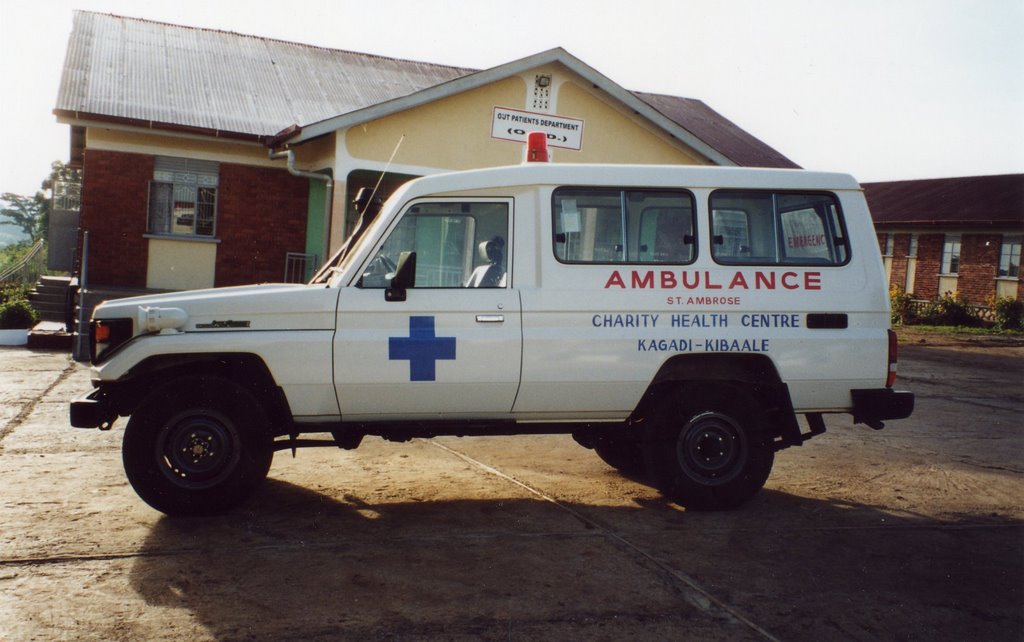
Of course, Fr. Joseph was pleased by my excitement and thoughtfulness, but he also knew I was only a 13 year-old boy. As he told me later, he didn’t expect that I would be able to accomplish much. Nonetheless, he decided to dream big. Fr. Joseph said the new health center would need an ambulance and asked if I could try to get one for him. At first, I thought it would be impossible, but eventually I convinced myself I could do it. The Toyota dealership in Uganda’s capital city of Kampala gave him an ordering price of $50,000! I knew that in order to raise that much money I would need a really great idea. I decided to make life-size foamboard cut-outs of Fr. Joe and ask people in my community to “host” him for a day at their home, business, classroom, meeting, or special event. He would come with a “suitcase” containing information about Uganda and the need for the ambulance, a video message from Fr. Joe, a camera to record a picture of the hosts with Fr. Joe for my scrapbook, and a yard sign to show their participation in my project – and, hopefully, inspire others to participate too. I asked each host for a donation to the ambulance fund and a small medical supply.

Many people helped me prepare the supplies and promote the project, although I initially had to overcome my fear of public speaking. I knew that the no one would know about the need of the Ugandan people if I couldn’t tell them. I spoke to service clubs, school groups, and church congregations—anyone who would listen. Thousands of people responded. I collected 20 boxes of medical supplies and raised over $67,000 in less than 4 months.

I actually traveled to Uganda and went with Fr. Joe to sign the order for the ambulance. During my one month stay I met and lived with the people who would benefit from my project. My trip to Uganda left an indelible mark on me and it is an experience I will never forget. All the people I met were so friendly and, even in their poverty, they wanted to share what little they had. I have seen that all people of the world share the same needs and wants. We are really all more alike than we are different. Everyone needs food, shelter, clean water, and necessary health care. We all want to know happiness, health and love. Parents everywhere want the best for their children and children want to learn and grow. But not everyone gets the same chance for success.

My project helped to provide quality healthcare and emergency transportation to those who would otherwise have no place to go and no way to get there. It brought the world a little closer together as my community realized—and met—the needs of a community across the ocean. Fr. Joseph’s dream became reality when the health center opened its doors in April 2003. His health center treats anyone who comes, regardless of who they are or whether or not they can pay. Hundreds of people have been treated and the ambulance has provided emergency transportation to other facilities when necessary. The ambulance also transports nurses to villages far from the health center to teach disease prevention and provide immunizations. Since the ambulance goal was achieved, I have continued to help by raising awareness and funds—largely at my high school—to help ship a 40-foot container of medical equipment from Michigan to Uganda.

I have been privileged to lead a project that has directly impacted many people living in Uganda. Additionally, the project itself greatly increased awareness in my community about the lack of healthcare and other basic needs. Although my original goal was accomplished, I realized that once I made a connection with the people of Uganda, I couldn’t just walk away. I couldn’t assume that my part was over and that someone else would pick up where I left off. I had seen their faces, held their hands, visited their homes, and eaten with them. I know that I saw the faces of people who are no longer there—and so I continue to tell their story and ask for help.

I have realized that working to help those who are in need in the global community is the best way to show that I care. When I traveled to Africa, I came to understand the many differences in culture that separated the Ugandan community and my community. And even though we were physically distanced, I saw how my project brought us together. I know that I need to continue to work to change the world for the better.

Through my project, I also learned a few important lessons about life. One, it is our deeds, not our words, that change and shape our communities and our world. Second, we must all believe that one person can make a difference. Everyone has the potential to make a difference, but who among us will choose to act on that potential – and what kind of difference will we choose to make? Third, we must first believe in ourselves before anyone will believe in us. And lastly, although one person can make a difference, one person cannot make a difference alone – we need one another to succeed. It takes a group of dedicated people to create change. From my own efforts to promote global understanding, I know that YOU, as one person, can make a difference in the world!