the impact of conflict on health

The correlation between violent conflicts and health may seem to be very obvious, but there is more to the issue than what crosses the mind. Everyone can make the simple connection that there is direct impact of conflict on being unbenefittal for the betterment of health. For example it is easy to read this <a href="http://news.bbc.co.uk/2/hi/africa/6590965.stm
“>article and see the obvious connection to artillery shells hitting a hospital in Mogadishu. Internal clashes and conflict creates a more difficult situation for humanitarian operations all over Africa.

Africa represents the highest rates of internal conflict and disease, especially HIV/AIDS. This disease has been used as a weapon in conflict. Many times infected soldiers are sent to the front lines to spread disease and infect the opposition, which generally turns out to be the innocent population. Populations affected by armed internal conflicts end up experiencing severe public health consequences from food insecurity, displacement, and combat. All this ends in a collapse of basic health services which are essential to the survival of the population.

I could not find the article again, but the BBC had reported on the difficulties faced by those bringing humanitarian aid to Darfur, Sudan. They constantly faced issues with the government shutting areas down or denying them entrance. infrastructures for basic health, or created systems for basic health become neglected or destroyed. In many cases the impact of conflict can be felt at the very lowest levels of a population; women are unable to protect their families, fathers just might not be present anymore, children have no access to schooling, and everyone suffers from an absence of basic health – no food, no medications, no stable doctors, and no way to deal with the injury inflicted by the violence of conflict.

With the renewed peace talks for Uganda, the twenty year civil war seems to be coming to a close and the health of the northern Ugandan population may be improving. The rebuilding effort is going to be long and difficult, but there is hope. Many organizations are beginning efforts to improve the health situation and support hospitals and health centers that have been impacted by the conflict.

There are so many topics that can be covered as a result of conflict in a country and its correlation to health. However, I am not here to expound all of the information available, but know that it is out there: sexual violence, psychological impact on children, and especially the toll on health workers. Conflict impacts health plain and simple, but there is so much more as the impact trickles down to the population, the families, and the children. The future of a country in conflict lies in its ability to rebuild and provide aid to their populations after conflict.
brand of global health: gates

The new major player on the global health scene is the Bill & Melinda Gates Foundation, but is it possible for two people to become a brand of global health? Is the Gates Foundation really providing aid and investment in the best possible way with their power and influence as a global health ‘brand?’

The Gates Foundation has already become one of the top players in global public health. And with last year’s gift from Warren Buffet, the Foundation is set to double its giving this year. Last year the Gates’ invested $1.36 billion in many different areas of public health, from providing childhood immunizations to agricultural research in developing countries. One of the major priorities is HIV/AIDS prevention and treatment, with over $350 million given in grants.

In June of 2006, on NPR’s All Things Considered, Thomas Quinn, director of the Johns Hopkins Center for Global Health, and Gerald Keusch, Associate Dean for Global Health at Boston University’s School of Public Health, answer questions about the practices and abilities of the Gates Foundation. They answer questions such as the Foundation’s role with the WHO and UNAIDS, its ability to make a difference, fears of responsibility and being a private foundation, and what the Foundation can do with its billions. I highly suggest checking out the link.

The two simple core values of the foundation’s work are one, that all lives—no matter where they are being led—have equal value, and two, to whom much is given, much is expected. Great values, with which great hope rests upon. Some people do not have as much hope in the Foundation as much of their practices and investment policies are out of date. I will not attempt to try and voice all of the concerns (check out the entry from‘My social life’ on 16 January 2007 Open Letter to the Gates Foundation). Has the Foundation inherited too many of the corporate practices from Mr. Gates to run effectively? Is the Foundation too big to be accountable to the people?

malaria awareness day

April 25th, the first US Malaria Awareness Day. An award winning photographer, Chien-Chi Chang, traveled to Uganda to give image to the story that is very often never heard, to give a face to the people who are never seen. This is not just another award winning privileged person traveling to get pictures or a story because these images and story are accompanied by a call for action. The images were used to raise awareness and promote involvement with Malaria No More. This is an organization that is fueled by celebrity involvement and received great attention from American Idol, but this is an issue and conflict that does not require you to be a celebrity to make a difference. Everyone is a celebrity in their own right.

On the <a href="http://newsforums.bbc.co.uk/nol/thread.jspa?threadID=6178&&edition=2&ttl=20070426013440
“>BBC’s news forum where people can write in their thoughts, many people called for a change in government actions and in people’s actions. Governments need to provide more funding for their health sectors and people need to depend less on their governments. I would add that we here need to understand that governments are not the ones who will make the greatest impact, when individuals support other individuals more lives will be saved.

In her blog, Acumen Fund Fellow, Keely Stevenson, writes about a socially responsible company in Tanzania working to provide bed nets. AtoZ uses a simplified, cheaper manufactoring process to make more bed nets for less. The company then charges a nominal fee to get the bed nets to people who will actually use them. Many times when organizations just hand out bed nets they end up as fishing nets or table cloths, but when there is a small fee – people who actually want them to use them will be supplied with them. This has been credited with bringing malaria deaths down in Tanzania.

Malaria is a preventable disease that claims the lives of over <a href="http://news.bbc.co.uk/2/hi/africa/6591169.stm
“>one million people, 90% of them in Africa. Using a bed net is said to reduce a pregnant woman’s birth complications and potential miscarriages by one third. A treated bed net costs about $4 and can save the lives of so many people is it is used. There have been numerous studies on the impact of malaria on mothers, children, and others – but the simple and known truth is that using a treated bed net can save your life and your family’s. There is no reason that malaria should kill so many people each year, our government should be stepping up its efforts, governments in Africa need support so that they can support their health sectors, and we here need to step up our efforts. Making bed nets more available and more affordable is the answer to a preventable disease without a cure.

Read up on malaria here.

a phamaceutical not bent on profit?

Do you see it there on the horizon? Hope is dawning and the situation seems to be less grim in this radiating light. Diseases run rampant in Africa, plan and simple, there is no health infrastructure to deal with the burden of preventable diseases. Meningitis for example can kill a child in Africa in less than six hours, while we can sit here in our ‘developed’ world knowing that the vaccination is right around the corner office.

The largest drug company in Europe, GlaxoSmithKline (GSK) announced a new drug for sole use in Africa to fight meningitis. The drug will be introduced with prices that will never have potential to cover the research or production costs. Experts and critics see this as a huge change in big companies changing their business practices to be more compassionate. Some critics say it isn’t enough, but I’d say this is an enormous and important positive step in the right direction. The company does not expect to make a profit. In a quote from the BBC article: “We have found a pretty clever way to fund therapeutic solutions for the developing world without essentially sacrificing the more traditional research we do on diseases around the world,” said the GSK chief executive Jean-Pierre Garnier.

This new approach comes about as last year big companies tried to sue South Africa over its purchase of cheaper, generic drugs to combat diseases. From the public outcry the big companies decided to back down amidst a PR disaster and the knowledge that their current practices were not going to cut it. They had to come to the realization that the old way of conduction business had to change. Now big firms are partnering with smaller firms in India and China and they are researching the ‘neglected diseases.’

This is an amazing positive in the way of saving lives. Changing the way companies do business can save lives. Currently four out of the twelve major companies have centers focusing on major diseases like HIV/AIDS, Tuberculosis, and Malaria. This is seen as the first big step following a number of small steps in the direction of doing something more for the ‘developing’ world.

s.c.o.u.t. b.a.n.a.n.a.

Our mission is to combine efforts to save lives with commitment and determination in Africa. S.C.O.U.T. B.A.N.A.N.A. as an organization has a purpose dedicated to converting passion into action. All too often people are presented with extremely moving and emotional experiences, but without an opportunity to act on their new found feelings of empathy. SB believes that ONE person can make a difference in the world. All ONE needs to decide is what kind of a difference they want to make. SB works to link individuals and groups in North America and Western countries with projects creating sustainable solutions to the crisis of access to basic healthcare in Africa. With the understanding that `big plans’ will not solve the problems of the world, SB seeks out the people and organizations, who are making effective and sustainable change on the ground in Africa. SB is focused on partnering student chapters in the West with projects in Africa.

The necessity of basic healthcare as a basic right of all people is huge issue in Africa as people die needlessly from preventable diseases and a lack of access to the right to health. Clean drinking water, secure sources of food, access to medications, need for emergency transportation, and supporting health infrastructures are the overarching goals of SB. We are committed to using the power and privilege of where we live to save lives in Africa. We are not imposing our ideas on the people of Africa, but working with them to find the best solutions to provide the necessary basic healthcare.

SB is not interested in giving handouts, but in providing sustainable aid for people and projects who will change and shape their communities in need. SB believes in the idea of a global community and that no matter where you live or what your desires – every person has the same wants and needs: to have clean water to drink, food to eat, medicines to get well, to be healthy. SB is dedicated to uplifting the oppressed and assisting them in turning their dreams into futures by way of health.

We are students, parents, teachers, activists, artists, musicians, and community leaders combining forces to create sustainable and healthy changes for the health crisis in Africa. We are an organization committed to working innovatively to provide what is most needed by people suffering from the health crisis. SB’s goal is to raise awareness about the health crisis in Africa and also raise funds to support projects effectively reaching the people in need on the ground in Africa.

People are dying, that is our reason for action; that is our rally cry. People are dying and they shouldn’t be. We have the access and the ability to give the dying a face and a voice and a life. The short time I spent in Uganda four summers ago, I ate, played, sang, smiled, and met with people who I know are no longer there and that is why I continue to tell their stories and ask for help.

interesting things to note in the new year for africa

The $100 laptop computer project was launched this year. The goal is to put computers in the hands of people in the ‘developing’ world. The inventor, Nicholas Negroponte, says, “I’m 62 years old. I’ve seen massive changes in people’s lives through technology over the years.” In the next two weeks three more African countries are expected to sign on to the plan. The laptop has built in wireless capabilities. Maybe Mr. Negroponte can partner with American Millionaire, Greg Wyler, who is working to make Africa wireless starting with Rwanda. (post) Many note, as I do as well, that when you are starving and hungry, striken by disease, and have no clean water – what good is the internet or a laptop. I am not one to say that the internet does not hold great educational possibilities, but how many people will die before even accessing the webpage on wikipedia about their own country?

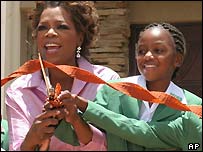
Keeping a promise to Nelson Mandela, Oprah has opened her ‘Leadership’ Academy for girls in South Africa. Girls are selected based on their potential from families with a monthly income less than $700. With a huge showing from Western celebrities I wonder if this initiative will be copied. The access to education in South Africa is the best of any African country being nearly universal, why is there a need for what some call an ‘elitist’ academy that cost over $40 million to build? A very good question as still thousands of African children do not even have books, pens, paper, classrooms, teachers, healthcare or security to become educated. “We have to change the way they think,” she said. Time out – we need to change the way we think? With a beauty salon shoving American materialist values at these 152 South African girls how can she believe that their minds are the ones needing change. We may need to help their minds develop with access to good education, but we do not need to change them. Yet another example of the Western mindset. Oprah is to open a school for 1000 boys later this month. I hope Oprah will begin to focus on reaching the unreached people in her next African venture.

Effective as of the new year, United Nations Secretary General Kofi Annan, a Ghanian native, is no longer the head man for the UN. Annan served two terms as Secretary General and many say he quietly and effectively brought Africa to the forefront. As an African he worked to raise issues in Africa without being too baised to one side (not giving too much to African leaders and not sucking up to the West). His tenure saw the creation of the Human Rights Council to take over human rights monitoring, the US’s diplomatically unilateral approach to the Iraq War, and the current test of Darfur, Sudan for the UN’s new powers to act, along with many reforms and calls for reform of the UN system. His tenure was not without scandal or missed opportunities, but I am sure no one during his term would have faced any different challenges. With Annan now gone I wonder if the UN will remain as focused on the Darfur genocide and other African and ‘developing’ world issues, such as the Millennium Development Goals. However, with hope, the new UN Secretary General, Ban Ki-Moon, has set the conflict in Darfur as a priority of his term. Kofi Annan will be greatly missed, and not missed by some, but I still feel he has much greatness to offer Africa.

Lastly, Somalia – the only true failed state? (Failed states are based on Western ideas and ideals, but Somalia seems trapped in conflict) What will come of the country as US military trained Ethiopian government forces supporting the ‘Somalian Government’ take control from the Islamic leaders? How will the peace be kept and how many refugees will flood surrounding countries? How will aid agencies and the UN respond? Be sure to read your news and from multiple sources to get the full view, which sadly is not possibly unless you are actually in Somalia, but at least be knowledgable. Here is the latest BBC article.

something new for the new year

A group that has really captivated my interest this year has been the Acumen Fund. They do amazing work towards creating change and sustainable solutions to global poverty issues with people at the center. Check out their work and what they do, I would encourage you all to get involved in the new year! Have a good one!

Acumen Fund Philosophy
Who we are and why we exist:
Acumen Fund is a non-profit venture fund that uses entrepreneurial approaches to solve the problems of global poverty. We build financially sustainable and scalable organizations that deliver affordable, critical goods and services that target the four billion people living on less than $4 a day. We adhere to a disciplined process in selecting and managing our philanthropic investments as well as in measuring the social and financial returns.

How we work:
We identify some of the world’s best entrepreneurs and organizations focused on delivering critical, affordable goods and services – such as water, healthcare, and housing – to improve livelihoods, health and opportunities for the poor.

Our investment process:
Using the skills of business, the flexible capital of philanthropy, and the rigor of the marketplace, we aim to develop and deliver systems-changing solutions to the world’s problems. Our investment approach focuses on organizational sustainability, strong leadership and scalability through managerial support and financial investment.

Measuring results:
Within each investment organization, we focus on the areas of design, pricing, distribution and marketing of critical goods and services to the poor. We measure and share both social and financial returns of our investments, as well as our own financial sustainability and the strength of our community. Our risk management aims to generate positive returns where possible and recover a substantial portion of their capital to reinvest in new philanthropic ventures.

2010: access for all, stories of hope

HIV/AIDS – Part III:

20 million dead, 40 million infected, 4 million new infections each year, and counting. As the numbers grow, so too should your hope. At the heart of the issue is access to treatment and drugs for all those infected with HIV/AIDS – the number with access is growing, however it is not growing at a rate equivalent to the spread of the epidemic. Nevertheless, hope is on the horizon and is always dawning. Now here are some stories to strengthen your hope in regards to the AIDS pandemic and Africa.

At the Saint Leo clinic in small, dusty village in central Lesotho a small cluster of patients gather to be diagnosed. A thin woman sits waiting to hear advice about her racking cough. A mother of five, she said her husband had died two years earlier and had also coughed incessantly. She does not know what killed him. With these common symptoms of tuberculosis and sexually transmitted infections, many of these patients will today learn about HIV and will be tested. The test results will take a few days to be sent back from the city and many patients question why it will take so long. “We have no money and no manpower” says the clinic manager, “I have to manage everything, but neither do I feel comfortable referring patients elsewhere. They often do not show up because they are too sick, or don’t have money, or transport.” The Saint Leo clinic presents an ideal site to introduce a program to involve community members with training for HIV testing and counselling, leaving nurses time to focus on more complex aspects of treatment. Providing HIV testing and counselling at primary health clinics is key to enabling access to HIV prevention and treatment services. Lesotho has a very high rate, where 23% of adults were estimated to be infected in 2005.

When Rose Dossou became pregnant she did everything she could to have a healthy baby. SHe visited an antenatal clinic at the university hospital in Abidjan, Cote d’Ivoire. She had lost 2 babies before and was tested because she wondered if HIV had killed her babies. The test came back positive. Rose wondered how she was going to handle this, at six-months pregnant and how would she tell her husband. The doctors told her the baby may also be infected. She told her husband who remained supportive and found he was HIV positive as well. Rose wanted to do everything she could to stop the transmission to her baby and began volunteering for a clinical trial of AZT in pregnant women. Even with a good trial and a smooth birth, her new-born son at 12-months was HIV positive. Rose dropped out of school and turned her HIV positive status into her life passion. Her son spent the first three years in the hospital and she became an expert on HIV. Soon both Rose and her son were recieving treatment from a french charity. Rose’s son is now 10, goes to school and rides his bike. Rose is 42 and runs Chigata, an organization that supports children who need HIV treatment and AIDS orphans. Chigata, means Hope in the local language, organizes discussions, courses in theatre , distributes food kits, and provides drugs through a community-based pharmacy.

In Rwanda, Mwavita acquired HIV at birth, or as a result of breastfeeding. Once diagnosed Mwavita was urgently treated for both TB (tuberculosis) and HIV. She finished her TB treatment successfully, but had to stop the HIV treatment because the medicines had to be taken with food and after one month there was nothing to eat. Thankfully a neighboring family agreed to give Mwavita food whenever her family had none so she can continue her treatment. Most dosages of antiretrovirals (ARVs) are unavailable for children, so health workers have to cut and divide tablets designed for adults in order to treat children infected with HIV. This makes pediatric care extremely difficult and puts children at a much greater risk. After a few months of restarting treatment, Mwavita is healthier than ever, she has put on weight and has returned to school.

These are just a few of many stories (from WHO) that can offer great hope to the future of combatting HIV/AIDS and other disease in Africa. The HIV/AIDS pandemic highlights many issues and brings the inter-related issues of health under one lense. The lack of health workers and health infrastructure are made painfully clear, the lack of pediatric medicines and focus, and the greater problem of the lack of access to basic treatment and food almost screams at us as we examine the HIV/AIDS pandemic.

the quick facts


HIV/AIDS – Part II:

HIV/AIDS in Africa:
– 25.8 million people living with HIV/AIDS in Africa
– sub-Saharan Africa has only 10% of the world’s population, yet has over 60% of new infections
– 77% of new infections in women
– Out of the 15 million AIDS orphans in the world, 95% of them are living in Africa
– Only one in ten Africans who currently needs antiretroviral treatment for HIV is receiving it


Since its discovery 25 years ago in 1981 HIV/AIDS has:
– Claimed the lives of over 25 million people
– Roughly 40 million people infected and living with HIV/AIDS
– 14,000 new infections each day
– 5 million new infections each year (estimated)
– 64% of all people living with HIV are in sub-Saharan Africa
– There were 13 million AIDS orphans living in sub-Saharan (South & South East Asia are second worst affected with 15%)
– AIDS accounts for the deaths of 500,000 children in Africa
– Two-thirds of HIV/AIDS infections in Asia occur in India


According to the latest figures published in the UNAIDS/WHO 2006 AIDS Epidemic Update:
– 39.5 million people are living with HIV (estimated)
– 4.3 million new infections in 2006
– 2.8 million (65%) new infections occurring in sub-Saharan Africa
– Increases in Eastern Europe and Central Asia rates have risen by more than 50% since 2004
– In 2006, 2.9 million people died of AIDS-related illnesses.
– Of the 2.9 million deaths, 2.1 million of thiose occurred in sub-Saharan Africa