who do you think you are? (identity, constructivism, and colonialism)

I am not an African, I am not an American, I am not white, I am not black, I am not a Michigander, I am not a catholic, I am from no country, I am of no nation. I like to consider myself a global citizen, a person of the world. The constructed boundaries of countries hold no bearing in my mind, I see no lines drawn upon the earth and I believe that no falsely imposed blockade of governments can hold me back. We are all people of this world and being so we all hold the same basic hopes and dreams. Everyone wants enough food to eat, clean water to drink, a shelter to be warm or safe, education for themselves and their children, and most importantly to be loved by one another. There are no boundaries when people care.

So you may be thinking, this guy is a crazy social constructivist and an idealist – sure if you’d like to use the language of old, white, men with too much time spent on picking at the elements of human nature, then sure I am a social constructivist and an idealist.

A recent article in the BBC: Identity: Who do you think you are? explores the changing roles of ‘African’ identity. Soon Ghana will be holding its 50th Anniversary of becoming independent from colonial rule. If you do not know the history of Africa and colonialism, the continent was divided at the Berlin Conference of 1884-5 by the leaders of Europe. These leaders gave no attention to ‘nations’ of people, or ethnic groups or lands held, or really anything that would pertain to the continent besides gaining the most property. This led to the division of nations within countries.

What I believe is the most important excerpt from the BBC article follows:

“People should be able to move freely and transcend all forms of mental and physical boundaries. Family and national belongings should not be used to divide us but to better understand each other and bridge our gaps because we have a lot that unites us. I have become a black man in Europe but I try to move beyond that and not to let others impose their will on me. I am what I am because of circumstances and choices I make in life. I believe I am my own country: the clothes I wear are my national flag; the song I sing in the shower is my national anthem and all my body parts are the different departments and ministries of my government. The social ministry goes to the eyes, mouth and ears. The home affairs ministry functions through the heart and the brain and my sexual organs have the most important portfolio covering foreign affairs. To be a human being is to understand oneself by understanding others. This can only be achieved by creating relationships with other fellow humans on the basis of true humanism: one love; one heart and one destiny.”

Who do you think you are? This question I feel goes along very well with YP4’s question of ‘What do you stand for?’ Do you identify with family, ethnicity, religon, region, or country? Who are you and what do you stand for?
barack, blessing in disguise

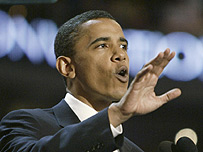
He is too black, he is too young, he is not experienced enough, he is just a political phenomena now, he can’t hold his popularity for 2 years. . . Barack Obama a man of many talents, attributes, and ideas – mired in petty complaints and cries against his ethnicity and youth. Seeing as so many have written about Barack Obama’s potential as a presidential contender I figure I might as well jump on the bandwagon and start tooting my horn on what I think of Obama and his potential for a change in the US Africa policy. Are you ready to listen to the tune of a fast changing world? Listen to those drums, the beat goes on.

Barack Obama presents for many a great hope for America. A change in our misguided political system. A dream of beautiful coexistence. He has written two best selling books and recieved a grammy, besides gaining the support of so many common Americans. For me Obama embodies progress, he embodies the advancement for all people to finally become equal, he represents the dreams and hopes of a country torn in so many social and political directions. Many see his youth and political inexperience as a downfall – I see it as his greatest attribute. We are not a country of large, old, white men. We are a country of young movers and shakers. If the old graying white men can no longer stand up for what they believe in and what the people believe in, then maybe it is time for them to step down! Obama can and does bring a new and refreshing perspective on American politics and problems. He is now mostly an outsider and sometimes that is what we need most when we cannot recognize our own faults and short-comings.

Hillary Clinton, now the front-runner in bidding for the democratic candidacy, recently was interviewed by NPR. In her interview she stated that she did not believe that he could keep up his popularity for 2 years until the election. To paraphrase what she said, Obama represnts a dream that has yet to collide with harsh reality. She understands that he represents the aspirations of many Americans, but she says there is no way he can sustain expectations and the media scrutiny has yet to bring Obama back to earth. I am not so sure what she represents for me or what she will even be able to do for me, but for the time being Obama embodies my ideals and passions more than anyone who looks like me, a privileged, white male.

Barack Obama also represents a great hope for Africa. In a previous post I noted the growing popularity of Obama and his dedication to Africa with his ‘Africa Tour’. If America ever does elect a president with black and African heritage, I can see a great turnaround for the US Africa Policy. Currently it is in the state of sheets of paper and statments – no action. Many Africans wrote on the BBC ‘Have your say’ piece that no matter what color his skin is he is still American, so Africa is still at a loss. Some noted that skin color has no bearing on whether you are good for Africa or not, it is no factor in raising support for Africa. Others note that there are numerous Africans in high US goverment positions and they have done nothing substantial for Africa (ie: Powell, Rice). However, I feel with Obama’s current support of Africa and his heritage in Kenya that he will create a big change and shift in at least a reformed Africa policy. Another important issues to take note of is Obama’s ethnicity. He is not black, he is not African-American. He is an American born of a Kenyan father and American mother. He is a mix of ethnicities just as the majority of people are today.

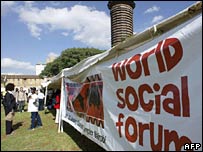
Along with all this talk on progress and Kenya comes the World Social Forum in Nairobi. Over 80,000 delegats from all over the world will convene to address a wide spectrum of social problems facing the world, including a focus on African issues. This year is focused on the issues faced by deprived Africans. The forum started with a march, which began in the large Kibera slum of central Nairobi. Progressive movements are growing all over the world and in this case Africa. The World Social Forum describes itself as a platform for ordinary people to exchange ideas opposed to a world dominated by capitalism and imperialism. In keeping with an organization opposed to prescriptive solutions to the challenges facing the world, the multitude of meetings and activities are what is called “self-organised”. People are the solution to all the world’s problems, no large plan for positive change will ever work. Do you believe in equality? Do you believe in equal rights for all people? Are you acting progressively?

out of africa

This morning I was listening to some hip hop music and the artist, Saul Williams‘ “African Student Movement” song came on. Part of the chorus is a repitition of ‘African people’, which for some reason kept sticking in my head. Earlier that morning I had read an article on National Geographic about the discovery of a 36,000 year-old skull proving the 2nd migration of the human race out of Africa.

This discovery proves that at around 50,000-70,000 years ago modern humans left Africa to populate Eurasia. This is still in a theory stage, but the evidence is growing in support of the ‘Out of Africa’ Theory. Essentially this means that Africans populated the world. I also learned this theory in one of my required university science courses. I found it very interesting and extremely thought provoking given the history of the US and ‘race’. Just 60,000 years ago people from East Africa spread to the Middle East, Asia, Australia, and Southern Africa. We are all Africans!

When Saul Williams is calling for African people to work together and join to build equality – he is really calling to us all. Our home is Africa! Now don’t get me wrong I am a privileged ‘white’ male with what some would say is no connection to Africa. Wrong, I feel more at ease and comfortable with my ‘black’ and African friends, I love Africa, the people, culture, and especially music. I feel for the plights of the people and work to change that. I have a strong connection to Africa and now that connection is proven even stronger. I am an African (not in the literal sense, I don’t mean to offend anyone) before and above anything else.

the pearl of africa, tarnished and shined

Once called the pearl of Africa by Winston Churchill, Uganda was seen as the great hope for Africa with its beauty and its believed secure government. However, as a recently viewed documentary has made me realize, that nickname is not far off and no where close. The documentary, Reporting Africa, which I just watched in my Africa and the World course looked at the way the West was reporting Africa or rather how the West was not reporting on Africa at all. The documentary was made in 1987, the year I was born, and the realities of Western media in Africa are nearly the exact same. The reporters all recognized the disparity in news coverage and were very dedicated to bringing out the blaring issues and hopes of Africa. They began their travels in Kenya and then headed on to Uganda where they were covering the new government of Yoweri Museveni and the AIDS crisis in the state run hospital. The reporters were from CNN, BBC, and a local independent journalist. As they likely would today, the reporters faced government delays and approvals and denials.

They first covered the AIDS crisis and the government hospital’s denial that it was a large threat or problem. The doctors turned them away and failed to recognize that people were dying from the disease. However there were both sides to the story and the reporters also found recognition of the realities. One doctor recognized that although there were no ‘reported’ cases of AIDS yet, people were dying and he also recognized that action was needed. The reporter also praised the Uganda government’s unique openness about the disease. The other story they covered was the new government of Museveni. After covering the history of Uganda from Idi Amin, who transported Uganda into the Western mind with his brutality, to his even worse predecessor, Milton Obote. The world only began to understand Obote’s horrible impact after Museveni invited Western media to see the killing fields of Uganda.

Yet, even today, the Ugandan pearl is still in conflict with Museveni’s rule. As his government began so too did its opposition movement. It is very interesting to view the Uganda of 1987 from the documentary and the Uganda we know today. The woman credited with founding the long-running resistance movement in northern Uganda, Alice Lakwena died today from illness while exiled in Kenya. She claimed to channel the Holy Spirit and told soldiers that her magic would protect them from government bullets. The predecessor or her movement was Joseph Kony, who claimed to be a relation of hers and could also use magic. Lakwena’s 7000 fighters nearly reached the capital, Kampala, before being beaten by government forces in 1988. Kony has built a resistance that hinges on the abduction of children to fill its ranks forcing many children to commute at night to larger city centers and bus parks to be safe from abduction. Kony calls for a government run by the Bibical Ten Commandments, yet his perpetuation of the conflict seems to be out of order with the commandments.

Peace talks have been underway in southern Sudan to work towards a peaceful end to the fighting in Acholi land, northern Uganda. There are now threats from Kony’s fighters, the Lord’s Resistance Army, that they are fed up with the stalled talks and want to return to Uganda. They are not welcome in south Sudan and are prepared to re-enter Uganda, which the government of Uganda says will start the fighting again. The Ugandan forces say that they will attack and fire on any rebels that try to enter Uganda from Sudan. This has frightened aid agencies in Uganda working to rebuild. The peace agreement in August was seen as a hope to end the 20-year conflict that has torn so many lives apart. The LRA has said it may send fighters back soon, but was not reached for comment. Kony is wanted by the International Criminal Courts as both sides accuse each other of breaking agreements.

As always there is hope. An organization that I learned about just two years ago is working to raise awareness about this forgotten conflict. Invisible Children was started by a group of three college-age aspiring film makers who decided to travel to Sudan and make a documentary about the civil war between the North and South, however, on their journey they came across the Ugandan conflict. They first met night commuters as they walked miles for safety and packed themsleves into shelter for the night. They were moved and inspired by their experience and now their documentary has been viewed across the country and world. Besides raising awareness, Invisible Children also runs programs to assist those affected. Their premier program is with bracelets. The bracelets are made from materials from Uganda, crafted by people who otherwise have no employment, and sold in the US with a story of a person affected by the conflict. Through this program Invisible Children has allowed numerous people to rebuild their lives and has enabled many children to get an education. Even with great conflict and pain comes great hopes for the future. Check out the Invisible Children site and get involved.

ka-boom-ratta-tatta. . . airstrikes in somalia

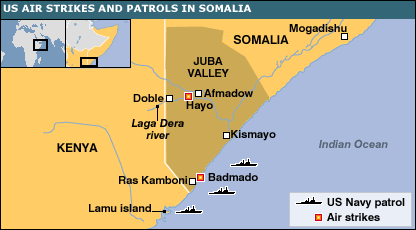
Now you have a small snapshot of the truth. The US has reportedly carried out two airstrikes in Somalia and has conducted raids on al-Qaeda targets tied to the 1998 bombings of the US Embassies in Kenya and Tanzania. The Pentagon has denied that any of this is happening, however witnesses have seen firsthand and the denials by the Somalian and US government make these events seem undeniably true. The Somalian President, Abdullahi Yusuf, told journalists that the US, “has a right to bombard terrorist suspects who attacked its embassies in Kenya and Tanzania.” The targets were Islamists driven to the wedge between the sea, patrolled by the US Navy and the Kenyan border, which is heavily guarded. The airstrikes were followed by gunships attacking the al-Qaeda targets. This is the first US military offensive in an African country since the 1993 Somalia operation. See the complete NPR article and report from witnesses in Mogadishu here. To try and claim that the US has no hand in this operation or that it never happened is obsurd. There has been an obvious build-up in the region (ie: new Africa Command, live military exercises in Cape Verde and neighbors, tracking Somalian ‘terrorists’). I had written a post last year about the threat of Chinese economic attack to gain natural resources, but now I am even more worried for the US military’s involvement in the name of fighting terror. What will the US do to Africa? Hasn’t the West already done enough military ill from the past? Where is our Africa policy headed now? Unilateralism again?

Update: The Pentagon has claimed the attack, but will not release their success. Somali elders say 19 were killed. White House Spokesman, Tony Snow: “This administration continues to go after al-Qaeda,” he said. “We are interested in going after those who have perpetrated acts of violence against Americans, including bombings of embassies in Kenya and Tanzania.”This is after hte US said it would send only money, no troops or military to help stabilize the Somalian conflict. Check out the BBC Article.

Update 09.10.07: Somali hatred of the US has been rekindled by the recent airstrikes and it is reported that 27 civilians were killed, no al-Qaeda were among the dead. It will be very interesting to see what direction the US government and military takes on African conflicts in the name of fighting terrorism.

Update 09.11.07: Supposedly the US has not claimed the attack. However residents of the two areas attacked saw US gunships involved.

the US policy on africa

What is the US’s policy on Africa? Do you know? Many people do not and now is your chance to find out. On the US government page on African Policy the first thing I notice is the picture displayed on the top, not just because it is a picture, but because it is President Bush and President Ellen Johnson-Sirleaf of Liberia at a ‘Partners in Democracy’ forum. As you can see Bush is pointing off into the distance and Ellen looks quite fed-up and dismayed. First, is this the US policy on Africa point to the distance and not involve the African leadership. Second, did we forget that Africa is not a country and that there are 54 countries within the continent. Africa as a whole does not have one policy on the US, each different country has a policy – why doesn’t the US have a policy for each country in Africa? Maybe it is just not strategic enough or worth the US’s time? Whatever the case I find the picture very telling of the US goverment approach to Africa. They then jump right into the Darfur conflict and the subsequent peace agreement in the works. This I find very disturbing as all the US government has done for the Darfur conflict is give it lip service and some nicely written statements. After scrolling down the page, to what is almost the bottom, you will find the outline of the US policy on Africa:

“In Africa, promise and opportunity sit side by side with disease, war, and desperate poverty. This threatens both a core value of the United States—preserving human dignity —and our strategic priority—combating global terror. American interests and American principles, therefore, lead in the same direction: we will work with others for an African continent that lives in liberty, peace, and growing prosperity. Together with our allies and friends, we must help strengthen Africa’s fragile states, help build indigenous capability to secure porous borders, and help build up the law enforcement and intelligence infrastructure to deny havens for terrorists. An ever more lethal environment exists in Africa as local civil wars spread beyond borders to create regional war zones. Forming coalitions of the willing and cooperative security arrangements are key to confronting these emerging transnational threats.”

Bush’s Africa policy has three pillars which mostly are comprised of holding lots of meeting with various groups and on different issues affecting African countries (ie: AU, malaria, HIV/ AIDS, growth and opportunity act, etc.) Meetings a indispensible when one does not want to act. I am afraid the US’s policy on Africa is just a bunch of words, no action.

Another great site that I found helpful in my search of US’s African policy was Africa Action. Each year they write a full report on the US policy for Africa. They critique and offer potentials and what needs to happen in years to come. Africa Action opens the report with this quote, “2006 will help clarify whether the compassionate concern for the African continent, worn like a badge by western leaders last year, is a true determinant of Africa policy, or whether it merely masked other, more ‘strategic’ and less ‘benevolent’ impulses and interests.” 2005 was a great year for more focus and interest in African issues. It was a year of more advocacy and awareness about Africa and thus there was more talk of doing something on the continent. I find this is a beautiful quote to begin critiquing the US African policy. What has 2006 shown? It seems that US policy is focused only on strategic advancement and leans no where to the benevolent side. Africa Action begins by outlining the year from Live 8 to Live X. Concerts which raised funds and awareness for Africa to US military sweeping into the continent to be sure America is secure. This comes with the development of the Africa Command as well. This military shift in Bush’s Africa policy obviously speaks to the ‘War on Terror’ focused on intelligence gathering and keeping al-Qaeda out of Africa. Yet even with this upswing of troops and US intelligence in Africa a genocide continues and conflicts spread, threatening regional security.

Another development to note in US policy is the potential of African oil. It is estimated that over $10 billion a year will be invested by the US in African oil activities. Many policy analysts say that the US needs to shift its oil dependence from the Persian Gulf to the Gulf of Guinea, however as many analysts fail to realize, African oil is a creates a great deal of conflict by itself without the US involvement. The US may only intensify conflicts and make themselves a target. Lastly, the Africa Action report notes the slim mention of security in the US Africa policy. With the growing threat to public health and differences on global issues, a great disparity is enlightened between African priorities and American interests. The report also highlights the hypocrisy of the current Administration focused on showing its humanitarian side and not its creeping military and strategic involvements. The US African policy is also not within in the lines of what most Americans would like to see as the US policy towards Africa. The US needs to adapt its policy to involve African leaders and to include the voice of the American people. I encourage you all to read the site on US Africa policy and the Africa Action report. After reading let your politicians know how you feel and what you want to see happening in Africa from the US.

africa’s long to-do list?

In a recent article posted on the BBC By Ofeibea Quist-Arcton, a National Public Radio reporter in Accra, the issues of Africa and challenges to face in the new year are highlighted. However I would say that it is nothing new or exciting to a person who follows the news of Africa daily. The article notes the conflicts across the continent from Niger Delta, to Somalia, to Darfur, to Northern Uganda. Quist-Arcton notes the coming elections in many countries and the worries of violence at the polls. The reporter does well to examine the challenges in the future and the causes of problems in the past. However, this African reporter seems to have very little hope for the new year, except for a few lines near the end hope is finally noted – the country of Ghana turns 50 and the 2010 South African World Cup is on its way. Is that the only hope for the continent? I think not. I hope that I have noted some positives for Africa in 2007. I do not wish to hide the realities and so the positives are accompanied with the negatives, but there is always hope. Check them out here:

finally, something good happens in that country

something new for the new year

interesting things to note in the new year for africa

a promise fulfilled, land rights deferred, the new UN, and spreading violence

a promise fulfilled, land rights deferred, the new UN, and spreading violence

An election promise, a first for Africa, a hope for a better future. The Ugandan government in cooperation with private donors will begin offering free secondary schooling for high performing children. Yoweri Museveni, Uganda’s “President” of 20 years, made a promise in his re-election bid to offer free secondary schooling for needy students. The education ministry has said there has been a high demand for secondary school after universal primary education was introduced in 1997. Of the 350,000 primary school students only about 40% are absorbed into the secondary school system due to the need for help at home, lack of funds to attend, or a number of other reasons. Incredibly the Japenese government will be providing teaching expertise and a grant from the African Development Bank will allow for the construction on facilities. This is an amazing development in Africa with the role of advanced education moving to the forefront. I am glad that Mr. Museveni has recognized the importance of secondary schooling. I can see this as a great hope for Uganda’s future and Africa’s future. While I was in Uganda, in 2002, we traveled to so many schools. Schools which were small brick structures with open squares for windows and doors, schools which had maybe a few benches and possibly a black board, schools that were jam-packed with young children who had walked many miles (as far as 8 miles) without shoes, schools where one teacher had as many as 80 students. We visited so many schools and met so many inspiring and dedicated students. They really wanted to learn, when you compare that to students here in the US, there is a drastic difference in academic drive at such a young age. With all the schools we visited there was just one that continues to stand out in my mind. Near the end of our time in Uganda we visited an orphanage and montessori school for children affected by the HIV/AIDS epidemic. The children welcomed us excitedly, sang welcome songs, performed dances, and then demonstrated their academic poweress. These students could read, point out many countries on the map, and do simple math among many things – take note these students were only preschool age! Preschool and they already knew where they were in relation to the globe, where the US was, how to add 10 and 2, and how to sing and dance their traditions. And yet even with so much hope, there is a great despair. Being HIV/AIDS orphans means that more likely than not most of the students are also positive for HIV. These children have no access to medications or treatments, they do not possess great financial means to survive. And I wonder, are these inspiration little geniuses alive today? Did they make it past their fifth birthday as many do not? Will they be able to benefit from the free secondary schooling program?

Late last year there was great hope that people would cease to be exploited by their governments. That has now been called into question in Botswana. The San people, more wrongly referred to as the Bushmen, were granted the rights to their ancestral lands, which now reside on the Central Kgalagadi Game Reserve (CKGR), in the Kalahari Desert. However, even though the Botswana high court determined that the San were forcibly removed to make way for tourist and economic development, when the San went to begin rebuilding their community they were turned away at the gates being told that they did not have clearance. Governments will no longer exploit their people? There is hope and fear for the future. Another great hope for Africa is the appointment of Tanzanian Foreign Minister Asha-Rose Migiro as Deputy Secretary General of the UN. Today she became only the second woman in history to be appointed to the position. The AU special envy on Sudan welcomed the appointment as do I. There is hope that African issues will remain a top priority for the UN in the years to come.

In less hopeful news, there is increased violence in Chad due to the Janjaweed’s attempts to drive people from their homes. Spilling over from the Sudanese conflict in Darfur, this conflict is beginning to threaten the regional security of Central Africa. Is that not enough to intervene? In a recent poll (because they are so reliable, and I can’t remember the source) 64% of Americans support sending US troops into the Sudan to help qwell the violence. I agree, what a better use of our massive military budget – saving lives, repairing the US’s tattered image, and bringing peace to so many people. Behold, emerging on the US political scene. . . Barack Obama! An American born of a Kenyan father who was an immigrant and an American mother, Obama brings a beautifully refreshing and hopefully new approach to American politics. Besides speaking to the people, Obama also has a great place in his heart for Africa. With his father being from Kenya it makes sense. Just last year the Illinois Senator went on an African tour visiting South Africa, Kenya, Ethiopia, and Chad – discussing the issues of the HIV/AIDS epidemic, the growing violence in Darfur, refugees from the Sudan conflict, the Kibera slums, and Africa becoming a new haven for terrorists. I wonder if he is in favor of the Africa Command? Obama presents a great hope for American political reform and rebirth, but also Obama presents a great hope for Africa and bringing about a more focused and effective and involved US African Policy that is not afraid to invest in the continent.

is philanthropy good for africa?

The big question recently revisited, yet again, by the involvement of Oprah and Western celebrities conducting what some call “super-philanthropy”: is philanthropy good for Africa’s long-term development? My answer is yes, but a certain use of philanthropy. When the West tries to help the Rest (Africa) with a big fix or big plan there is most often failure and cynical backlash. Big plans do not work, as the economist William Easterly has helped me realize through his new book, The White Man’s Burden. He writes that the Planners need to give more power to the Searchers. Searchers being the people who look for the small-scale, community-based, effective projects that actually reach people in need. Searchers are the people on the ground implementing programs that actually get the $4 bed nets to families that need them and the easily accessable medicines for preventive diseases. I would categorize Oprah as a Planner, a celebrity Planner at that. She has heritage and roots in Africa and so she thinks she has a good reason to use her massive amounts of capital to shove solutions in the face of Africans.

On the BBC this question is asked and a dialogue has been opened to get the views of readers. One commenter thanks Oprah, but then says, “But you know what? Your deed is like throwing a gallon of water on the Sahara desert.” A beautiful metaphor for the Planners approach. What philanthropy needs is the opposite approach – pumping a gallon of water to the people in need of water in the Sahara desert. More effective investment philanthropy is needed if philanthropy in Africa is to get a better wrap. Many commenters expressed the thought that they would rather see no giving as opposed to seeing funds given to goverments. This takes us back to Searchers idea, give the funds to the people and organizations implementing effective programs that reach people.

This brings me back again to the work of the Acumen Fund supporting social entreprenuerial projects that are based in communities. Read one of the Acumen Fellows’ blog. Partners in Health implementing programs building health infrastructure in countries where the infrastructure is inadequate and in need of philanthropic support to reach people in need. As for the question, I believe that philanthropy is good for Africa’s long term development as long as it is directly aiding the people who truly need it. I cannot speak for a continent, but I would say Africa does not need celebrity Planners with big ideas to try misguided efforts. What Africa needs is a commitment by Planners to support searchers who are African and who are making sustainable advances for their communities. Likewise we need potential Western aid-givers, organizations, and foundations to work with African communities to invest in effective projects.

I highly recommend reading The White Man’s Burden by William Easterly to receive a great critique of Western aid agencies and efforts to aid. The book also gives a great presentation of what needs to be supported and implemented. It tells compelling stories of those who need the help and can benefit from the West’s effective philanthropy and engagement.