HIV/AIDS – Part I:
A silent call from a distant land
Crying for a helping hand, so
How long will it go on?
Ignorance and vanity
Supercede humanity, so
How long will it go on?
I want to know, how long will it go on?
We can’t wait any longer
They’re crying out, doesn’t it matter
We can’t wait any longer
No, no. Too long in a slumber
Shake it up, wake it up now.
We can’t wait any longer. No, no.
Another child is laid to rest
Another day of hopelessness, so
How long will it go on?
And every day we’re on the fence brings
Another fatal consequence, so
How long will it go on?
I want to know, how long will it go on?
Yuko awezayo kusikia kilio chetu? (Can somebody hear us crying out?)
Twaomba msaada wenu (Somebody help us)
Aweko mwenye kttoka (Somebody save us)
Aweko mwenye kutupa uhuru (Somebody free us)
From all that I have done and all that I have read the one thing that creeps into my mind every time the issues are talked about are invisible people, exploited people, dying people I cannot help but have the above song, “We Can’t Wait Any Longer,” run through my head (Michael W. Smith, 2004). The most important theme that the HIV/AIDS pandemic highlights, I believe, is the theme, plain and simple, that people are dying! People are dying! I think Smith speaks to the crisis well in his song and this important theme is what will eventually save lives and prevent the HIV/AIDS pandemic by inspiring people to act. The HIV/AIDS crisis is not just another growing problem prevalent in Africa, it is not just a media game of growing numbers, it is not just another cause to shirk and say someone else will take care of it. This pandemic is a cause that affects us all whether we live in Asia, Africa, or the Americas. The major theme of why people are left to die is what I will focus on, which will draw on America’s actions, structural violence, the impact of the disease, and, most importantly, indifference. Bringing people together in activism should be our biggest concern now if we are to change the course of history.
America, as Greg Behrman writes, has slept through the greatest humanitarian catastrophe of our time. How can America, the supposed greatest nation, remove itself from such a world-altering event – which is still taking place? It took some time to actually determine what the HIV/AIDS disease was and what it does, but even after discovering, the response was a hand waggle at best. You cannot get to know someone just by waving to them. You have to stop, talk, and listen – three things that America neglected to do. At the meeting on the Potomac, four years after the CDC discovered the disease, the President of the US publicly acknowledged that AIDS even existed. Four years! How can that be! Four years, by today’s numbers (still not accurate) is 12 million people! 12 million dead people! Two years ago the World Health Organization (WHO) was supposed to accomplish their plan of 3 by 5 (to get at least 3 million people on ARVs by 2005). That initiative failed, but why – indifference, lack of support, lack of passion. These themes keep coming back over and over. “It is difficult to see what is happening, harder to measure, easiest to deny.” (Barnett & Whiteside, 5) This great indifference is all too evident in politics. Politicians and policy makers and the media are all too concerned with the past and can’t look to the immediate present. HIV/AIDS is a huge issue of the present, but it has been too often in the media and newspapers and they now go for the more exciting, flash-bang issues of everyday life. People are dying, but the media needs people to read their papers and politicians need to look good in office to get re-elected for another term without controversy.
Authors, Barnett and Whiteside, point out that the US could have stepped up and emerged as an international leader at the 1987 International AIDS conference, but instead later that year Bush (Sr.) adopted a policy to keep all people infected with HIV/AIDS from entering the US. This action goes beyond indifference and speaks to the great ignorance that America and the world had and has about HIV/AIDS. This was not the first time that the US failed to take critical action. In the second presidential debate in 2000, Bush (current) was asked about the role of the US intervening on the continent of Africa to prevent humanitarian catastrophe. His response, “Africa is important. . . but there’s got to be priorities.” (Behrman, 246) Priorities! How about saving lives, how about preventing death – is that not a priority for the US political system? In 2002 the pandemic reached the mainstream media in full force. Behrman quotes an opening editorial by Sebastian Mallaby of the Washington Post,
“[…] sometimes the obvious needs stating, because it is taken for granted and then quietly ignored. A century from now, when historians write about our era, one question will dwarf all others, and it won’t be about finance or politics or even terrorism. The question will be, simply, how could our rich and civilized society allow a known and beatable enemy to kill millions of people” (297)
This quote sums up the ultimate American attitude of indifference. We were too caught up in politics and money and terrorism to even see the murder standing at our doorstep. The US as Behrman says, slept through the AIDS pandemic. His words and quote have a great impact on how we, as Americans, should view our response and caring nature. The AIDS crisis really asks the painful question of how “we” value other human beings. Are human beings of no importance unless they are advancing or helping to advance our country or position? Are human beings just numbers? 130 people die each day in Ugandan IDP camps, 3800 people die each month in the violence in the Democratic Republic of the Congo, 3 million people die each year from AIDS – are we just supposed to take those numbers in their pure numerical value or should we delve deeper into the true impact of those numbers?
This brings about another underlying theme, the impact of the HIV/AIDS Pandemic. Each number has the face of a person, out of those three million people is a life, a life just like yours or mine, a life just as valuable and precious, a life so intricately linked to a family, a community, a city, a country, a world. AIDS was not just a health problem, it was a catastrophe that touches on every dimension of national and international society. (Behrman 173) This story is based on true events:
A father, seeking work in the transport industry since work is scarce in his villag in Africa, dies after contracting HIV/AIDS from a sex worker at a truck stop. He leaves behind a family with 6 children. After HIV/AIDS was contracted, the first child born afterwards most likely died from in vitro infection. That family is now without a “breadwinner” and provider (in the typical patriarchal system). With the father gone, the mother will have to find a way to make an income for the family to survive. The children may not be able to attend school anymore, most likely only a few were going to school to start, because they are now needed to work or cut costs. Now the children are helping work at home and the mother is trying to find work so that the family can get the basic things they need to survive. Many women faced in this situation of extreme poverty can find only sex work to earn money. This increases the chances of becoming infected with HIV/AIDS, if she was not already infected from her husband. The mother, now having the added responsibility of generating income, will very likely contract HIV/AIDS from her work, if that happens then it is only a matter of time until she will succumb to AIDS. Due to her impoverished situation and lack of income, receiving treatment is not an option. Now her 6 children have watched their father die and now they have lost their primary care giver – their mother. Children now are out on their own, without a family structure, trying to survive, can we even imagine?
The HIV/AIDS crisis has the face of a woman says Stephen Lewis. That statement is all too true. Women are the most affected, most vulnerable, and most impacted by the HIV/AIDS pandemic. Women are, for one, more biologically vulnerable, they are bound by traditional and societal practices, they are forced to sell their bodies when their poverty becomes too much, all this on top of caring for a family and having the responsibility of providing food, clothes, and health. Stephen Lewis’ statement should more accurately read ‘the HIV/AIDS crisis has the face of a dying woman.’ Why must one family have to witness so much death? Just in this one family story there have already been three deaths and now six orphaned children fending for themselves in one of the harshest environments to survive. That environment is of a developing country. The family forms one root of a community and now that community is weakened by so much loss. The orphaned children will be left to fend for themselves since the it will be too much of a burden on their own families. Largely those infected with HIV/AIDS are members of the workforce (age 15-49) and when the workforce is disappearing due to AIDS, the economic impact is severe. The economic impact starts at the family, then the village community, and eventually that impact reaches the national level. How is a community to dig itself out of the already present poverty with a rampant disease coursing through and killing its people? As Barnett and Whiteside write:
“Where people lack material resources and do not have access to institutions and organizations beyond their limited and poor locality, they cannot be expected to take on extra costs and responsibilities in the absence of outside support. The great challenge for those who would assist communities, households, clusters and ultimately individuals to deal with the awful consequences of the AIDS epidemic is to face realities – to develop interventions and methods of support that recognize these realities, which can be effective at the local level and can take full account of the forces of globalization which will otherwise only exacerbate the already established processes of poverty and exclusion.” (195)
This quote is the key to what we all can do to intervene in the AIDS pandemic. Although it does tell us directly what a single individual can do, it should help us to remember reality when we do intervene or urge others to intervene. It does not tell us how to act, but why. We must intervene for the sole reason of the reality of the pandemic – people are dying! The main reason that people are dying is because of the all too prevalent structural violence. This also speaks to the earlier posed questions of: What kind of people are we? And How do we value human beings? Paul Farmer brings clarity to the thoughts of all these authors in speaking about structural violence.
“But the experience of suffering, it’s often noted, is not effectively conveyed by statistics or graphs. In fact, the suffering of the world’s poor intrudes only rarely into the consciousness of the affluent, even when our affluence may be shown to have direct relation to their suffering.” (31)
How can we be so indifferent? How can our government know and not act? How can people die without a name, without a face, without so much as a moment of silence. The world marches on. We know that we are privileged here in the US, and we must know that we are satisfied by the exploitation of the poor. Our affluence is a product, not a privilege of our circumstance. How can we not realize that with our affluence we can change the world? Farmer throughout his book suggests that we can. Suffering cannot be compared, it cannot be measured, and it cannot be put into one image. At the root of suffering is structural violence, a violence that does not necessarily involve physical means. It is a violence that is perpetuated by the government and imposed institutions of the world. The effects of structural violence are all too evident in the HIV/AIDS pandemic. The lack of basic health care, the lack of basic rights to live, and the lack of affluence all contribute to the structure of violence present in the HIV/AIDS pandemic. Another important theme that is tied in with structural violence is that of human rights in regards to health. From the Universal Declaration of Human Rights, article 25:
“Everyone has the right to a standard of living adequate for the health and well-being himself and his family, including food, clothing, housing, medical care and necessary social services, and the right to security in the event of unemployment, sickness, disability, widowhood, old age, or other lack of livelihood in circumstances beyond his control.” (Farmer, 213)
There is one thing that I cannot stop thinking. Everything looks good on paper, but in reality, as Barnett and Whiteside remind us, we need to see the actual situation. In reality this declaration is not upheld and I cannot help but wonder how many of the countries who signed the declaration can actually provide these promises to its people. I am sure most cannot due to the violence of structure. Farmer says:
“Social inequalities based on race or ethnicity, gender, religious creed, and – above all – social class are the motor force behind most human rights violations. In other words, violence against individuals is usually embedded in entrenched structural violence.” (219)
By saying this Farmer means that people are affected by the relationship between structural violence and human rights. People are dying because the social classes do not line up with the basic human rights of health and right to life. We need to not only realize this relationship, but also come up with a positive intervention. Farmer presents his ideas with the term ‘pragmatic solidarity.’ By pragmatic solidarity he means that our plan needs to involve a rapid response using our tools and resources to remedy the inequality in health care and human rights.
People are dying! However I don’t think you need someone to tell you the reality. The message and knowledge needs to be out first before we can even begin to know where to start. Indifference, impact, and structural violence are all prevalent themes that explain why people are dying. How long will this crisis go on? How long will the indifference linger? How much longer will it be before structural violence is remedied? How many more people will die? We can’t wait any longer and neither can those most affected by HIV/AIDS. Can someone hear their cries before another so needlessly dies? I for one will be listening and acting.

 The $100 laptop computer project was launched this year. The goal is to put computers in the hands of people in the ‘developing’ world. The inventor, Nicholas Negroponte, says, “I’m 62 years old. I’ve seen massive changes in people’s lives through technology over the years.” In the next two weeks three more African countries are expected to sign on to the plan. The laptop has built in wireless capabilities. Maybe Mr. Negroponte can partner with American Millionaire, Greg Wyler, who is working to make Africa wireless starting with Rwanda. (post) Many note, as I do as well, that when you are starving and hungry, striken by disease, and have no clean water – what good is the internet or a laptop. I am not one to say that the internet does not hold great educational possibilities, but how many people will die before even accessing the webpage on wikipedia about their own country?
 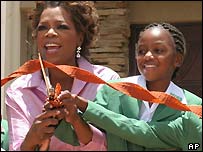 Keeping a promise to Nelson Mandela, Oprah has opened her ‘Leadership’ Academy for girls in South Africa. Girls are selected based on their potential from families with a monthly income less than $700. With a huge showing from Western celebrities I wonder if this initiative will be copied. The access to education in South Africa is the best of any African country being nearly universal, why is there a need for what some call an ‘elitist’ academy that cost over $40 million to build? A very good question as still thousands of African children do not even have books, pens, paper, classrooms, teachers, healthcare or security to become educated. “We have to change the way they think,” she said. Time out – we need to change the way we think? With a beauty salon shoving American materialist values at these 152 South African girls how can she believe that their minds are the ones needing change. We may need to help their minds develop with access to good education, but we do not need to change them. Yet another example of the Western mindset. Oprah is to open a school for 1000 boys later this month. I hope Oprah will begin to focus on reaching the unreached people in her next African venture.
 Effective as of the new year, United Nations Secretary General Kofi Annan, a Ghanian native, is no longer the head man for the UN. Annan served two terms as Secretary General and many say he quietly and effectively brought Africa to the forefront. As an African he worked to raise issues in Africa without being too baised to one side (not giving too much to African leaders and not sucking up to the West). His tenure saw the creation of the Human Rights Council to take over human rights monitoring, the US’s diplomatically unilateral approach to the Iraq War, and the current test of Darfur, Sudan for the UN’s new powers to act, along with many reforms and calls for reform of the UN system. His tenure was not without scandal or missed opportunities, but I am sure no one during his term would have faced any different challenges. With Annan now gone I wonder if the UN will remain as focused on the Darfur genocide and other African and ‘developing’ world issues, such as the Millennium Development Goals. However, with hope, the new UN Secretary General, Ban Ki-Moon, has set the conflict in Darfur as a priority of his term. Kofi Annan will be greatly missed, and not missed by some, but I still feel he has much greatness to offer Africa.
 Lastly, Somalia – the only true failed state? (Failed states are based on Western ideas and ideals, but Somalia seems trapped in conflict) What will come of the country as US military trained Ethiopian government forces supporting the ‘Somalian Government’ take control from the Islamic leaders? How will the peace be kept and how many refugees will flood surrounding countries? How will aid agencies and the UN respond? Be sure to read your news and from multiple sources to get the full view, which sadly is not possibly unless you are actually in Somalia, but at least be knowledgable. Here is the latest BBC article.


 Alex B. Hill