After lecture, and another drum lesson from master drummer Chris, on Monday I gathered a group of people interested in visiting the Peace Corps offices. Six of us worked to get taxis outside of the University with a certain degree of difficulty – probably because no driver knew where it was located. It seems that our group is very good at choosing destinations of which no one has heard. All we knew was that the office was located at 26 W. Cantonments Road – nothing more.
After a great deal of roundabout driving, a couple stops for directions, and some backwards driving (as in driving backwards) we found the offices located on Switchback Road near the house of the Ambassador of Cote D’Ivoire. It turns out with all our driving that we arrived right at closing time for the day with no appointment – I guess that helps. There happened to be a few volunteers at the check-in guard house and thankfully just as we were about to be turned away one of the volunteers claimed that he had gone to school with one of us and he just wanted to show us around.
Alex showed us around the compound and answered any and all questions we had about the Peace Corps. He also shared with us his experience. He is near completing his second year and is located in a very remote farming village in the north of the country. Originally from Nebraska, he was selected for the agriculture and natural resources area. His village is on the cliffs of the north where a ten year war has just ended between neighboring clans. He has started a cashew cooperative with 13 area villages, teaches at a secondary school, works in a hospital, started an HIV/AIDS club, and is attempting to work towards reconciliation between the former warring clans. The Ghana country coordinator had at first called Alex’s assignment ‘hell,’ but he is really enjoying himself and is working very hard to make the most difference that he can. After hours of talking we accompanied Alex to dinner, since we had made him late for a previous dinner engagement – it was ok he said, “they were just high schoolers.” It was really great talking to Alex and hearing his experiences and it really solidifies my plans to join the Peace Corps after college.
This discussion with Alex really made me think about ‘development’ as the word was thrown around a lot that night. Alex has said that he really likes the Peace Corps model because it deals with integration. A volunteer is placed in a village or area and works with the people to improve their situation. This as opposed to some large organization or institution just giving out money to big plans they believe will work. But, what is the definition of development? Who gets to determine what development is? Who is allowed to call one developed or developing or underdeveloped? Is development all based on a desire or push to become Western? Yes, I think in the very recent past it was and really still is to a degree, but for me development holds a different definition. Development for me mirrors positive progress in people’s lives. Development should be based on getting and giving people their basic needs (rights) for survival and life. Even in this regard the almighty ‘West’ needs development.
It is very interesting to be actually in Africa and get the news about Africa. I am actually in the continent that I have covered and studies so much.
2 June 2007 Woke up at noon from a late Friday night. I jumped in the plan with some other students to go to the Makola market and then the beach. There is just something about Makola market that I love. It is not like the other markets or anywhere else in Accra. It may be crazy and seem very frightening and insane to some people, but I love it. The people are hospitable, they are nice, they are business people. They are there to make an honest sale, to run a business, to get you what you want. Many store owners who do not have what you want will direct you to where you need to go. They will not hold you up and try to get you to buy something that they have like most other places. I did not go to buy anything, but people watching is a favorite pasttime of mine. Sure, I am usually the one being watched, but I have come to find out how to be a less imposing and conspicious Obrooni. I have taken to wearing my flip flops often, as many Ghanaians do, my clothes are not flashy or ‘American,’ I have learned more Twi, and I carry only small bills, nothing larger than 10,000 cedi note ($1 USD). I am still obviously an Obrooni, but now after 3 weeks I am slightly more accepted because I know – to a tiny degree – Ghana.
The next day I watched the CNN special show called ‘Inside Africa.’ From being in Ghana (Africa) and getting the news about where I am is really exciting. Namibia is having troubles with illegal ivory trade, Tanzania is developing its gold production industry with foreign investment, Uganda is constructing a power plant on the Nile, Tony Blair is taking his last official Africa tour. He is calling for the West to keep promises of aid because it is a duty and in self-interest. During his term British aid tripled, and some citizens have called it, “… a waste of English time and tax dollars.” Bono was interviewed about the G8 summit in Germany – as usual he stated to keep the promises. He noted that now in the 21st Century people die from a simple mosquito bite – why? how? He also can see a social movement growing in the US and Europe. Finally in the news, the Nigerian president is sworn in, but are the people really happy with the status quo? In Nigeria 77% of the people live on less than one dollar a day, yet their president is re-elected.
The nature of Africa is all about rhythm. Rhythm pervades everything. There is a great love of music that is almost unseen anywhere else. From the very birth of a child there is rhythm in that tiny life. The child enters the world with built in rhythm: crying, kicking, blinking. This child is then exposed to the natural rhythms of the world: frogs croaking, dogs barking, crickets chirping. We all move about our days in rhythm, we talk, chew, sneeze, laugh, go to the bathroom, speak, and walk in rhythm. A child develops this sense of rhythm in Africa as it swings wrapped on its mother’s back – she fetches water, walks, and dances and the child learns rhythm. Rhythm is present even on a less basic level. In many parts of Africa the ritual of greeting someone is very rhythmic – asking the health of the greeter, his family, and his work. This is all done in an almost sing-song rhythm.
This rhythm is transferred from the natural happenings of the world into the lives of the people through drumming and dance. Drums are a key part of life in Africa. Many communities still use drums for their traditional purpose of calling a community together and sending messages. The tradition of drum and dance is never lost in Africa, that is an aspect that I think will never be lost from the cultures. We have experienced a great deal of this drum and dance tradition as part of our escapades around Ghana and in our course on the art, music, and culture of Ghana. As soon as we arrived in Ghana the rhythm of drums surrounded us. I met the rastas on the second day and began learning from them right from the get go drumming in the market. In Cape Coast we had the performance by the traditional drum and dance group and interacted in the performance with our mostly unrhythmic attempts to dance. More recently we have been coordinating drum and music lessons with our professor and professional music teachers. We had a lesson from the University of Ghana,who is a master drummer, for one of our lectures. We used the traditional Ghanaian drums for this session, they hurt the hands a bit more.
We have also been receiving lessons from Kwasi, who has traveled extensively in the US performing and teaching drumming. He taught and did his dissertation at the University of Michigan. We took the bus to his home which was far from the center of Accra because there is a noise ban. The noise ban was in place from the government so as not to upset the gods before the harvest. Kwasi is an older, stylish and spunky man. He has a nice short afro, dark aviators, creased khakis, and an awesome tie. We start each session with creating random musical rhythms out of words that pop into Kwasi’s head and we often dance around his compound singing and stomping our feet to a rhythm. When we finally got to the drumming we were almost too tired from the dancing workout, you wonder why Africans are so fit – take up some type of African dance. Kwasi was amazing to learn from and was extremely excited to be involved with teaching students music again. He group is supposed to perform for us before we leave. we only have two more days of our course on art, music, and culture.
Along with rhythm consuming life in Africa, there is a certain natural socialism that seems to work quite well. The idea of socialism was attempted across the continent, but it failed – why – because the elites in power were too interested in keeping that power. In much of Africa, specifically in Ghana, people live in secluded hamlets (communes). These hamlets are often isolated, but they remain connected with one another through traditional festivals. In these housing groups there is an idea of communal labor. If your neighbor’s fence has a hole in it the community comes together to work and fix it. This concern for everyone in the community builds the connectivity and social care. This is also evidenced in the ritual greeting and concern for the well being of a fellow community member. Within the hamlet everyone learns how to do every job, everyone knows how to do everything – so everyone helps with everything. There is also a communal yard, court, open space for market, dance, festival, and meeting. I think that this natural socialism helps to build and grow the rhythm of the community.
Professor Dzokoto, lecturing us on the music of Ghana, told us that if you are not part of the community you will not know the rhythm of the community. If you are a stranger to the community you will not know the rhythm of the community. Rhythm pervades all. Kwasi told us that from a young age he began drumming, first on people’s heads. I like to think that I understand that rhythm. As far back as I can remember and as I am told, I was drumming on everything. From my leg, to my desk, to the church pew, to the dinner table – I loved rhythm, rhythm pervades all.
News from Africa: If you may have missed the news President Bush has placed sanctions on Sudan over Darfur. This marks a great point in his botched presidency. Placing sanctions on companies that operate in Sudan or with Sudan will create a stronger push for a change and hopefully a peace in the Darfur region.
Today the government of Niger dissolved. Yes dissolved, their parliament voted no confidence in the Executive branch because of troubles and corruption in regards to money usage. What this means for Niger I cannot say, but this will definitely be something to keep watch.
The past two Thursdays we have traveled to the Volta region – one trip to witness tradition, the other to indulge in tourism. Both were early morning trips to the furthest eastern region of Ghana. The region is the major Ewe region of Ghana, it was decided by the British to slice Ewe-land in two after the defeat of the Germans in World War I. The major ethnic group and the remainder of Ewe-land is in Togo. The British were greedy. The route we took was a toll road, no speed bumps or potholes (relatively smooth ride) straight across from Accra into Togo. I couldn’t sleep and our guide accompanying us told us before we left that in the Volta Region we would see things that we may have only dreamed about. Everyone tells us that whenever we travel we will see something so different. This really say something for the small country of Ghana, that just traveling to a different corner of the country can be such a unique experience – this says something more for Africa, since Ghana is one of its smaller countries.
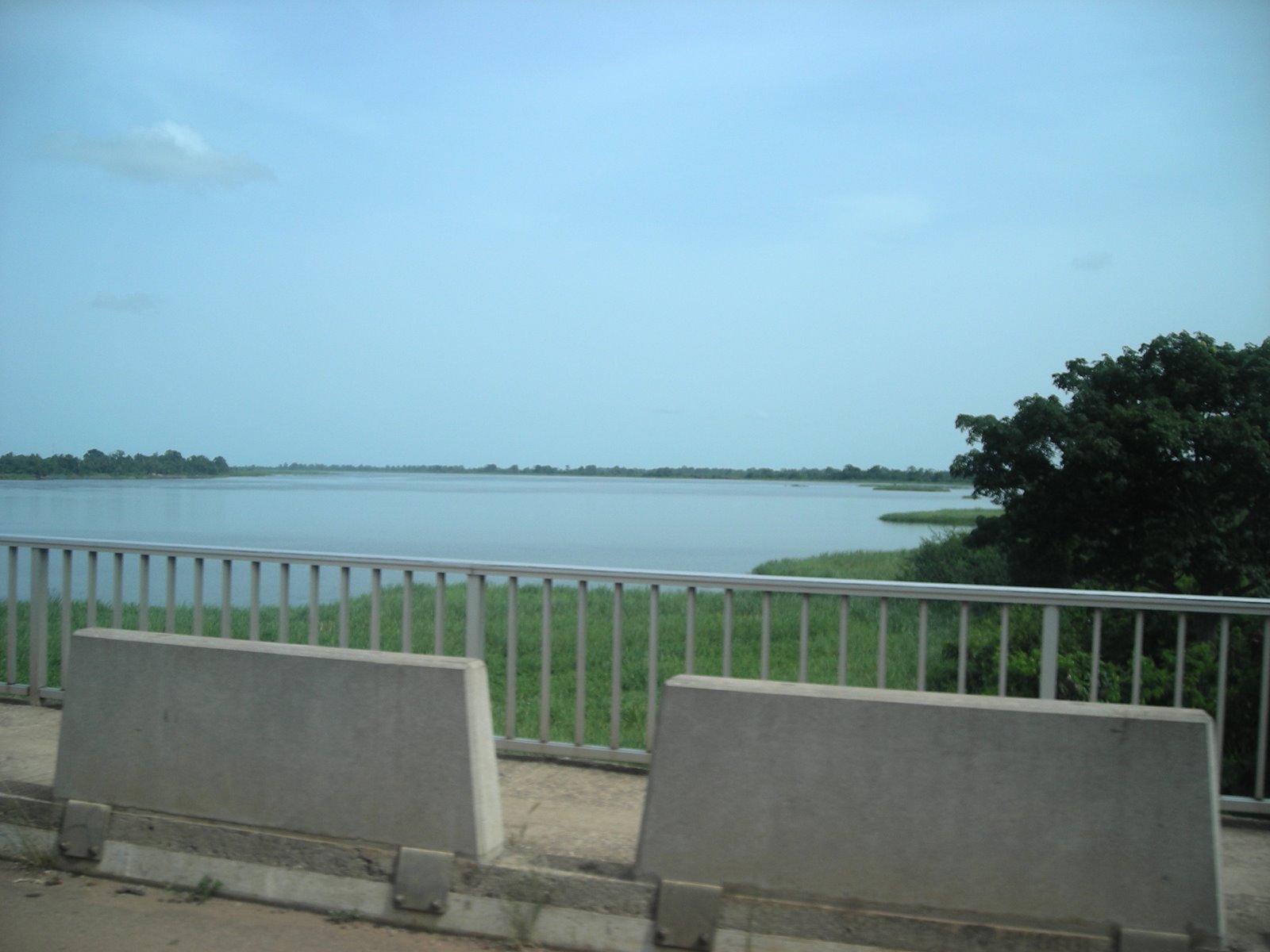
27 May 2007 As we left the Accra area we passed many huge, mansion style, western homes built far from the city’s busy, crowded and slightly imposing character. These palatial (check that out mom) homes seemed to present a city of their own set above the rest. Further out was the land of big trucks and truck stops. Rows upon rows upon rows of trucks; tanker, flatbed, carrier, produce, waiting for cargo filled a long stretch of road. Even further from the city everything turned to green. Oh so green, we passed a lush landscape dotted with trees and two-person high mounds of red dirt – this was the kingdom of the termites. The mountains in the distance were highlighted by the rainclouds overhead. After crossing the man-made River Volta we were finally in the Volta Region. Here we were treated to a very different ride – massive potholes. The bus zigzagged the roadway to avoid the potholes and crevasses – it felt as if we were in a Star Wars asteroid field. It seems that the government does not have much to do with the region.
We first went to visit the local chief of the village of Klikor, which is one of the important settlements of the Ewe people. The chief has ruled over a kingdom that is over 400 years old. The chief commented on this related to development. He noted that they were much older than the US, but that they were less than one-tenth as developed. He orated a great history of his people, village, and how they eventually settled in Klikor. It was almost like living the reality of so many books that I have read. He also gave us a history of Ford and what he did for the US. He mentioned that everyone here (Klikor) had benefitted from the Ford Foundation, how I am not sure. But he did make a great point that President Ford was not one of the wealthiest men, but he left a great deal to charity and his foundation. The chief went on to tell us what to tell our friends back home, but instead jumped into a lecture on the US and Iraq. This is about the fourth such lecture that I have experienced on this trip. He made an important note that even the ‘smallest mistake of the US’ has an impact around the world. One of the students later commented on how “Africa-esk” that experience was – this is Africa!
We then traveled to another part of the village to experience traditional African religious practices. We were to see a ritual possession ceremony. Before the ceremony we were treated to the most simple, but delicious meal that I have had yet -the best tuna that I have ever eaten. We changed into the proper dress – a wrapped cloth. We were welcomed with drum and song and given kola nut and whiter clay as a sign of welcome along with a small, narrow, triple shot coconut cup of dry gin which tantalized the throat and assisted with the dancing later.
The possession had already begun and the high priestess already conveying messages from the sea-god. I have complete respect for the traditions of the village, but throughout the ceremony I could not help but think that this was a performance. I think Kyle put it best during our discussion of the ceremony, “It is like a choir performance, we may never understand what is happening, but it is still a performance.” The performers exchanged knowing looks and laughs and my thoughts were solidified. I mean no disrespect, and I really think that our experience would have been different had we been embedded in a village and taken part in the ceremony firsthand.
The rains had come as we ate and continued throughout the day. We left and our bus navigated the narrow ‘roads’ of the village where bikes and motorcycles dominate the streets. The typical houses were mud and thatch, the wealthy had cinder block houses. We returned home in the growing rainstorm.
31 May 2007 Memorial day spent in Ghana, I hope the water is not too cold for putting the dock in. This is the first time that I have really thought of home. It is plenty warm here to put a dock in any day.
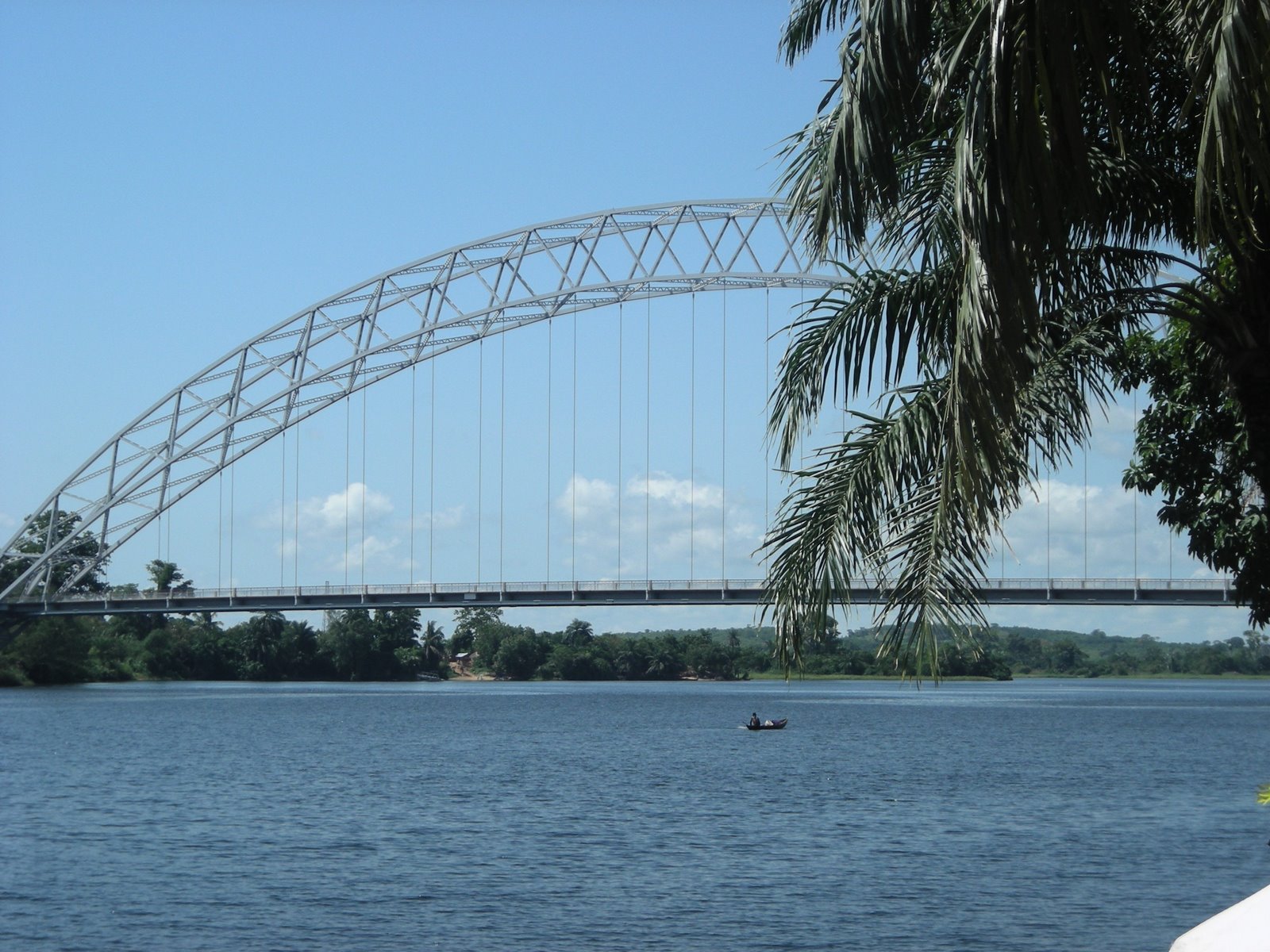
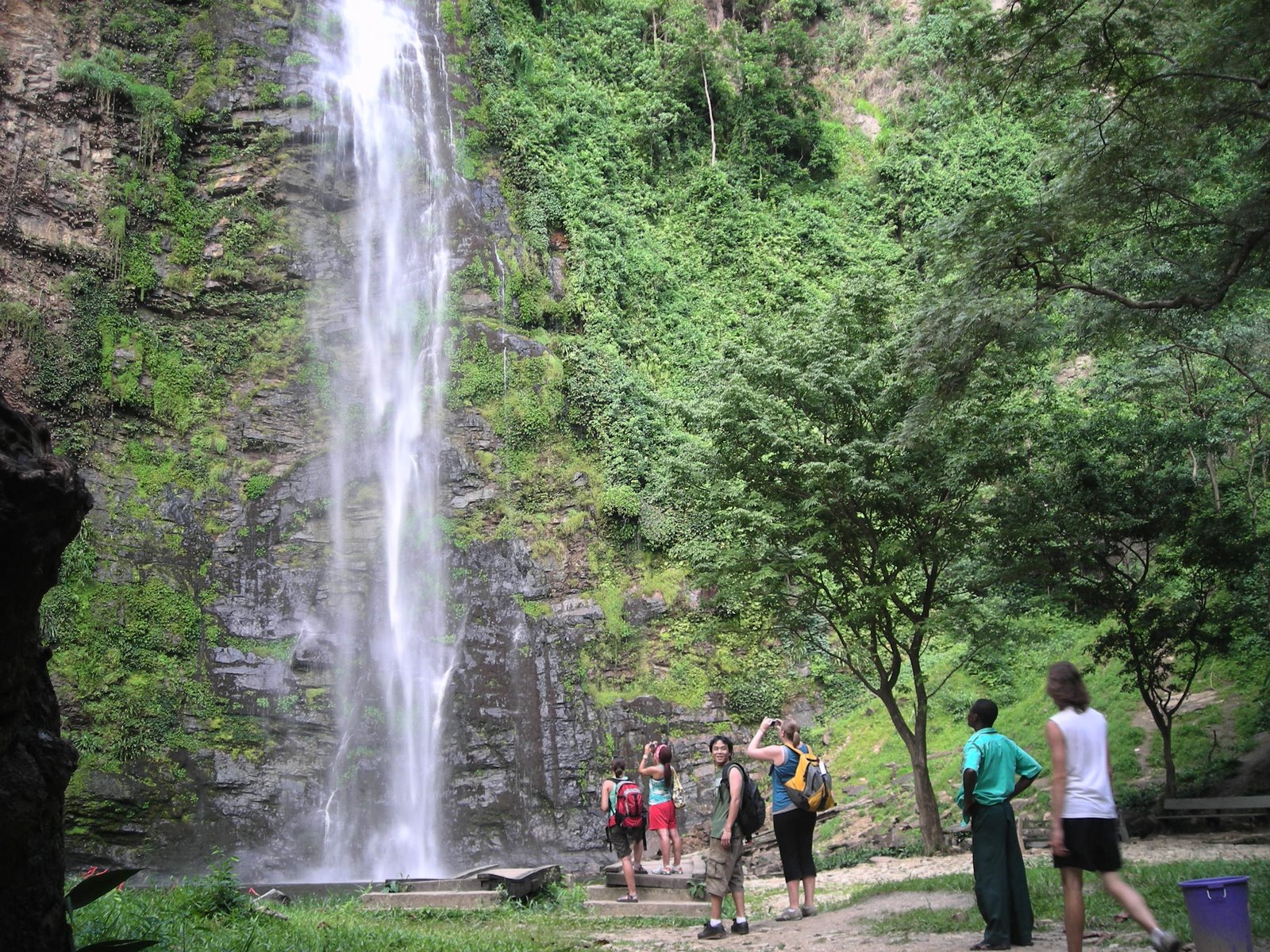
This was another early morning headed back to the Volta Region to see the waterfalls. We took a much different route than before since the falls are about 6 hours drive from Accra: three hours to Volta and then three hours more in Volta. This time as we crossed the Volta River, we stopped at a riverfront hotel. This hotel was very nice, a prime place to spot an Obrooni. There were none, but there were monkeys and exotic birds in cages. There were speedboats and jet skis to be rented and a very nice pool to swim in. We had entered the second Volta. We crossed the river this time by way of a nice large bridge. and the roads showed that the government had not neglected this tourist favorable side of Volta. We arrived at the falls and met our guide. He took us on the 40 minute walk to the falls and showed us some of the local trees and wildlife as we went. He told us that behind the mountain pictured was Togo, so close.
We journeyed through the beautiful wilderness and finally heard the sound of the falls and saw its wonder. The falls were amazing, the tallest in all of West Africa. The fruit bats covered the mountain side and screeched and sprang to life as the group screamed and swam in the falls below. It was incredible to see. I wish that I had not forgotten my swim trunks. Next time.
These experiences brought to life my thoughts that there are two Voltas in Ghana. We saw them both and I guess if you can bring the government tourist money then you will have paved roads, nice hotels, and the access to basic infrastructure like electricity. This also makes me think of George Packer’s chapter in The Village of Waiting titled ‘Three Africas.’ I think it is very interesting that what he explains in the pages of his book, I have seen in my limited African experience. I saw the ‘village’ Africa while traveling rural Uganda, the ‘tourist’ Africa in the Queen Elizabeth National Park of Uganda and the waterfalls of Volta, and the new, growing, struggling Africa in the booming city of Accra, Ghana. Full of new technology, development, and thriving with entrepreneurs. These three Africas can be seen on any travel to Africa, but most of the time these three very different Africas are only seen one at a time. Does that mean that I have seen the true and complete Africa? I think not, I have only traveled to three countries in Africa – there is so much more to see!
As I wrote earlier, I will now be writing on issues and thoughts that come to my mind while in Ghana. This will range from day to day adventures to reflections to just plain critical thinking. I will still write about the numerous and various experiences and field trips that occur, but there will be less of the play by play of the day to day. In ‘The Village of Waiting,’ the author writes about the certain desire and longing to live in a developing country. I can completely understand what he means, however there is no way that I can verbally express that magnetism. I attempt here to give you a glimpse of my African experience, but it is just that a glimpse. The author goes on later in the book to discuss how Westerners and ‘white’ people will never be able to experience the true Africa. You can be a tourist, an accepted member of the workforce, and an honored volunteer, but you will never be able to step out of your skin – your permanent suit from your wedding day with your identity does not come off. And so with those thoughts in mind, here is what happens when I am in Africa, Ghana to be more correct.
While watching the Champions Cup match, at halftime the Ghana television channel took over the feed and displayed commercials to explain the new Ghanaian cedi. The commercials played over and over, repeating until halftime had expired. The commercials emphasized the phrase that we just can’t get enough of here in Ghana, “the value is the same.” Throughout the entire match the message scrolled along the bottom of the screen: “The new Ghanaian cedi and the current cedi will have the same value. The value is the same.” Up and down the roadways hawkers carry the signs to explain the new currency and to show the neat new bills and coins. We have seen these posters everywhere and even bumper stickers, it has become a running joke with our group now. The value is the same.
Next year the cedi is set to change. The value will be the same, but the numbers will change. Instead of carrying around a huge wad of bills you will have only a few to carry now. The 10,000 cedi note will turn into the new 1 Ghanaian cedi note. Joseph, at the hostel, explained to us that this was a political move since in the next few years there will be a West African Union established, like the European Union. The new West African Union will have its own new currency so it is completely unnecessary and frivolous to create a new cedi now. The politicians are using this new cedi as a push to emphasize their dedication to Ghana. Wouldn’t it make more sense to invest that money in the country’s infrastructure? To me this represents the complete disregard for the well being of a country’s people. Needless to say, the campaign has gained amazing ground and even we, who will be here for 6 short weeks, understand the change completely.
This is an important and potentially positive event in Ghana, but there is a question that will not leave my mind. Will the value of corruption remain the same as well? On the way back from the beach the other night, our taxi was stopped at the simple police check point of a section of bicycle fence across the road and a smiling policeman with his AK-47. We happened to have more than the acceptable number of passengers in our car, but the taxi driver told us not to worry. We pulled up and stopped, the policeman shone his flashlight around, he exchanged some words with our driver, and then the two men shook hands. However as they did so, a seemingly minor transaction took place. We drove off and the taxi driver explained that this happened often. He said that just about every policeman in Ghana could get paid off very easily. The economics of a badge and a gun continue. This seems to be a scene that is repeatedly described in developing countries.
Yesterday Kyle bought the Daily Graphic, the New York Times of Ghana. It has been the premier paper and also the longest running in Ghana. It was really a well put together piece of daily literature and the authors for their articles wrote compelling pieces. The most interesting to me was an article on the World Bank, Wolfowitz, and Ghana’s role as the chair of the African Union (AU). The president of the World Bank, Paul Wolfowitz is resigning under intense pressure. In the unwritten code of the development world the President of the United States gets to appoint the head of the World Bank. In its inception the World Bank was used as a US tool to aid the European governments in their reconstruction after World War II. The US used to be the largest development aider in the world and was owed much by Europe. Now China is the top aider and can easily match the World Bank in capacity to give aid, but China gives aid without requirements. The author of the article called for Ghana to use its power as the new AU chair to unite Africa and other ‘developing’ country groups to join in calling for a reform in the process of appointing the leader of the World Bank. Wolfowitz’s reign was marked by calls to end corruption and reform corrupt systems. Now there needs to be a push to reform the very processes that Wolfowitz championed in the most influential development agency. Does it make sense that a, possibly unqualified, American runs the world’s most important development group? Why would there not be a World Bank president from the ‘developing’ countries?
The value may be the same, but there is still a lot to do before values across the board will be the same. In the past few decades the gap between the Western world and Africa has grown exponentially. In our brief time here we will spend at least, or more than the per capita of the average Ghanaian. Per capita income is placed at $450, the goal is to have it be $1000 by the year 2020. Roughly 20 students from the States will spend well over the per capita income of most Ghanaians in a 6 week time period – this is a fact that I hope most of us will not look past when we return.
Day 12 We got up so early today. Egg salad sandwiches (Ghana style) for breakfast with a delicious multi-fruited juice. The bus was late because traffic was so thick, almost like pure, unprocessed groundnut paste, mmmmmm. Lecture today was on the ethnicities and ethnic relations in Ghana. I am going to begin writing more about thoughts and issues that come to mind while in Ghana now that I have covered the basics of where I am, what I am doing, and how it all happens.
Ghana is a state with many nations of people, many ethnic groups. Ghana is a state of nations and needs to be one united nation of people. There is a long history of ethnic tension and turmoil in Africa, you cannot lump every African experience with ethnic conflict into one ball of dough. You cannot think that every issue of ethnicity results in what you have seen in Hotel Rwanda.
Nigeria has had a long spat with ethnic tensions, especially in politics. This led to a civil war in 1964, of which I do not know much about. This war has created a tense ethnic political struggle as evidenced by the most recent elections and the numerous calls of foul. Nigeria now sits divided into 36 states, most based on ethnicities.
Cote d’Ivoire began an ‘open door’ policy and many people flocked to the country. However when elections rolled around only natural born Cote d’Ivoirians could run for the office of President even though now the country had so many new citizens from many differing places who felt the need to be represented.
The most well known example of ethnic tensions built into full blown conflict is that of Rwanda and Burundi. With the Tutsi minority given the reins of power by the colonial controllers, the Hutu majority did not appreciate this and built up the difference of ethnicity until this was such an important issue to cause genocide in 1994. However this conflict began well before 1994 and continues long after. The conflict spread into the DRC and countries such as Uganda became involved.
Among the many examples of ethnic tensions and conflict Ghana remains a fairly good example of how conflict and death can be avoided. As with many African countries Ghana was a country etched onto a map without regard to established nations of people or traditional ideas of territory. Because of this Ghana has a number of ethnic groups. Politically Ghana has avoided conflict by requiring, in the constitution, that each ethnic group should have representation within the Ministries of the government. Another point that has led to the uniting of ethnic groups for one Ghana is the secondary school system. The secondary school system is a boarding school model and most students travel long distances to go to the best schools in Cape Coast. While in school the student learn about the different ethnic groups and learn to live with one another. This creates more of a rivalry between school teams and less of a rivalry between ethnic groups. The issue of language often arises in Ghana. Most of the country is Akan speaking, yet it is considered politically incorrect to declare the major Akan language of Twi to be the official language. Therefore the country is united in language by English, but everyone says ‘Akwaaba.’ No matter where you are a Ghanaian will welcome you with this Twi phrase.
We had a field trip today to the National Museum of Ghana, which is also celebrating its 50th year of being open. The museum was really quite lame. There were some cool artifacts from the history of Ghana and other African countries and people, but it was again nothing that we had not already seen. The tour guide was a bit loopy too and told us most of the knowledge about Ghana that has been hammered into our heads from every tour we take. Back at the hostel we ate bananas (the short sweet ones), crackers with pure fat happy cow cheese, and vanilla wafer cookies. Kyle and I headed to the internet cafe. Our first ‘reflection’ paper is due on Thursday and some of the students are typing them out. I finished mine the old fashioned way. I reverted back to the good ole days of elementary school and handwriting a paper, it was very reminiscent – and yes it was legible.
We all gathered around the tv in the courtyard to get ready for the Champions Cup game between Liverpool FC and AC Milan. We were all pulling for Liverpool. They dominated the ball the entire match, but Milan’s ability to make a goal out of anything did them in. Milan took the match 2 – 1. What a let down. The ‘the value is the same commercials were quite entertaining as well,’ but more on that later. It was a sad ending. We also found out that our good friend Richard was fired. The story is that he supposedly took something from a room after a visitor had left and denied it.
That evening the rasta guys showed up to take us to the reggae club on the beach. We had been warned by our other Ghanaian friends about this because bad things had happened in the past. However, the majority of our group wanted to go and since most of them were girls we were not about to split the group. The rasta brought a trotro,one of them must have owned it, but we joked that they might have stolen it. It was my first ride in a trotro. They are the cheapest form of transport in Ghana, but not the safest. All 20 of us piled in and headed to Osu to pick up some more members of our group. We headed to the beach with a typical trotro load – packed like sardines. At the beach we were charged to get in, first it was 10,000 cedis, then it suddenly changed to 20,000 cedis. That made quite a hassle, but we finally entered the beach. The rasta for some mysterious reason did not have to pay (because they brought the white girls). We got to the beach, were given seats, and ordered drinks. The waves on the beach at night are amazing. They are massive and seemed to go in no particular rhythm as they usually do during the day. Glancing around the beach it was easy to see that all present were Obroonis or rastas looking to make friends with an Obrooni to get a drink or to get a girl. Our group stuck together, looked out for one another, enjoyed the music and dancing, and helped each other out of creepy and potentially bad situations. In the end it was a very fun evening, but this is where the true intentions of our rasta friends showed through. I hope everyone in our group now understands now my previous wariness.
The rasta are a very interesing group and fill a very odd and unimaginable role in Ghana. They worship Bob Marley and weed. If you get them talking they will go on and on for eternity about how it is ‘nice to be nice’ or ‘charity is carity.’ Many have great musical skills, but not such great skills when it comes to meeting a girl without creeping her out. Most are defined by their dreads, knit hats, drums, or weed wisdom.
When writing about Africa many times it is difficult to bring the proper perspective or ‘view’. So often people write about Africa with the view, that many of us have come to know, from the myths of Africa. The old myths of a ‘dark’ continent, Heart of Darkness, uncivilized, and savage to the new myths of a continent wrought with poverty, disease, and conflict, these are all too often emphasized in writings about Africa. That, I would say, is a poor representation of Africa, its many countries, and its many peoples. In her blog, Acumen Fund Fellow Jocelyn Wyatt, writes about her training in writing about Africa before being stationed in Kenya for eight months. She tells us of three views often evident in writings about Africa. I will allow her writing to continue this message. And I hope, that I can write about Africa with a critical eye and not with a jaded or an overly simplistic mindset. I hope to understand the intricacies of Africa and not look too far past the idea that all people are more alike than they are different.
The Acumen Fund Fellows have been fortunate to meet many inspiring leaders and engage in plenty of thought-provoking discussions over the past four weeks. The question about how to write and talk about Africa has been raised several times. In April, Jacqueline referenced “How to Write About Africa” on this blog and discussed it with the fellows during the first week of orientation. This piece exposes the simplicity of how most people write about Africa and inspired us to think about how to do it in a different way.
View 1 – The Outsider Who Gets It: Gayle Smith, currently a Senior Fellow at the Center for American Progress, and former journalist and senior staff member of the National Security Council and USAID, spoke to the Acumen Fund fellows about her work in Africa and as a member of the U.S. government. Many people don’t understand the appeal of living in the developing world, and I often have trouble articulating it. After living in East Africa for 20 years, Gayle explained it well, It was easier and more satisfying to live there than in the U.S. There’s a sense there’s something bigger than you there. In D.C., there is nothing bigger than any of us. While working for various NGOs in Africa, Gayle saw that there were stories that needed to be told and insisted that the media print them. Gayle’s unique combination as an outsider with extensive experience in East Africa provided her an honest view of the culture, people, politics, and economy and her understanding of the complexities led to her success as a journalist.
View 2 – The Insider Who Exposes It: The book Things Fall Apart by Chinua Achebe is a powerful reflection on the introduction of western culture and colonization to a Nigerian village. When it was published in 1959, it was probably the first book written by an African that most Americans read. Achebe’s novel is honest and extremely critical of the colonial forces who he recognized did not see anything in Africa that was larger than themselves. As an insider, Achebe delivers us well-rounded and real characters and aptly describes the complex forces that pulled Nigerian villages apart.
View 3 – The Outsider Who Simplifies It: In the recently released movie, The Last King of Scotland, a young doctor from Scotland moves to Uganda to work in a rural health clinic. He becomes Idi Amin’s personal physician and gets caught up in the ruthless dictatorship. The film begins with colorful, stereotypical footage of Africa, people singing and dancing on the side of the road, a beautiful African woman seducing a young westerner, and an older white doctor and his wife “saving” a village of Africans at their rural clinic. As the movie goes on, Uganda becomes a much darker, more corrupt, and violent place as Amin’s rule becomes harsher. Even in a ‘flat,’ globalized world, we are frequently exposed to such stereotypical portrayals of Africa: one that is simple, happy and colorful, and the other that is dark, corrupt and violent. While an interesting story with strong characters, in an effort to simplify the context, the film does little to accurately showcase Uganda.
It crowds my thoughts; it accompanies my dreams; it wrenches my heart; I am so close to arriving on its glorious soil: Africa. In less than three days I am going to travel back to the continent that stole my heart. Six years ago I was captivated and moved by my travels in Uganda and now I will be headed to Ghana to continue my journey. This summer I am going as part of an official study abroad through my university, Michigan State University’s study abroad program in Ghana: A Multidisciplinary Perspective. And so this blog’s title is about to become a bit oxymoronic, however regardless of title this blog will cover my experiences in Africa this summer and will continue to chroncile my work in and for Africa.
From the MSU Ghana Program Handbook:
Introduction to Ghana The Republic of Ghana, the first country in colonial Africa to gain its independence in 1957, is roughly the size of the state of Oregon and lies about four degrees north of the equator in West Africa. Formerly the Gold Coast, Ghana bordered by Togo to the east, Côte d’Ivoire (Ivory Coast) to the west, Burkina Faso to the north and the Atlantic Ocean to the south. The country is divided into ten administrative regions, each with a capital city, and the capital of the country is Accra, a port city. English is the official language, and at least seventy-five African languages and dialects are spoken, generally divided into Akan, Mole-Dagbani, Ewe and Ga language groups. Twi is the main Akan language, it is the first language to approximately half of the population, including both the Ashanti and Fante, and is widely spoken in the central and southern parts of the country.
The current population of Ghana is approximately 20.7 million, 63% of Ghanaians are Christians, 16% are Muslim, and 21% practice indigenous beliefs. Christianity dominates the south and Islam is the predominant faith in the northern part of the country. Most Ghanaians maintain some traditional beliefs and customs no matter what their professed religion.
Politically Ghana is a constitutional democracy – John Kufuor is the current president, elected January 7, 2001. The currency is the cedi, $1 = 9,445 cedis.
Climate Ghana’s climate is tropical. In the south it’s usually hot and humid (average daily temperature is 86 degrees F). There are two rainy seasons, from April to July and from September to November. The heaviest rains usually fall in May and June. The Harmattan, a dry desert wind, blows from the northeast from December to March, lowering the humidity and creating hot days and cool nights in the north. In the south the effect of the Harmattan is felt in January. In most areas the highest temperatures occur in March, the lowest in August.
University of Ghana You will be spending much of your time on the University of Ghana at Legon campus, about 14 km outside of Accra. The University of Ghana began in 1948 as an affiliate college of the University of London. In 1961, however, the University of Ghana was, by an Act of Parliment, reorganizaed as the University of Ghana to award its own degrees. The University has over 20,000 students, including many international students. The campus is large with many buildings, dorms, cafeterias, a botanical garden, bookshop and library.
Field Trips – Elmina Castle in Cape Coast – Kumasi, capital of the Ashanti Region, home of the Ashanti, the richest and most powerful people in Ghana, with the largest open-air market in West Africa – Bonwire to observe the kente cloth weavers – Volta Lake, the world’s largest artificial lake created by the Akpspmbo Dam in 1964 – Kakum National Park
Be prepared to read of some great adventures and be sure to check back often for updates! I would say Africa awaits, but Africa does not wait for me, I am waiting for Africa.
The correlation between violent conflicts and health may seem to be very obvious, but there is more to the issue than what crosses the mind. Everyone can make the simple connection that there is direct impact of conflict on being unbenefittal for the betterment of health. For example it is easy to read this <a href="http://news.bbc.co.uk/2/hi/africa/6590965.stm “>article and see the obvious connection to artillery shells hitting a hospital in Mogadishu. Internal clashes and conflict creates a more difficult situation for humanitarian operations all over Africa.
Africa represents the highest rates of internal conflict and disease, especially HIV/AIDS. This disease has been used as a weapon in conflict. Many times infected soldiers are sent to the front lines to spread disease and infect the opposition, which generally turns out to be the innocent population. Populations affected by armed internal conflicts end up experiencing severe public health consequences from food insecurity, displacement, and combat. All this ends in a collapse of basic health services which are essential to the survival of the population.
I could not find the article again, but the BBC had reported on the difficulties faced by those bringing humanitarian aid to Darfur, Sudan. They constantly faced issues with the government shutting areas down or denying them entrance. infrastructures for basic health, or created systems for basic health become neglected or destroyed. In many cases the impact of conflict can be felt at the very lowest levels of a population; women are unable to protect their families, fathers just might not be present anymore, children have no access to schooling, and everyone suffers from an absence of basic health – no food, no medications, no stable doctors, and no way to deal with the injury inflicted by the violence of conflict.
With the renewed peace talks for Uganda, the twenty year civil war seems to be coming to a close and the health of the northern Ugandan population may be improving. The rebuilding effort is going to be long and difficult, but there is hope. Many organizations are beginning efforts to improve the health situation and support hospitals and health centers that have been impacted by the conflict.
There are so many topics that can be covered as a result of conflict in a country and its correlation to health. However, I am not here to expound all of the information available, but know that it is out there: sexual violence, psychological impact on children, and especially the toll on health workers. Conflict impacts health plain and simple, but there is so much more as the impact trickles down to the population, the families, and the children. The future of a country in conflict lies in its ability to rebuild and provide aid to their populations after conflict.

 Alex showed us around the compound and answered any and all questions we had about the Peace Corps. He also shared with us his experience. He is near completing his second year and is located in a very remote farming village in the north of the country. Originally from Nebraska, he was selected for the agriculture and natural resources area. His village is on the cliffs of the north where a ten year war has just ended between neighboring clans. He has started a cashew cooperative with 13 area villages, teaches at a secondary school, works in a hospital, started an HIV/AIDS club, and is attempting to work towards reconciliation between the former warring clans. The Ghana country coordinator had at first called Alex’s assignment ‘hell,’ but he is really enjoying himself and is working very hard to make the most difference that he can. After hours of talking we accompanied Alex to dinner, since we had made him late for a previous dinner engagement – it was ok he said, “they were just high schoolers.” It was really great talking to Alex and hearing his experiences and it really solidifies my plans to join the Peace Corps after college.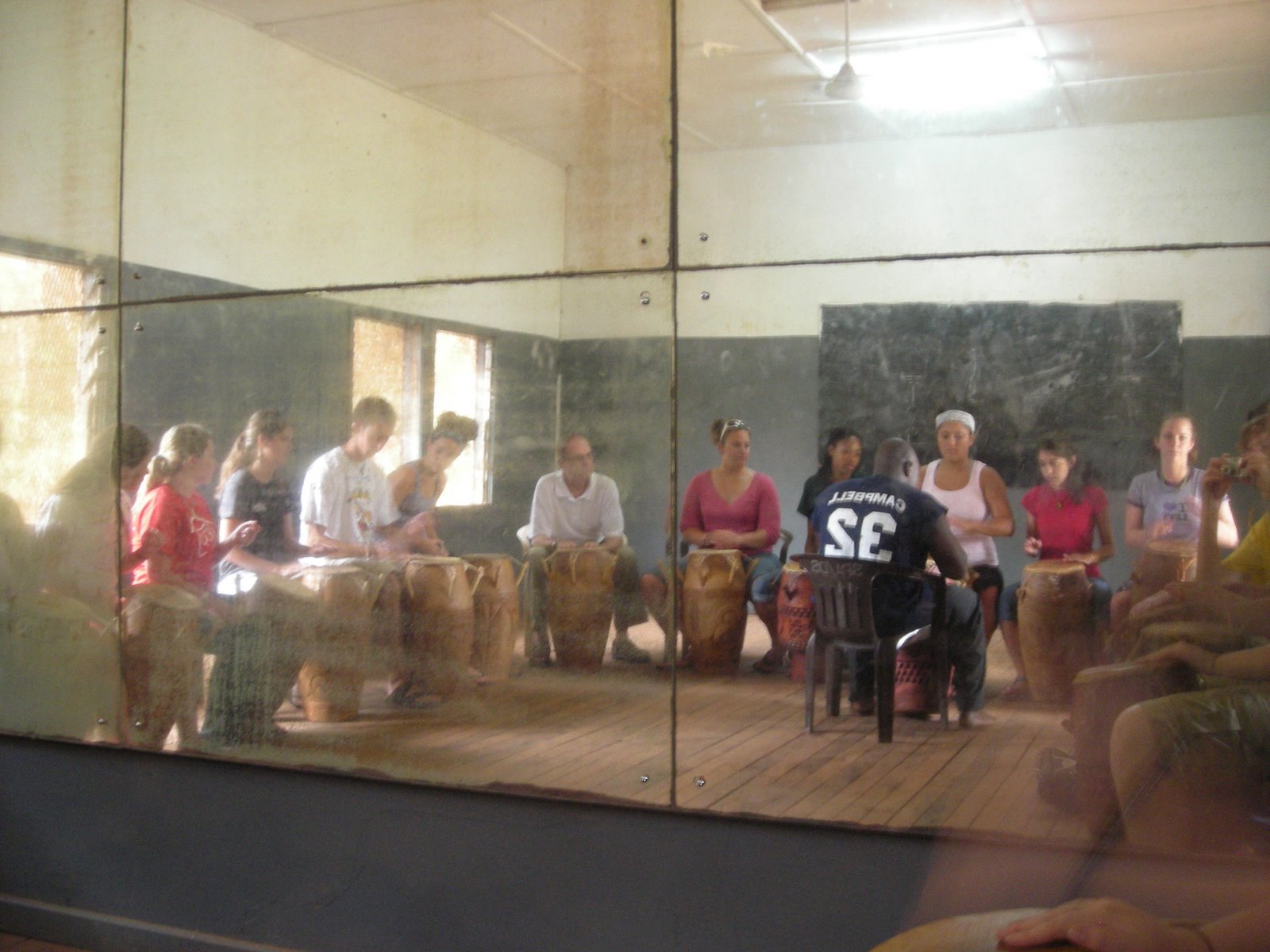





 Alex B. Hill