global health is everyone’s responsibility

ban
People young and old across the US have connected with seven different communities across the African continent to support locally initiated health projects. Using the vibrant color of bananas and the enthusiasm of youth, a new nonprofit has grown to support the coming revolution in African health care.

It all began with one individual, Fr. Joseph Birungi, who had the dream of providing access to basic health care in a remote area where he worked. His dream was transferred on to me through his stories of those who died because they did not have access to basic health care. At the time I was a 14 year-old who knew little of the world beyond Michigan’s borders, but I was inspired to do something. Just entering high school, I was full of naive optimism with a goal to figure out how I could make an impact in the world. Although I was youthful, naive, and optimistic I had an incredible mentor, my mother. She helped me form basic assumptions that laid the foundation for my understanding of “global health as everyone’s responsibility. ”

One assumption that grew from my optimism was the belief that everyone had the potential to make a difference in the world. From Fr. Joseph to myself to my mother, the chain of individuals who embodied this grew to include hundreds of families, church congregations, school assemblies, and individuals from across the country working to fund an ambulance. These individuals, linked by a common cause, were able to raise over $67,000 in less than three months for the health center in Uganda.
It is easy for many people to take for granted the small things: clean water from a sink, medicine readily available in your cabinet, adequate food sources, etc. In the summer of 2002, I was able to traveled to Uganda. During my one-month stay I met and lived with the people who would benefit from the ambulance project. The people I met were so friendly and, even in their poverty, they wanted to share what little they had. I have seen that all people of the world share the same needs and wants. Everyone needs food, shelter, clean water, and necessary health care. We all want to know happiness, health and love. Parents everywhere want the best for their children and children want to learn and grow. But not everyone gets the same chance for success. And so keeping in mind the interdependent and similar nature of our world it is not so difficult to see “global health as everyone’s responsibility.”

As I graduated from high school with my classmates so did SCOUT BANANA. My friends began expanding our work into Chapters at colleges and universities across the US and Canada. This allowed our outreach to grow along with our ability to support more local projects. We became seriously focused on community-based solutions and empowering young people in the US to take responsible action when “making a difference” in Africa. Just because you have the means to do something doesn’t necessarily mean that you should. With an expanding support base and the desire to empower young people and community leaders we decided to pursue 501c3 status in order to better serve as a resource. Utilizing privilege in the US to connect communities in Africa with inspired students, SCOUT BANANA has been able to raise almost $200,000 to date and engage over 50,000 young people in partnering with African projects to provide access to basic health care.
SCOUT BANANA believes that global health is everyone’s responsibility and that everyone has the potential to make a difference. We look at global health issues systematically and our solutions are focused on revolutionizing structures as well as shifting paradigms of development thinking in regards to education, power, and privilege. We seek to create lasting social change in African health care and believe that solutions come directly from communities in need. SCOUT BANANA is dedicated to empowering community solutions as well as young people who want to responsibly make a difference in Africa. By connecting communities in long-term cooperative partnerships, we will build a movement dedicated to fundamental social change in which global health is everyone’s responsibility and every individual’s human right.

SCOUT BANANA is a nonprofit organization that works to provide access to basic health care in Africa. Focusing on community-based solutions and empowering community leaders as well as young people who want to make a difference in Africa, SCOUT BANANA is supporting the innovation in African health care. The organization connects student Chapters with local health project in Africa.

Learn more about the Chapter network & apply to launch a Chapter at your school HERE!

Written for Change.org’s Global Health Blog.

vvocf education fund


17 June 2008
Sphe and Nhlanhla helped me learn some more Zulu today with even more Swahili similarities coming to light. The Bantu peoples spread from central to east and south Africa, thankfully they kept the same language structure and vocabulary similarities.

Today we began the VVOCF Education Fund! We had the idea of collecting the 5 cent pieces that everyone throws on the ground to be collected and used as a way to provide educational scholarships for the VVOCF students. The four teams will have a competition with the winner getting some prize determined later – the students in secondary will be able to apply for the scholarship later. This will be a way for the children to invest in their own education while providing ground to approach other investors overseas or in more wealthy neighborhoods/ SA businesses. Funding cannot solely come from the outside so this is a great start. “Our future is in our hands” education campaign begins today!

The on-the-ground of running a project and NPO is exciting and a great experience for me to see to be able to find out how SCOUT BANANA can be most helpful to our own projects later. Linking education with health development will be important. Giving youth a voice in-country is just as important as giving developed youth a voice to help other youth.

Why There is No Doctor: the Impact of HIV/AIDS on the Post-Apartheid Health Care System of South Africa

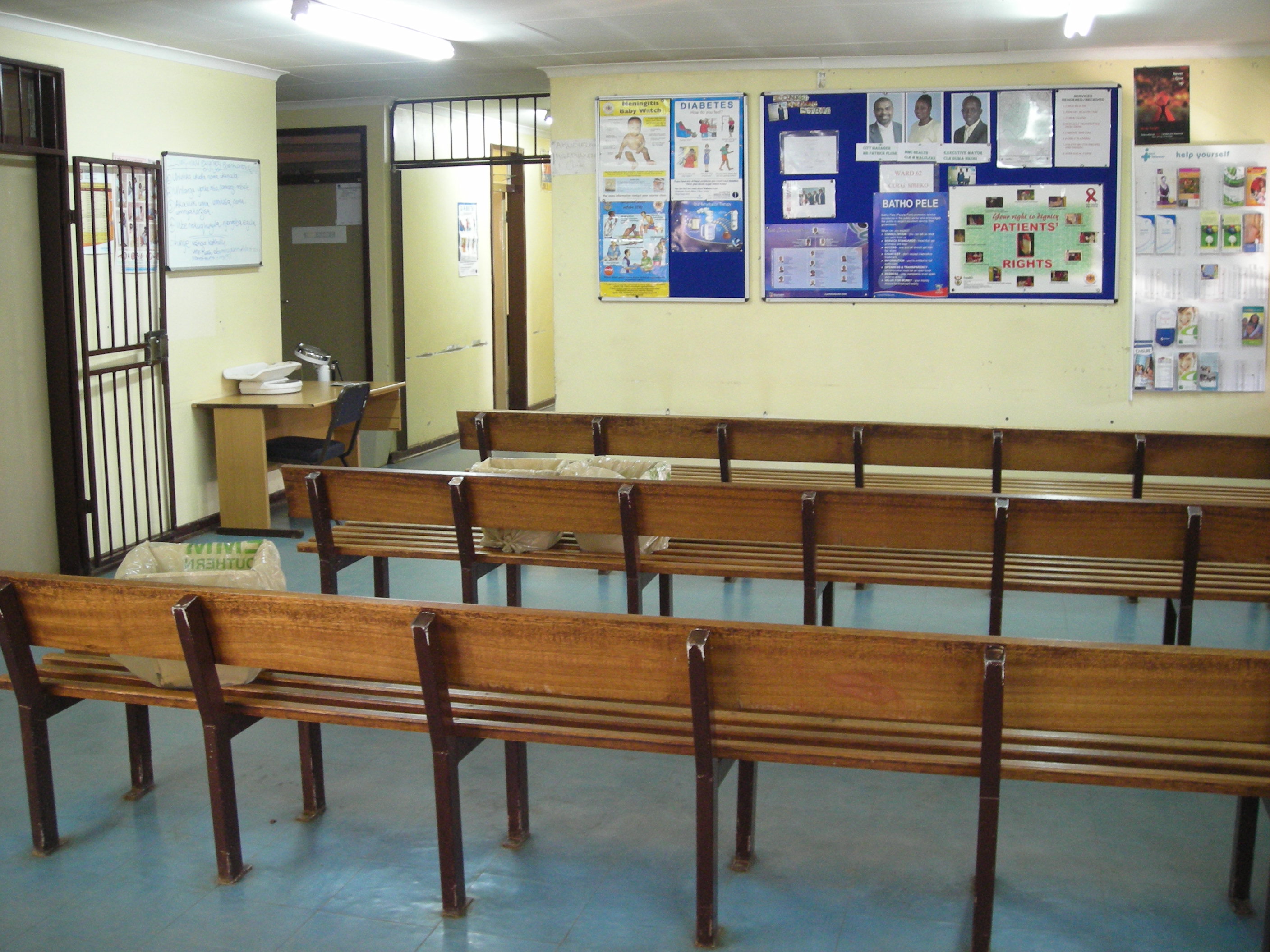
Empty waiting room at Clinic 2 in Zonkizizwe, the doctor was not in (photo credit: Alex B. Hill, 2008)

This research was the culmination of my three month long internship at Vumundzuku-bya Vana “Our Children’s Future,” a center in Zonkizizwe, Katlehong, South Africa (Gauteng Province) for children and youth affected by HIV/AIDS. During my time there I developed an HIV Peer Educators curriculum and taught HIV/AIDS information sessions to the youth. The piece that I am most proud of was the planning and organizing of a area-wide HIV Testing Day where over 80 people were tested in a settlement where there was a very high testing stigma.

What I noticed during my time in Zonkizizwe was the lack Doctors (at government clinics, private clinics, etc.) as well as the lack of a working health system in an informal settlement not far from Johannesburg and Germiston. The research focuses on how and why apartheid and HIV/AIDS impact South Africa’s current post-apartheid health system.

Related blog posts:

Implications for Foreign Aid Across the Continent: The Shifting Africa Policies of China and the USA

China’s growing influence in Africa has been a topic that I have followed for a long time starting in 2006 when I recognized the increase in economic investment by China is various African countries. Since then I have been following China’s development investments and arms deals as well as the USA’s increase in “anti-terrorism” training with African militaries, notably in the Sahel region, via AFRICOM. This research paper was completed as part of a senior level Capstone course on the historical relationship between China and the USA, specific to international relations and policy.

Related blog posts:

why there is no doctor: the impact of hiv/aids in the post-apartheid health care system of south africa

This is a series of posts based on the lengthy research paper that I completed as part of my “field experience” requirement for my International Relations major at James Madison College, as well as my Global Area Studies: Africa major and International Development specialization through the College of Social Science at Michigan State University. I was supported by the Young People For internship program as well as my friends and family. My field experience was completed as a three month long internship at Vumundzuku-bya Vana ‘Our Children’s Future’ (VVOCF) in the peri-urban settlement of Zonkizizwe, just south of Johannesburg. My tasks as an intern were to conduct health classes, run the HIV/AIDS Peer Educator courses, help with day-to-day programming, as well as assist in the nonprofit development and paperwork. The highlight of my work was organizing an HIV Testing Day with the clinics for the whole community. In all 80 people were tested in an area where stigma around HIV/AIDS and testing is very high. Please feel free to send comments and recommendations to help improve my work. Thanks!

Index:
i. Why are there No Doctors?
Academic Paper:
1. Introduction to an Epidemic
2. The Health System via Apartheid
3. Cleaning Black Spots of off a White Land?
4. High-Risk Migration Patterns
5. Scapegoating “tropical workers”
6. HIV/AIDS in South Africa
7. Denial is the First Step
8. What happened to Reconstruction and Development?
9. Post-Apartheid Health: the Burden Continues to get Heavier
10. Harsh Realities in Zonkizizwe (part 1)
11. Harsh Realities in Zonkizizwe (part 2)
12. Conclusion & Works Cited
13. Appendix A: Timeline of Health Care and HIV/AIDS in South Africa

a day wasted on the youth

15 June 2008
There is a sort of perpetual dance party on the weekends. Many people remain drunk off of the South African Breweries – remnant of apartheid appeasement of township and settlement peoples – and they blast their old tunes and techno beats to the high heavens and well into the late hours of the night. Is this their escape? Is this the real South Africa? Where the people are, is the real South Africa – not Sandton, Florida, or Alberton – but the townships, the majorities, the people that make South Africa; in their miseries, poverty, diseases, lack of family, absence of hope and utter lose for future dreams attained – the real South Africa resides with these people who have yet to realize and actualize their potential with support from uncorrupt (transparent) organizations that can give them and their children the resources to overcome, but never forget.

16 June 2008
The day rings hollow for the busloads of excited school children and township youth as ANC propaganda is spoken and popular music performed for unattentive throngs of young people with a new freedom and privilege to throw away. Politics is wasteful when it is departed from the masses and cannot compose a meaningful message to the future of the country – the youth!

Township youth are bussed in from all over. Politicians speak of real multiracial unity, but we are the only white people in the entire stadium. Speeches talk of 1976 and the youth movement, but there is no real remembrance or understanding of the past events inspired by youth. It has become less a national holiday and more a day wasted on youth, who are unguided in their development. ANC politicians talk of “all to the polls” but there is no real attempt to register youth and get them active in the governmental process. The youth were there for the pop music show as opposed to the meaning of June 16th 1976, those who died, or what it represented for their country. It is a day that has become a market opportunity for many to sell food, clothes, candies, and anything else. It is a day that has become more of an excuse than anything. An excuse for youth to skip school, to leave home, to do things their parents may not approve of, to hear popular music. An excuse for the government to feign caring about the youth, to spout their slogans, and to give lip service to their ideals. An excuse for many to forget the past and waste the future.

Reflections: 17 July 2009
The day rang hollow for me and my understanding of South Africa history, present, and future. Everything I wrote I still believe, especially now with the World Cup coming ever closer, I can only see it as another wasted opportunity. The government scrambles to hide its poor and failed systems, workers have to strike to get a fair wage, politicians have a field day with what this all means for South Africa, but again it is the masses; the majority of the population that suffers or is forgotten.

“It is best to rely on the freely given support of the people”
Nelson Mandela

With Mandela Day being today, Madiba’s 91st birthday, the world recognizing the imprint that one man left on his country and the entire world community. The problem, much like last year’s Mandela Day, was that it was a publicity event. Yes, it was a time to honor a great man and inspire others to action, but it was as if he was begin used, ushered around to coordinate yet another large money making event. Let’s not forget what Mandela did for so many people, let’s not forget those still in so much need across South Africa, the continent of Africa, and the world.

why there is no doctor: conclusion & works cited (12)

The sea of gravestones near Zonkizizwe was almost unimaginable. I would not have believed it myself if I had not seen it firsthand. This scene conveys the real implications and impacts of HIV/AIDS on a health care system and a country that has been stripped, divided, and neglected by apartheid.

While I often asked why there is no doctor, I was able to track down a traditional medicinal doctor who seemed to see no patients as well as the private clinic doctor who did not seem to care about providing real health care to the residents of Zonke. Writing has been done on where there is no doctor and what to do when there is no doctor, but the number one question in South Africa is why there is no doctor. This question is answered through history: apartheid, oppression, denial, and failure to recognize a crisis. The reality of apartheid health policies continuing to affect Black populations and responses to HIV/AIDS can be seen firsthand in the Zonkizizwe informal settlement.

Health was a weapon of apartheid and it worked. Denying medical access and training to the Black majority has kept the population in submission even 16 years after the end of apartheid. The critical period of 1993-2000 saw the new democratic government with its hands tied behind its back. There was no way that the health care system could be so dramatically scaled-up to meet the human and social needs of the HIV/AIDS crisis. As Seedat stated in Crippling a Nation, 1984, “Health in South Africa is inseparable from the economic, political and social structure of the apartheid state.” The health and HIV/AIDS realities that can be seen Zonkizizwe are direct result of apartheid’s legacy. HIV/AIDS in South Africa is not a direct result of apartheid policies, but the impact of HIV/AIDS and the health care system of South Africa is still inseparable from its apartheid past.

Works Cited
Beinart, William. “Labour Migrancy and Rural Production: Pondoland c.1900-1950.” In
Black Villagers in an Industrial Society, edited by Philip Mayer, pp. 81-108. Cape Town: Oxford University Press. 1980.

Boseley, Sarah. “Mbeki Aids denial ‘caused 300,000 deaths.” Guardian News UK. 26 November 2008. .

Chirwa, Wiseman Chijere. “Aliens and AIDS in Southern Africa: The Malawi-South Africa Debate.” The Royal African Society. African Affairs 97:53-79, 1998.

E. O. Nightingale, K. Hannibal, H. J. Geiger, L. Hartmann, R. Lawrence and J. Spurlock. “Apartheid Medicine. Health and Human Rights in South Africa.” Committee on Health and Human Rights, Institute of Medicine, National Academy of Sciences. Vol. 264 No. 16, October 24, 1990.

‘Forced removals in South Africa 1977-1978’, paper prepared by IDAF for the United Nations Centre Against Apartheid, No. 44/78, Oct. 1978, p.9.

“HIV and other STDs. Chapter 3, Part 1” Population Reports. Population Information Program, Center for Communication Programs, The Johns Hopkins School of Public Health. Volume XXIV, Number 3. November, 1996.
http://www.infoforhealth.org/pr/J45/j45chap3_1.shtml.

“HIV & AIDS in South Africa: The history of AIDS in South Africa.” Avert.
http://www.avert.org/aidssouthafrica.htm.

J Yawitch, Betterment. “The myth of homeland agriculture” SAIRR: Johannesburg, 1981, p.86.

Kon, Zeida R. and Nuha Lackan. “Ethnic Disparities in Access to Care in Post-Apartheid South Africa.” American Journal of Public Health. December 2008, Vol. 98, No. 12.

Lodge, Tom. “The RDP: Delivery and Performance” in “Politics in South Africa: From Mandela to Mbeki”, David Philip:Cape Town & Oxford, 2003.

Lurie, Mark N., Brian G Williams, Khangelani Zuma, David Mkaya-Mwamburi, Geoff P Garnett, Michael D Sweat, Joel Gittelsohn, Salim SAbdool Karim. AIDS:17 October 2003 – Volume 17 – Issue 15 – pp 2245-2252.

Packard, Randall. White Plague, Black Labor: Tuberculosis and the political economy of health and disease in South Africa. University of California Press, 1989.

Palitsza, Kristin. “A Burden that Will Only Become Heavier.” Inter Press Service News Agency. May 28, 2006. http://www.ipsnews.net/africa/nota.asp?idnews=33396.

Posel, Dorrit. “Have migration patterns in post-apartheid South Africa changed?” 4-7 June 2003.
http://74.125.95.132/search?q=cache:4Oor9pRwaTkJ:pum.princeton.edu/pumconferenc e/papers/1-Posel.pdf+the+economic+of+apartheid,+labor+migrations&cd=1&hl=en&ct=clnk&gl=us&client=firefox-a.

Seedat, Aziza. Crippling a Nation: Health in Apartheid South Africa. International Defence Aid Fund for Southern Africa, London, April 1984.

“The Demographic Impact of HIV/AIDS in South Africa – National and Provincial Indicators for 2006” Centre for Actuarial Research, South African Medical Research Council and Actuarial Society of South Africa. November 2006.

“The uprooting of millions, forced removals.” For their Triumphs’ and Tears. ANC, 1983.
http://www.anc.org.za/books/triumphs_part1.html#3back1.

UNAIDS 2006 Report on the Global AIDS Epidemic, Chapter 4: The impact of AIDS on people and societies
http://www.unaids.org/en/KnowledgeCentre/HIVData/GlobalReport/2006/default.asp.

UNAIDS 2008 Report on the Global AIDS Epidemic. http://www.unaids.org/en/KnowledgeCentre/HIVData/GlobalReport/2008/.

Appendix A

appendix a: timeline of health care and hiv/aids in south africa

1913 – “Tropical workers” migrating bring in high prevalence of tuberculosis (Packard, 230)
1919 – Public Health Act places government control over mission health centers (Seedat, 63)
1930 – Mines experience shortage of workers (Packard, 229)
1934 – 2000 “tropical workers” brought into SA on experimental basis (Packard, 230)
1937 – The number of “tropical workers” increases dramatically after government ends ban on recruiting mine workers above 22nd parallel (Packard, 230)
1948 – National Party takes control and apartheid laws are enacted
Health budget is drastically cut (Seedat, 63)
Over 40,000 “tropical workers” are entering SA (Packard, 230)
1950 – Population Registration Act required S. Africans be segregated into three racial categories
Group Areas Act establishes separate residential areas for different racial groups, “forced removals” began of those living in the “wrong” area
1951 – Bantu Authorities Act established “homelands” (Bantustans) taking away SA citizenship and rights
Prevention of Illegal Squatting Act began destruction of basic health services developed by individuals in the “wrong” areas
1960 – Black townships became areas of concentrated population far from towns and city centers
*Sharpeville massacre kills 69, wounds 187 protesting the pass laws
1963-1964 – Rivonia Trials
1970 – South African Department of Health takes over control of all health services from ‘local’ governments, including mission and church hospitals (Seedat, 69)
1973 – Department of Bantu Administration and Development begins takeover of all mission hospitals in the Bantustans (Seedat, 69)
1976 – Soweto uprising kills 23, wounds 500 in protest of Bantu Education policies
1976-1981 – Four “homelands” (Bantustans) de-nationalize 9 million Black South Africans
1982 – First case of AIDS diagnosed in SA, increased charges in governmental health services (Seedat, 71)
1983 – Doctors in the Department of Medicine at Baragwanath describe overcrowding and shortage of staff as having reached a ‘breaking point’ (Seedat, 65)
1985-1989 – SA declares ‘state of emergency’
1986 – First AIDS Advisory Group established to aid the government’s response to the growing problem
1990-2003 – Most rapid increase in HIV prevalence rates
1990 – Mandela released from imprisonment
First antenatal survey estimates that between 74,000 and 120,000 people are living with HIV
1991 – Apartheid laws repealed
1992 – Referendum on de Klerk’s policy
Mandela addresses the newly formed National AIDS Convention of South Africa (NACOSA)
Free National AIDS Helpline established
1993-1999 – Internal labor migration increases significantly, specifically among women
1993 – National Health Department reported the number of HIV infections had increased by 60% in the previous two years and was expected to double over the year
1994 – First democratic elections held, Mandela wins
Minister of Health accepts the basis of the NACOSA strategy as the foundation for the government’s AIDS plan
1995 – International Conference for People Living with HIV and AIDS was held in South Africa, Deputy President Mbeki acknowledges the seriousness of epidemic
South African Ministry of Health announces that 850,000 people (2.1% of population) are believed to be HIV-positive
1998 – Treatment Action Campaign is launched
2000 – Department of Health outlines five-year plan to combat HIV/AIDS
International AIDS Conference in Durban, new SA President Mbeki denies HIV causes AIDS, cites poverty as cause
2002 – SA High Court orders government to make nevirapine available
Government remains hesitant to provide treatment to people living with HIV
2003 – Government approves plan to make antiretrovirals (ARVs) publicly available
2004 – ARV treatment program launches in Gauteng Province
2005 – One service point in each of the 53 districts established for AIDS related care and treatment
HIV prevalence reported at 30.2% – a steady increase since 1990
2006 – Former Deputy President Jacob Zuma claims taking a shower prevented HIV transmission after “having sex” with an HIV-positive woman
UN Special Envoy on HIV/AIDS, Stephen Lewis attacks SA government at International AIDS Conference in Toronto over ARV treatment access
2007 – Mbeki is forced to resign, interim president appoints Barbara Hogan as Health Minister, activists welcome the change and expect greater government commitment to HIV/AIDS
An estimated 1,400,000 orphans of HIV/AIDS in SA
2009 – Apology for Mbeki ARV policy
Development of health services/ access to health services is a major issue in 2009 elections

when in ghana. . .

This is a series of post that I wrote while completing an MSU Study Abroad program on “Disparities in Health Care” in Ghana. Our group was based in Accra at the University of Ghana, Legon and we stayed in a hostel in Shiashie. We traveled often: Volta Region, village of Klikor, Kakum National Forest, Volta Dam, Cape Coast, Kumasi, and Osu was a usual hangout. The posts are all pictures and reflections during that 6 week program in Ghana. The first post is a research paper I completed for a class about “development” in Ghana.

i. The Quest for Development: Aid to the Rescue in Ghana
ii. off to the continent of my dreams
In Ghana:
1. something you can taste
2. water by day, apples by night
3. for the love of america
4. scenery and speed bumps
5. aljazeera, acrobats, and aloe
6. imperialist footprints: the development story from the inside
7. the quest for the west
8. what is so important about ethnicity?
9. the value is the same
10. weekend of the obrooni [obruni]
11. two voltas, one ghana, three africas
12. the nature of africa: rhythm and socialism
13. image of america, the blinding lights
14. inside africa
15. definition of development
16. . . . keep your promise
17. the chinese influence
18. snapshot of health in ghana
19. a mixture of black, white, red
20. the longest driveway
21. when in ghana
Returned:
22. when not in ghana. . .
23. the land of culture, africa
24. the caramel apple of globalization
25. cynicism from a jaded summer
26. the crouching tiger and the curse of black gold
27. rastafarian confusion