two voltas, one ghana, three africas

The past two Thursdays we have traveled to the Volta region – one trip to witness tradition, the other to indulge in tourism. Both were early morning trips to the furthest eastern region of Ghana. The region is the major Ewe region of Ghana, it was decided by the British to slice Ewe-land in two after the defeat of the Germans in World War I. The major ethnic group and the remainder of Ewe-land is in Togo. The British were greedy. The route we took was a toll road, no speed bumps or potholes (relatively smooth ride) straight across from Accra into Togo. I couldn’t sleep and our guide accompanying us told us before we left that in the Volta Region we would see things that we may have only dreamed about. Everyone tells us that whenever we travel we will see something so different. This really say something for the small country of Ghana, that just traveling to a different corner of the country can be such a unique experience – this says something more for Africa, since Ghana is one of its smaller countries.

27 May 2007
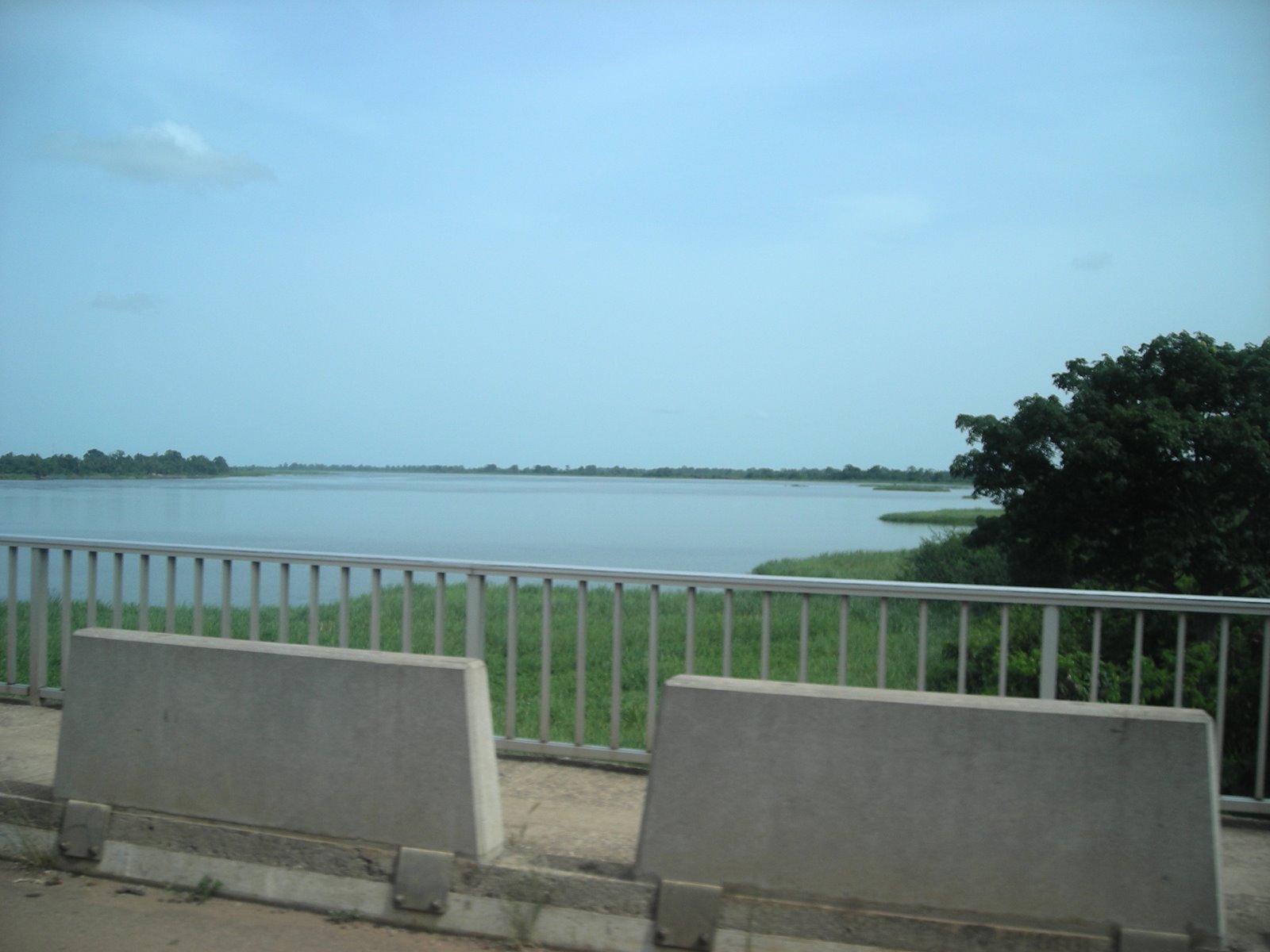
As we left the Accra area we passed many huge, mansion style, western homes built far from the city’s busy, crowded and slightly imposing character. These palatial (check that out mom) homes seemed to present a city of their own set above the rest. Further out was the land of big trucks and truck stops. Rows upon rows upon rows of trucks; tanker, flatbed, carrier, produce, waiting for cargo filled a long stretch of road. Even further from the city everything turned to green. Oh so green, we passed a lush landscape dotted with trees and two-person high mounds of red dirt – this was the kingdom of the termites. The mountains in the distance were highlighted by the rainclouds overhead. After crossing the man-made River Volta we were finally in the Volta Region. Here we were treated to a very different ride – massive potholes. The bus zigzagged the roadway to avoid the potholes and crevasses – it felt as if we were in a Star Wars asteroid field. It seems that the government does not have much to do with the region.
We first went to visit the local chief of the village of Klikor, which is one of the important settlements of the Ewe people. The chief has ruled over a kingdom that is over 400 years old. The chief commented on this related to development. He noted that they were much older than the US, but that they were less than one-tenth as developed. He orated a great history of his people, village, and how they eventually settled in Klikor. It was almost like living the reality of so many books that I have read. He also gave us a history of Ford and what he did for the US. He mentioned that everyone here (Klikor) had benefitted from the Ford Foundation, how I am not sure. But he did make a great point that President Ford was not one of the wealthiest men, but he left a great deal to charity and his foundation. The chief went on to tell us what to tell our friends back home, but instead jumped into a lecture on the US and Iraq. This is about the fourth such lecture that I have experienced on this trip. He made an important note that even the ‘smallest mistake of the US’ has an impact around the world. One of the students later commented on how “Africa-esk” that experience was – this is Africa!

We then traveled to another part of the village to experience traditional African religious practices. We were to see a ritual possession ceremony. Before the ceremony we were treated to the most simple, but delicious meal that I have had yet -the best tuna that I have ever eaten. We changed into the proper dress – a wrapped cloth. We were welcomed with drum and song and given kola nut and whiter clay as a sign of welcome along with a small, narrow, triple shot coconut cup of dry gin which tantalized the throat and assisted with the dancing later.


The possession had already begun and the high priestess already conveying messages from the sea-god. I have complete respect for the traditions of the village, but throughout the ceremony I could not help but think that this was a performance. I think Kyle put it best during our discussion of the ceremony, “It is like a choir performance, we may never understand what is happening, but it is still a performance.” The performers exchanged knowing looks and laughs and my thoughts were solidified. I mean no disrespect, and I really think that our experience would have been different had we been embedded in a village and taken part in the ceremony firsthand.

The rains had come as we ate and continued throughout the day. We left and our bus navigated the narrow ‘roads’ of the village where bikes and motorcycles dominate the streets. The typical houses were mud and thatch, the wealthy had cinder block houses. We returned home in the growing rainstorm.

31 May 2007
Memorial day spent in Ghana, I hope the water is not too cold for putting the dock in. This is the first time that I have really thought of home. It is plenty warm here to put a dock in any day.

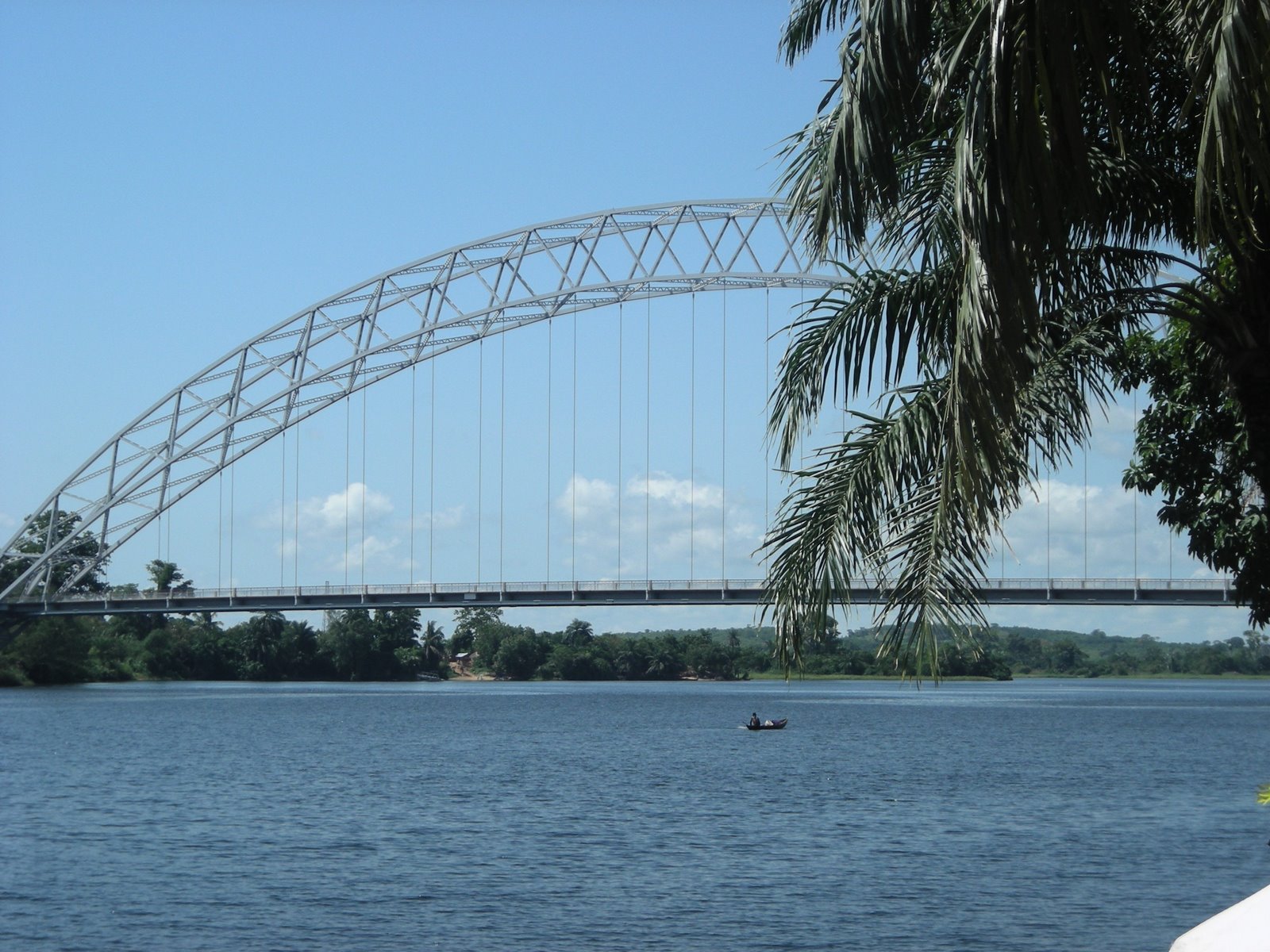
This was another early morning headed back to the Volta Region to see the waterfalls. We took a much different route than before since the falls are about 6 hours drive from Accra: three hours to Volta and then three hours more in Volta. This time as we crossed the Volta River, we stopped at a riverfront hotel. This hotel was very nice, a prime place to spot an Obrooni. There were none, but there were monkeys and exotic birds in cages. There were speedboats and jet skis to be rented and a very nice pool to swim in. We had entered the second Volta. We crossed the river this time by way of a nice large bridge. and the roads showed that the government had not neglected this tourist favorable side of Volta. We arrived at the falls and met our guide. He took us on the 40 minute walk to the falls and showed us some of the local trees and wildlife as we went. He told us that behind the mountain pictured was Togo, so close.
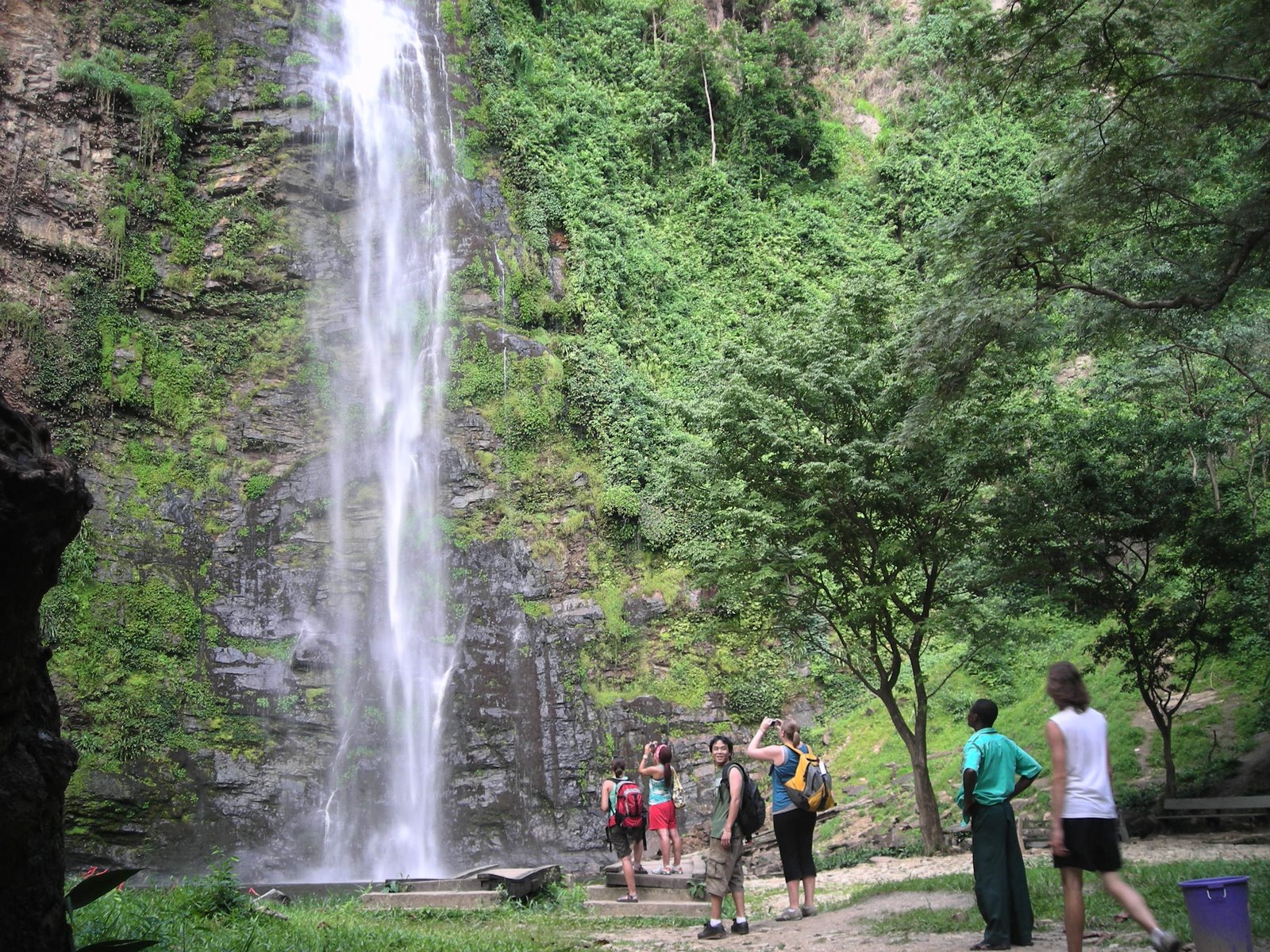
We journeyed through the beautiful wilderness and finally heard the sound of the falls and saw its wonder. The falls were amazing, the tallest in all of West Africa. The fruit bats covered the mountain side and screeched and sprang to life as the group screamed and swam in the falls below. It was incredible to see. I wish that I had not forgotten my swim trunks. Next time.

These experiences brought to life my thoughts that there are two Voltas in Ghana. We saw them both and I guess if you can bring the government tourist money then you will have paved roads, nice hotels, and the access to basic infrastructure like electricity. This also makes me think of George Packer’s chapter in The Village of Waiting titled ‘Three Africas.’ I think it is very interesting that what he explains in the pages of his book, I have seen in my limited African experience. I saw the ‘village’ Africa while traveling rural Uganda, the ‘tourist’ Africa in the Queen Elizabeth National Park of Uganda and the waterfalls of Volta, and the new, growing, struggling Africa in the booming city of Accra, Ghana. Full of new technology, development, and thriving with entrepreneurs. These three Africas can be seen on any travel to Africa, but most of the time these three very different Africas are only seen one at a time. Does that mean that I have seen the true and complete Africa? I think not, I have only traveled to three countries in Africa – there is so much more to see!

Index of blog post series on Ghana.
weekend of the obruni

This past weekend is when we began our intense American weekend. This was when we did the most Obrooni things and par-took in the delights and desires of an Obrooni. When you think of everything that a visiting Obrooni might do, we did it. Every place where an Obrooni was most comfortable, we went.

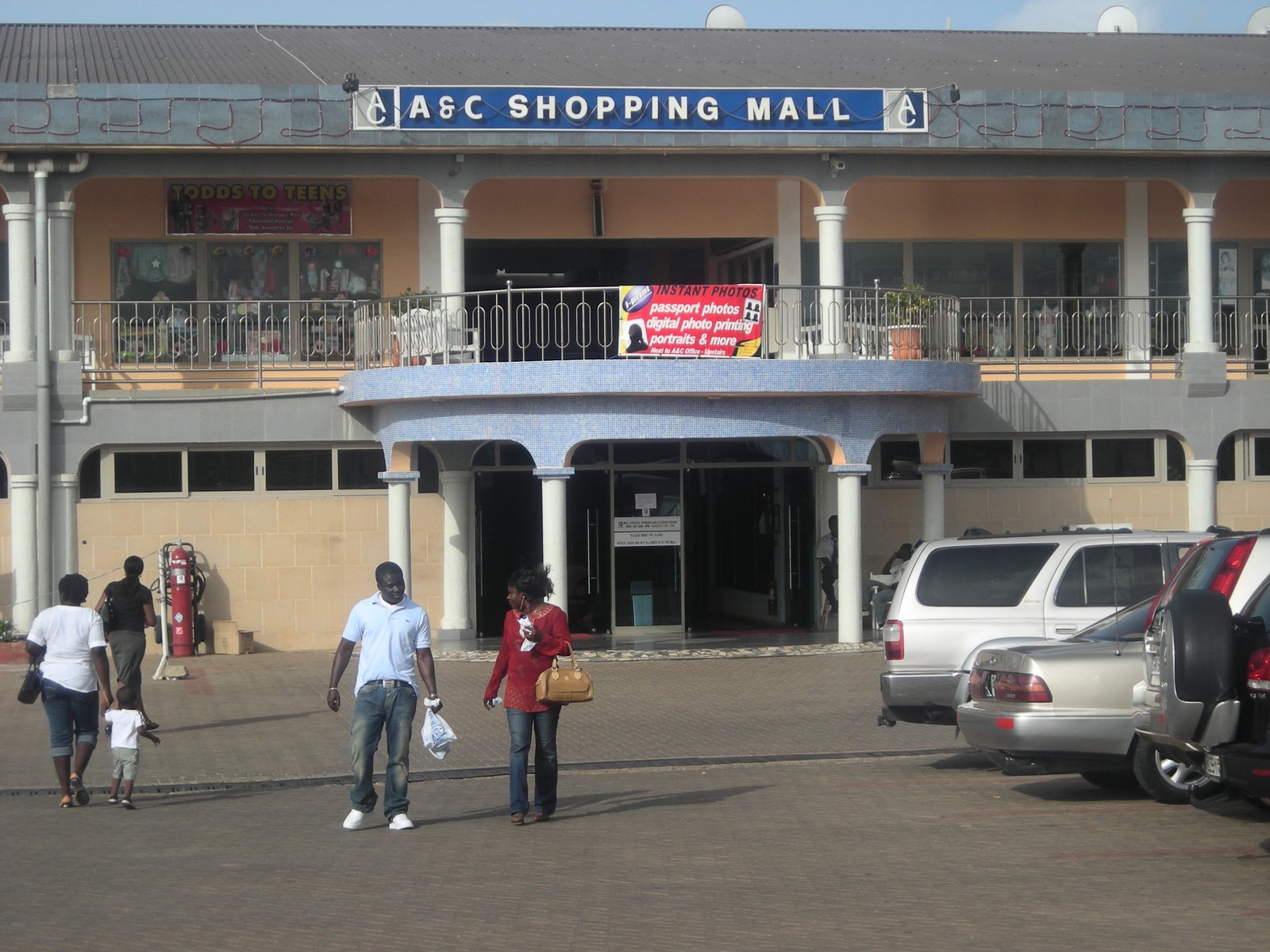
We started out by going to the shopping mall. Yes, a shopping mall It didn’t contain much that was amazing, but it was close enough to home for most of the area Obroonis to shop there. The shopping mall was tucked away, hidden almost, in the opulent, lavish, private homes of the wealthy – and Obroonis. There was a liquor store, jewlery store, ice cream, fedex, small grocery store, some beauty salons, offices, and a very nice internet cafe. It was easy to tell that Obroonis from the area and those working in Ghana frequented the shopping mall. It was easy to tell that these Obroonis flocked there for their daily needs, but it so much easier to get what you need on the street. This is also where I saw my first ‘real’ parking lot in Ghana.

We did some shopping and haggling in the ‘Center for National Culture’ and headed back to the hostle to eat some lunch.
It was a big meager and a bit Obrooni of us, but still good. We ended the eating session with some FanChoco, it is a plastic pouch, like the water, of frozen chocolate milk – so good during a hot day. A few of us decided to go for a run for the first time in Ghana. So far the only people running that I have seen are either training for soccer or are late for something. As we ran the back streets behind our hostel, people called out, “Obrooni, what are you doing?” Children ran to the street and callled ‘Obrooni’ to us. The children lined the road clapping, cheering, and chanting, ‘Obrooni.’ It was almost as if I was in a high school cross country race again. The best was the taxis who honked at us to see if we wanted a ride. No, just some silly Obroonis who want their excerise. It must really make no sense to most Ghanaians since most of their daily lives and jobs are excerise. Here they can’t choose when to excercise or not, it is run or just stop.

We had heard of a great recommended restaurant called Afrikiko and decided to go there for dinner, since there was also music. But we arrived and all the lights were off, it looked quite shady so we headed to another recommended place called ‘Home Touch.’ On the way to Home Touch, our taxi passed the new, under-construction american embassy. It was so disgustingly huge and unnecessarily gigantic. The US has pulled it foreign aid from Ghana, so why does it seek such an imposing presence? The compund was massive, many storied almost like a hotel, multpile gates, and numerous secuirty cameras. I couldn’t believe the extent of the new embassy. We arrived and got a big table and at the start of the evening we were the only people in the place. We drank and ate goat and fufu in a light soup. I am not sure what light soup means because my soup was so hot that my lips and throat burned with goodness afterwards. Some of the girls in our group sang with the live band (quite Obrooni) and made fools of themselves, but it was a great time. When we were given our bill it was about 200,000 cedis too much and we thought we were getting jipped, but oh well.

We had the rest of the weekend plus Friday off since we were traveling to the far eastern region of Volta on Sunday. We woke up early, for some reason unknown to me, for breakfast on Friday because some of the girls were picking up dresses made in Osu and some of the other girls were getting their hair braided. Most people returned to their beds to regain some lost sleep – which I hear is impossible to do, but I did likewise. I slept for a really long time and did some more reading, finishing The Village of Waiting. We then met up with hte group at Frankie’s to go out and Francis joined us. We first went to Epo’s bar with Francis and met and had some drinks. While we were there a big volunteer group from England arrived and we chatted it up. I talked to a girl who was stationed in a very rural village in the north of Ghana and found out that each person was stationed far off in a different area. The English people, with their beautiful accents, were headed to a nightclub called ‘Bliss,’ so we decided to tag along. It seems that no one, no taxi driver or otherwise, knows of Bliss or where it is. Finally we found a taxi driver who knew the place and headed there. We arrived and were treated to the most Western style bar and club that I have seen yet. It was full of Obroonis – American and English – no wonder no one had heard of the place.

Saturday we all slept in after the night of clubbing. I missed breakfast since I slept too late. Most of us stayed in our rooms sleeping, reading, or just hanging out. I didn’t emerge until 2pm and didn’t eat until very late. We all went in waves to the internet cafe and talked in the courtyard about our experiences in Ghana so far. What an Obrooni weekend – in style, food, company, experience, and habit. We ended up having a great Ghanaian meal at Cez Arfique, but otherwise so Obrooni.

Index of blog post series on Ghana.
what is so important about ethnicity?

Day 12
We got up so early today. Egg salad sandwiches (Ghana style) for breakfast with a delicious multi-fruited juice. The bus was late because traffic was so thick, almost like pure, unprocessed groundnut paste, mmmmmm. Lecture today was on the ethnicities and ethnic relations in Ghana. I am going to begin writing more about thoughts and issues that come to mind while in Ghana now that I have covered the basics of where I am, what I am doing, and how it all happens.

Ghana is a state with many nations of people, many ethnic groups. Ghana is a state of nations and needs to be one united nation of people. There is a long history of ethnic tension and turmoil in Africa, you cannot lump every African experience with ethnic conflict into one ball of dough. You cannot think that every issue of ethnicity results in what you have seen in Hotel Rwanda.

Nigeria has had a long spat with ethnic tensions, especially in politics. This led to a civil war in 1964, of which I do not know much about. This war has created a tense ethnic political struggle as evidenced by the most recent elections and the numerous calls of foul. Nigeria now sits divided into 36 states, most based on ethnicities.

Cote d’Ivoire began an ‘open door’ policy and many people flocked to the country. However when elections rolled around only natural born Cote d’Ivoirians could run for the office of President even though now the country had so many new citizens from many differing places who felt the need to be represented.

The most well known example of ethnic tensions built into full blown conflict is that of Rwanda and Burundi. With the Tutsi minority given the reins of power by the colonial controllers, the Hutu majority did not appreciate this and built up the difference of ethnicity until this was such an important issue to cause genocide in 1994. However this conflict began well before 1994 and continues long after. The conflict spread into the DRC and countries such as Uganda became involved.

Among the many examples of ethnic tensions and conflict Ghana remains a fairly good example of how conflict and death can be avoided. As with many African countries Ghana was a country etched onto a map without regard to established nations of people or traditional ideas of territory. Because of this Ghana has a number of ethnic groups. Politically Ghana has avoided conflict by requiring, in the constitution, that each ethnic group should have representation within the Ministries of the government. Another point that has led to the uniting of ethnic groups for one Ghana is the secondary school system. The secondary school system is a boarding school model and most students travel long distances to go to the best schools in Cape Coast. While in school the student learn about the different ethnic groups and learn to live with one another. This creates more of a rivalry between school teams and less of a rivalry between ethnic groups. The issue of language often arises in Ghana. Most of the country is Akan speaking, yet it is considered politically incorrect to declare the major Akan language of Twi to be the official language. Therefore the country is united in language by English, but everyone says ‘Akwaaba.’ No matter where you are a Ghanaian will welcome you with this Twi phrase.

We had a field trip today to the National Museum of Ghana, which is also celebrating its 50th year of being open. The museum was really quite lame. There were some cool artifacts from the history of Ghana and other African countries and people, but it was again nothing that we had not already seen. The tour guide was a bit loopy too and told us most of the knowledge about Ghana that has been hammered into our heads from every tour we take. Back at the hostel we ate bananas (the short sweet ones), crackers with pure fat happy cow cheese, and vanilla wafer cookies. Kyle and I headed to the internet cafe. Our first ‘reflection’ paper is due on Thursday and some of the students are typing them out. I finished mine the old fashioned way. I reverted back to the good ole days of elementary school and handwriting a paper, it was very reminiscent – and yes it was legible.

We all gathered around the tv in the courtyard to get ready for the Champions Cup game between Liverpool FC and AC Milan. We were all pulling for Liverpool. They dominated the ball the entire match, but Milan’s ability to make a goal out of anything did them in. Milan took the match 2 – 1. What a let down. The ‘the value is the same commercials were quite entertaining as well,’ but more on that later. It was a sad ending. We also found out that our good friend Richard was fired. The story is that he supposedly took something from a room after a visitor had left and denied it.

That evening the rasta guys showed up to take us to the reggae club on the beach. We had been warned by our other Ghanaian friends about this because bad things had happened in the past. However, the majority of our group wanted to go and since most of them were girls we were not about to split the group. The rasta brought a trotro,one of them must have owned it, but we joked that they might have stolen it. It was my first ride in a trotro. They are the cheapest form of transport in Ghana, but not the safest. All 20 of us piled in and headed to Osu to pick up some more members of our group. We headed to the beach with a typical trotro load – packed like sardines. At the beach we were charged to get in, first it was 10,000 cedis, then it suddenly changed to 20,000 cedis. That made quite a hassle, but we finally entered the beach. The rasta for some mysterious reason did not have to pay (because they brought the white girls). We got to the beach, were given seats, and ordered drinks. The waves on the beach at night are amazing. They are massive and seemed to go in no particular rhythm as they usually do during the day. Glancing around the beach it was easy to see that all present were Obroonis or rastas looking to make friends with an Obrooni to get a drink or to get a girl. Our group stuck together, looked out for one another, enjoyed the music and dancing, and helped each other out of creepy and potentially bad situations. In the end it was a very fun evening, but this is where the true intentions of our rasta friends showed through. I hope everyone in our group now understands now my previous wariness.

The rasta are a very interesing group and fill a very odd and unimaginable role in Ghana. They worship Bob Marley and weed. If you get them talking they will go on and on for eternity about how it is ‘nice to be nice’ or ‘charity is carity.’ Many have great musical skills, but not such great skills when it comes to meeting a girl without creeping her out. Most are defined by their dreads, knit hats, drums, or weed wisdom.

Index of blog post series on Ghana.
the value is the same

As I wrote earlier, I will now be writing on issues and thoughts that come to my mind while in Ghana. This will range from day to day adventures to reflections to just plain critical thinking. I will still write about the numerous and various experiences and field trips that occur, but there will be less of the play by play of the day to day. In ‘The Village of Waiting,’ the author writes about the certain desire and longing to live in a developing country. I can completely understand what he means, however there is no way that I can verbally express that magnetism. I attempt here to give you a glimpse of my African experience, but it is just that a glimpse. The author goes on later in the book to discuss how Westerners and ‘white’ people will never be able to experience the true Africa. You can be a tourist, an accepted member of the workforce, and an honored volunteer, but you will never be able to step out of your skin – your permanent suit from your wedding day with your identity does not come off. And so with those thoughts in mind, here is what happens when I am in Africa, Ghana to be more correct.

While watching the Champions Cup match, at halftime the Ghana television channel took over the feed and displayed commercials to explain the new Ghanaian cedi. The commercials played over and over, repeating until halftime had expired. The commercials emphasized the phrase that we just can’t get enough of here in Ghana, “the value is the same.” Throughout the entire match the message scrolled along the bottom of the screen: “The new Ghanaian cedi and the current cedi will have the same value. The value is the same.” Up and down the roadways hawkers carry the signs to explain the new currency and to show the neat new bills and coins. We have seen these posters everywhere and even bumper stickers, it has become a running joke with our group now. The value is the same.

Next year the cedi is set to change. The value will be the same, but the numbers will change. Instead of carrying around a huge wad of bills you will have only a few to carry now. The 10,000 cedi note will turn into the new 1 Ghanaian cedi note. Joseph, at the hostel, explained to us that this was a political move since in the next few years there will be a West African Union established, like the European Union. The new West African Union will have its own new currency so it is completely unnecessary and frivolous to create a new cedi now. The politicians are using this new cedi as a push to emphasize their dedication to Ghana. Wouldn’t it make more sense to invest that money in the country’s infrastructure? To me this represents the complete disregard for the well being of a country’s people. Needless to say, the campaign has gained amazing ground and even we, who will be here for 6 short weeks, understand the change completely.

This is an important and potentially positive event in Ghana, but there is a question that will not leave my mind. Will the value of corruption remain the same as well? On the way back from the beach the other night, our taxi was stopped at the simple police check point of a section of bicycle fence across the road and a smiling policeman with his AK-47. We happened to have more than the acceptable number of passengers in our car, but the taxi driver told us not to worry. We pulled up and stopped, the policeman shone his flashlight around, he exchanged some words with our driver, and then the two men shook hands. However as they did so, a seemingly minor transaction took place. We drove off and the taxi driver explained that this happened often. He said that just about every policeman in Ghana could get paid off very easily. The economics of a badge and a gun continue. This seems to be a scene that is repeatedly described in developing countries.

Yesterday Kyle bought the Daily Graphic, the New York Times of Ghana. It has been the premier paper and also the longest running in Ghana. It was really a well put together piece of daily literature and the authors for their articles wrote compelling pieces. The most interesting to me was an article on the World Bank, Wolfowitz, and Ghana’s role as the chair of the African Union (AU). The president of the World Bank, Paul Wolfowitz is resigning under intense pressure. In the unwritten code of the development world the President of the United States gets to appoint the head of the World Bank. In its inception the World Bank was used as a US tool to aid the European governments in their reconstruction after World War II. The US used to be the largest development aider in the world and was owed much by Europe. Now China is the top aider and can easily match the World Bank in capacity to give aid, but China gives aid without requirements. The author of the article called for Ghana to use its power as the new AU chair to unite Africa and other ‘developing’ country groups to join in calling for a reform in the process of appointing the leader of the World Bank. Wolfowitz’s reign was marked by calls to end corruption and reform corrupt systems. Now there needs to be a push to reform the very processes that Wolfowitz championed in the most influential development agency. Does it make sense that a, possibly unqualified, American runs the world’s most important development group? Why would there not be a World Bank president from the ‘developing’ countries?

The value may be the same, but there is still a lot to do before values across the board will be the same. In the past few decades the gap between the Western world and Africa has grown exponentially. In our brief time here we will spend at least, or more than the per capita of the average Ghanaian. Per capita income is placed at $450, the goal is to have it be $1000 by the year 2020. Roughly 20 students from the States will spend well over the per capita income of most Ghanaians in a 6 week time period – this is a fact that I hope most of us will not look past when we return.

the quest for the west

Day 11
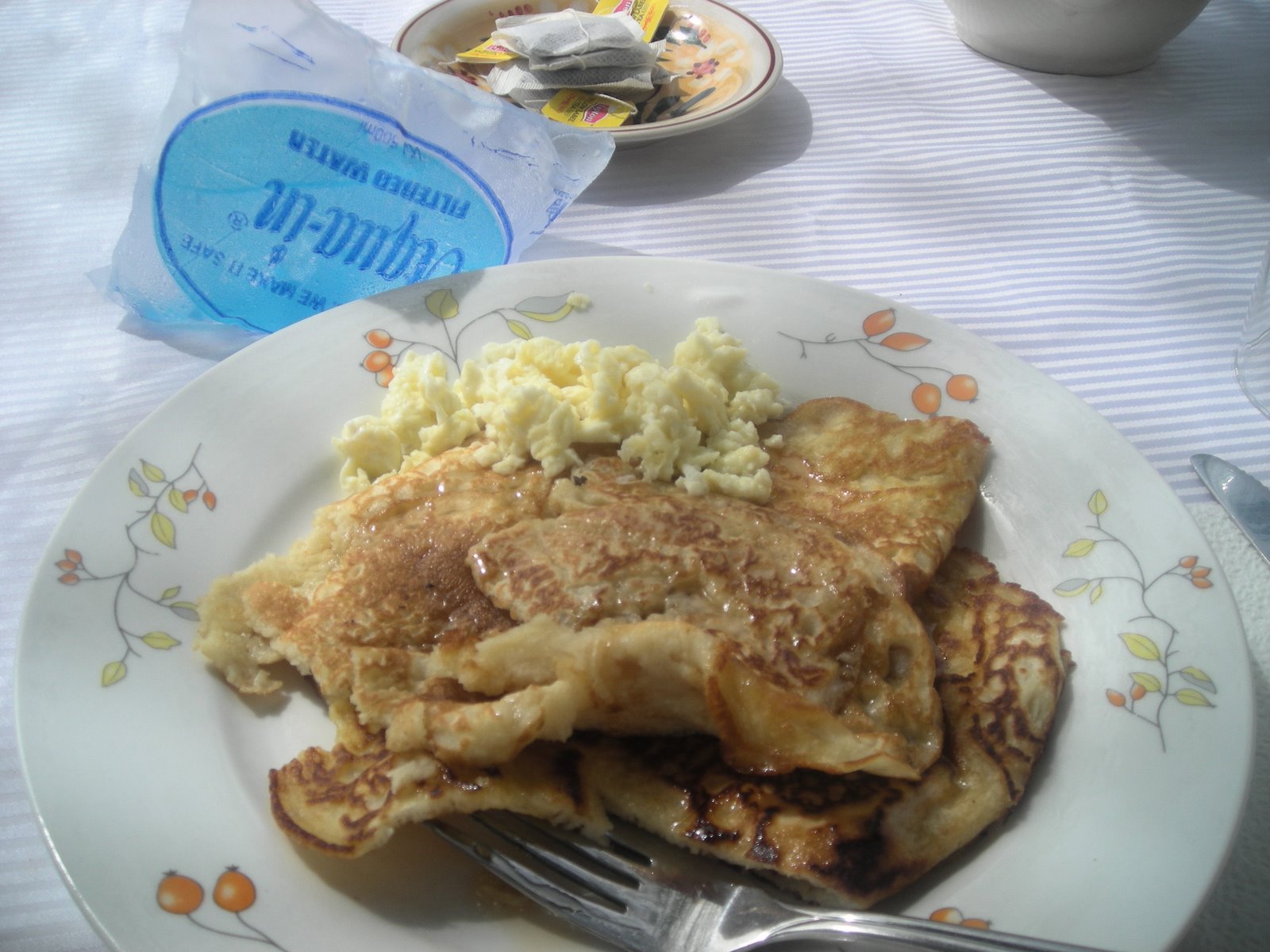
Applied lots of Aloe today. The sunburn is getting better. The bus arrived as we sat down to eat. Kyle and I always seem to be two steps behind. Breakfast was a large, thin, pancake thing with chicken sausage and some eggs, it was so good. At the seminar room today we got to bond with Ted (Prof. Tims). We talked about ourselves, majors, passions, and future plans. We then discussed the novel, The Beautyful Ones Are Not Yet Born. The book was mostly about corruption, the attainment of wealth, poverty, the quest to be western, and one man’s journey to live and work honestly. In the end of the book all he is left with is an “aching emptiness” and that is all the rest of his life could offer him. Kind of a downer, but it is interesting since the day before we met a woman working with some anti-corruption group doing a study on Ghana’s judicial system.

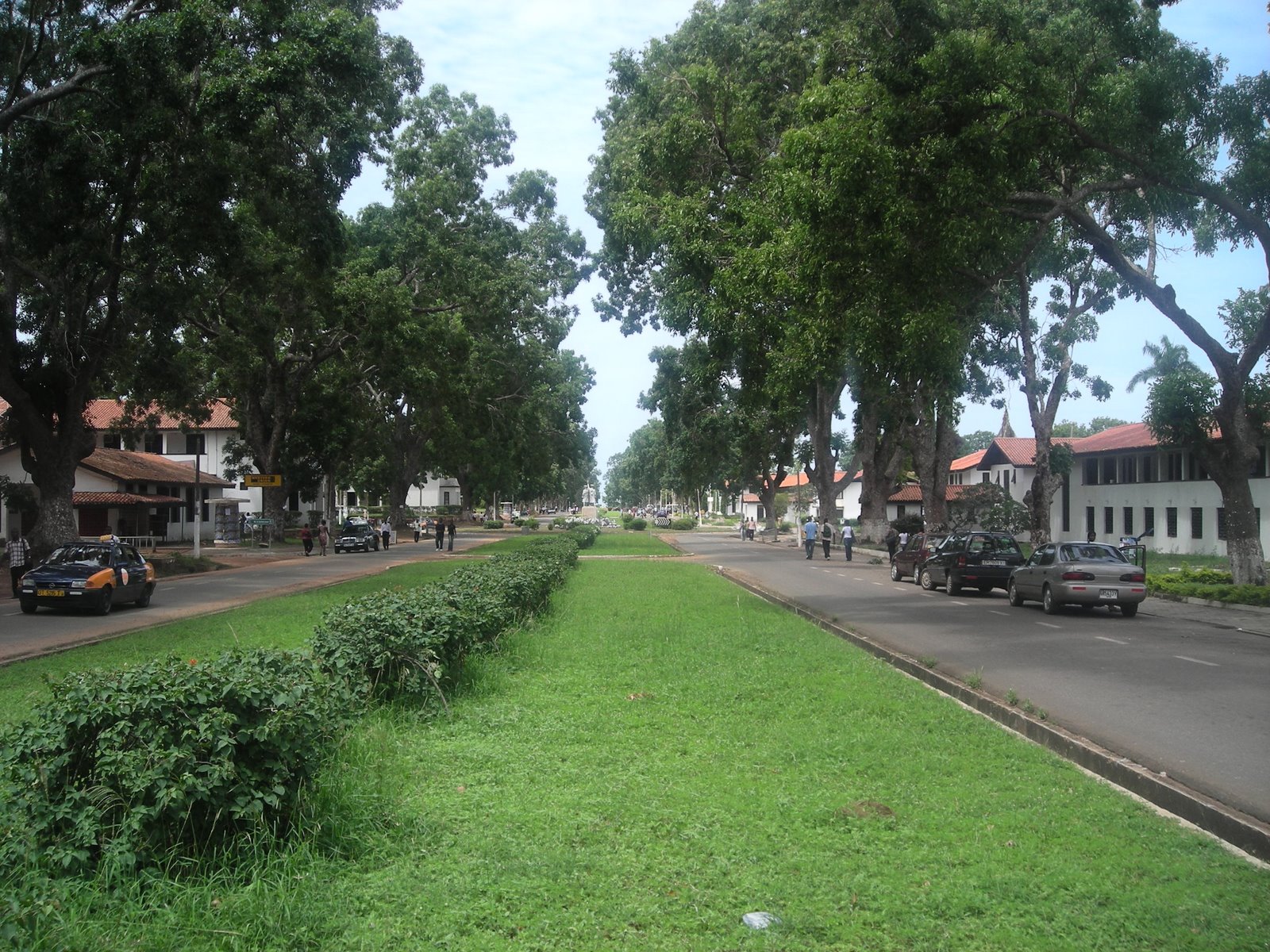
It was then lunchtime and breaktime. We wandered campus and explored some. We ventured all over the campus. We saw the Library, the Center for African Studies, the dorms, and much more. The campus is much like any you would see anywhere in the world, obviously it has its differences, but nothing too out of the ordinary. The biggest difference, as on any college or university campus, was the dorms. These are huge structures of block squares where four people live. When school is in session you see the clotheslines of each student strung out with brightly colored clothing drying in the Ghanaian sun. Surprisingly on campus you see many people walking around with ipod or MP3 headphones in their ears. Higher education in Ghana is still very much a place for those with the money. It is interesting to see, since we have come to know Ghana as a place that favors and loves human interaction, instead of the secluded american, music in ears, head to the ground, walk right past you attitude. This happens to be few students however, and most will greet you cheerily. The West cannot taint the Ghanaian tradition of greeting.

We settled down at an small cafe called ‘Tyme Out,’ got some cokes and played pool. This is where my mind recalled the idea of a hip hop planet. The walls of Tyme Out were adorned with posters of former great and popular rap artists and the music on the radio was their past hits. Even here this glorification and fascination of the gangsterism and commercialized hip hop culture exists. It is not surprising since West Africa is where hip hop was born. The radio often plays Ghanaian hits from the hip hop artists who brought the american style to Ghana. Why is the american style born from West Africa mirrored in the place of hip hop’s birth?

After lunch we learned more about Ted and his love and life of music. He was a music major turned music therapist. He has helped countless people recover from illness with music. He was trained as a concert pianist and this lecture brought us a drumming exercise. We first learned the history of drumming. The Europeans could not grasp the complex rhythms and beats of African drumming because it was like nothing they had heard before. Drumming was used to induce trances and was often used for social events. African drumming has many complex rhythms and patterns, but in the end they all come together to make one song. You cannot stop and listen to everything at once without being confused, you have to concentrate and focus from one beat to another. In this lecture we also discussed the aspects of health. The West decided to cut health to focus just on body. Where other cultures and societies looked at health as comprehensive in mind, body, and spirit. Music is a huge aspect of bringing together those aspects.

In the evening we went to a nearby Chinese restaurant. We ventured down our extremely busy road in Shiashie Accra to reach the restaurant. It was much bigger and fancier than we had thought. Sadly the food was also worse than we thought it would be. The menu was 20 pages long and didn’t really have much traditional Chinese foods. A let down at the least. I had the spring rolls, which just had cabbage and some random chunks of beef. A poor end to the evening, but tomorrow is another day.

Index of blog post series on Ghana.

aljazeera, acrobats, and aloe

Day 8
Today was a sleep-in day. It felt great , but still we woke up too early for me. We enjoyed the 103.7 FM top 30 songs on the shiny, red, shortwave radio at breakfast, before everyone disappeared again to fall asleep. Kyle and I had a nice french conversation with Joseph before also heading back into the hostel to rest. I slept until I was awakened by Kyle because people were heading to Osu to shop and eat. When we arrived I noticed that on a Saturday afternoon everyone in Accra is out and about. Today everyone is called to or hissed at (which is the most common way of getting someone’s attention) ‘sssss.’ It did not matter today if you were an Obrooni on the street or an Obibini (black or African). We first went to the bank for Kyle to try to use his ATM card. The result was not unexpected as it did not work again. We headed then to the internet for an hour.

This was by far the hottest day since we had been in Ghana. We were dripping as we just walked ‘the strip’ in Osu. We stopped at Frankie’s to get some amazing ice cream and chilled there for a while. We then ventured to the dressmaker so that the girls could order some traditional Ghanaian dresses. After getting lost a number of times and asking many directions we found the small shop that was unclearly marked. The girls looked at fabrics and we watched the game on the television in the back. Manchester United was playing Chelsea for the UEFA cup. The men in the shop gave us chairs and invited us to watch with them. We arrived just for the exciting part of the game. No goals had been scored in regular time or extra time, so now the game was in overtime. What a game, Chelsea came put on top much to the joy of the shop workers. I noticed that on the walk to the shop the streets had been mostly empty and no one was out. Everyone was tuned in to a radio or tv. The world really does stop for football – the world’s game.

We met up with everyone near Frankie’s and headed to the Pizza Inn. This, as you can imagine, happened to be the next Obrooni and wealthy Ghanaian hangout. People sat in nice outfits, suits, some seemed to be on dates at what we would consider a fastfood court. We ordered a pizza and it was very good. However, we ordered an 8 slice pizza with 5 people eating the pizza. So we all had a slice and then we came up with a great communal solution. For the last 3 slices each person would take a bite and pass the slice until it was gone. This happened to be a great solution, at least a very interesting experience, until some people (Kyle) decided to take bigger bites than what is acceptable. This made Molly very sad and angered (see picture). Later that night some people went out, but mostly everyone hung out at the hostel enjoying pineapple, which we bought on the return trip from Kakum. We completely bought two ladies out of their pineapples for the day. The were very happy.

Day 9
We woke up early today to head to Labadi Beach. Breakfast was oats (oatmeal) and toasted jam. I am not too much of a fan of oats, but the toast was great. We were going to the beach to play soccer and enjoy the sun. After eating we hailed a taxi. The first wanted too much money, but the second agreed to a price of 35,000 cedis – I am getting very good at bargaining. It cost 20,000 cedis to enter the La Pleasure Beach,so we tried to sneak into the Labadi each Resort. Unfortunately half of our group decided to turn around and give us away – not good crashing technique you have to be confident.

We paid and were immediately grabbed by hawkers. A man who claimed to paint sat me down for nearly 20 minutes with a stack of paintings trying to get a price and a sale. However after the sixth time of telling him that I was not going to buy a painting he still couldn’t believe it. Finally I got away and we agreed to be friends. We set up with some cushioned chairs, played frisbee, soccer, and enjoyed the water and waves of the Atlantic. We body surfed and tackled the amazing waves. After exhausting my swimming, I went to sit down in the shade for a while. I met a drummer who taught me four traditional rhythms. He was very cool and would not finish the lesson until I had memorized the rhythms in the brief 30 minute period. He them wanted me to buy him a drink and I thought it a fair trade after a comprehensive drumming lesson.

Joseph from the hostel arrived and just as he did the beach acrobats were warming up. They were amazing. They were all extremely muscular and could balance just about anything of anyone on any part of their body. They jumped, balanced, yelled, juggled, and put on a really great show. I could not believe all that they could do with just three guys, a table, some straw hats, and a lot of practice. It was a nice break from the hawkers.

Kyle, Sarah, and I left early since we could feel our bodies being scorched by the Ghanaian sun. We had some trouble getting a taxi, but made it back. We got back and noticed how badly burned we were, SPF 30 just couldn’t hold up. I should have applied a second coat. After showering and applying lotion and aloe we watched the highlights of the UEFA league finals. As we watched we slowly dozed off and slept for four and a half hours! I have no idea how, the beach and sun just wear you out. Kyle woke me and asked if I wanted some PB&J since it was well past dinner time and it was dark out. It was some of the best PB&J that I have ever had. As we enjoyed the reduced fat, super crunchy Skippy peanut butter, raspberry jelly, and Ghanaian wheat bread we enjoyed also the courtyard TV playing the African version of ‘American Idol.’ The Mentor show has terrible singers and harsh judges just like it American counterpart. The Nigerian students staying in the hostel were absolutely loving the show. All of the music was bad and American. Most of what we watch on the TV is the football games and the news. The best news is Aljazeera News, it covers so much and they send reporters to a lot of places that usually no one will go. I enjoy the updates from Aljazeera even at home in the States.

There are no pictures from the beach because there was no time and there were enough sleezy guys taking care of that. The beach was like any in America or Europe, but the water was so much warmer.

Index of blog post series on Ghana.

imperialist footprints: the development story from the inside

Day 10 | May 21, 2007
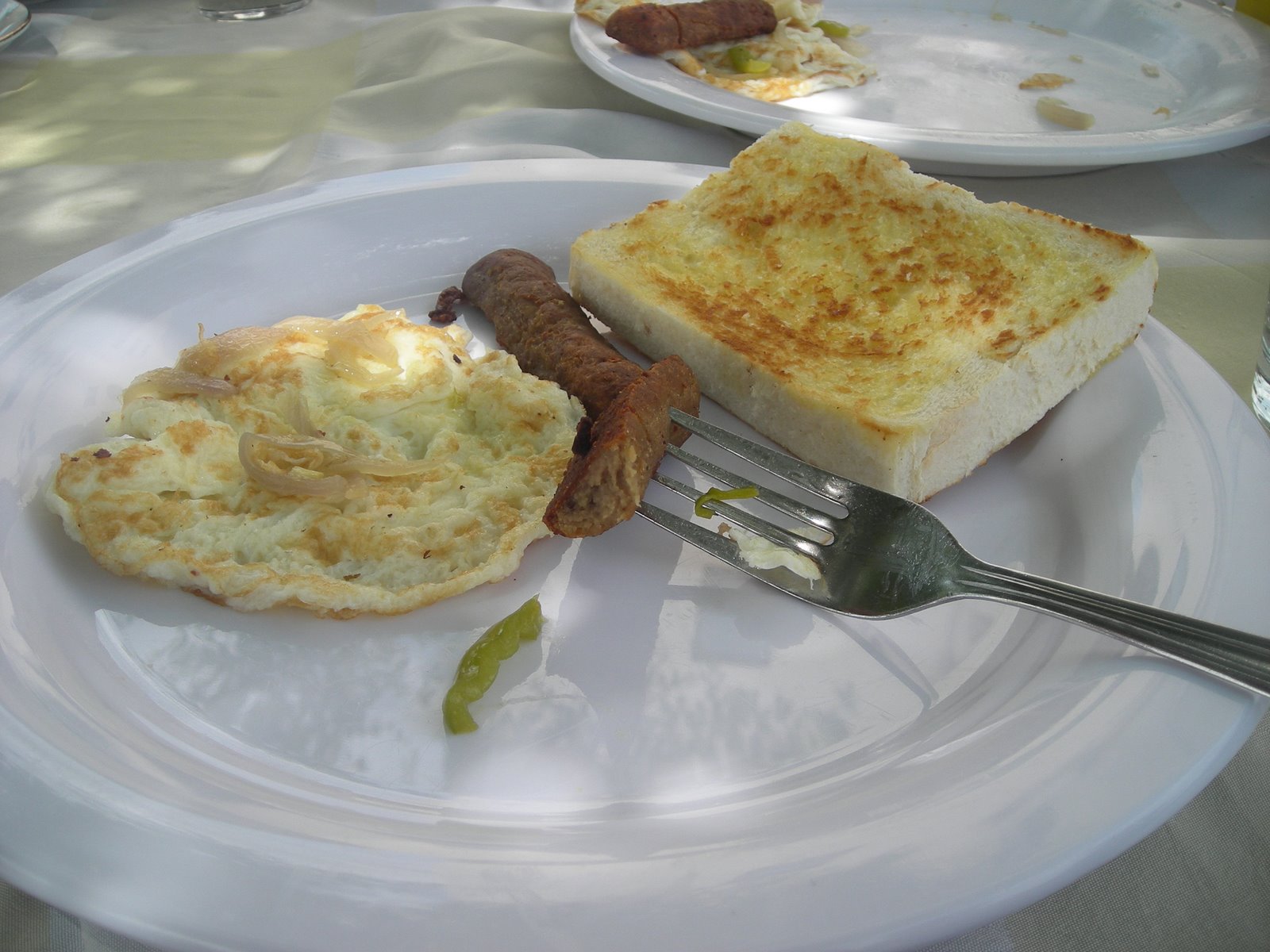
We actually woke up on time today. It was probably because it was very difficult to sleep with sunburn. I kept tossing and turning to find the right angle to get some rest. Without the sheet it was too cold because of the AC on the sunburn, with the sheet it was too hot on some sunburned areas. Having sunburned hands I think s worse than sunburned feet or shoulders. When you even wash your hands it sends s shooting tingle through your hands. At any rate we were up and enjoyed toast and eggs for breakfast. It was a very overcast day and for once my sunglasses were not needed. Rain seemed imminent. The sky was so dark as we headed to the University for lecture. We arrived for lecture and the skies grew darker yet.

During lecture the lights flicked and soon the rain came pouring down. Our professor had to speak up to be heard over the roar of the rain on the roof. As the lecture progressed the rain seemed to increase and the ceiling began leaking profusely. Lecture was on colonialism again, with emphasis on de-colonizing and colonial legacies. Another day to zone out and relax. Sixty-eight years old, not an ounce of gray hair, and chasing 20 somethings across the African continent in his khakis, collared safari-style shirts, straw, old man hat, water bottle and bug spray clipped on his belt at the ready, he may not always hear us or understand what the Ghanaians say, but Ted Tims, Teddy Bear, T-bear will always be a great travel partner and has definitely, at his young age, not lost his passion and sense of adventure. Can you imagine 68 and still traveling the world? I sure hope I can do that and without gray hair.

As I sat in lecture I listened slightly and thought about how the colonial legacy was so strong in Ghana. The leading bank is Barclays, a prominent British bank, sponsor of the Premier League of Football in England. The tourists that I encounter are mostly from the UK and when you see an Obrooni it is most often a British accent that responds. The game of football is huge, this may not be a colonial legacy, but as I wrote before, many Ghanaians stopped for the final game in the British football league. Interestingly British Airways has the only flight that comes to Ghana from the US connections or Europe. Ghana is also marked by the English language – anglophons surrounded by francophones. The BBC is a top source for news in Ghana. The education system also is very English. One of the very prominent and important colonial legacies is religion. Almost 70% of Ghanaians are Christian and that shows from the motto and phrases pasted on the backs of taxis, trotros, trucks, and storefronts: ‘Trust God’, ‘Triumph’, ‘God’s Will’, ‘All to Him’, or ‘God is Great.’ These British footprints have a colonial legacy that is amplified by the political and economic implications of colonialism for Ghana.

Politically the Ghanaians adopted the English parliamentary system of governance. They even used to have a governor general like Canada and Australia, but eventually got rid of that stain by adopting the more American system with a Presidency along with a Parliament. The development story of Ghana has largely already been told in a earlier posting on the development of Ghana, but this is what I have been taught and seen from being in Ghana. From the colonial time period Ghana was made to produce cocoa and now they are trapped in that mono-crop (cocoa) production of raw goods. In the 1970s Ghana attempted some ISI (import substitution), but it failed to have an impact because this was just not possible with Ghana’s situation of having limited abilities for industry. From 1970 – 1980 is what is called the ‘lost decade of development’ for Ghana. Ghana began to liberalize its markets with the involvement of the IMF and World Bank and their Economic Recovery Programs (ERP). Ghana still struggled and had difficulty and was soon named an HIPC (highly indebted poor country). This title limited their possibilities for development and aid. Ghana was relieved of its HIPC status later when its debts were forgiven and it began taking, “ginger steps toward standing on our [its] own (Prof. Johnson). This is what Ghana is working on now. The ginger steps of development in this globalized economy driven world. As a few points of interest on development: the government has nothing to do with land ownership – only taxes on businesses, China is Ghana’s number one foreign aider (rogue aid? – see earlier post on subject), and so far I have only seen a handful of micro-finance and lending groups.

I have noticed that the only real developed region is the Accra region, where most ofthe people and aid organizations reside. The other areas to the north and even to the immediate south are left under-developed and neglected. Cocoa is their number one export, but if the country is to develop they need an industry established to produce a finished good with that cocoa. That is impossible however because that role is already set up in the Western industrialized countries. How is Ghana to develop? More foreign aid? I have noticed that there is an interesting relationship with Iran and some development projects. Not surprisingly the US has withdrawn its aid and has nothing to do with Ghana besides USA rice.

Our second lecture was more interesting, maybe because the lecturer was more interested in passing her knowledge to us. The topic was the role of the media in the political system and political change of Ghana. The media was huge in Ghana’s political development. It was first used to combat colonialism, then was controlled by the newly independent state government, used during this time as a public voice for dissent, and finally as a promoter and grower of democracy. In 2000 Ghana experienced, for the first time, a peaceful transition of power to a new administration. The new administration was the politicians who had opposed the government since 1992. This administration had fueled the media’s public dissent and made alliances with the media. The question now is: ‘Is the current media as critical of the new administration since it had alliances?’ Ghana has a very multi-lingual media and this allows for a more participatory democratic system and society.

After lectures we headed to Makola market. Now you see whenever we tell anyone of our Ghanaian friends that we are going to Makola market they laugh, ask us if we are serious, and then tell us ‘goodluck,’ so we were a bit afraid and interested at the same time to go. After arriving it is easy to see why we got such a response – Makola market is pure insanity of commerce. Even though Makola market may seem like pure insanity there is definitely an order and control to the confusion. In the market everything has its place, there is a section for candies, clothing, luggage, seafood, crabs, fufu, pretty much anything you are looking for in Ghana is here. This is the real super (duper) market, the commercial center of the country. Most of us just went to look and experience It was actually very fun and not at all a bad experience as friends had warned. Navigating the alleyways and the crowds and seeing the extent of the market was amazing. So far this is the only place where I have experienced the real hustle and bustle and hurry. Girls with empty bowls rush back to their stands in the alley to refill and sell more, every second seems to be a lost opportunity to sell, so I often get out of their way quickly. Women call and haggle, sellers bother Obrooni and Obibini alike to make a sale. This was the first place where I heard the call “Obrooni! what are you doing here?” We responded with ‘Obibini’ and some other Twi that we had learned to the surprise of the market women. I saw quite a few Obroonis around the market that day.

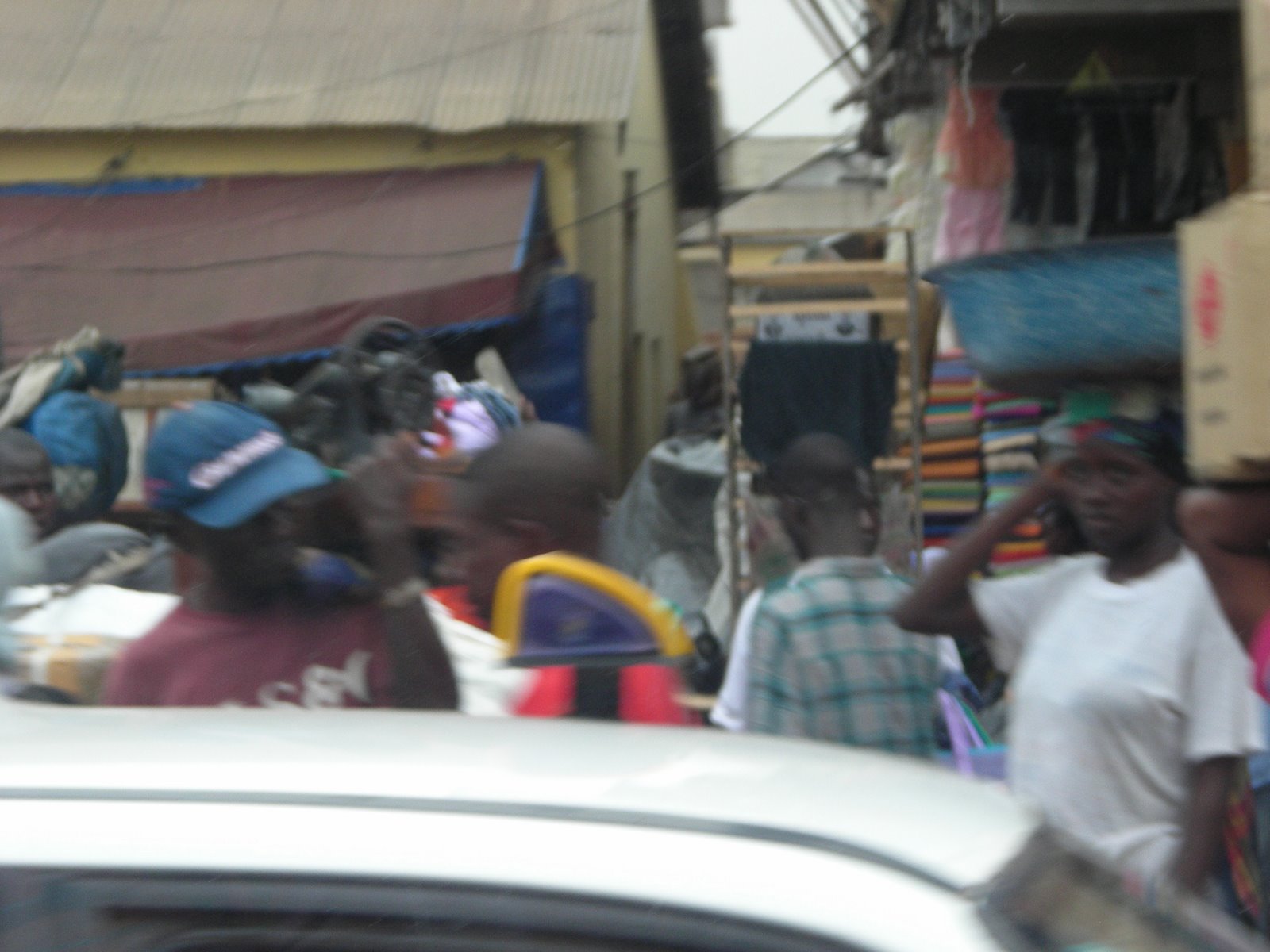
I decided to not take any pictures while in the market because it had caused problems in the past – at least until we got back on the bus. Some pictures are a little blurry. Here in Makola, as in many places in Ghana and Africa, people everything on their head. At Makola I saw a new range of this skill as boxes and goods were stacked very high and carried aloft to the numerous stands. This market was nice and more fun and much more welcoming in comparison to the ‘art market’ in Osu. Probably because not many Obroonis dare to venture inside the beautiful chaos.

We arrived back at the hostel and toured the kitchen to see how we could save some money on eating costs. We decided to eat at Fresherz down the road, a very american-style restaurant with american foods. As per Ghanaian standards, after our drinks were ordered, it took nearly two hours for everyone to get their food. It was very tasty food after waiting two hours. Joseph later took us to a nice little market to get some inexpensive food. He got a taxi to take the seven of us for just 20,000 cedis ($2). First, the taxis here are very small cars, second, it is difficult to breath with someone on your lap in a small car. Five people crammed in the back, Don on my lap and two in the front. The bumps in the road were uncomfortable, but not a bad ride otherwise. Suddenly an unmarked black car drove in front of us and stopped. “Police?” we all asked, but Joseph said no. But it was the police and they began giving the driver an earful about taking seven people, Obroonis at that, in one taxi. They threatened to take his taxi sticker and asked if 20,000 cedis was worth his taxi career. In the end it was just a lecture for our driver and we were on our way again. Ghanaian police – don’t mess with them.

As we entered the small market we noticed huge flying bugs. They were very large and interesting. However they became less interesting and more bothersome as their numbers increased rapidly and they were drawn to the market lights. Large-winged, meaty flies filled the air and swarmed the lights of the market as we attempted to buy food. In our hair, faces, and brushing our legs these flies were not done kicking until their wings fell off and they all scurried away. Joseph told us that after a big rain these bugs come out and that some people catch, fry with salt, and eat them. I had heard of this before and it sounds like a treat. Maybe I can try some here.

We frequent an internet cafe down the road a ways from out hostel. We often walk in the dark to the cafe. I noticed on this night that the american tunes played in the cafe unconsciously were stuck in my head on the walk back and unknown to me I hummed them aloud. I also realized that since we were Obroonis walking on the street in the dark that we must want a taxi ride. When a taxi is empty and wants to give you a ride they honk at you. We must have been honked at over a dozen times! Can’t an Obrooni walk on the street!

scenery and speed bumps

Day 6
We left at 9am to head to Cape Coast to see the ocean and the slave castles. It was a very long ride and would take nearly 3 hours. Good thing, that means I could sleep some more. It took an hour to get out of Accra and then 2 more hours to reach Cape Coast. I decided to start out by doing some of our class reading from The Beautyful One Are Not Yet Born, but it was so difficult to read a book describing Ghana when the very country is passing by your window. My focused reading was punctuated often by the series of speed bumps. These speed bumps were not set in any sort of order, randomly plaed along the long route to Cape Coast in sets of 10, 5 far apart and 5 closer together. This made it very difficult to read or sleep, however many other students managed to catch some z’s. Also the difference between reading and seeing was just too great to pass up, so I spent my time looking out the window. Richard who started working at the hostel the day we arrived told us that we would see a very different Ghana. He was very right, this was the Ghana that I expected to see. There were numerous slums and rolling hills with so much greenery.

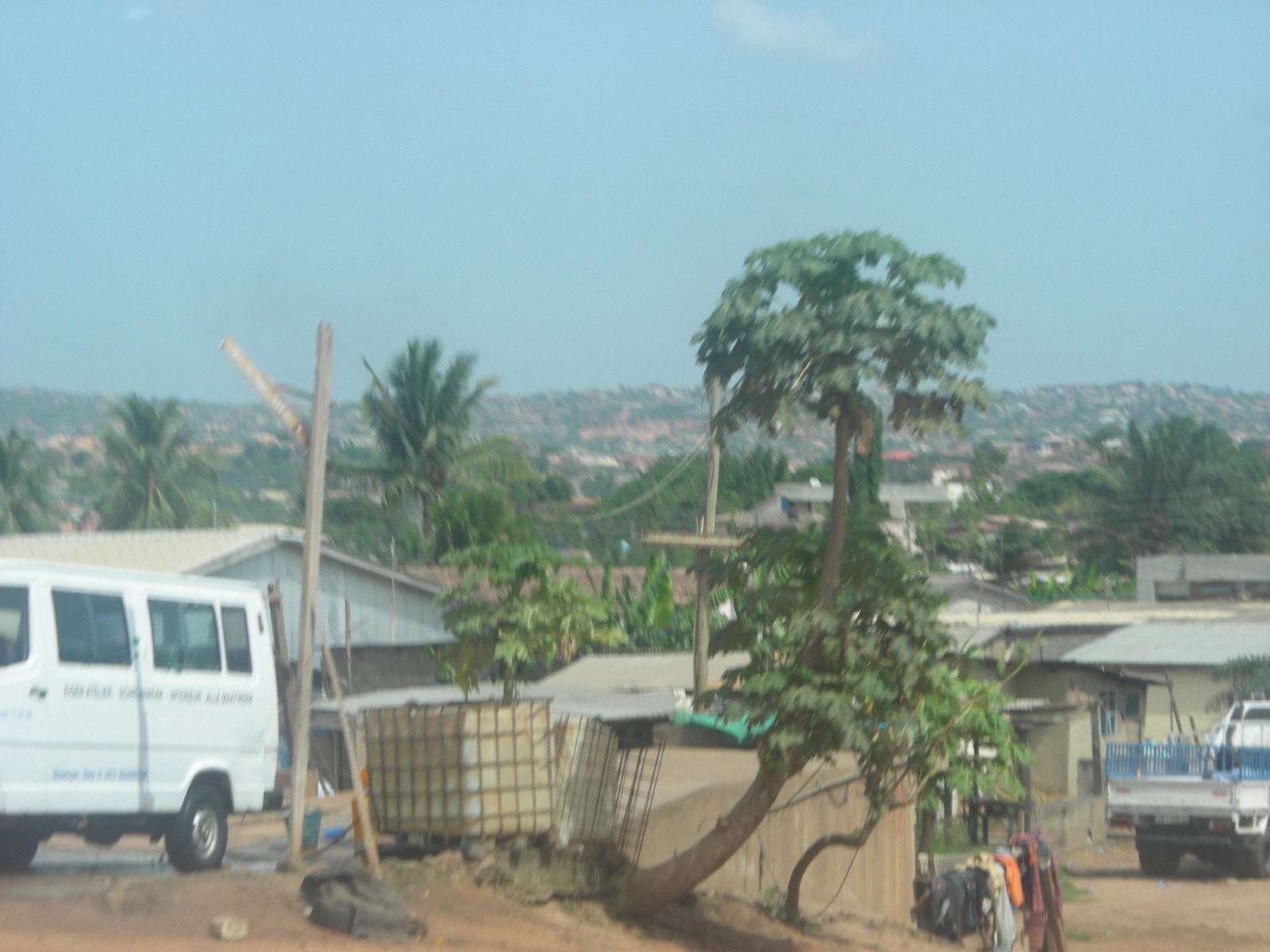
Here are some random snapshot from the road:


We arrived finally at the Cape Coast area and passed Fort Amsterdam, set up by the Dutch. As we neared the actually town center, the Cape Coast Castle stole the view and I was awedby what it stood for. We entered the castle, again hawkers followed us in, and readied ourselves for the tour by exploring the museum. History, artifacts, and knowledge on culture were thrown at us in neat displays, but these could not prepare us for the walking tour that awaited us.
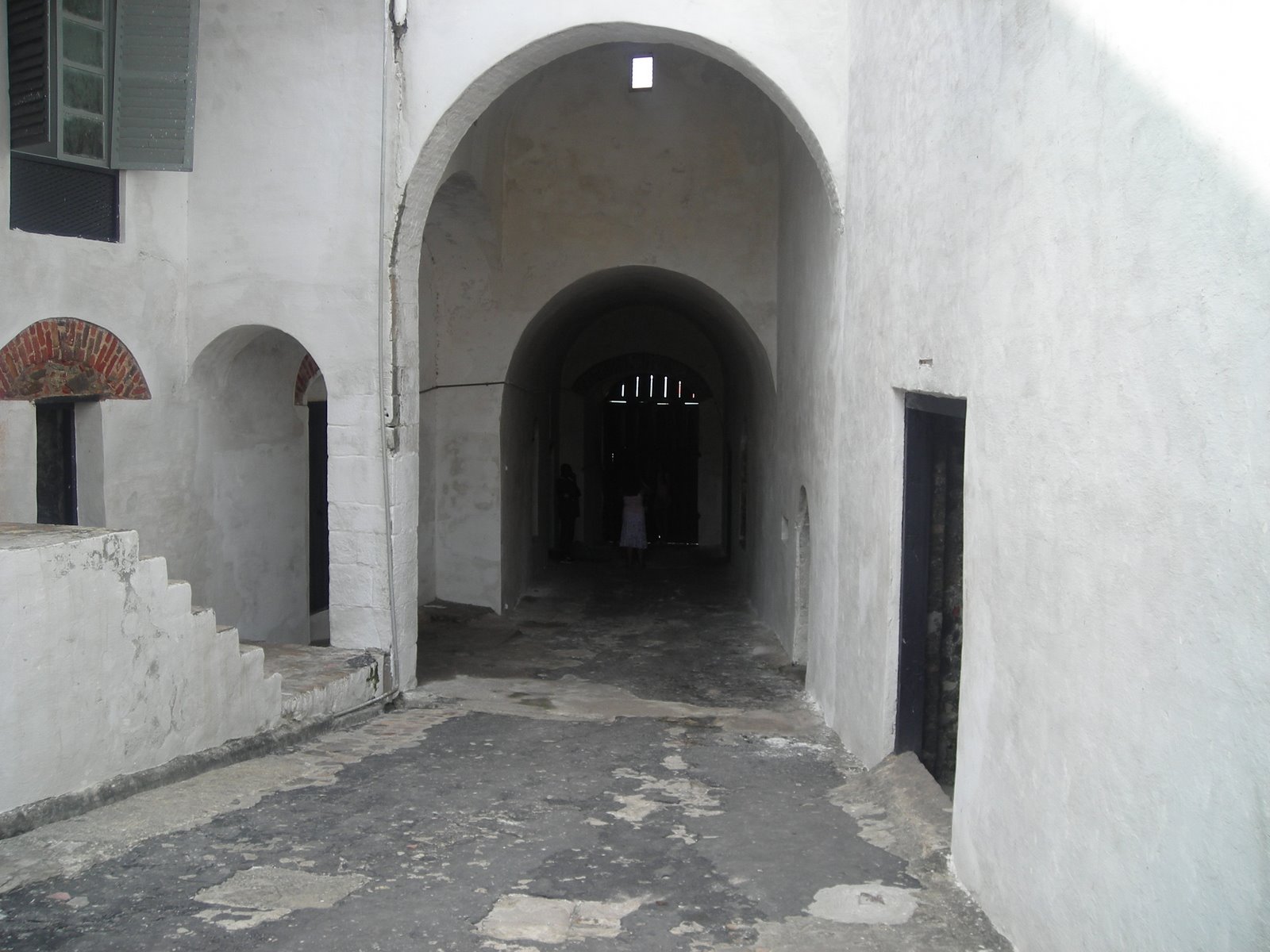
Our guide was a very somber Ghanaian who was very smart. We started in probably the hottest room in the castle, Palaver Hall, where the Bond of 6 March 1844 was signed to create peace between the warring Ashanti and the coastal groups. The tour was great and the views from the castle were breath taking. Near the end of the tour we entered the holding cells for the slaves. Many slaves passed through these cells, many starved, many died, and so many more exited Africa through the ‘door of no return.’ It was a sobering reminder of how our world used to operate and how our people used to treat others. What every happened to that neat ‘Golden Rule?’

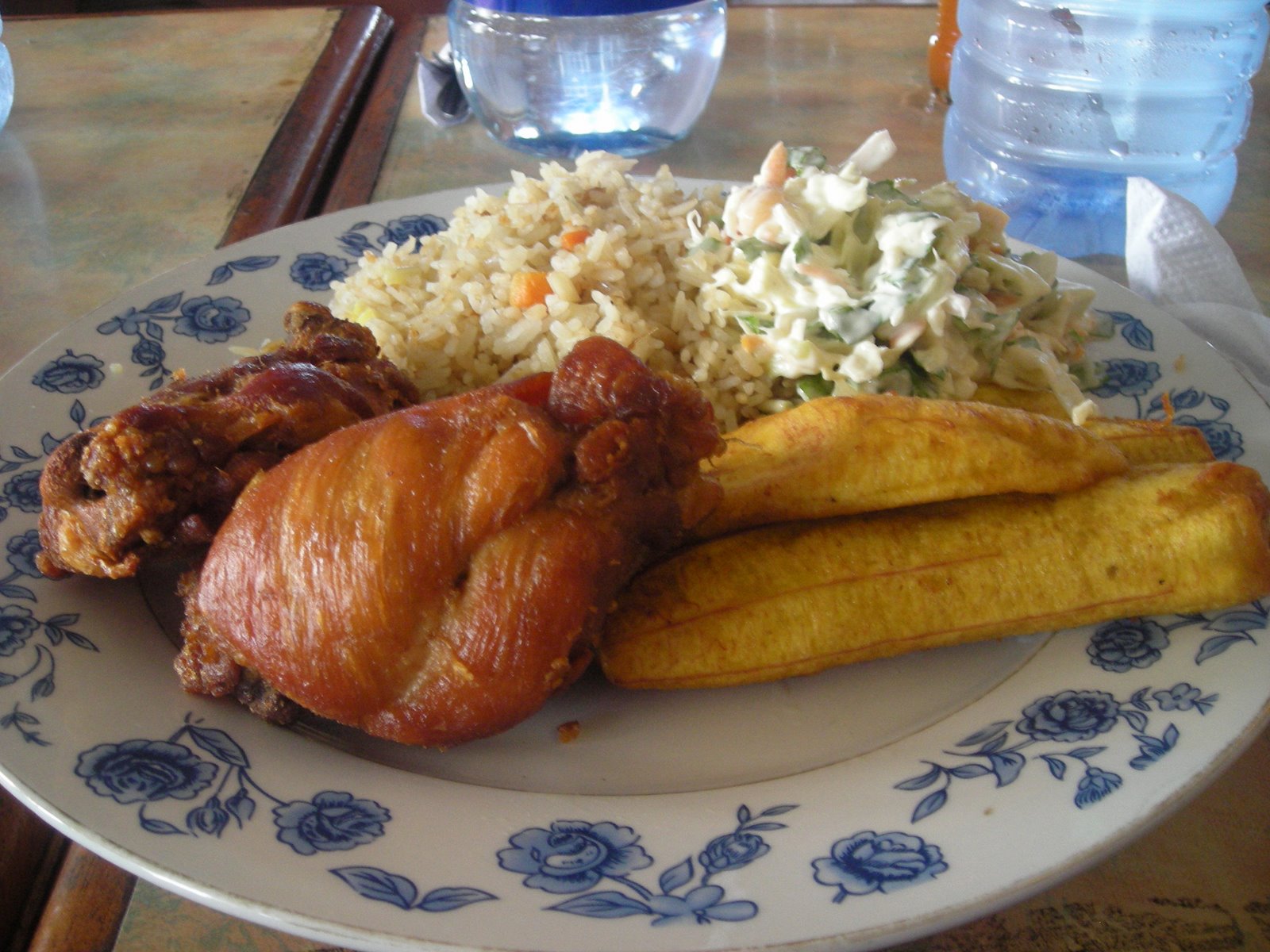
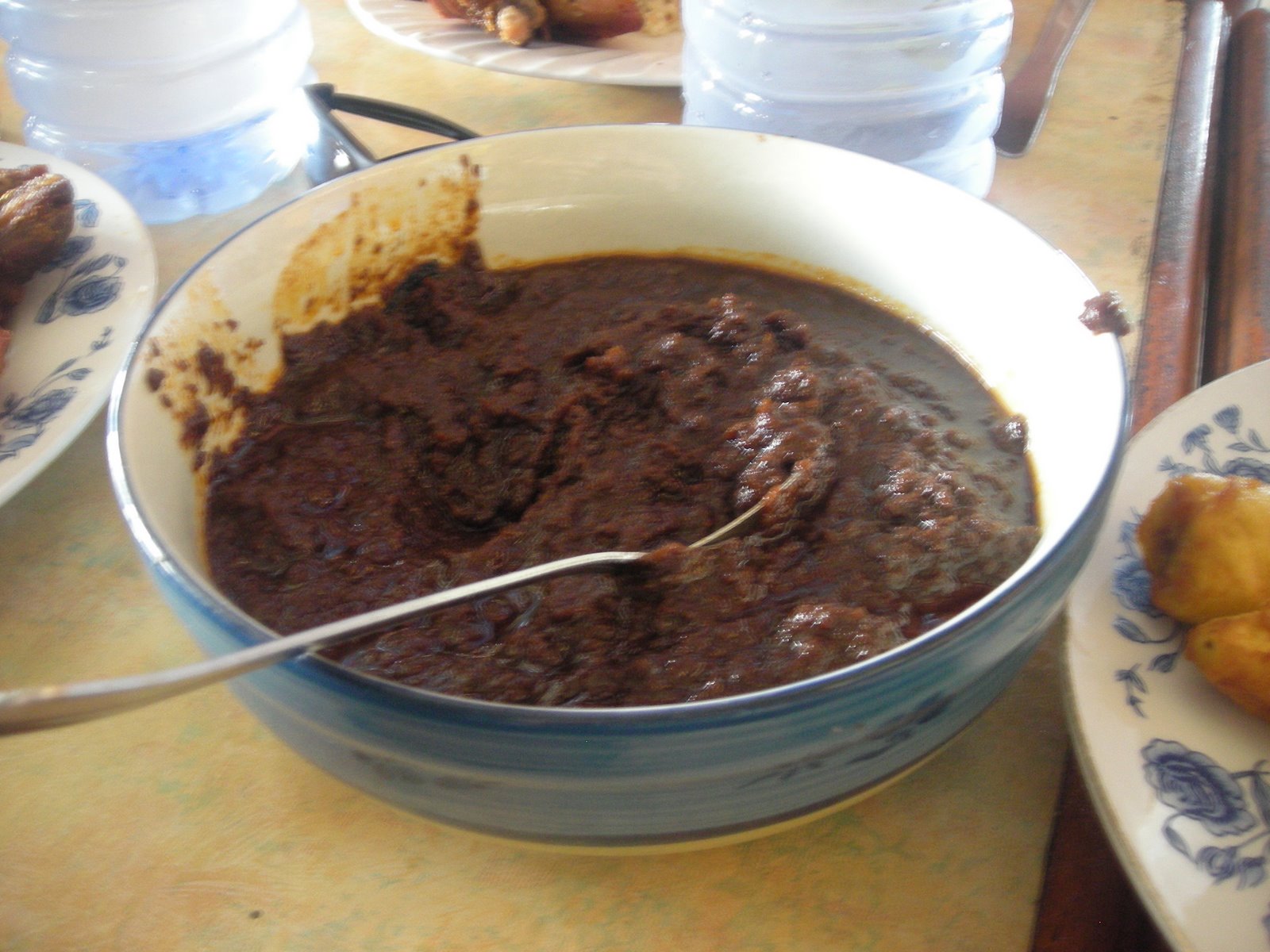
We ate lunch at the Cape Coast castle resturant. We had the usual meal of chicken and rice. Here they served a big bowl of what we call ‘hot.’ (Please pass ‘the hot’) We have determined that this is Ghanas’s equivalent to red hot sauce. It is so hot!

Next we took a short bus ride to the neighboring fort, Elmina Castle. Elmina as I wrote before was called ‘The Mine.’
It was used mostly as a trade and military based center, however many slaves did pass through its walls. We also had a tour here, but it was not as good. The guide was not as somber and heart felt for the deeds of the past. After our tour we went outside the castle. There is a bay area where all the fishing boats line the docks to sell their catch. They all have vibrant and multi-colored flags to adorn their vessels.
Here we bought bags of water from some very cute kids. Everyone took their picture so I didn’t want to add to the insanity of a photo op. They were extremely happy to have our business.

We then headed to our hostel for the night. We arrived by way of a very bumpy road. It was a bit confusing at first as we waited on the bus to get our rooms. Eric had us first check out the rooms since he thought they were not the nicest and there was no AC. I am not sure if he thought we could not take the heat or if he didn’t want to have to deal with the heat. The rooms were not bad and many students from the University of Cape Coast stay here. We all said the rooms were fine and we could handle no AC, little did we know. . . That evening we went out to the gazebo for dinner, beans, rice and chicken (getting a bit repetitive). This is where I got my first mosquito bites. By the end of the evening my ankles were eaten alive. Good thing that I am taking my anti-malarial. The Cape Coast is in the Central region, not really the center of the country, but central still, where the Fante people live. After dinner we had a performance by traditional drummers and dancers. It was an amazing performance and we were all made to try our skills at Ghanaian dance. The locals and students enjoyed our show just as much as the professionals. I wish could have taken a video to post here, but it was too dark out. Afterwards we met some UCC students and the performers. We got into a discussion about tradition and culture in America. I had to respond that we really have no culture, but a pop culture driven by sex, money, and fame. Tradition in America is all up to what a family wants to remember and practice or not. Just like keeping in touch with family or keeping a family name is completely optional in America, but it is just not so in Ghana.

We returned to our rooms for the night to the realization that the power had gone out. No power, no lights, no fans, no power – many people showered by flashlight and I wrote my journal in the hallway where the generator was keeping power on. It was an interesting experience as without even a fan the heat engulfs your body. It was so sticky to sleep. I decided to shower in the morning when I could see and when the cool shower would feel so much better. I actually slep very well and somehow encorporated the sounds of a barking dog (for 10 min.), a muslim call to prayer, and loud shouting into my dreams as I was the only one not awakened by the noises. I heard them, but never awoke.

Day 7
The power came back on at 6am and the breeze of the fan was a welcome relief from the stale heat. I had slept fine during the night, but most students said they could not sleep at all. The cool shower in the morning was amazing before breakfast – only to begin sweating in the heat again. I brought out my soccer ball and we all played a nice game of ‘one-touch.’ It was time to leave and I was dripping in sweat. We stopped again in Cape Coast to change money, get water, and saw the castle for one last time. On the bus ride to Kakum National Forest the movie, Blood Diamond was brought up again. Some students expressed fears that this conflict of diamonds would spread to where we were in Ghana. I could not help but speak out and explain the distance of the conflict, the history of Ghana, and the understanding that bad things that happen in one African country are not automatically replicated in another.

We arrived at Kakum National Forest from a short bus ride where we were able to see so much more of the beautiful countryside. It was so beautiful and green. Our tour guide was very nice and took us around the park.
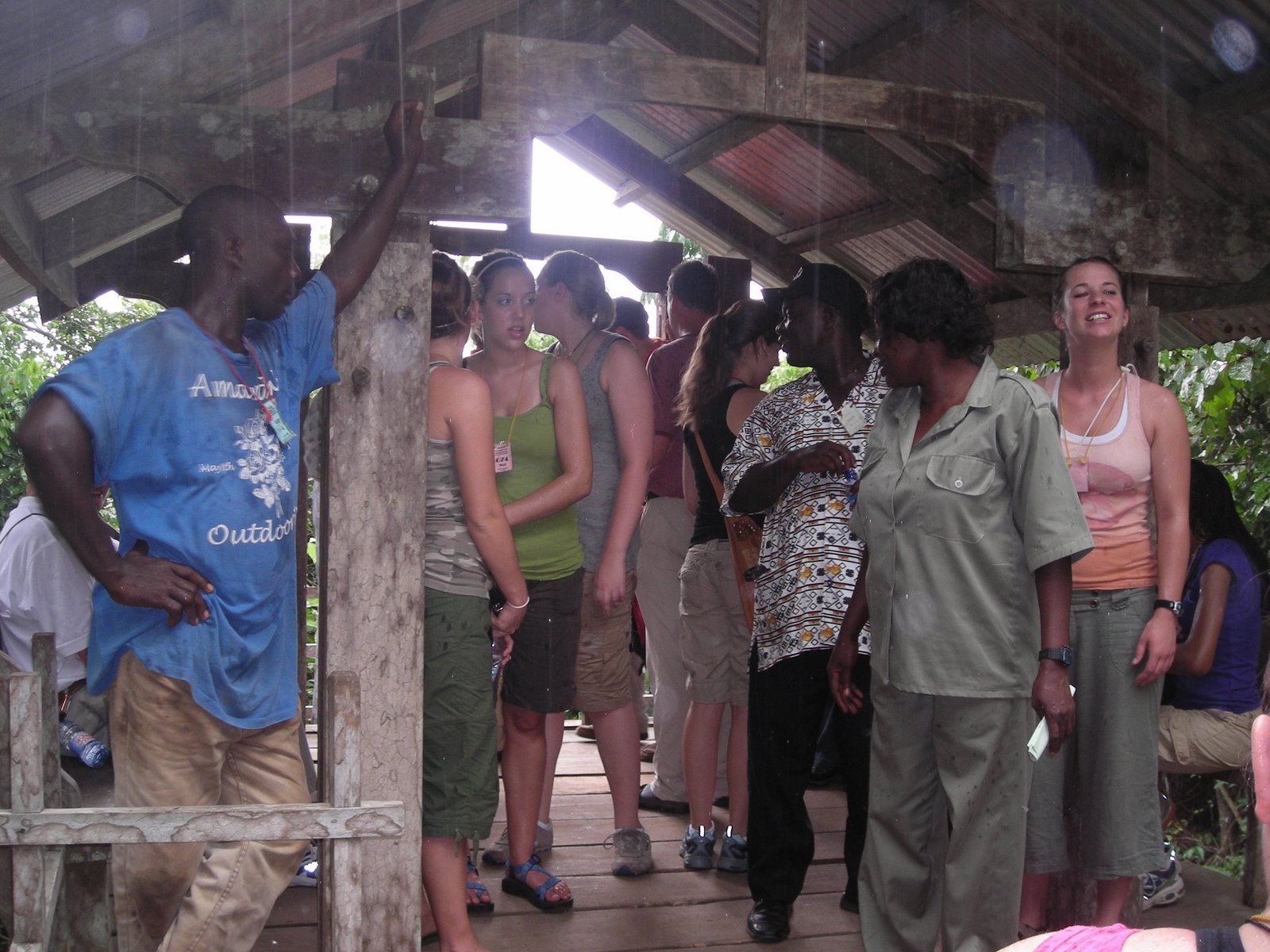
We trekked the steep stone steps through the forest. Our guide told us that we would not see much wildlife because they were all away from the tourist noise on the other side of the park. Just as we began our ascent of the first steps it began to rain. Would this be a typical African rain that I had experienced before? Oh yes. Rain in the rainforest, it poured. Many students sought shelter in the nearby roofed pavilion, but the rain felt so good. The rain let up for a bit and we walked to the next shelter to walk the canopy. As we reached the shelter, the rain poured down more heavily. We had time to meet a Ghanaian politician who had studied at MSU and another politician from Holland, doing an exchange program with the local Elminaian government council, who had also studied at MSU about 20 years ago. Everyone is a spartan even in the rainforest.


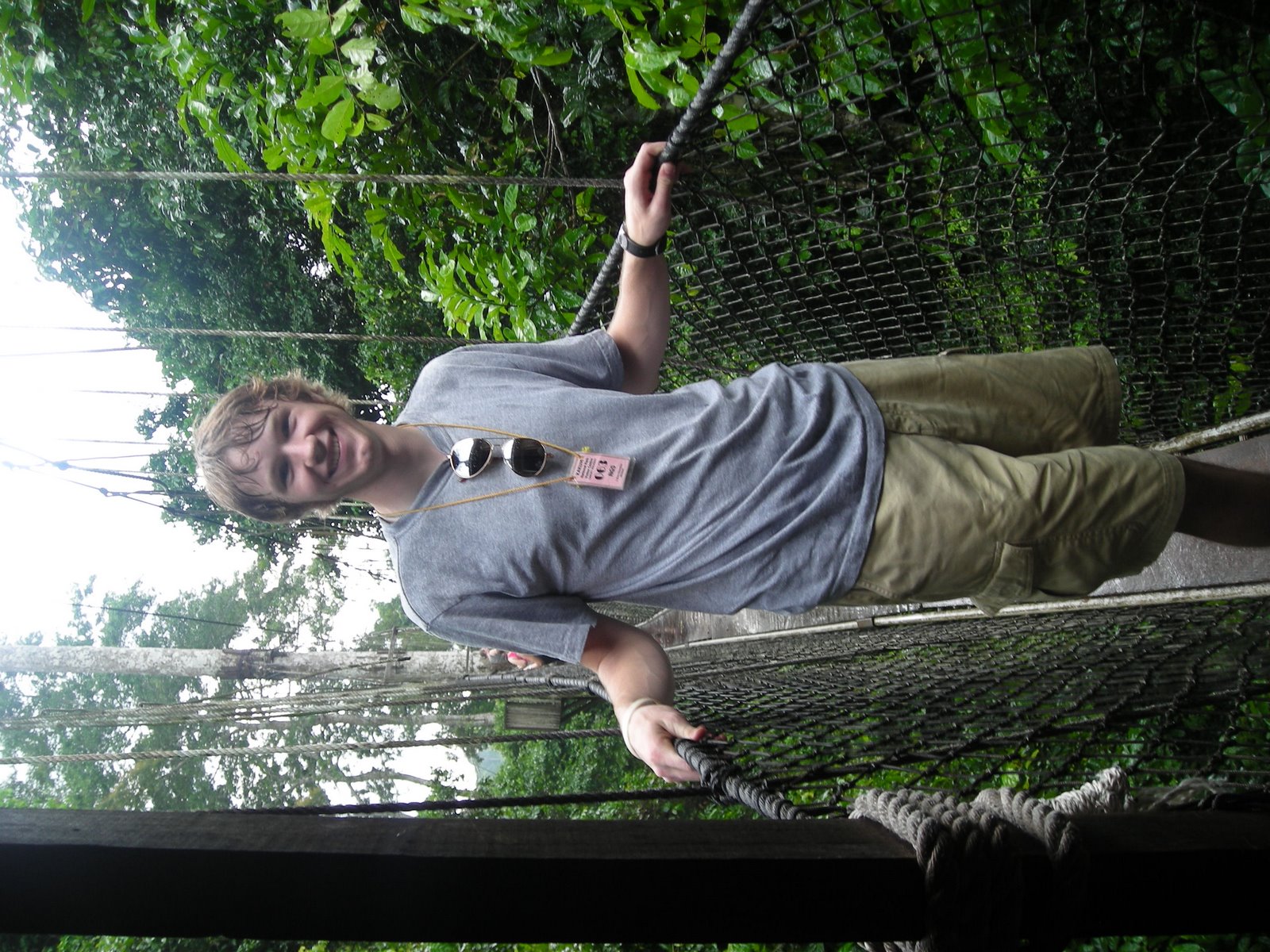
The canopy bridges are 316 meters long, there are seven rope bridges and six platforms. The bridges buckle and sway as more people get on, but you know you are safe. Some people had fears of heights, but the view was so beautiful and how many chances do you get to walk the canopy of a rainforest? We all made it across and received a hug from our guide since we survived. As we walked back I realized it was more difficlt descending the stone steeps than climbing. We waited while Don ate his food which he had ordered before our walk. Grrr, Don.

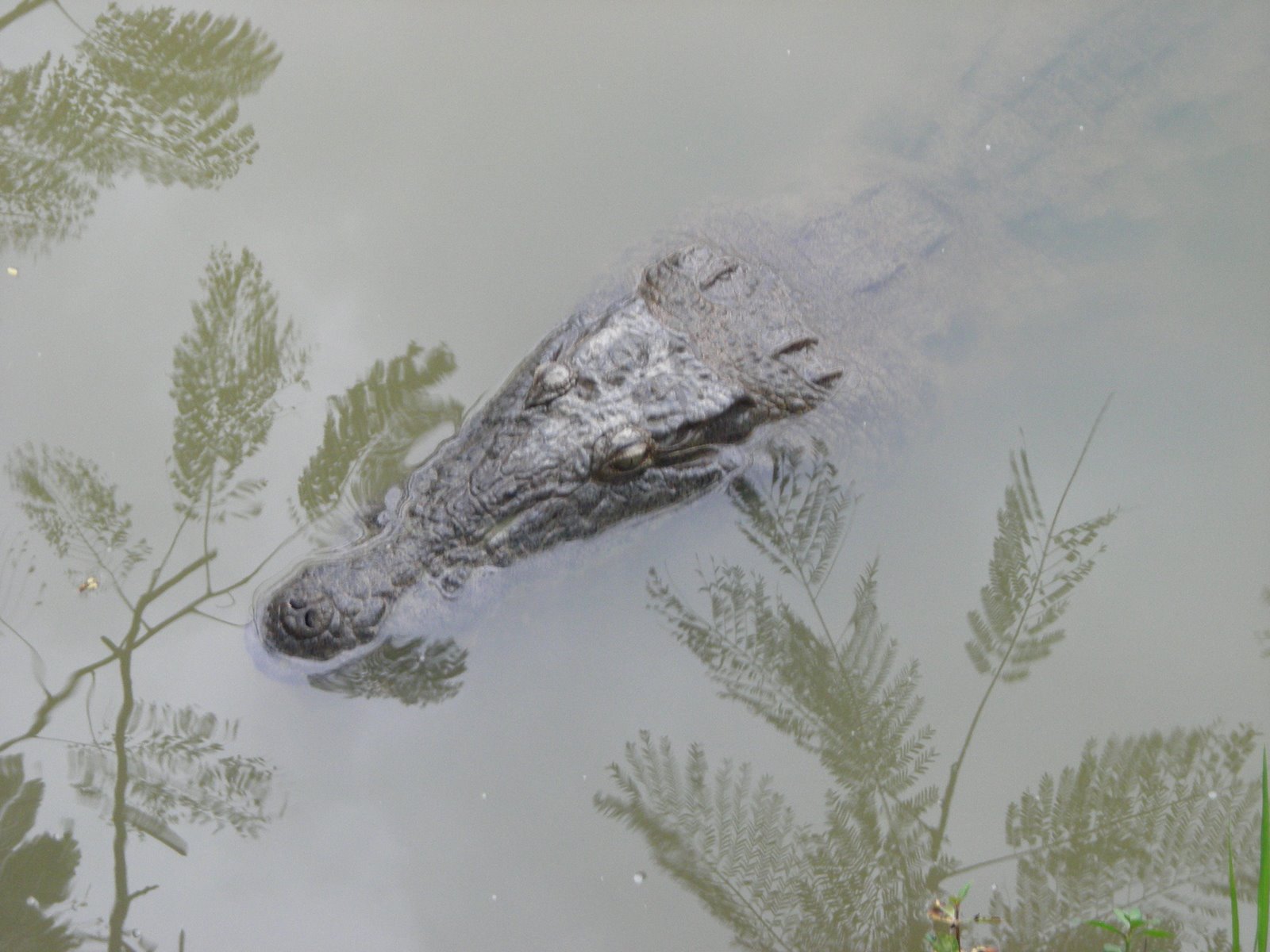
We all then boarded the bus to eat at the crocodile resturant and hotel that we had passed on the way to the park. It was a very nice and expensive place. There were crocodiles in a pond surrounding the resturant. The grounds keeper was showing off the crocs to some local school children. The crocs lunged at meat on the end of a stick and the children screamed and ran away. I sat down on the steps near the pond to relax. As I sat a large crocodile slowly swam towards me. It did not turn away so I stood up to the delight of the school children. It finally decided to run my relaxation and chill at the edge of the steps, probably envisioning me as a tasty morsal of meat. Maybe it had never seen an Obrooni?

We left for the long trip home and I slept most of the way. We stopped at a pump station (gas) and bought water and I got a coke. It tasted very similar to coke in Americ, but with less bite. Back in Accra, some people bought toilet paper through the window from the hawkers. 4 rolls for 10,000 cedis ($1). We unloaded at the hostel and got ready for a night out. Richard took us to a neaby pump station that supposedly had internet, but that was false, so we hailed taxis to get back. We had by now figured out the proper pricing and worked to get the right price instead of being ripped off Obrooni style. After the thrid taxi drove away, we conceded to a slightly higher price. This is what happens when Obroonis get tough, the tough get going and leave the Obroonis behind. We used the internet in Osu and later enjoyed some Gordon’s Spark (fruit and gin) and hit up the club with some drummer friends.

Index of blog post series on Ghana.
for the love of america

Be sure to check updated Days 3&4.

Day 5
Lecture this morning was on indigenous slavery and the Trans-Saharan slave trade. All of this I have learned about extensively because you cannot study Africa and skip over such a subject. So that is why I began journal writing during lecture. As I said before it is great to be an Africa Studies major studying in Africa, but I want to learn what I do not already know.

I remember the other day our bus driver Eric was listening to the radio and there was a discussion of the importance of local chiefs. The discussion was on the need to unify the chiefs and include them in the political process because it would not matter if a policy was adopted if the local chiefs with all the power did not agree. There is no way to get around the chiefs or work around them because they hold such power at the local level. If the government is to work smoothly then they will need to include the local chiefs in the political process. Now this is the type of African Studies that you just can’t get in the classroom.

The traffic goes by outside, a car alarm triggers, I am sitting in a classroom listening to a boring lecture – it is almost as if I am back at MSU, the AC masks the intense humidity and heat. The only difference is that the professor standing before me is actually teaching in his home country. I have had a total of 7 professors from Africa in my two short years in college, so there is nothing new: traditional dress, accent, and use of odd American sayings. Professor Passah likes to preach his own ideology and views to us during lectures. Today he brought up the Iraq conflict (falsely called a war). He noted that the money spent on the conflict could work towards the development of Africa. Not just Ghana, but the whole of Africa. I could not have agreed more. He then went into how Ghana became a target for international corporations and NGOs. He noted how this is seen as no problem and makes him very happy because a Ghanaian gets a lot of money in his pocket. He said to not think of him as a bad man for saying that, but this is where I worry. So he is not a bad man, but a man blinded by the Western desires promoted and unaware of the possibly and often negative effects of a huge international involvement and presence.

At the end of the lectures we were again on our own until 2pm. We went to the internet cafĂ© again to check emails and blog some more. No time to eat. The University is very interesting because there are houses, living complexes, dorms, a primary school, fields, horses, and more all within the campus grounds. It is like a small city in itself. We boarded the bus to have our tour of Greater Accra. Accra is the second largest city in Africa behind Lagos, Nigeria. Eric showed us all around Accra. This is when we got to see the more impoverished parts of the city; the slums and rundown areas, the wood scrap and sheet metal housing, the shirtless and hungry. As we neared the coast the poverty seemed to increase and the development decreased. The wide streets, colonial fortresses now used as prisons, and the old style colonial shops have all slipped in to decay and have been abandoned to ruin. The wealth and high class has left the coast of Ghana. We toured the private homes area with their western styles, gates, barbed wire, guards, and tennis courts. We saw the president’s personal residence – no pictures – and the palace. As usual there are hawkers everywhere. Later we returned to the art market to exchange money and met up with some of our old ‘friends.’ This time the hawkers calls were more subdued, but nevertheless relentless.

This is the exchange for a $100 bill into Ghanaian cedis. It is quite a stack of money:

After manuvering the thick traffic we returned to Catters Hostel near the village od Shiashie, which we have learned is not a road name, but a village that was engulfed by the growth of Accra. You can’t help but notice the signs on the corner of every intersection telling you of the direction of each embassy, organization, hostel, hotel, business, or resturant. The foreign investment is at a very high level. So much for fighting neo-colonialism.

Sitting in the courtyard, listening to the birds in the tree overhead, hearing the end of the day traffic go by, looking at the clouded over sky, and nearby hotels, enjoying a Star beer – life in Ghana could not be any more relaxing. No one here walks fast or runs, unless they are making a sale, no one is rushed and everyone is involved in the customary tradition of greeting their fellow human being. Everything runs on GMT (Ghana Maybe Time). This is Africa, this is life. Last night one of the hostel workers was hanging out with us as we sat. When someone asked what we were doing tomorrow he responded, “This is today, it is now today, you will know when it is tomorrow when it becomes 12 o’clock. Then it is tomorrow.” I could not have agreed more, live always in the present.

After relaxing and writing for a bit, Kyle and I left for Osu to meet the group. The gatekeeper, Stephen, has started helping everyone to get taxis so as not to be charged the Obrooni price. We were supposed to meet up at the Asanka Local Chop Bar. Asanka means bowl, and local means you will be only eating the local foods out of that bowl. The directions we were given were to head down the street from Frankie’s and turn left. So we walked ‘the strip’ of downtown Osu at night. Quite an experience, not bad at all. An Obrooni walking the streets is not bothered, but Obroonis on a University bus – target for hawkers. We ecided we had headed too far in the wrong direction and turned to go the other way. We really had no clue where we were going and finally a Ghanaian called out and we asked for directions.

Francis and Abraham knew exactly where Asanka Local was and took us there. Francis had a friend in New Jersey and Abraham and I listened to his MP3 player on the way. They joined us at the chop bar, where our friend from the market, GQ and the rest of the group was hanging out. The food was great and the servers were very nice. The chop bar closed and our rasta drumming friends met us outside to take us out on the town. We headed for the main road. Just as we turned the corner, one of the girls in our group tripped and disappeared completely from view. We all jumped to grab her and the drummers pulled her out of one of the ubiquitous sewage drains next to the roadside. She was soaked in sewer water and had some bad scrapes on her knees and arm, but was only a little shaken. She said as she fell she was on the phone with her mom, just as her mom said “hi”, she fell. Bobo, a drummer, wiped her down with his shirt and Akwesi said, “You have to be careful this is not america, this is Africa.” Jerod and I took her back to the hostel in a taxi.

She cleaned up and later laughed about the ordeal saying that it was an experience to remember. It was too late to drum so we practiced our Twi and learned some more. We had a great conversation with Richard and Joseph. It was great to hear them talk about their lives and how life is and should be. These guys are some very great Ghanaians. They are not looking to make a buck off of you and they do not want anything but to share experiences and be friends. These Ghanaians actually genuinely care about us and we care about them. However they had very skewed views about America. They could not believe that there was poverty, that you did not get shot on the streets for driving (as someone told them), and that we have very different city lives than Accra. Not bad assumptions, many people make them. They also said that Bush is their friend. They love Bush and they have no criticism of his ‘war.’ They like Bush because he acts like a man. I almost lost control of my body, but held back. Voice of America (VOA) is a highly publicized radio station. Kyle has this joke where everytime we pass the billboard he mockingly quotes VOA saying, “America did something awesome today.” VOA probably doesn’t help with the skewed view of America. Many of the popular radio stations here also play American top songs. We heard all the classic from our childhood on one bus ride. Many store owners paint the American flag on their shop and some taxi drivers have Uncle Sam stickers. Where does this unknowning love of America come from?

Everyone returned safely and headed to bed. All was well and we had an early morning the next day to leave for our Cape Coast field trip.

Index of blog post series on Ghana.