a mixture of black, white, red

14 June 2007
Our third visit to the Volta Region.
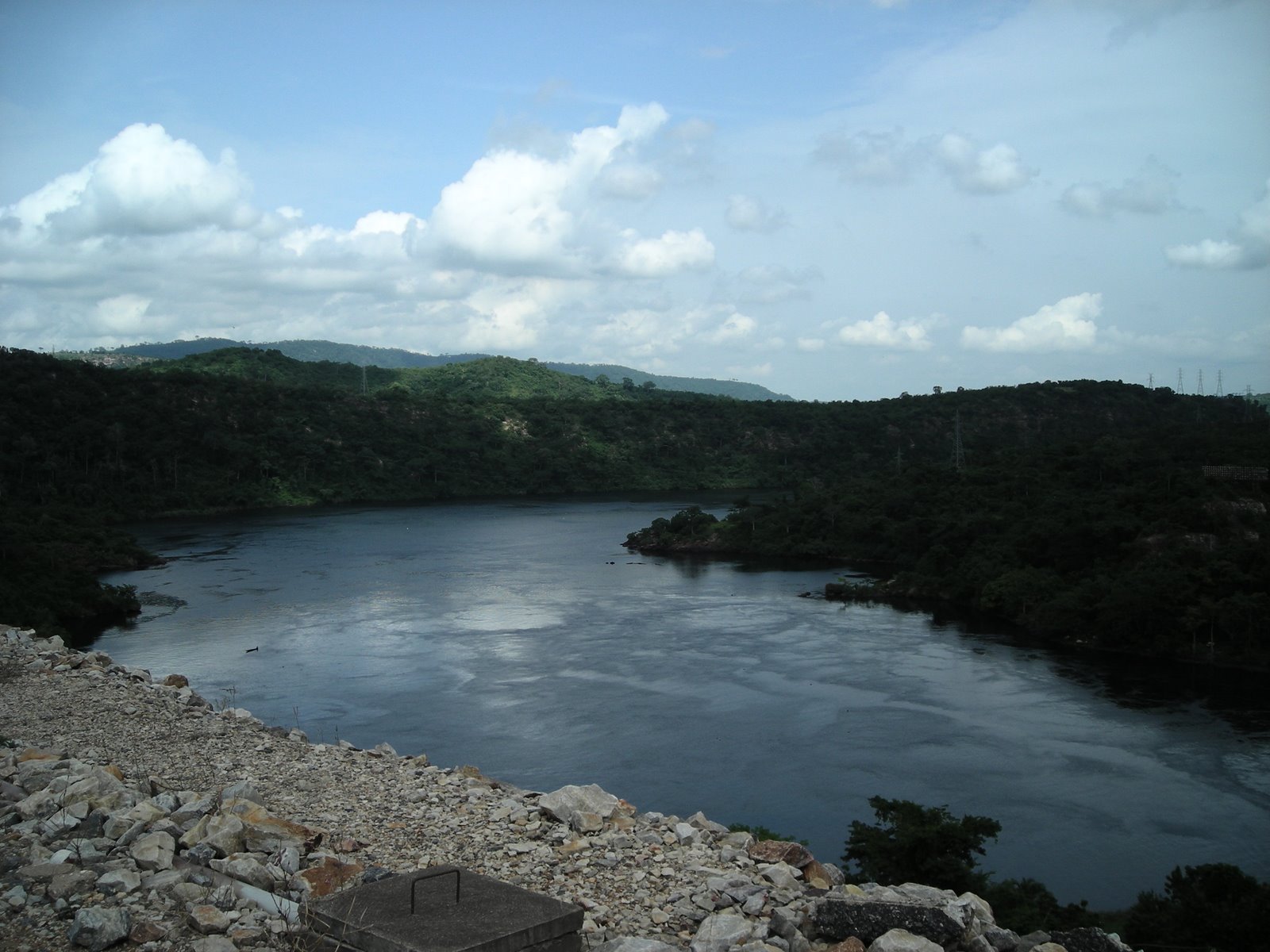
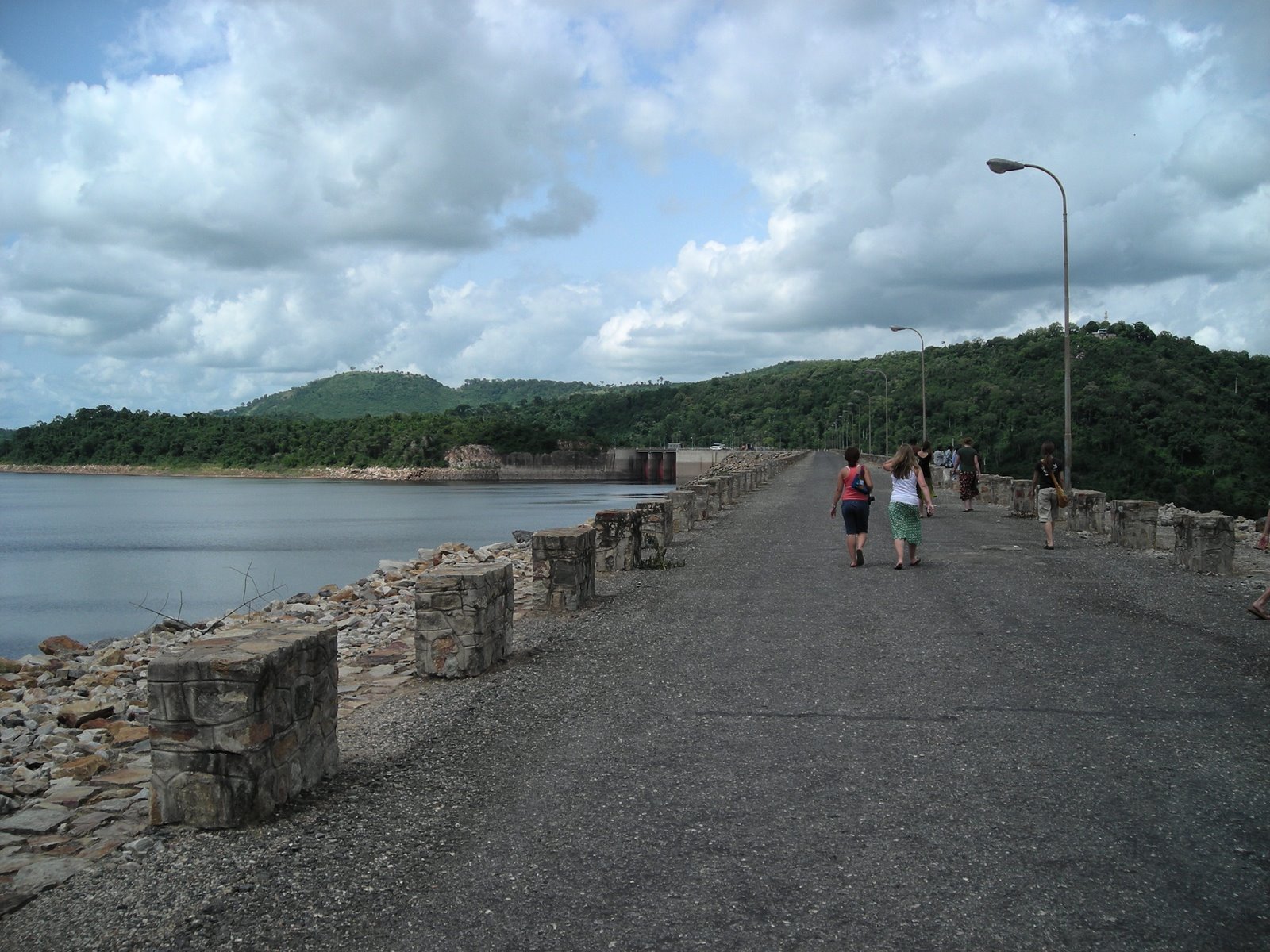
We visited the Akosombo Dam, creator of the largest man-made lake in all the world. This dam was constructed in a brief three years by Italian engineers. The Lake is formed from the Black, White, and Red Volta Rivers coming from Togo, Benin, and Cote d’Ivoire. Volta in the local language means ‘rapids,’ now there is just a giant dam. The dam was built to be used for electricity and to create a source for fishing. The dam was huge and presented a great mark on the landscape of Ghana’s lush forests near the Volta Region. The dam provides all the power for Ghana, but currently there is an energy crisis. We have experienced this crisis with frequent black outs and power outages al across Ghana. We discovered why this is happening by viewing the extremely low water levels for the operation of the dam. Our guide told us that they are waiting for the rainy season to get into full swing to fill the Lake Volta and increase the power.
No pictures were allowed of the operational side of the dam, but here they are. After learning all about the dealings and history of the dam and how it works we walked back across the bridgeway and I noticed that there were less power lines heading to the north of Ghana and a great number headed to the Accra city center and southern Ghana. This seemed to be an all too common theme and yet again more evidence of the disparitites between North and South in Ghana. Kyle noted correctly that this was a great scar of development. The dam stopped up the rivers that now create the Lake Volta which covers one fourth of the country. It harnesses the water for electricity and development. It sits high and heavy on the once beautiful landscape on Ghana and screams of a continued practice of harmful ‘development.’

Seeing Lake Volta for the first time reminded me of an article that our professor showed to us about child labour in the fishing industry on lake Volta. The article was from the New York Times and followed the stories of families that could not eat and sold their children into labour for money with the promise of seeing their child once a year and being sent more money. Those promises rarely hold up and often the children are beaten, overworked, and never return home. The article covered the story of a young boy who worked on Lake Volta, fishing in the potentially dangerous waters with little sleep or rest, and a lot of work. Child labour is not beyond the ‘most developed’ country in Africa. It happens here, in the very eyes of development.


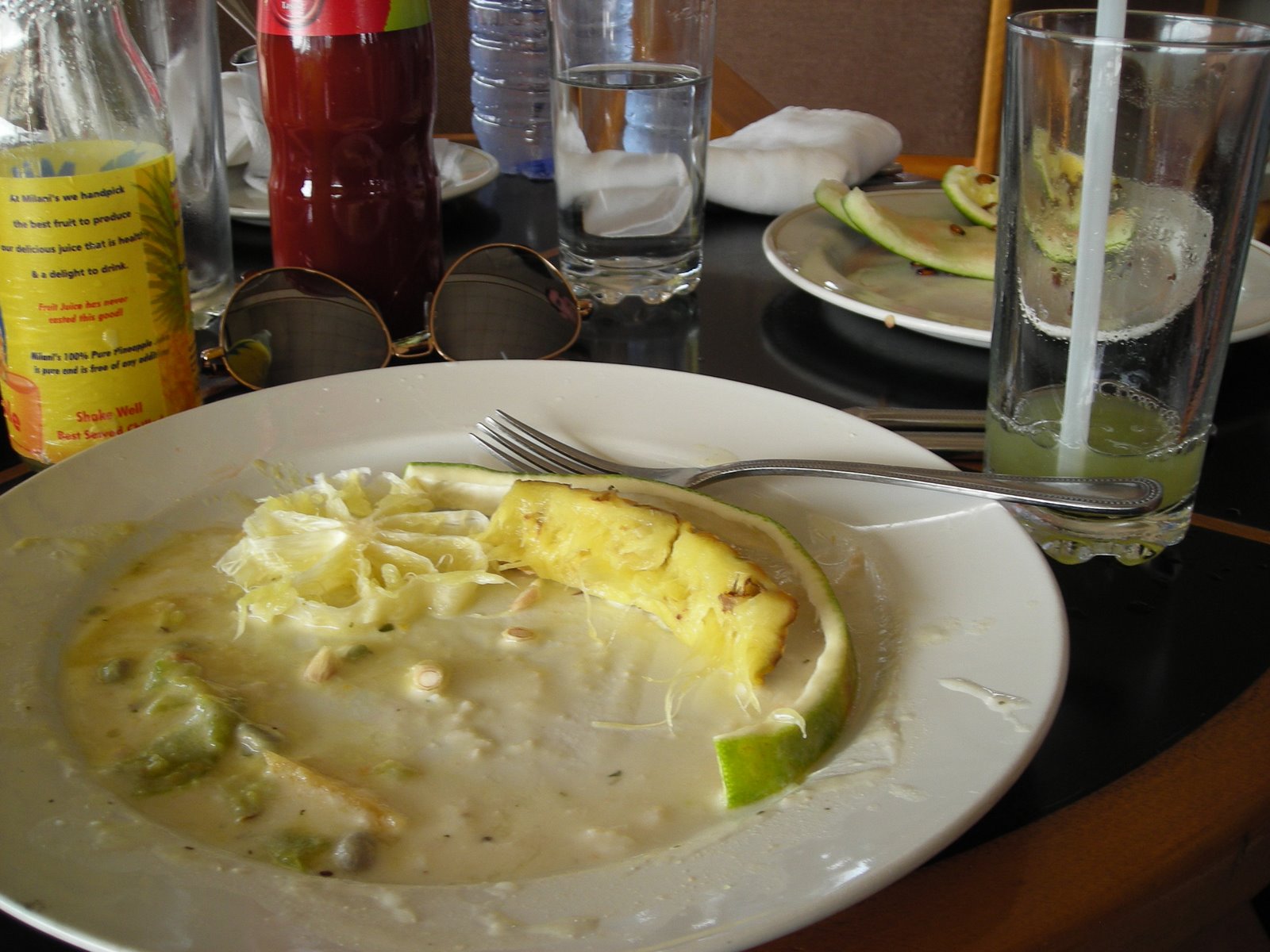
We headed over to the Volta Lake Hotel to have lunch. The hotel was a great Western hub catering to Obrunis (this is the correct spelling) and providing one of the most delicious meals yet. I forgot to take a picture before the meal, but here is the after picture of my ravaged plate. I was quite hungry by this time and the fillet of perch with a cocktail fruit drink and fresh fruit hit the spot.
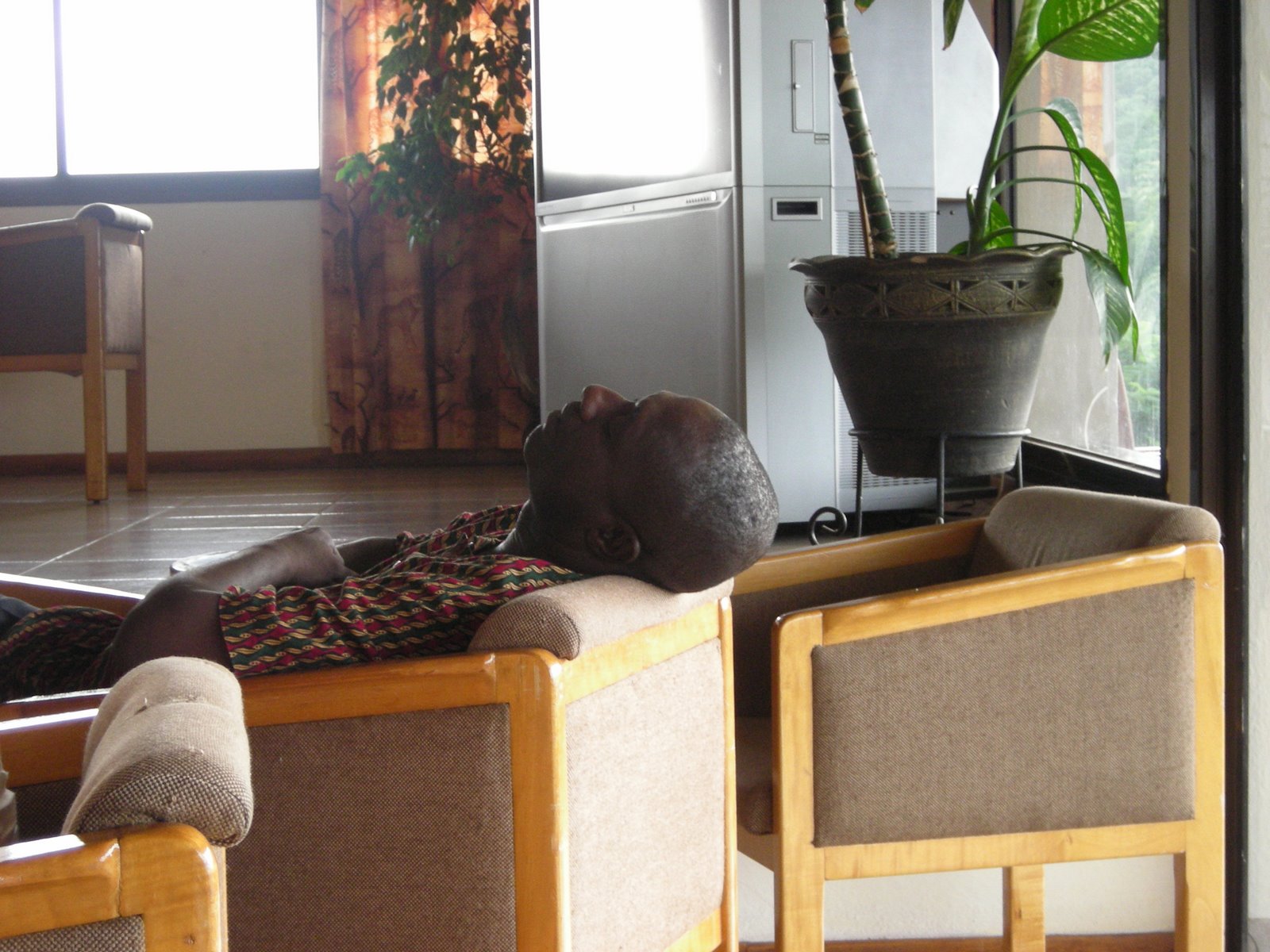
Our bus driver was very tired this day since the day before the bus needed repair and there was trouble finding the part, he had been up since 5 am that day. He took a little nap.

Index of blog post series on Ghana.

the chinese influence

The Chinese influence in Africa is a topic that I have been researching for a few years now. I have conducted most of my research by way of news sites and journals in the States and with the help of the internet, but now I have the opportunity to see firsthand the impact of the Chinese influence in an African country. This entry will follow my experiences and insights on how China is involved in Ghana.

The first thing that someone traveling in Ghana will notice is that there are so many Chinese restaurants. They are just about everywhere. Chinese food is almost as prevalent as Ghanaian food. Sadly, the Chinese food is not at all what you would find in America or for that matter China. The menus are often 15 pages long and with only minimally Chinese named dishes. Nevertheless, Chinese restaurants are everywhere. Also in the service industry there are a number Chinese themed hotels that host a number of Chinese tourists and business people. On our walks down East Legon we see them buying bread and other food stuffs at the market.

As some of you may know, China is currently one of the highest (maybe the number one) foreign aid provider. This is often called ‘rogue’ aid because it is not administered through an aid institution without any restrictions on aid usage. This aid is evident in Ghana with a number of projects sponsored by the Chinese government. One day on a tour of Accra, near the Kwame Nkrumah moselium a police escorted motorcade shot through the traffic with a handful of Chinese officials. The wonders of Chinese aid is prominently displayed in the construction of the National Theatre, it was completely funded by the Chinese government. I wonder if there is any linkage between Kwame Nkrumah’s administration and the remaining Chinese connection. During his rule Nkrumah often hosted Chinese officials and received help from China.

The people, the aid, the food, the history is all here. There is a deep worry, that I often agree with, China is seeking to gain natural resources from African countries. They make a number of aid packages for ‘development’ and sign bilateral trade agreements, but what does it all mean? Is China’s motive in Ghana to reach a growing market economy? Is it to cash in on the mineral wealth of Ghana? It cannot be just to build a National Theatre and assist the Ghanaian government with ‘development.’ I really wonder what the specific trade-off for China is.

China is not the only big aider that I have noticed while in Ghana. Iran is sponsoring a number of projects and many of the government ambulances are donated by the Republic of Iran. I will touch more on this in ‘A Snapshot of Health in Ghana.’

Index of blog post series on Ghana.

. . . keep your promise!

Congratulations big sister Molly on graduating from Kettering University! Now the lifelong education starts which no school or curriculum can offer.

At the end of this week we traveled to the Ashanti Region to visit Kumasi and some of the surrounding villages. We began our travels just as the G8 Summit was ending and the news has been all over the importance this summit held for Africa and Ghana.

8 June 2007
The eggs and toast constant has finally been broken with some glorious french toast – syrup, cinnamon, and a delightful change. No one in our group has ever appreciated or enjoyed french toast as much as we did that morning. The heat and sun have also returned from an absence. It has been a rainy and overcast week, but the sun emerged to greet us. Before hitting the road we stopped at the Forex to exchange some money. Aljazeera News was playing and the topic was the G8 keeping promises to African aid. They reported that $25 million is sent to Africa in aid each year, but that there is an $8 million shortfall. During this summit the G8 pledged to give $60 million to fight HIV/AIDS, TB, and malaria in Africa. Will these be promises kept?

We hit the road for the 5 hour trek to Kumasi. It would have been a very boring and tiresome ride, but I had my book and BBC radio to keep me company. Top stories included the role of the G8 in keeping promises and African nations also keeping promises, J.A. Kufor, President of Ghana, speaking on behalf of the African Union as chairman asking for G8 commitment, and a stunning story about female genital mutilation (FGM) in Cameroon – a boy ran from home with his younger sister to protest and to protect her from the harmful practice. Their father then went to the village council to plead with them to abandon the practice as it had taken his son and daughter away from him. The village then banned the practice and the children returned home knowing that now many girls would not have to suffer FGM. I had also purchased a novel from the University bookstore, The Last Duty. The book is about the Nigerian Civil War of 1964, which I knew nothing about in all of my studies of Nigeria. The book tells of the war and its effect from six different people’s views, all six are linked, and all six represent a different side of the story – except for the rebel view.

Our first stop before Kumasi was Bonwire village where we visited a Kente cloth weaving shop. We were mobbed by children here and people trying to get us to buy their stuff. It must have been one of those tourist common spots. It was interesting to see all the Kente cloth and Eric, out bus driver, helped me bargain for a Kente cloth tie – very awesome. Some of the sellers were very persistent. One, I forgot his name, stuck with me and haggled me for a long while. He tried to sell me bookmarks, then helped his friends sell me stuff, then asked for money for his grandmother, sister, and himself – the story always changes.

Gracious Living Hostel was situated on a road that I knew well. It was the typical African roads that I had come to know from Uganda and feel always in my hindquarters – not a smooth surface to be found, dust kicked in the air blinding all, and a tense body ready for the next impact. At the hostel there was some trouble with rooms and so we were a bit crowded in the beds, but hey this is Africa, we can deal. Some of us played a card game called ‘peanuts,’ but which I later found out was the game I knew as ‘nertz.’ It reminded me of some great afternoons with Grandpa.

9 June 2007
We began our day with a nice breakfast and went to the Kejeta Market in Kumasi. This is the largest open air market (in the world? in Ghana?). The market was much like Makola market, but much bigger and crazier. It was also much more fast paced and there were narrower alleyways and more grabby stall owners, there was just so much more happening. In the market is where I also witnessed the ‘travels of a t-shirt in the global economy.’ There were many stands sporting the latest Western fashions, but these were obvious imports. There were large groups of people sorting slacks, jeans, and t-shirts from piles of clothes imported from the ‘developed’ world.

Afterwards we headed to the village of Kurofuforum where we learned how brass figurines are made. It is such a long and tedious process with so many steps. It gave us a new appreciation of the artwork. The man showing and teaching us had scars all over his knees and arms and could pick just about anything directly out of the fire – so calloused and hardened by his work. We then went to Bosumtwi Lake. Here we were accompanied by local fishermen on their fishing boats to swim in the lake. The fishing boats are comprised of half of a tree log, that is it. It was a very good workout to paddle all the way to the middle and a joy to swim in the, what felt like, 90 degree water. What a great experience.

10 June 2007
We began today by stopping at an Adinkra village to see how cloth is stamped. We bought a cloth and witnessed some of our professor’s skill at arguing and bargaining in Twi to get a good price. We then all took turns stamping the cloth to take back with us as a reminder of our trip.

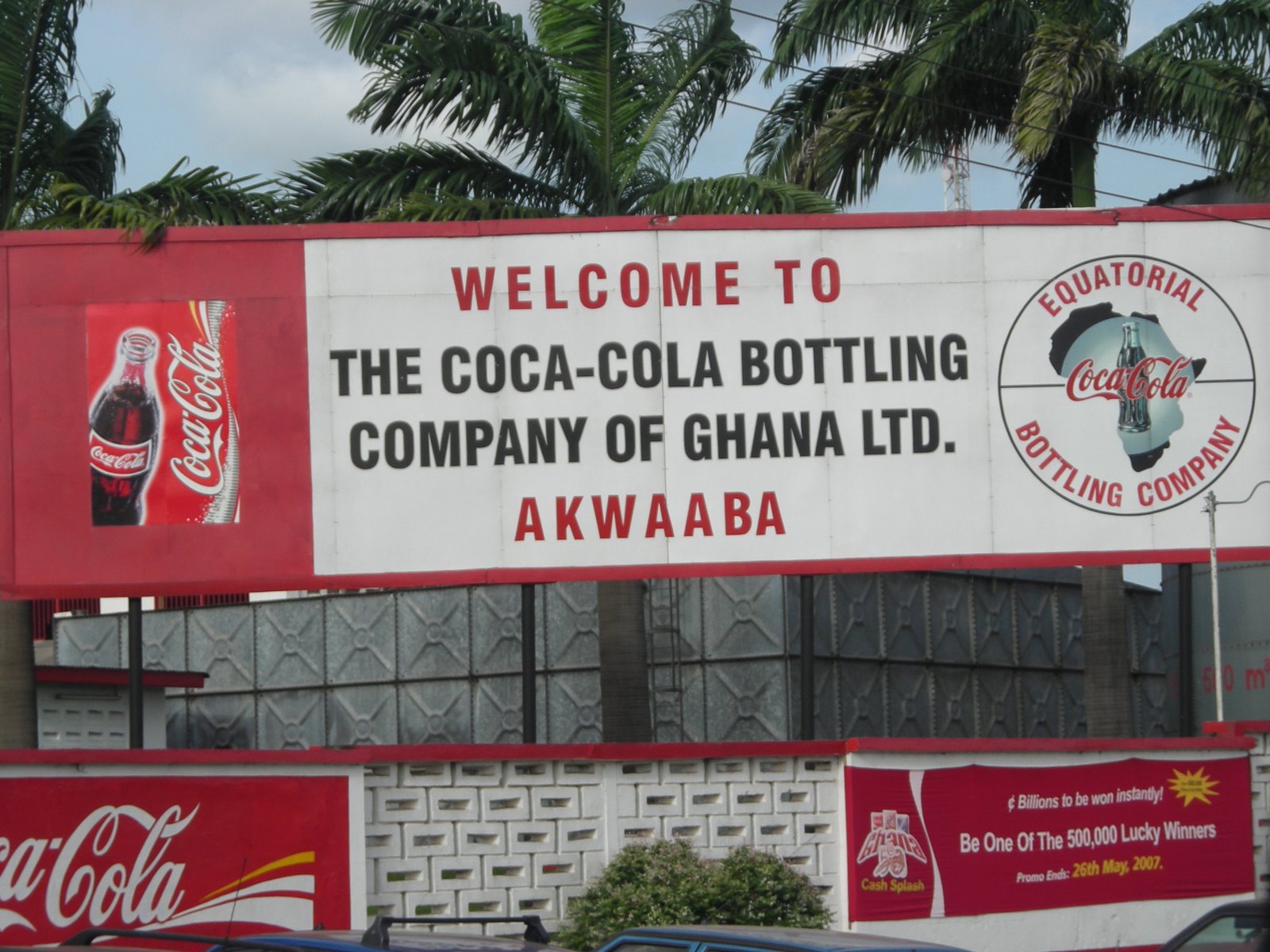
We happened to pass the regional bottling station for Coca-Cola in Kumasi. Coca-Cola is the drink of Ghana. It holds about 90% of the soda industry here against Pepsi.

We visited the Royal Court and Palace Museum of the Asantehene, the ruler of Asanteland in the Ashanti Region. No pictures were allowed and the outrageous price for foreigners followed us into the compound. We were first subjected to a propaganda video about the Asante people. The video claimed that the Asante were peace loving people, yet if you look at their history it is clearly evident that they were quite to use violence and were very aggressive people who instigated many conflicts. It was very interesting to learn about the history of the Asante people from the very place where their kingdom resides. It was especially interesting to learn directly about a people that I have studied so much.

On the way back to Accra from Kumasi, BBC doesn’t come in until you get closer to the greater Accra region, I finished my book and was finally able to listen on the BBC to debates about the G8 summit from an African’s perspective as callers from Tanzania and expats from other parts of the world voiced their opinions and reactions. Another interesting story was about the Burma Boys of Nigeria who fought in WWI for the British in Burma. The story was of colonized Nigerians fighting in Burma and being addressed by the Japanese fighters in perfect Hausa, one of the major language groups of northern Nigeria.

This weekend we have seen the greatness of the very western oriented Kumasi and the kingdom of the Asnatehene. We were able to see part of the reason that the British gave Ghana the colonial name of the Gold Coast from the wealth of the Asnate. We have experienced a region deeply rooted in tradition, powerful traditional rulers, and great wars with imperialist countries.

On the way to Kumasi our professor commented on how much has changed since the last year. She noted that there was so much money flowing into the country now as opposed to just a year ago. Is the G8 keeping promises in Ghana? we have passed so many road improvement projects that it is almost as if I am back in Michigan and experiencing the common ‘summer of orange barrels.’ Except that there is no such thing as orange barrels here, there is just random stuff in the road to divert traffic. The money and aid flowing into Ghana makes me wonder if there are any G8 promises not being kept here. The promises for keeping aid promises by G8 countries is rebuttled by the G8 calling for promises to be kept for good governance in Africa, and is again clashed with the argument by many African intellectuals to have foreign countries leave ‘development’ to the Africans.

Check for new pictures of drumming and the Peace Corps in older posts.

Index of blog post series on Ghana.

definition of development

7 October 2008 Update:
Read a more comprehensive analysis of the definition of development in a more recent post here:
definition of development (revisited): beauty in the palm of your hand.

————————————————————————-

After lecture, and another drum lesson from master drummer Chris, on Monday I gathered a group of people interested in visiting the Peace Corps offices. Six of us worked to get taxis outside of the University with a certain degree of difficulty – probably because no driver knew where it was located. It seems that our group is very good at choosing destinations of which no one has heard. All we knew was that the office was located at 26 W. Cantonments Road – nothing more.

After a great deal of roundabout driving, a couple stops for directions, and some backwards driving (as in driving backwards) we found the offices located on Switchback Road near the house of the Ambassador of Cote D’Ivoire. It turns out with all our driving that we arrived right at closing time for the day with no appointment – I guess that helps. There happened to be a few volunteers at the check-in guard house and thankfully just as we were about to be turned away one of the volunteers claimed that he had gone to school with one of us and he just wanted to show us around.

Alex showed us around the compound and answered any and all questions we had about the Peace Corps. He also shared with us his experience. He is near completing his second year and is located in a very remote farming village in the north of the country. Originally from Nebraska, he was selected for the agriculture and natural resources area. His village is on the cliffs of the north where a ten year war has just ended between neighboring clans. He has started a cashew cooperative with 13 area villages, teaches at a secondary school, works in a hospital, started an HIV/AIDS club, and is attempting to work towards reconciliation between the former warring clans. The Ghana country coordinator had at first called Alex’s assignment ‘hell,’ but he is really enjoying himself and is working very hard to make the most difference that he can. After hours of talking we accompanied Alex to dinner, since we had made him late for a previous dinner engagement – it was ok he said, “they were just high schoolers.” It was really great talking to Alex and hearing his experiences and it really solidifies my plans to join the Peace Corps after college.

This discussion with Alex really made me think about ‘development’ as the word was thrown around a lot that night. Alex has said that he really likes the Peace Corps model because it deals with integration. A volunteer is placed in a village or area and works with the people to improve their situation. This as opposed to some large organization or institution just giving out money to big plans they believe will work. But, what is the definition of development? Who gets to determine what development is? Who is allowed to call one developed or developing or underdeveloped? Is development all based on a desire or push to become Western? Yes, I think in the very recent past it was and really still is to a degree, but for me development holds a different definition. Development for me mirrors positive progress in people’s lives. Development should be based on getting and giving people their basic needs (rights) for survival and life. Even in this regard the almighty ‘West’ needs development.

————–
Read a more comprehensive analysis of the definition of development in a more recent post here:
definition of development (revisited): beauty in the palm of your hand.

Index of blog post series on Ghana.

inside africa

It is very interesting to be actually in Africa and get the news about Africa. I am actually in the continent that I have covered and studies so much.

2 June 2007
Woke up at noon from a late Friday night. I jumped in the plan with some other students to go to the Makola market and then the beach. There is just something about Makola market that I love. It is not like the other markets or anywhere else in Accra. It may be crazy and seem very frightening and insane to some people, but I love it. The people are hospitable, they are nice, they are business people. They are there to make an honest sale, to run a business, to get you what you want. Many store owners who do not have what you want will direct you to where you need to go. They will not hold you up and try to get you to buy something that they have like most other places. I did not go to buy anything, but people watching is a favorite pasttime of mine. Sure, I am usually the one being watched, but I have come to find out how to be a less imposing and conspicious Obrooni. I have taken to wearing my flip flops often, as many Ghanaians do, my clothes are not flashy or ‘American,’ I have learned more Twi, and I carry only small bills, nothing larger than 10,000 cedi note ($1 USD). I am still obviously an Obrooni, but now after 3 weeks I am slightly more accepted because I know – to a tiny degree – Ghana.

The next day I watched the CNN special show called ‘Inside Africa.’ From being in Ghana (Africa) and getting the news about where I am is really exciting. Namibia is having troubles with illegal ivory trade, Tanzania is developing its gold production industry with foreign investment, Uganda is constructing a power plant on the Nile, Tony Blair is taking his last official Africa tour. He is calling for the West to keep promises of aid because it is a duty and in self-interest. During his term British aid tripled, and some citizens have called it, “… a waste of English time and tax dollars.” Bono was interviewed about the G8 summit in Germany – as usual he stated to keep the promises. He noted that now in the 21st Century people die from a simple mosquito bite – why? how? He also can see a social movement growing in the US and Europe. Finally in the news, the Nigerian president is sworn in, but are the people really happy with the status quo? In Nigeria 77% of the people live on less than one dollar a day, yet their president is re-elected.

Index of blog post series on Ghana.

two voltas, one ghana, three africas

The past two Thursdays we have traveled to the Volta region – one trip to witness tradition, the other to indulge in tourism. Both were early morning trips to the furthest eastern region of Ghana. The region is the major Ewe region of Ghana, it was decided by the British to slice Ewe-land in two after the defeat of the Germans in World War I. The major ethnic group and the remainder of Ewe-land is in Togo. The British were greedy. The route we took was a toll road, no speed bumps or potholes (relatively smooth ride) straight across from Accra into Togo. I couldn’t sleep and our guide accompanying us told us before we left that in the Volta Region we would see things that we may have only dreamed about. Everyone tells us that whenever we travel we will see something so different. This really say something for the small country of Ghana, that just traveling to a different corner of the country can be such a unique experience – this says something more for Africa, since Ghana is one of its smaller countries.

27 May 2007
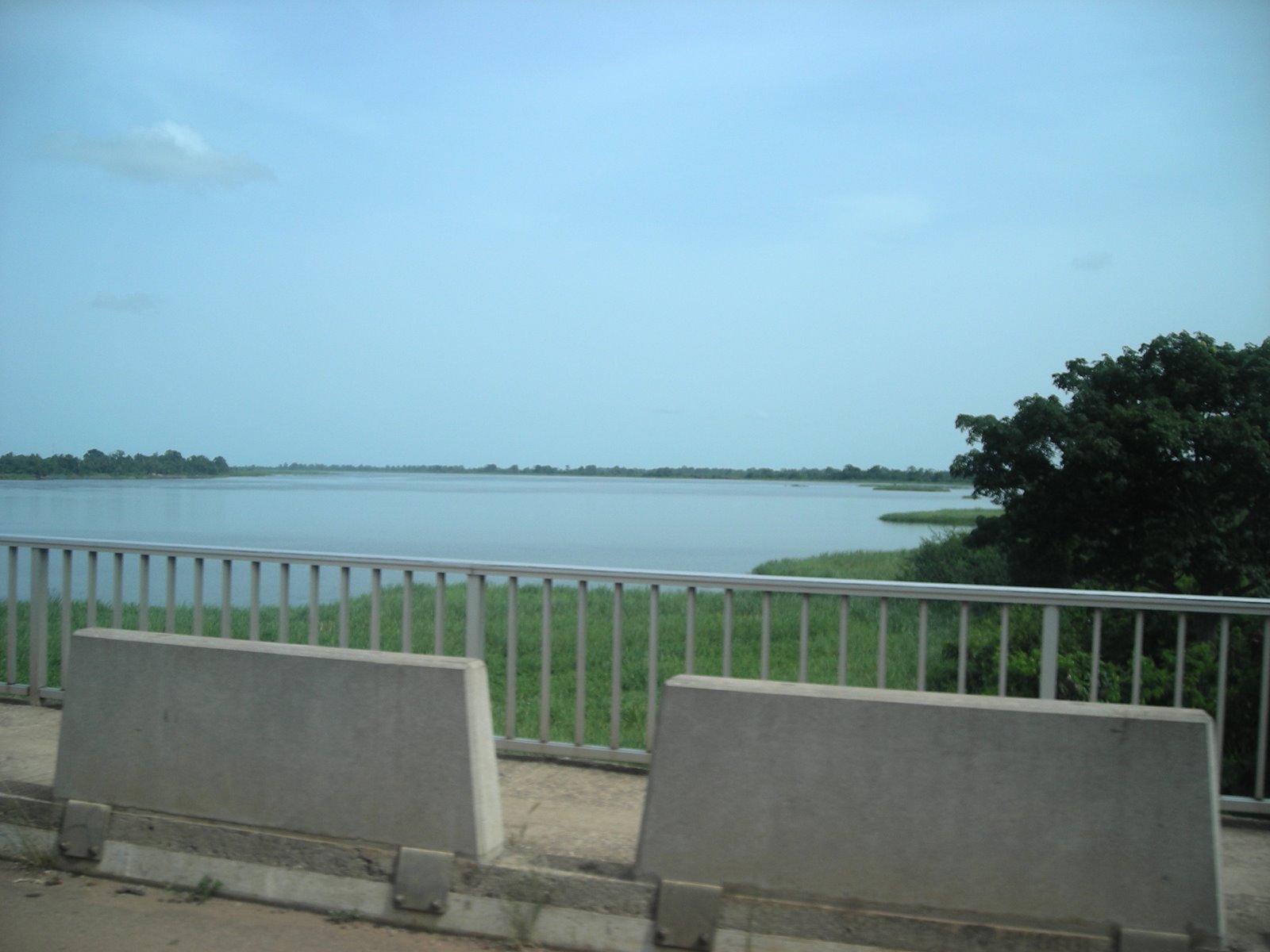
As we left the Accra area we passed many huge, mansion style, western homes built far from the city’s busy, crowded and slightly imposing character. These palatial (check that out mom) homes seemed to present a city of their own set above the rest. Further out was the land of big trucks and truck stops. Rows upon rows upon rows of trucks; tanker, flatbed, carrier, produce, waiting for cargo filled a long stretch of road. Even further from the city everything turned to green. Oh so green, we passed a lush landscape dotted with trees and two-person high mounds of red dirt – this was the kingdom of the termites. The mountains in the distance were highlighted by the rainclouds overhead. After crossing the man-made River Volta we were finally in the Volta Region. Here we were treated to a very different ride – massive potholes. The bus zigzagged the roadway to avoid the potholes and crevasses – it felt as if we were in a Star Wars asteroid field. It seems that the government does not have much to do with the region.

We first went to visit the local chief of the village of Klikor, which is one of the important settlements of the Ewe people. The chief has ruled over a kingdom that is over 400 years old. The chief commented on this related to development. He noted that they were much older than the US, but that they were less than one-tenth as developed. He orated a great history of his people, village, and how they eventually settled in Klikor. It was almost like living the reality of so many books that I have read. He also gave us a history of Ford and what he did for the US. He mentioned that everyone here (Klikor) had benefitted from the Ford Foundation, how I am not sure. But he did make a great point that President Ford was not one of the wealthiest men, but he left a great deal to charity and his foundation. The chief went on to tell us what to tell our friends back home, but instead jumped into a lecture on the US and Iraq. This is about the fourth such lecture that I have experienced on this trip. He made an important note that even the ‘smallest mistake of the US’ has an impact around the world. One of the students later commented on how “Africa-esk” that experience was – this is Africa!

We then traveled to another part of the village to experience traditional African religious practices. We were to see a ritual possession ceremony. Before the ceremony we were treated to the most simple, but delicious meal that I have had yet -the best tuna that I have ever eaten. We changed into the proper dress – a wrapped cloth. We were welcomed with drum and song and given kola nut and whiter clay as a sign of welcome along with a small, narrow, triple shot coconut cup of dry gin which tantalized the throat and assisted with the dancing later.


The possession had already begun and the high priestess already conveying messages from the sea-god. I have complete respect for the traditions of the village, but throughout the ceremony I could not help but think that this was a performance. I think Kyle put it best during our discussion of the ceremony, “It is like a choir performance, we may never understand what is happening, but it is still a performance.” The performers exchanged knowing looks and laughs and my thoughts were solidified. I mean no disrespect, and I really think that our experience would have been different had we been embedded in a village and taken part in the ceremony firsthand.

The rains had come as we ate and continued throughout the day. We left and our bus navigated the narrow ‘roads’ of the village where bikes and motorcycles dominate the streets. The typical houses were mud and thatch, the wealthy had cinder block houses. We returned home in the growing rainstorm.

31 May 2007
Memorial day spent in Ghana, I hope the water is not too cold for putting the dock in. This is the first time that I have really thought of home. It is plenty warm here to put a dock in any day.

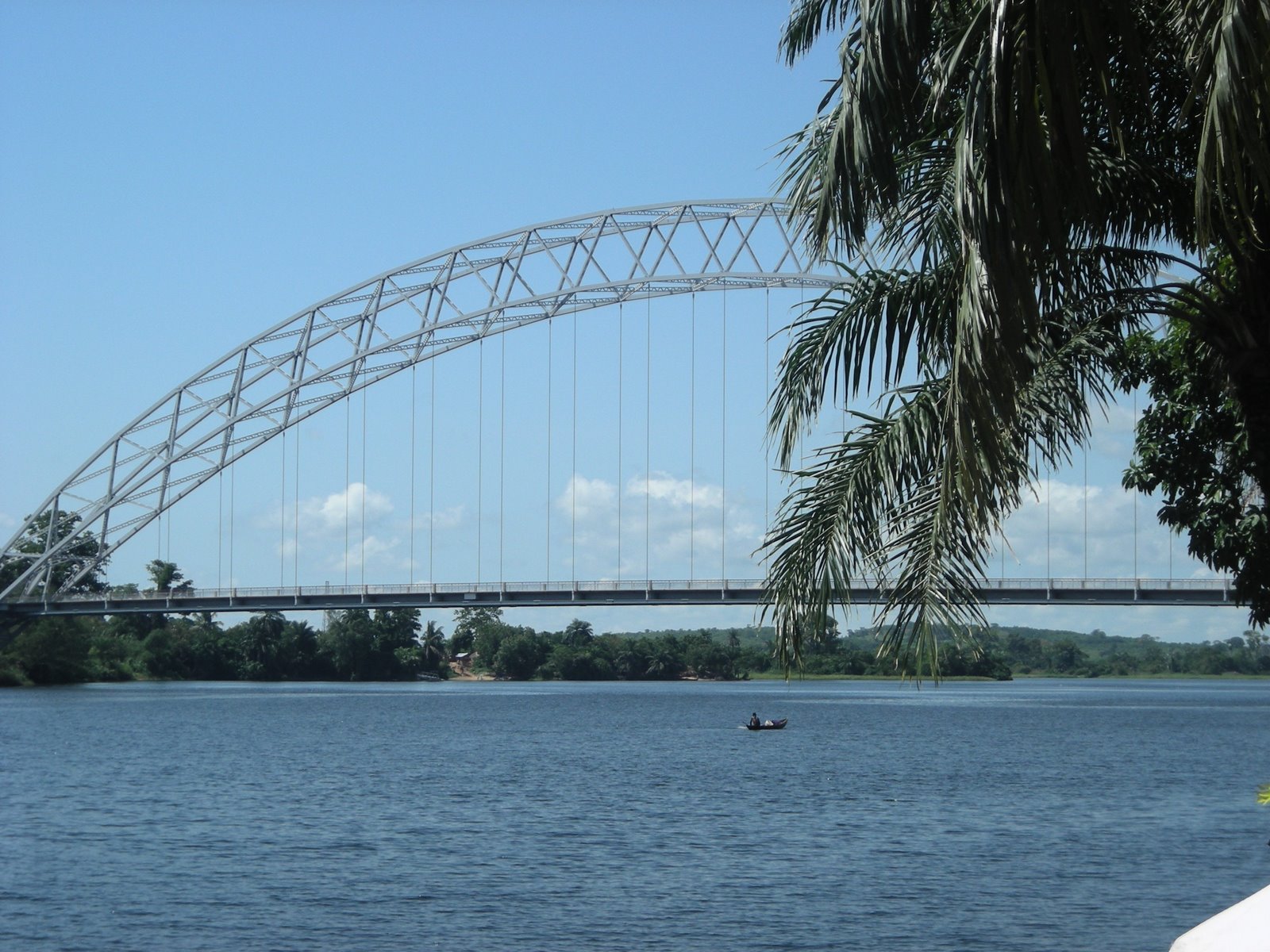
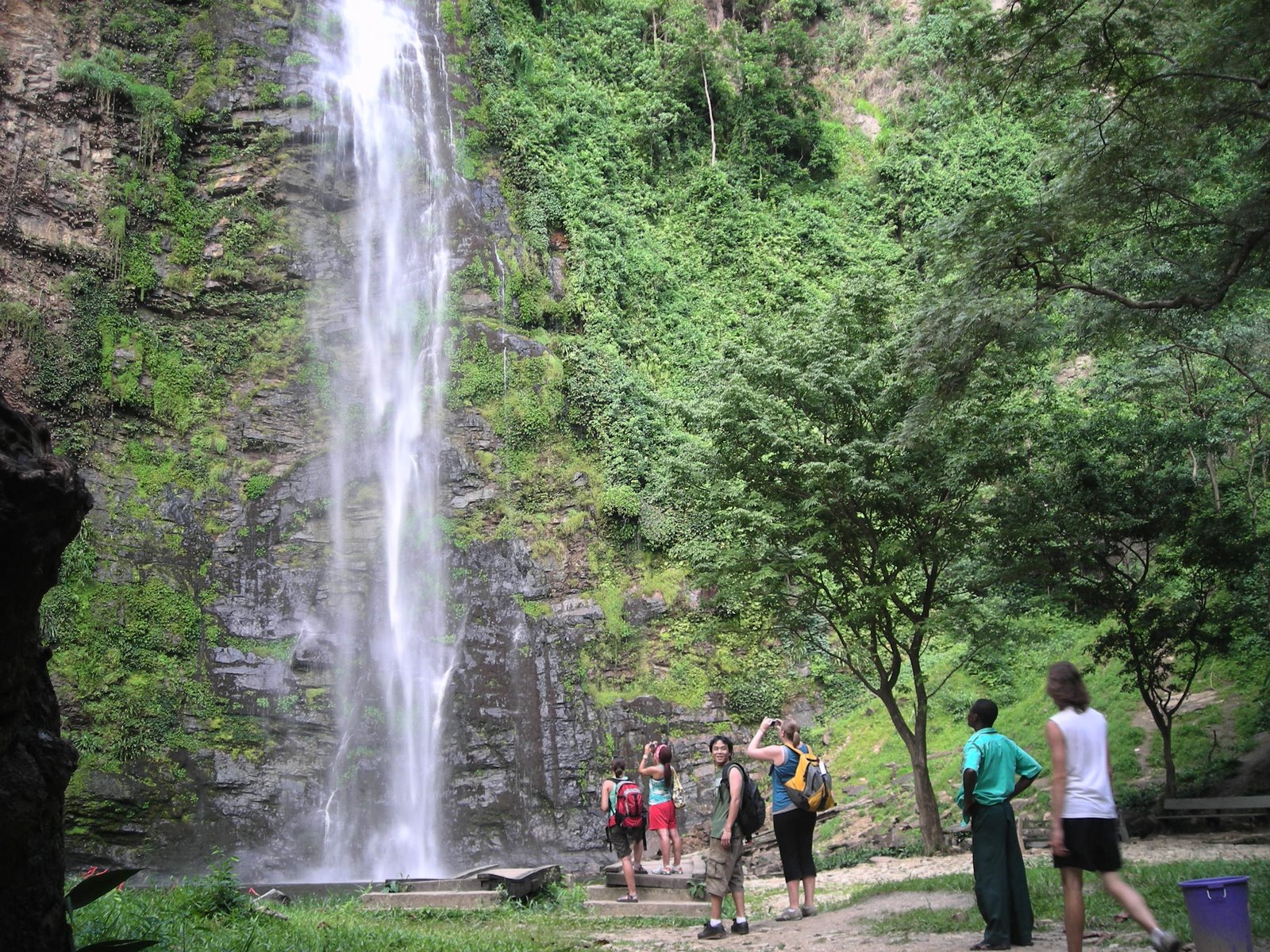
This was another early morning headed back to the Volta Region to see the waterfalls. We took a much different route than before since the falls are about 6 hours drive from Accra: three hours to Volta and then three hours more in Volta. This time as we crossed the Volta River, we stopped at a riverfront hotel. This hotel was very nice, a prime place to spot an Obrooni. There were none, but there were monkeys and exotic birds in cages. There were speedboats and jet skis to be rented and a very nice pool to swim in. We had entered the second Volta. We crossed the river this time by way of a nice large bridge. and the roads showed that the government had not neglected this tourist favorable side of Volta. We arrived at the falls and met our guide. He took us on the 40 minute walk to the falls and showed us some of the local trees and wildlife as we went. He told us that behind the mountain pictured was Togo, so close.

We journeyed through the beautiful wilderness and finally heard the sound of the falls and saw its wonder. The falls were amazing, the tallest in all of West Africa. The fruit bats covered the mountain side and screeched and sprang to life as the group screamed and swam in the falls below. It was incredible to see. I wish that I had not forgotten my swim trunks. Next time.

These experiences brought to life my thoughts that there are two Voltas in Ghana. We saw them both and I guess if you can bring the government tourist money then you will have paved roads, nice hotels, and the access to basic infrastructure like electricity. This also makes me think of George Packer’s chapter in The Village of Waiting titled ‘Three Africas.’ I think it is very interesting that what he explains in the pages of his book, I have seen in my limited African experience. I saw the ‘village’ Africa while traveling rural Uganda, the ‘tourist’ Africa in the Queen Elizabeth National Park of Uganda and the waterfalls of Volta, and the new, growing, struggling Africa in the booming city of Accra, Ghana. Full of new technology, development, and thriving with entrepreneurs. These three Africas can be seen on any travel to Africa, but most of the time these three very different Africas are only seen one at a time. Does that mean that I have seen the true and complete Africa? I think not, I have only traveled to three countries in Africa – there is so much more to see!

Index of blog post series on Ghana.

what is so important about ethnicity?

Day 12
We got up so early today. Egg salad sandwiches (Ghana style) for breakfast with a delicious multi-fruited juice. The bus was late because traffic was so thick, almost like pure, unprocessed groundnut paste, mmmmmm. Lecture today was on the ethnicities and ethnic relations in Ghana. I am going to begin writing more about thoughts and issues that come to mind while in Ghana now that I have covered the basics of where I am, what I am doing, and how it all happens.

Ghana is a state with many nations of people, many ethnic groups. Ghana is a state of nations and needs to be one united nation of people. There is a long history of ethnic tension and turmoil in Africa, you cannot lump every African experience with ethnic conflict into one ball of dough. You cannot think that every issue of ethnicity results in what you have seen in Hotel Rwanda.

Nigeria has had a long spat with ethnic tensions, especially in politics. This led to a civil war in 1964, of which I do not know much about. This war has created a tense ethnic political struggle as evidenced by the most recent elections and the numerous calls of foul. Nigeria now sits divided into 36 states, most based on ethnicities.

Cote d’Ivoire began an ‘open door’ policy and many people flocked to the country. However when elections rolled around only natural born Cote d’Ivoirians could run for the office of President even though now the country had so many new citizens from many differing places who felt the need to be represented.

The most well known example of ethnic tensions built into full blown conflict is that of Rwanda and Burundi. With the Tutsi minority given the reins of power by the colonial controllers, the Hutu majority did not appreciate this and built up the difference of ethnicity until this was such an important issue to cause genocide in 1994. However this conflict began well before 1994 and continues long after. The conflict spread into the DRC and countries such as Uganda became involved.

Among the many examples of ethnic tensions and conflict Ghana remains a fairly good example of how conflict and death can be avoided. As with many African countries Ghana was a country etched onto a map without regard to established nations of people or traditional ideas of territory. Because of this Ghana has a number of ethnic groups. Politically Ghana has avoided conflict by requiring, in the constitution, that each ethnic group should have representation within the Ministries of the government. Another point that has led to the uniting of ethnic groups for one Ghana is the secondary school system. The secondary school system is a boarding school model and most students travel long distances to go to the best schools in Cape Coast. While in school the student learn about the different ethnic groups and learn to live with one another. This creates more of a rivalry between school teams and less of a rivalry between ethnic groups. The issue of language often arises in Ghana. Most of the country is Akan speaking, yet it is considered politically incorrect to declare the major Akan language of Twi to be the official language. Therefore the country is united in language by English, but everyone says ‘Akwaaba.’ No matter where you are a Ghanaian will welcome you with this Twi phrase.

We had a field trip today to the National Museum of Ghana, which is also celebrating its 50th year of being open. The museum was really quite lame. There were some cool artifacts from the history of Ghana and other African countries and people, but it was again nothing that we had not already seen. The tour guide was a bit loopy too and told us most of the knowledge about Ghana that has been hammered into our heads from every tour we take. Back at the hostel we ate bananas (the short sweet ones), crackers with pure fat happy cow cheese, and vanilla wafer cookies. Kyle and I headed to the internet cafe. Our first ‘reflection’ paper is due on Thursday and some of the students are typing them out. I finished mine the old fashioned way. I reverted back to the good ole days of elementary school and handwriting a paper, it was very reminiscent – and yes it was legible.

We all gathered around the tv in the courtyard to get ready for the Champions Cup game between Liverpool FC and AC Milan. We were all pulling for Liverpool. They dominated the ball the entire match, but Milan’s ability to make a goal out of anything did them in. Milan took the match 2 – 1. What a let down. The ‘the value is the same commercials were quite entertaining as well,’ but more on that later. It was a sad ending. We also found out that our good friend Richard was fired. The story is that he supposedly took something from a room after a visitor had left and denied it.

That evening the rasta guys showed up to take us to the reggae club on the beach. We had been warned by our other Ghanaian friends about this because bad things had happened in the past. However, the majority of our group wanted to go and since most of them were girls we were not about to split the group. The rasta brought a trotro,one of them must have owned it, but we joked that they might have stolen it. It was my first ride in a trotro. They are the cheapest form of transport in Ghana, but not the safest. All 20 of us piled in and headed to Osu to pick up some more members of our group. We headed to the beach with a typical trotro load – packed like sardines. At the beach we were charged to get in, first it was 10,000 cedis, then it suddenly changed to 20,000 cedis. That made quite a hassle, but we finally entered the beach. The rasta for some mysterious reason did not have to pay (because they brought the white girls). We got to the beach, were given seats, and ordered drinks. The waves on the beach at night are amazing. They are massive and seemed to go in no particular rhythm as they usually do during the day. Glancing around the beach it was easy to see that all present were Obroonis or rastas looking to make friends with an Obrooni to get a drink or to get a girl. Our group stuck together, looked out for one another, enjoyed the music and dancing, and helped each other out of creepy and potentially bad situations. In the end it was a very fun evening, but this is where the true intentions of our rasta friends showed through. I hope everyone in our group now understands now my previous wariness.

The rasta are a very interesing group and fill a very odd and unimaginable role in Ghana. They worship Bob Marley and weed. If you get them talking they will go on and on for eternity about how it is ‘nice to be nice’ or ‘charity is carity.’ Many have great musical skills, but not such great skills when it comes to meeting a girl without creeping her out. Most are defined by their dreads, knit hats, drums, or weed wisdom.

Index of blog post series on Ghana.

imperialist footprints: the development story from the inside

Day 10 | May 21, 2007
We actually woke up on time today. It was probably because it was very difficult to sleep with sunburn. I kept tossing and turning to find the right angle to get some rest. Without the sheet it was too cold because of the AC on the sunburn, with the sheet it was too hot on some sunburned areas. Having sunburned hands I think s worse than sunburned feet or shoulders. When you even wash your hands it sends s shooting tingle through your hands. At any rate we were up and enjoyed toast and eggs for breakfast. It was a very overcast day and for once my sunglasses were not needed. Rain seemed imminent. The sky was so dark as we headed to the University for lecture. We arrived for lecture and the skies grew darker yet.

During lecture the lights flicked and soon the rain came pouring down. Our professor had to speak up to be heard over the roar of the rain on the roof. As the lecture progressed the rain seemed to increase and the ceiling began leaking profusely. Lecture was on colonialism again, with emphasis on de-colonizing and colonial legacies. Another day to zone out and relax. Sixty-eight years old, not an ounce of gray hair, and chasing 20 somethings across the African continent in his khakis, collared safari-style shirts, straw, old man hat, water bottle and bug spray clipped on his belt at the ready, he may not always hear us or understand what the Ghanaians say, but Ted Tims, Teddy Bear, T-bear will always be a great travel partner and has definitely, at his young age, not lost his passion and sense of adventure. Can you imagine 68 and still traveling the world? I sure hope I can do that and without gray hair.

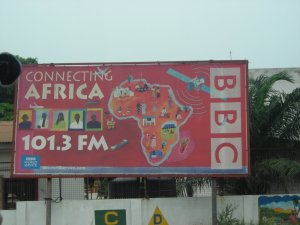
As I sat in lecture I listened slightly and thought about how the colonial legacy was so strong in Ghana. The leading bank is Barclays, a prominent British bank, sponsor of the Premier League of Football in England. The tourists that I encounter are mostly from the UK and when you see an Obrooni it is most often a British accent that responds. The game of football is huge, this may not be a colonial legacy, but as I wrote before, many Ghanaians stopped for the final game in the British football league. Interestingly British Airways has the only flight that comes to Ghana from the US connections or Europe. Ghana is also marked by the English language – anglophons surrounded by francophones. The BBC is a top source for news in Ghana. The education system also is very English. One of the very prominent and important colonial legacies is religion. Almost 70% of Ghanaians are Christian and that shows from the motto and phrases pasted on the backs of taxis, trotros, trucks, and storefronts: ‘Trust God’, ‘Triumph’, ‘God’s Will’, ‘All to Him’, or ‘God is Great.’ These British footprints have a colonial legacy that is amplified by the political and economic implications of colonialism for Ghana.
Politically the Ghanaians adopted the English parliamentary system of governance. They even used to have a governor general like Canada and Australia, but eventually got rid of that stain by adopting the more American system with a Presidency along with a Parliament. The development story of Ghana has largely already been told in a earlier posting on the development of Ghana, but this is what I have been taught and seen from being in Ghana. From the colonial time period Ghana was made to produce cocoa and now they are trapped in that mono-crop (cocoa) production of raw goods. In the 1970s Ghana attempted some ISI (import substitution), but it failed to have an impact because this was just not possible with Ghana’s situation of having limited abilities for industry. From 1970 – 1980 is what is called the ‘lost decade of development’ for Ghana. Ghana began to liberalize its markets with the involvement of the IMF and World Bank and their Economic Recovery Programs (ERP). Ghana still struggled and had difficulty and was soon named an HIPC (highly indebted poor country). This title limited their possibilities for development and aid. Ghana was relieved of its HIPC status later when its debts were forgiven and it began taking, “ginger steps toward standing on our [its] own (Prof. Johnson). This is what Ghana is working on now. The ginger steps of development in this globalized economy driven world. As a few points of interest on development: the government has nothing to do with land ownership – only taxes on businesses, China is Ghana’s number one foreign aider (rogue aid? – see earlier post on subject), and so far I have only seen a handful of micro-finance and lending groups.

I have noticed that the only real developed region is the Accra region, where most ofthe people and aid organizations reside. The other areas to the north and even to the immediate south are left under-developed and neglected. Cocoa is their number one export, but if the country is to develop they need an industry established to produce a finished good with that cocoa. That is impossible however because that role is already set up in the Western industrialized countries. How is Ghana to develop? More foreign aid? I have noticed that there is an interesting relationship with Iran and some development projects. Not surprisingly the US has withdrawn its aid and has nothing to do with Ghana besides USA rice.

Our second lecture was more interesting, maybe because the lecturer was more interested in passing her knowledge to us. The topic was the role of the media in the political system and political change of Ghana. The media was huge in Ghana’s political development. It was first used to combat colonialism, then was controlled by the newly independent state government, used during this time as a public voice for dissent, and finally as a promoter and grower of democracy. In 2000 Ghana experienced, for the first time, a peaceful transition of power to a new administration. The new administration was the politicians who had opposed the government since 1992. This administration had fueled the media’s public dissent and made alliances with the media. The question now is: ‘Is the current media as critical of the new administration since it had alliances?’ Ghana has a very multi-lingual media and this allows for a more participatory democratic system and society.

After lectures we headed to Makola market. Now you see whenever we tell anyone of our Ghanaian friends that we are going to Makola market they laugh, ask us if we are serious, and then tell us ‘goodluck,’ so we were a bit afraid and interested at the same time to go. After arriving it is easy to see why we got such a response – Makola market is pure insanity of commerce. Even though Makola market may seem like pure insanity there is definitely an order and control to the confusion. In the market everything has its place, there is a section for candies, clothing, luggage, seafood, crabs, fufu, pretty much anything you are looking for in Ghana is here. This is the real super (duper) market, the commercial center of the country. Most of us just went to look and experience It was actually very fun and not at all a bad experience as friends had warned. Navigating the alleyways and the crowds and seeing the extent of the market was amazing. So far this is the only place where I have experienced the real hustle and bustle and hurry. Girls with empty bowls rush back to their stands in the alley to refill and sell more, every second seems to be a lost opportunity to sell, so I often get out of their way quickly. Women call and haggle, sellers bother Obrooni and Obibini alike to make a sale. This was the first place where I heard the call “Obrooni! what are you doing here?” We responded with ‘Obibini’ and some other Twi that we had learned to the surprise of the market women. I saw quite a few Obroonis around the market that day.
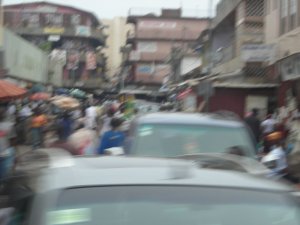
I decided to not take any pictures while in the market because it had caused problems in the past – at least until we got back on the bus. Some pictures are a little blurry. Here in Makola, as in many places in Ghana and Africa, people everything on their head. At Makola I saw a new range of this skill as boxes and goods were stacked very high and carried aloft to the numerous stands. This market was nice and more fun and much more welcoming in comparison to the ‘art market’ in Osu. Probably because not many Obroonis dare to venture inside the beautiful chaos.
We arrived back at the hostel and toured the kitchen to see how we could save some money on eating costs. We decided to eat at Fresherz down the road, a very american-style restaurant with american foods. As per Ghanaian standards, after our drinks were ordered, it took nearly two hours for everyone to get their food. It was very tasty food after waiting two hours. Joseph later took us to a nice little market to get some inexpensive food. He got a taxi to take the seven of us for just 20,000 cedis ($2). First, the taxis here are very small cars, second, it is difficult to breath with someone on your lap in a small car. Five people crammed in the back, Don on my lap and two in the front. The bumps in the road were uncomfortable, but not a bad ride otherwise. Suddenly an unmarked black car drove in front of us and stopped. “Police?” we all asked, but Joseph said no. But it was the police and they began giving the driver an earful about taking seven people, Obroonis at that, in one taxi. They threatened to take his taxi sticker and asked if 20,000 cedis was worth his taxi career. In the end it was just a lecture for our driver and we were on our way again. Ghanaian police – don’t mess with them.

As we entered the small market we noticed huge flying bugs. They were very large and interesting. However they became less interesting and more bothersome as their numbers increased rapidly and they were drawn to the market lights. Large-winged, meaty flies filled the air and swarmed the lights of the market as we attempted to buy food. In our hair, faces, and brushing our legs these flies were not done kicking until their wings fell off and they all scurried away. Joseph told us that after a big rain these bugs come out and that some people catch, fry with salt, and eat them. I had heard of this before and it sounds like a treat. Maybe I can try some here.

We frequent an internet cafe down the road a ways from out hostel. We often walk in the dark to the cafe. I noticed on this night that the american tunes played in the cafe unconsciously were stuck in my head on the walk back and unknown to me I hummed them aloud. I also realized that since we were Obroonis walking on the street in the dark that we must want a taxi ride. When a taxi is empty and wants to give you a ride they honk at you. We must have been honked at over a dozen times! Can’t an Obrooni walk on the street!

writing about africa. . . a simple exercise or a skill?

When writing about Africa many times it is difficult to bring the proper perspective or ‘view’. So often people write about Africa with the view, that many of us have come to know, from the myths of Africa. The old myths of a ‘dark’ continent, Heart of Darkness, uncivilized, and savage to the new myths of a continent wrought with poverty, disease, and conflict, these are all too often emphasized in writings about Africa. That, I would say, is a poor representation of Africa, its many countries, and its many peoples. In her blog, Acumen Fund Fellow Jocelyn Wyatt, writes about her training in writing about Africa before being stationed in Kenya for eight months. She tells us of three views often evident in writings about Africa. I will allow her writing to continue this message. And I hope, that I can write about Africa with a critical eye and not with a jaded or an overly simplistic mindset. I hope to understand the intricacies of Africa and not look too far past the idea that all people are more alike than they are different.

From My Year as an Acumen Fellow – 3 Views on Africa:

The Acumen Fund Fellows have been fortunate to meet many inspiring leaders and engage in plenty of thought-provoking discussions over the past four weeks. The question about how to write and talk about Africa has been raised several times. In April, Jacqueline referenced “How to Write About Africa” on this blog and discussed it with the fellows during the first week of orientation. This piece exposes the simplicity of how most people write about Africa and inspired us to think about how to do it in a different way.

View 1 – The Outsider Who Gets It: Gayle Smith, currently a Senior Fellow at the Center for American Progress, and former journalist and senior staff member of the National Security Council and USAID, spoke to the Acumen Fund fellows about her work in Africa and as a member of the U.S. government. Many people don’t understand the appeal of living in the developing world, and I often have trouble articulating it. After living in East Africa for 20 years, Gayle explained it well, It was easier and more satisfying to live there than in the U.S. There’s a sense there’s something bigger than you there. In D.C., there is nothing bigger than any of us. While working for various NGOs in Africa, Gayle saw that there were stories that needed to be told and insisted that the media print them. Gayle’s unique combination as an outsider with extensive experience in East Africa provided her an honest view of the culture, people, politics, and economy and her understanding of the complexities led to her success as a journalist.

View 2 – The Insider Who Exposes It: The book Things Fall Apart by Chinua Achebe is a powerful reflection on the introduction of western culture and colonization to a Nigerian village. When it was published in 1959, it was probably the first book written by an African that most Americans read. Achebe’s novel is honest and extremely critical of the colonial forces who he recognized did not see anything in Africa that was larger than themselves. As an insider, Achebe delivers us well-rounded and real characters and aptly describes the complex forces that pulled Nigerian villages apart.

View 3 – The Outsider Who Simplifies It: In the recently released movie, The Last King of Scotland, a young doctor from Scotland moves to Uganda to work in a rural health clinic. He becomes Idi Amin’s personal physician and gets caught up in the ruthless dictatorship. The film begins with colorful, stereotypical footage of Africa, people singing and dancing on the side of the road, a beautiful African woman seducing a young westerner, and an older white doctor and his wife “saving” a village of Africans at their rural clinic. As the movie goes on, Uganda becomes a much darker, more corrupt, and violent place as Amin’s rule becomes harsher. Even in a ‘flat,’ globalized world, we are frequently exposed to such stereotypical portrayals of Africa: one that is simple, happy and colorful, and the other that is dark, corrupt and violent. While an interesting story with strong characters, in an effort to simplify the context, the film does little to accurately showcase Uganda.