
those who are seen without a blur and those who remain invisible

As you may have figured, the previous story is about myself. I can safely say that this story and the events, experiences, and following actions have defined my life. Yes, defined my life. Traveling to Africa four summers ago after conducting a project that allowed me to meet so many incredible people and truly believe that I, and many others, have been able to make a difference in the world, has created the most indelible impression on who I am and what I do.

Therefore this blog will be my expressions of thought set down in text as I continue developing and searching for my path in this great world. I could say that my life is well mapped out, but that would be a lie. All I have are ideas of what I would like to happen, but no one knows for sure what I will do, or where I will go.

This blog has been named ‘When not in Africa…’ because, although I have only been to once, one of the ideas I have for my future is that I will return to Africa very soon (hopefully Ghana, summer 2007) and I do plan to live the majority of my life on the continent of Africa or working for the people that inhabit its lands.

As I write there is one thing that has been on my mind for a long while. About a week ago my grandfather passed away. I was very close to him and although he had been gradually getting more sick and it was not a sudden death, it has still been very hard. I believe that grandparents make up a significant section of the core of our being; a section that parents, friends, role models, and leaders cannot touch; a section where no matter what happens you always know your grandparents’ touch will be with you forever. However, even with all that, I cannot help but think about the countless number of lives lost in the countries of Africa. Every day in Africa, 6,600 people die from and another 8,500 contract the HIV virus – 1,400 of whom are newborn babies infected during childbirth or by their mothers’ milk. Africa is home to 25 million people with HIV – 64% of global infections. There are more than 13 million children in Africa have lost at least one parent to HIV/AIDS; this total will reach 18 million by 2010. (UNAIDS) Every week, it is estimated, in Uganda over 1000 people die in a conflict that has claimed over 100,000 lives in its now 20 year span. In Darfur, with over 400,000 already murdered by their own government, tensions rise over a UN peace-keeping force. Tensions are still fresh in the Congo where countless, thousands of lives are lost unknown to the world. Due to the intensity of the wars and diseases and just plain poverty, children are lucky to make it past their fifth birthdays. (Sorry I do not have the links to all of the relevant news articles.)

Preventable diseases – preventable conflicts – and preventable circumstances end the lives of so many invisible people on the African continent. Invisible people who it seems have no pull in the worldly system of quest for success and competition at any cost. People are people. Whether in Africa or Asia or the Americas, people share the same pain, the same loss, the same wants and fears, people everywhere want to have the ability to live without fear of avertable worries. And as I think of how my grandfather died; surrounded by friends and family, without pain, after living a long and happy and productive life – I cannot help but think about the countless others in the world who do not have such a luxury. At his funeral service I played TAPS, on the bugle which he gave me when I was 10 years old. After playing the solemn tune I could not contain myself and broke down, because as I played I could not help but think of all those others who passed with my grandfather, I thought of how supportive my grandfather was of my work and how he loved every person he met, how he shared something with everyone. As the tears for my grandfather streamed down my cheek, my body shaking with loss, those tears messed with the tears for the world’s invisible people.

hmm, what is this?

Here is the first of many stories:

It all started on a Sunday in July 2000. I was at Mass in the church I had attended all my life, Holy Family Catholic Church, when there was an announcement made that a visiting priest from Uganda would be living in our parish for the summer. He would be offering African drum lessons to anyone who wanted to learn. Since I drummed on everything—including the dinner table, my desk, and the church pew—my mother gave me a knowing look. After Mass, I introduced myself to Father Joseph Birungi and became his first student.

Fr. Joseph spoke with an accent native to Uganda and didn’t always understand my words. But we both understood a smile. We met several times over the summer and he taught me how to drum. But, Fr. Joseph taught me more than drumming. We talked about his home and his people and their great need for basic medical care. He told me of the many deaths of his people due to simple, preventable diseases. He told me of his dream to construct a health center in a remote area of his country. From those lessons, I was inspired to help the people of Fr. Joseph’s community—somehow. I asked him what I could do to help.

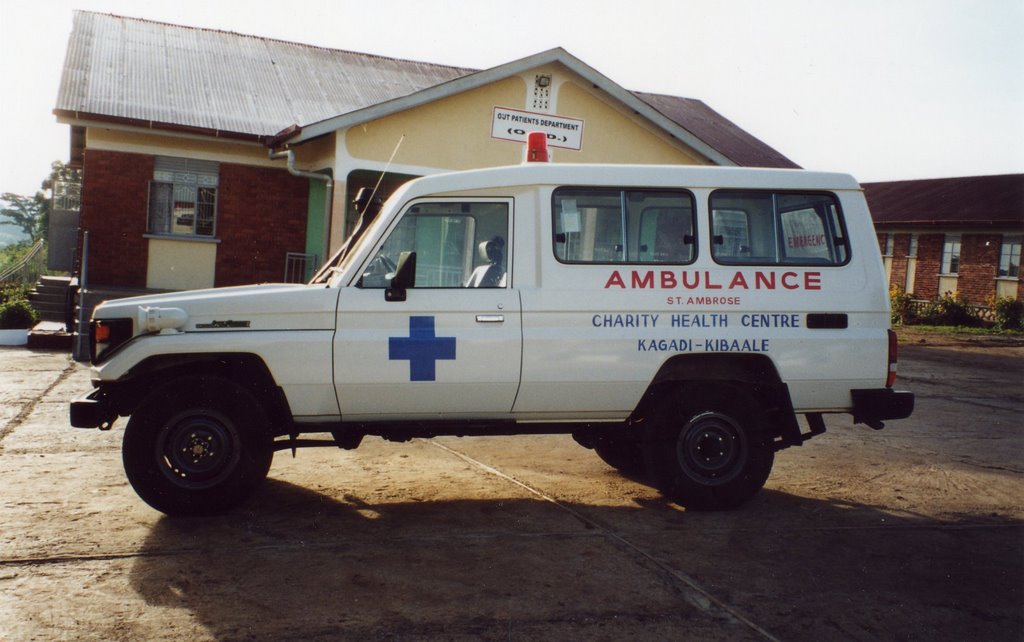
Of course, Fr. Joseph was pleased by my excitement and thoughtfulness, but he also knew I was only a 13 year-old boy. As he told me later, he didn’t expect that I would be able to accomplish much. Nonetheless, he decided to dream big. Fr. Joseph said the new health center would need an ambulance and asked if I could try to get one for him. At first, I thought it would be impossible, but eventually I convinced myself I could do it. The Toyota dealership in Uganda’s capital city of Kampala gave him an ordering price of $50,000! I knew that in order to raise that much money I would need a really great idea. I decided to make life-size foamboard cut-outs of Fr. Joe and ask people in my community to “host” him for a day at their home, business, classroom, meeting, or special event. He would come with a “suitcase” containing information about Uganda and the need for the ambulance, a video message from Fr. Joe, a camera to record a picture of the hosts with Fr. Joe for my scrapbook, and a yard sign to show their participation in my project – and, hopefully, inspire others to participate too. I asked each host for a donation to the ambulance fund and a small medical supply.

Many people helped me prepare the supplies and promote the project, although I initially had to overcome my fear of public speaking. I knew that the no one would know about the need of the Ugandan people if I couldn’t tell them. I spoke to service clubs, school groups, and church congregations—anyone who would listen. Thousands of people responded. I collected 20 boxes of medical supplies and raised over $67,000 in less than 4 months.

I actually traveled to Uganda and went with Fr. Joe to sign the order for the ambulance. During my one month stay I met and lived with the people who would benefit from my project. My trip to Uganda left an indelible mark on me and it is an experience I will never forget. All the people I met were so friendly and, even in their poverty, they wanted to share what little they had. I have seen that all people of the world share the same needs and wants. We are really all more alike than we are different. Everyone needs food, shelter, clean water, and necessary health care. We all want to know happiness, health and love. Parents everywhere want the best for their children and children want to learn and grow. But not everyone gets the same chance for success.

My project helped to provide quality healthcare and emergency transportation to those who would otherwise have no place to go and no way to get there. It brought the world a little closer together as my community realized—and met—the needs of a community across the ocean. Fr. Joseph’s dream became reality when the health center opened its doors in April 2003. His health center treats anyone who comes, regardless of who they are or whether or not they can pay. Hundreds of people have been treated and the ambulance has provided emergency transportation to other facilities when necessary. The ambulance also transports nurses to villages far from the health center to teach disease prevention and provide immunizations. Since the ambulance goal was achieved, I have continued to help by raising awareness and funds—largely at my high school—to help ship a 40-foot container of medical equipment from Michigan to Uganda.

I have been privileged to lead a project that has directly impacted many people living in Uganda. Additionally, the project itself greatly increased awareness in my community about the lack of healthcare and other basic needs. Although my original goal was accomplished, I realized that once I made a connection with the people of Uganda, I couldn’t just walk away. I couldn’t assume that my part was over and that someone else would pick up where I left off. I had seen their faces, held their hands, visited their homes, and eaten with them. I know that I saw the faces of people who are no longer there—and so I continue to tell their story and ask for help.

I have realized that working to help those who are in need in the global community is the best way to show that I care. When I traveled to Africa, I came to understand the many differences in culture that separated the Ugandan community and my community. And even though we were physically distanced, I saw how my project brought us together. I know that I need to continue to work to change the world for the better.

Through my project, I also learned a few important lessons about life. One, it is our deeds, not our words, that change and shape our communities and our world. Second, we must all believe that one person can make a difference. Everyone has the potential to make a difference, but who among us will choose to act on that potential – and what kind of difference will we choose to make? Third, we must first believe in ourselves before anyone will believe in us. And lastly, although one person can make a difference, one person cannot make a difference alone – we need one another to succeed. It takes a group of dedicated people to create change. From my own efforts to promote global understanding, I know that YOU, as one person, can make a difference in the world!

why africa?

Africa is a land of mystery and wonder; a land of the ancient kingdoms and beginnings of civilization; of untamed, giant beasts; of fascinating peoples and cultures; a beautiful sunset in a picture; a special on the national geographic channel; of exotic and wild scenes, a battlefield of innocents; tyrants, and neo-colonizers; a vast expanse of poverty, disease, and hunger. Africa is a continent of grand beauty and awe, but also a continent of excruciating pain and strife; a land of needless death and equally of vibrant life. Some say that Africa is in a “third” world. Personally I’d like to know where the second and is located, because I know of only one world of which we are all members; an interconnected and interdependent world where we all have the ability to change a fellow global citizen’s life from across the ocean. Here is where you can learn of the celebration of the many aspects of the African continent and also learn how to take action to end the greatest agony of its people.

Africa is a discarded newspaper article in the Times of life, we read the horrors, glad to be so distant, and move on to the newest and latest fashions of the hour. We see the faces of the dead and dying, we read their sad stories and somehow the pain which they feel, and which we could also so easily be feeling, that same pain can bring us, collective society, to act on the pain that is the same and brings us no gain. Broken and dying, on the doorstep of society they are lying, waiting for someone to hear their cries before another so needlessly dies. Starving and forgotten, they know not what will come of their fate, in this our world of power, corruption, money, and hate.

Africa is where the first human beings walked, the second largest continent, home to one in ten of the world’s people, with five of the ten fastest growing economies – The west in particular has a long and shackled history with Africa, and just as its past is strongly linked so too is it’s future. The West has assisted in creating the multi-faceted crisis of the African continent. From the first Portuguese soldiers, to the CIA aiding the assassination of Lumumba and propping up of Mobutu, to turning blind to Rwanda, and now in this day and age people still ask why africa?

Stop and take a look at that discarded article. Read and become informed, feel and be moved, because there are no borders when people care. This is a world created, whether by the forces of nature or by god, with no lines drawn in the sand. A world where the only thing that holds us down or holds us back is ourselves, we are the problem, the solution, and the sustainable future for this, our world. Be sure to for stories and opportunities to take action!