young people are the key drivers of social change

Harry S. Truman Scholarship Policy Proposal by: Alex B. Hill

Problem Statement
International development is a vast and complex issue. With over 18 million people dying each year from the lack of development assistance in health infrastructure something new needs to be done. Within the US there is a trend that foreign aid dollars are coming more from private NGOs and nonprofits as opposed to official government agencies. For so many years international development was tackled in simplified single-issue campaigns, which only created any effect in the short-term. This can be attributed to the fact that most Americans have a limited worldview. Most Americans have not traveled internationally, especially to developing countries. Therefore international development issues remain remote and abstract to most Americans. International development is a long-term issue. It is inherently complex and difficult to understand. There is no single enemy, and outcomes are rarely clear-cut or translatable through numbers. Faced with this challenge, some countries have opted to undertake broad-based efforts to build increased public understanding of development issues.4 There are a number of programs that promote volunteering and global engagement, such as the Peace Corps and Volunteers for Prosperity, through USA Freedom Corps. While these programs offer opportunities for highly educated and skilled Americans there exists a great void for those who are inspired and motivated, but may not have the degree or skills to qualify for these programs. The way to bring about increased political will on development issues in the US will lie in the creation of a long-term cultural and social movement, spurred by young people, to change the way in which many Americans think about international development. If this movement is to achieve change, it will be vital to increase the knowledge and understanding of development issues among the public.

Proposed Solution
Young people are the key drivers of social change. Considering this fact, there needs to be a policy focused on engaging young people in order to build a domestic constituency for international development that will create lasting connections. The policies on education and participation related to international development need to change. Young people have grown up with internet, global popular culture, and easier communications and travel, which has made the world smaller, more connected, and more accessible. Young people, specifically college students, have the opportunities to study abroad and are almost constantly encouraged to participate in global exchanges. Young people are left out of the equation when they exist as the greatest asset to making change in the development sector. If the problem is to be remedied then there needs to be a two-step plan. The first step needs to be increased support for a development curriculum in middle and high schools. This is where the US has fallen far behind Europe. European education efforts have focused their resources on offering learning initiatives for young people. Focusing on youth has been a key strategy of both European NGOs and government for many years. Countries that have embraced a long-term vision of youth-focused development education have the highest public awareness and support for development. According to the OECD the US spends less per capita on development education than any other OECD country. The second step needs to combine the learning activities of the school curriculum with action opportunities. The traditional classroom will not be enough to keep the engagement necessary to build an active constituency for change. Having action programs for youth will be a great method of measuring the success of the educational component. Pivotal to both steps will be increased support for a collaborative body dedicated to promoting development education. The US Development Education Alliance has been largely ineffective because it lacks support from both NGOs and the government agencies. This body needs to be coordinated at the national level and networked internationally so that efforts can be combined for maximum effect.

Major Obstacles/ Implementation Challenges
The major challenge facing this policy proposal is the US education system. In the US is largely determined locally, as opposed to Europe, where national governments set education policy standards. This will be the greatest difficulty in implementing a development-oriented curriculum. The next challenge will be government support. Having a coherent government platform to support development education will lend recognition and incredible support to the effort. Without a government backing, the policy will likely fail. Likewise, the US Development Education Alliance will need greater support from NGOs and government agencies, such as the USA Freedom Corps, Peace Corps, and USAID, in order to push for a change in policy.

Check out the Development Education Association, based out of the UK, it is a network of all development education organizations.

innocent impacts in nigeria

I recently read a recommended article from New York Times about a young woman terribly wounded by the wanton gunfights that have encompassed her neighborhood in the Niger Delta. The violence of the region is usually aimed at international oil corporations, their workers, and the police and government soldiers. But now the violence is focused at the internal as opposed to the external. The very people who are at the heart of the oil issue and conflict are being hurt and killed in the sights of the unhappy gangs of militias. The young and old are forced to flee the fighting when gangs enter and occupy their relatively peaceful villages.

Democracy returned to Nigeria in 1999, but since then it is known that politicians have used the gangs as spheres of influence around the Niger Delta. The government has claimed that it has cracked down on the gangs. They recently sent in an elite military unit to restore order and stop the violence in the streets. The violence has spread beyond the streets now and into the outlying villages. Traditional chiefs and village councils attempt to deal with the gangs and cults, but that only brings more violence to their doorsteps. In the NYT article a village meeting was said to be overrun by men on motorbikes with machine guns and grenades. The village leaders were killed and dumped in the river. One man is quoted as saying that such violence was completely bound up with politics, “Our politicians cannot stand on their own, so they find those who will stand with guns for them,” Dr. Ogan said. The fragile ceasefire could not last as the Nigerian militias continue to feel disenfranchised for the vast oil wealth flowing from their country.

The conflict in Nigeria is complex with many different sets of actors: individuals, groups, and communities; local, state, and national governments; police, paramilitaries, and navy; and oil company employees, officials, and management. I was recently chosen to be a research assistant to one of my professors working on dissecting the Nigerian oil conflict. This is the project’s goal:

Our project seeks to unpack the complexity of the conflict over oil, environmental degradation, and representation in the Niger Delta. Reducing this conflict down to a single issue-dimension—oil wealth—oversimplifies matters and obscures the linkages between different aspects of this problem, a problem which encompasses the political, economic, and social realms, and is manifested at the local, state national and international levels.

My professor is from Nigeria and has completed extensive work on the conflicts in Nigeria surrounding the oil resource. I have high hopes for the coming semester of research and further education on this pressing issue.

democractic movements as terrorism

The Movement for Democratic Change (MDC) is the Zimbabwean political party focused on promoting democracy in a country where it has become very dangerous to associate with politics. Formed as an opposition party to the Zimbabwean African National Union – Patriotic Front (ZANU-PF), which is led by current President Robert Mugabe, the MDC brings together a number of civil society groups. The MDC is now labeled as a terrorist organization by Mugabe’s government, political activists are regularly beaten and arrested, and known members of the MDC disappear. The MDC front webpage tells of three recent deaths of people closely affiliated with the MDC. The site notes that this is becoming an all too common.

In a 2000 parlimentary election MDC candidates won overwhelming majorities, but there were calls of unfair elections and the issue remains caught up in Zimbabwe’s Supreme Court. The South African Development Community (SADC) and the South African Ministerial Observer team both maintain their positions that the election was free and fair. MDC members say there was harassment and force used by the ZANU-PF government at the polls. In 2004 the MDC split over the decision to take part in the 2005 parlimentary elections because of the “illegitimate outcome” of the last election. The MDC voted to take part in the elections (33-31), but Morgan Tsvangirai voted the decision down saying it was a waste of time. The MDC then split into Tsvangirai’s decision supporters and pro-senate members, led by the former MDC deputy. Some say that the split was ethnic based.

There are two main ethnic groups in Zimbabwe, the Shona (75%) and Ndebele (19%). Ndebele was an ethnic category that grew out of the military state created by the British in 1830. The ethnic term of Ndebele encompassed people of many different origins and in fact Shona people lived in this conquered area, but were placed under the Ndebele label. However, the ethnic identifications of and between these two groups were very low and there was no historical enmity between them. In 1896-7 these ethnic groups actually joined in the Ndebele-Shona Chimurenga resistance to the British. Guerilla forces grew and became political parties, but neither was purely ethnic based and recruited across the board. Needless to say the ‘ethnic conflict’ in Zimbabwe was the least serious of all African ethnic conflicts. The greatest conflict was between Black and White in Zimbabwe. There have been recent talks to reunite the split political parties.

This is the real historical problem that has led to Zimbabwe’s current problems. The problem in Zimbabwe can be summed up to a battle between Pan-Africanism and Neo-colonialism. Mugabe has called for White people to leave and so it makes the situation difficult when British Prime Minister, Tony Blair, has said that he is working closely with the MDC to create a regime change. Well there may be a high degree of internal pressure, the external powers cannot be dismissed. In order for the Western powers to achieve the goal of regime change they will use their secret services, CIA, network os military bases, and economic tactics. There is this other side of the argument that says maybe the MDC is not promoting democracy at all and is really a facade for Westerners to experiment in African politics yet again (Zaire’s Lumumba?).

Back to democracy, regardless of conspiracies the basics for democarcy do not exist in Zimbabwe. Recently six MDC members were arrested under the “Law and Order Act” for holding illegal political meetings. The 2008 Presidential election is close and the MDC and ZANU-PF are in negotiations. Tsvangirai has said that the MDC wants to participate, but they want to ensure that it is a free and fair election. The MDC wants to participate to create democratic change and not to give legitimacy to a system favoring one side. The MDC is demanding that there be international control of the elections and that millions of Zimbabweans abroad be allowed to vote, a new voters’ roll and the appointment of an independent Zimbabwe Election Commission to supervise the polls. South African president, Thabo Mbeki has been chosen by the SADC to mediate the negotiations between the two political parties. There is worry that Mugabe will not comply with demands.

Zimbabwe Timeline from: 1200-2007

security is better with south africans

An interesting topic that I came to by way of my African Studies professor. In a meeting of the Michigan Action Network on Africa (MANA), he was listing off a number of woes for Africa and among that list was a quick comment about many South Africans working in the controversial security firm Blackwater USA. I could hardly believe it. Could the US security firms really be recruiting from South Africa? I then caught an article in glancing and noticed that foreign diplomats believed that the best security personnel were the South Africans. I had to look into it further. While I could not find the article again I have found a few others that were just as helpful in my knowledge search.

Being involved in the private military or security business is not something to let everyone know. When Mrs. Durant’s husband was kidnapped in an ambush in Iraq she had no support group of weeping war wives to turn to. All she had was her silence. What the Chicago Times called South Africa’s silent war in Iraq has been a very vocal war in the US especially with the controversy over Blackwater’s killing of Iraqi civilians. However, former military and police in South Africa are not new to harsh conflict. In the 1990s thousands of white military personnel left with the apartheid transition. Many of those unemployed officers and soldiers join private security firms and became involved in wars all across Africa, including Sierra Leone and Angola. So it is not surprising that working in a private security firm is something that is not talked about in South Africa. I am sure it holds a very sore spot in the country’s history.

It seems that Blackwater will search every inch of the earth to find good mecenaries. From Chile to Brazil and now South Africa. The UN recently reported that South Africa is one of the
top three suppliers
for security personnel in Iraq. One South African security company received a multi-million dollar contract to train military recruits in Iraq. There are almost 43,000 South African private security personnel working in Iraq. The Institute for Security Studies wrote and article and in it mentioned the story of a doctoral student heading to Iraq to do research and a friend told him to make sure he was placed with the South African security because they were the best.

This may not mean much for South Africa because this is a practice that is not publicized. If you are involved in private security then it is best not to let that be known. You will not be welcomed home as a hero. Many note that after the ‘troop’ surge (or private security surge?) that South Africans will be again be out of security jobs, but maybe the Iraqi government will sign them on after to continue helping at oil stations. At any rate this becomes a larger issue for the US. How can the US government, using private security firms, allow security and war to be outsourced even more? How can there be any more accountability if they are signing on former, white army officers who supported apartheid? It can’t be long before people get fed up with outsourcing in the war-industry, especially the lesser paid and trained soldiers on the ground. It is a very worrisome topic for both the US and South Africa. South Africa seems to have an influx of military personnel, who gained no further skills after apartheid. The US looks to have an issue of controlling said security firms in their actions.

who speaks for whom?

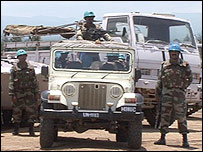
In the Democratic Republic of the Congo (DRC) peacekeepers are trapped in the middle of the fight. Checkpoints are all over the North Kivu province and the UN personnel are not exempt from interrogation. The UN peacekeepers are forced to live with a precarious relationship with the various warring factions in the DRC, including the government army. The DRC’s current government army is just a conglomerate of merged rebel armies and so there does not exist a common identity. You never know who you may have to deal with at a checkpoint. Recently a rebel leader in North Kivu surrendered to the UN forces. Kabila has given the green light to loyal troops to engage and disarm rebel General Nkundu. The recent fighting between government forces and rebels probably caused the small rebel group of about 30 to surrender. The resurgence of fighting has also brough with it human rights abuses. From 2005 – 2007, over 258 cases of rape were recorded along with 14,200 cases of sexual violence. Less than one percent of these made it to court. The UN Independent Expert on human rights has called for an end to the impunity of sexual violence cases and urged Kabila to take up a ‘zero-tolerance’ policy.

There is now talk of US military trainers coming to the DRC to train the mixed-up government army. A large Congolese delegation, along with President Kabila, will visit the White House on Friday to discuss the possibility. Is this yet another move by the US to gain ground over the Chinese resource grabbing machine? Will the US be able to bring together a divided government army? This is yet another great example of the US aiding the re-militarization of African countries. Well this case may be different I can’t see the US handling in a more focused approach of helping to create law and order in the security sector of the DRC.

In Sudan, we see the deployment of a UN-AU joint peacekeeping force. The force still lacks necessary equipment, notably from China, including specialized units in both air and ground support. A great step to ending a terrible conflict, but a step that I feel will meet the same difficulties as the UN peacekeeping mission in the DRC. There are so many disconnected rebel movements in Sudan that it will again be hard to know who you are dealing with. In both countries peace deals had been signed to end the fighting, but fighting quickly resumed when rebel factions not associated with teh signing groups continued fighting. Somehow everyone needs to be brought to the table, but how? You have the government forces propogating a genocide and numerous, divided rebel groups fighting against the government and each other. The UN-AU peacekeeping force will be a help in Sudan. However in both the DRC and Sudan, peacekeepers will need to find out who is who and who speaks for whom if they are to broker a successful peace deal.

the real weapons of mass destruction are in the congo

The conflict in the DRC is nothing new to the region. I would argue that the conflict began well before the assassination of the democratically elected leader, Lumumba, in 1961 and has only grown from there. After Lumumba was assassinated Mobutu Sese Seko gained power and ruled terribly for the next 32 years. He was overthrown by rebellion in 1997 by Laurent Kabila, who leader of the prominent rebel group. Unable to bring peace, Kabila faced his own rebel opposition until he was assassinated in 2001. Intense turmoil resumed in the DRC following Kabila’s assassination, sparking a six country war including Rwanda and Uganda. In 2002 a peace deal was signed to officially end the DRC conflict, 17,000 UN troops were deployed and yet the conflict continues. In 2006 Laurent’s son Joseph Kabila was elected in a tense, yet democratic and free election. Joseph Kabila faces opposition from his father’s rule (as well as support from his father’s popularity), calls that he is not Congolese – that his mother was Rwandan and he is not from the DRC, along with calls of corruption in his administration. When Joseph was born in Eastern Congo he was sent to live in hiding pretending to be part of a Tanzanian ethnic group. Later he recieved military training in China, which helps in the exploitation of the DRC’s vast resources. J. Kabila has been able to broker a written peace, but how well can he create peace in reality?

It is reported that 370,000 people have been displaced in a conflict that has more facets than a cut stone. Roughly 6000 Rwandan Hutu militiamen are hiding in the DRC hoping one day to invade Rwanda and retake control after the genocide they spurred. In an attempt to drive out the Hutu militias General Nkundu’s troops have torn through the region displacing thousands. He is estimated to control 8000 militiamen. Some claim that he is fighting a proxy war for the Rwandan government to keep the Hutu militias away from the Rwandan border. For this reason many local militias have formed to fight General Nkundu’s troops and stop them from wreaking havoc in the region.

The Eastern Region of the Democratic Republic of the Congo has not seen peace in a long time and now there is an increase in violence against women. In September of this year, in an interview with the BBC, the UN Special Rapporteur on Violence Against Women said that in the South Kivu province, sexual violence was the worst she has seen and warned that it was becoming something normal. Violence becoming normal? Sexual assault becoming normal? Rape becoming normal? In September the UN reported that there had already been 4000 incidents of sexual violence against women just in the Southern Kivu province.

It is interesting that Kabila is not doing more for the women of his home region and the region where he had the most political support. Why does he let the women of Eastern DRC be sexually abused? Rape has become so prevalent as a tool of war that women have stopped going to the fields. Girls as young as three, men, and boys have been raped too. Sadly even if the perpetrators are caught the court system refuses to hear cases on rape, witnesses are frightened away, and military leaders refuse to help. This year V-Day and UNICEF have partnered to raise awareness and bring aid to women affected by the weapon of mass destruction that is rape.

Since 1996, sexual violence against women and children in the eastern part of the DRC has been used to torture and humiliate women and girls and destroy families. UNICEF estimates that hundreds of thousands of women and girls have been raped since the conflict began in DRC. In addition to the severe psychological impact, sexual violence leaves many survivors with genital lesions, traumatic fistulae and other physical wounds, as well as unwanted pregnancies and sexually transmitted infections, including HIV.

All of the military forces have used rape as a weapon of war, even UN personnel have been implicated in cases of rape in the DRC. The victims of rape experience more than just the physical impacts of the act – from ostracism to physcological effects to a lack of justice through the local and formal courts. I cannot even begin to write everything of importance here and would highly recommend the V-Day site to read the full story and access a great set of resources to learn more.

our leaders skipped history class: revealing the u.s. foreign policy on africa

Learning from the past and taking lessons from history are what we often pride ourselves in doing. Our elementary and high school teachers would often use this phrase when referring to wars and conflicts, strategies and crises, mistakes and wrong-doings. We work so often in history courses to note that great leaders learned or did not learn from past actions. What can be said now for the our current leaders?

We are now the recipients of a bad history grade in policy on Africa. The US has a unprecendented push to re-militarize Africa. Before I continue on this point we need to look back in time. The colonial legacy began with the arrival of Portuguese soldiers on African soil. The first encounter that any Africans had with Europe was with the military. Likewise, the colonial masters first established the institutions of the military and police to be able to ‘control’ their territories. Eventually the occupied Africans were incorporated into those systems and made to conform to the militarized method of ruling a colony. Much of the conflict, war, and strife in Africa can be linked back to this colonial legacy of militarization. The colonial era of militarization moved on into World War II, further on then to the Cold War – each time Africa became more militarized with the most advanced killing equipment.

Now in the age of a supposed ‘war on terror’ the US is propogating the re-militarization on Africa. Back in January I wrote about the birth of the African Command and past US/ CIA ventures in Africa. This was a timely development as conflict grew on the African continent, the colonial military legacy expanded also in a time of great strife and forced division of Africa. Recently one of my professors gave a lecture on the current US involvement in Africa. Much of what he had to say I already knew, but an equally large amount was new information to me. He told the class that he had been invited to the Selfridge Air National Guard Base in Mihigan to talk to a unit about Africa. However, he soon learned that this was no introductory talk about Africa as everyone in the unit had traveled to the African countries where US interest is strongest. This month I wrote about the presidential candidates and their stances on African issues as well as the growing amount of military training and weapons supplied to Africa. Is all this really in the name of terrorism? Or is there a greater underlying issue? Oil? The US triangle of influence in Africa includes all of the African countries that have discovered and exported oil. Coincedence?

The new African Command is seen by some as a milestone in US foreign policy showing that the US actually does care about Africa. I would say this is a great representation of how we have seen Africa throughout our policy writing – only important when the US has a self-interest or gain to achieve. I have to agree with the growing number of people who are not pleased with AFRICOM. So far there is only a handful of African countries that agree to hosting the AFRICOM base. It seems that the only future for US foreign policy in Africa will be military based. Our ‘development’ and aid work will be conducted by the military and people will begin looking to the military for aid and assisatance. In a BBC article a Kenyan columnist sums up the fears of many, “The military now is going to be working with civil society, to promote health and education. Africa is going to look at all its development efforts through the lens of the Pentagon. That’s a truly dangerous dimension. We don’t need militarisation of Africa, we don’t need securitisation of aid and development in Africa.” For a comprehensive archive of US military involvement in Africa check out the Association for Concerned African Scholars (ACAS).

I cannot remember where I read, but in an article about the history of the US’s foreign policy an expert had said that it was, “one bad decision after another”(hopefully I can track down the quotee). From my study and knowledge of US foreign policy I can see the obvious truth of such a statement. The truth of this statement is relevant especially in regards to Africa. “One bad decision after another.” Zimbabwe is all over the news after Mugabe kicked out the white farmers and now the country’s economy is plummeting. What many people do not know is that as the Rhodesian conflicts waned and constitutions to grant freedom were written the US played a crucial role. When the new constitution was revealed with no mention of land for Northern Rhodesia’s majority population, Mugabe and Nkomo were ready to leave the talks. The British government reached out to the US President Carter to back a deal to pay white farmers for their land, which would then be redistributed.

the crouching tiger and the curse of black gold

Oil fouls everything in southern Nigeria. It spills from the pipelines, poisoning soil and water. It stains the hands of politicians and generals, who siphon off its profits. It taints the ambitions of the young, who will try anything to scoop up a share of the liquid riches—fire a gun, sabotage a pipeline, kidnap a foreigner.

What more can I say. The National Geographic article lays it all out in the first few lines. Nigeria represented a story of hope and promise, NG asks ‘What went so wrong?’ “Everything looked possible – but everything went wrong.” The NG article goes on to describe a trash heaped scene with black smoke filling the sky, streets with craters and ruts, peddlers and beggars crowd car windows, and vicious gangs rule the streets. This is a description given about Nigeria’s oil hub, Port Harcourt, right in the middle of oil reserves bigger than both the US’s and Mexico’s. But where does the oil money go?

Nigeria’s oil boom began back before their independence in 1960. Still a British colony, oil was discovered in a creekside village not far from Port Harcourt. Few people at the time ever thought that Nigeria would become a world oil giant from this seemingly small discovery. Decades later multinational oil companies moved in and turned the inaccessable wetlands into an industrial jungle of 4,500 miles (7,200 kilometers) of pipelines, 159 oil fields, and 275 flow stations, their gas flares visible day and night from miles away. This was an amazing technological achievement, but the physical environment was the easy hurdle as the social and cultural environments remained to high to jump. WIth over two dozen ethnic groups having a history of fighting over the riches of the delta, the oil companies had no idea what they had just jumped into for the idea of a sweet profit. Laying of pipelines and construction of oil infrastructure disrupted the fragile environment of fishing seasons, animal habitats, as well as splintering ethnic tensions.

Oil in the delta looked so promising and held so much potential, but Nigeria still failed to help its people. Addicted to oil money, the people grew increasingly corrupt, using sabotage and murder to get a fix of the wealth. The people who could have lived better lives are now left nearly hopeless and poorer than before the discovery. The world has reached its peak oil production so we will see prices rise from here on out, but every time there is a killed security guard, an attack on a pump station, kidnapped foreign oil worker, car bomb set off, or oil rig overrun the market price of oil shoots up. It is not difficult to see why these frightening occurances happen. This increased frustration among the people of the Nigerian delta is creating a worrisome environment teeming with militias ready to escalate violence. With little or none of the oil money reaching the people how can they remain satisfied? The oil money grows on trees and remains in the uppermost branches without getting to the roots (Micinski 2007).

In July, the shining example for Africa, Ghana discovered oil deposits. Ghana has been in an energy crisis for a while now. While I studied there in May and June we expereinced frequent power outages. When we visited the Okosombo Dam, which provides all the power for the country as well as some for Togo, Benin, and Cote d’Ivoire, it was explained to us that with such low water levels at the dam, enough power could not be produced. President John Kufuor has said that this find will make Ghana the ‘crouching tiger’ of Africa since its discovery of oil. I only hope that Ghana does not become another Nigeria.

Index of blog post series on Ghana.

the ‘third’ congolese war

From: !Enough: the project to abolish genocide + mass atrocities

Dissident Congolese Tutsi General Laurent Nkunda’s more than 3,000 loyal forces have carved out control of parts of North Kivu Province. The Congolese government has responded by realigning itself with the FDLR — a militia composed of more than 6,000 Rwandan Hutu rebels, many with links to the 1994 genocide in their home country — to fight Nkunda’s more effective force. This threatens to draw Rwanda back into Congo’s conflict, which would lead to rapid escalation and potentially plunge Congo back into regional war.

In recent weeks, fighting between the two sides has intensified, with increasing numbers of troops being deployed to the front line and more being forcibly recruited. Civilians inevitably are caught in the crossfire, and the prevailing climate of impunity allows all sides — Nkunda, the FDLR, the Congolese army and local militias — to exploit the local population without fear of consequences.

Not many people know that there is even a conflict happening in the Democratic Republic of the Congo (DRC). Not many people have even heard of the DRC or the frightening linkages between the conflicts in Rwanda, Uganda, Darfur and the DRC. People flee from southern Sudan into Uganda, rebels chase them into Uganda intensifying the northern Ugandan conflict. Some then flee to the DRC. During the First and Second Congolese Wars, Rwanda and Uganda intervened to try to bring stability to the region. Rwanda had an interest in intervening because Mobutu, leader during the Second Congolese War, was in support of the Hutu rebel militia, which was responsible for the genocide in 1994. Theseinterlocked conflicts have fueled the continued conflict in the DRC. There are now many competing militias in the DRC and they are all looking to gain the upperhand. A relative peace had fallen over the region, but the ceasefire between the rebel forces and government forces has been abandoned. Rebel forces resumed fighting just this month saying that it was in response to government attacks.

As the intense fighting waged on, China jumped into the turmoil to grab up the riches of the DRC. Because of the extended conflict the infrastrucutre of the DRC is extremely poor and nearly non-existant. China is investing a large sum to help the DRC build infrastructure in exchange for access to the mineral wealth of the country. The BBC writes about a recent study that concluded that China’s main interest in Africa is to guarantee its supply of raw materials. No study is necessary to conclude, just read the news. China’s work in the DRC is its largest loan out to any African country. There are plans to build a road from Kisangani to the Zambian border and a major railway to connect the mineral rich provice of Katanga to the port city of Matadi. Other funds are set aside to rebuild the deteriorating mining infrastructure. But where is this loan money going, who is recieving the money to build the roads and buildings and railways? Answer: China. As well as being the biggest loan supplier, China also has the largest building company, China Road and Bridge Construction, owned by the Chinese government, with 29 projects in Africa (many financed by the World Bank or other lenders) and offices in 22 African countries. Chinese money for big projects is going back to Chinese government. China is losing nothing in the deal while African countries lose everything. When there is no longer raw materials and resources an infrastructure is irrelevent.

Chinese trade and investment has galvanised mineral production from South Africa (manganese) to Niger (uranium), and from Sudan to Angola (oil). Much of that activity reflects an intense appetite for the African resources needed to fuel China’s manufacturing sector, but big Chinese companies have quickly become formidable competitors in other sectors as well, particularly for big-ticket public works contracts, like the ones now proposed for DR Congo. Chinese workers are engaged in dozens of African road-building projects. China is building major new railroad lines in Nigeria and Angola, large dams in Sudan, airports in several countries, and new roads almost everywhere.

The DRC is a lush, beautiful green land, full of extended unprotected forests. Minerals may be a hot commodity, but timber is what may become the DRC’s biggest challenge. A BBC reporter called the forest a “sea of broccoli.” The Congo forest stretches across six countries, but in the DRC it is disappearing at an alarming rate – more likely than not, due to the country’s instability. A recent report showed that the majority of the timber is headed to China, 90% illegally. Logging companies set up in the DRC in what appears to be far off forest wonderlands. These wonderlands are inhabited by groups of people who traditionally lived on the land being cleared by logging. Much of the land has traditional and religious importance to the people. In an article written for the BBC, the story of one traditional village is told with a overtone of hope. The logging company is working with the people to make maps and document which sites are of significance and should not be disturbed. They use handheld satelitte machines to mark sacred spots and the people could not be happier. In a country where logging companies overrun traditional peoples and sacred lands without any regard, this is an instance of positive development.