everyone wants to keep their power, don’t you?

As I sat at the conference table waiting for the theorists to arrive, I tried to understand the causes for the Rwandan intervention into the Democratic Republic of the Congo (DRC) in 1998. After some time passed I realized that no theorist was coming to confer their knowledge upon me, so I decided to seek them out myself. But before analyzing theories and dissecting Rwanda’s intervention in the DRC in 1998 (Second Congolese War), one must note that there were preceding events during the 1996 intervention that triggered the second intervention. Rwanda intervened in the DRC in 1996 because it’s newly empowered Tutsi regime realized that the DRC’s leader, Mobutu Sese Seko, was in support of the Hutu refugees and ex-FAR/Interhamwe, groups who had perpetrated the 1994 genocide of Rwandan Tutsis (Curtis 3). With Mobutu’s support and the foreign aid flowing into the Hutu refugee camps (from aid agencies and bureaucracies) located in the DRC the ex-FAR/ Interhamwe was regaining strength and re-organizing. The ex-FAR/ Interhamwe, with the encouragement of Mobutu and the Hutu government began a campaign of ethnic cleansing against the Congolese Tutsi. The Rwandan forces then intervened in 1996 in support of the rebel Congolese Tutsi units. The Rwandan forces had many victories and eventually the Alliance of Democratic Forces for the Liberation of Congo/DRC (ADFL) was formed with the Rwandan forces, Congolese Tutsis, and anti-Mobutu groups in the DRC.

However this relationship between Rwanda and the DRC’s liberation forces did not last. The alliance with Laurent Kabila, who was leading the ADFL forces, had been an alliance of convenience rather than a uniting of ideologies. The alliance was based on overthrowing Mobutu and not on achieving a greater security for the region. Kabila began distancing himself from his Rwandan supporters and began creating divisions within the forces of the ‘alliance.’ Kabila soon called for all foreign troops to be out of the DRC, which threatened Rwanda’s ability to eliminate the remaining Hutu militants. Rwanda, being interested in keeping hold of its regional political-military influence it had gained from the First Congolese War (intervention 1996) along with the growing threat from Hutu militants, decided that a second intervention would be necessary to keep its regional power and security. The Rwandan forces experienced a surprising amount of success and it looked almost to be a repeat of the 1996 intervention, but later it was evident that the Rwandan forces would fail (5). Another factor that led to Rwanda’s failure was the creation of the RCD (Congolese Rally for Democracy), which became the new political face of the movement to oust Mobutu. With Rwanda and Uganda’s involvement in Congolese affairs in the past years the RCD was condemned as an “instrument for neighboring countries to serve their interests” (6). To that same effect Kabila’s forces were successful in stirring anti-Tutsi sentiment before the war, which made it difficult to garner indigenous support to move the rebellion forward (6). Ugandan forces pulled out and opened their own anti-Kabila front, but continued to send moral and military assistance also Kabila’s regional allies: Angola, Chad, Namibia, and Zambia all contributed troops and support that eventually led to Rwanda’s defeat in its second intervention (6). These foreign allies all contributed to a score of strategic victories that saved Kabila from a sure defeat by Rwandan forces and shifted the focus of the Second Congolese War (7). The new Rwandan government found itself isolated in the region and in much the same situation as Mobutu’s regime, which they defeated just two years earlier.

The underlying causes of the Second Congolese War (Rwandan intervention in DRC, 1998) are based in a division of regional ethnic groups and the tensions of ideas between those militarized forces. Both Rwandan interventions were militarily launched to provide support for indigenous (Tutsi) rebellions (4). The national security for Rwanda was just as immediate as it was during the first intervention in 1996. The Hutu insurgency amounted to what some call a “virtual civil war” – which increased Rwanda’s sense of being vulnerable and reinforced the ‘siege’ mentality which had fueled the regime’s view of national security since it came to power after the 1994 genocide (5).

The international relations theory that best sheds light on the causes and reasons for the Second Congolese War and Rwandan intervention in 1998 is realism. Hobbes says that the classical realists would argue that the weakest has the strength enough to kill the strongest (Schecter, Sept. 7, 2006) – and therefore the newly in power Tutsis in Rwanda would still be under threat from the fleeing Hutu militant factions. The two groups: new Tutsi government and the defeated Hutu militants and government, both desired the control of the Rwandan state and because of that, could only become enemies and conflict is inevitable. Hobbes tells us there that will always be conflict when two men desire the same thing (Sept. 7, 2006). The classical realist, Rousseau, continues the argument noting that the Rwandan rational was to provide for their own self-interest and not depend on others (Sept. 7, 2006). When Kabila decided he was going to dismiss his Rwandan backers, the Rwandan government decided to end that convenient alliance and serve its self-interest to then move against Kabila. Rwandan again rationalized its alliance with Kabila being that it was set up previously to oust Mobutu and to continue rooting out the Hutu insurgency, and not necessarily in support of Kabila’s movement to liberate the Congo. Thucydides would argue that every country seeks more power, because with more power comes more security (Baylis & Smith 167). All states suffer from the security dilemma where self-help is the only cure in which a state needs more power and opposing states will also seek power in response (Schecter, Sept. 7, 2006). Rwanda had an underlying motive to keep its borders free from Hutu insurgent attacks and a probable Hutu invasion after the 1994 genocide. Rwanda had gained a significant amount of regional power after the First Congolese War and wanted to be sure to keep a hold of that power in order to ensure its own security.

This moves us on to the contemporary realist argument. The Rwandan intervention in the DRC of 1998 was a near repeat of its intervention in the DRC in 1996. History very nearly repeated itself, the governments did not learn from their mistakes. However it is debatable if there were any mistakes to learn from. The new Rwandan Tutsi regime had its security in mind when it saw the growing attacks from the strengthening former Hutu armies and militias. Is it a mistake to act on an attack and threat from an opposing force outside a nation’s borders? The Second Congolese War is a good example of the classical realist argument that there is no international order or law only power and force. The UN or other International Organizations did not intervene and Rwanda was forced to take the conflict into its own hands. Could a continuation of the 1994 genocide and thousands more deaths have been avoided by an international intervention? The classical theorists would argue not, since there is no international order or law except for power and force. Morgenthau, a contemporary realist, argues that the international order of power is a means and also an end – security. Rwanda used its power as a means to remain powerful in the region and ensure its national security in regards to its borders. Power of force was used as a means to a greater end of power in security (Baylis & Smith 167). The contemporary realists would also argue that peace can only be achieved by a balance of power, which is why Angola, Namibia, Zimbabwe and Chad intervened on behalf of the DRC government because Rwanda was too powerful in the region. The argument continues with the point being made that the political sphere is autonomous therefore military power is critical. Rwanda could not depend on any political force to come to its aid, it had to depend solely on its military power. Waltz, as a defensive realist, reminded me that countries continuously pursue power without regard to regime type, or people (Baylis & Smith 163). In this case Rwanda was not concerned with the type of regime in the DRC. It only wanted to see the Hutu insurgency put down.

With all this realist theory being tossed around I felt sure that there is was also an element of social constructivism. Onuf argues that a social constructivist theorist would be sure to add to the argument by telling us that power is not only materialist, such as military or economic, but also that power involves ideas (256). In this particular case, the conflict is purely of ideas. The Rwandan government has the idea that the Hutus need to be stopped. The Hutus hold the idea that they need to fight against the Tutsis to regain control of the Rwandan government. Kabila believes that be needs to liberate the DRC and oust Mobutu. The conflict is purely of opposing constructed ideas of ethnic division and dislike. The socially constructed identities of the cultures in conflict are based on the non-state actors of the Hutu former FAR/ Interhamwe, the Rwandan Tutsi army, the ADFL in the DRC, and other various factors in support or opposition to the current government leaders of Rwanda and the DRC. The one hope in this conflict is that the ideas and institutions are not always path dependent, change is still possible because the state’s interests are not a given.

This is where a semi-Idealist approach enters the scene. These socially constructed ideas of dislike for an ethnic group can be changed in the idealist’s view. The Hutu and Tutsi factions can learn from their mistakes and conflicts and can work to create peace in the region. Kant informs us that an idealist theorist would argue that when these militant groups start thinking about the good of the state and not of themselves then there can be a peaceful end to the conflict (188). But herein lies the problem. How can one push out a constructed history of violence and hate? How can one throw out a deep past of conflict and dislike? How can a state ask its people to forgive and forget and move towards peace with such atrocities committed? The Idealists believe this ‘peace’ is a possibility when governments move towards a more democratic rule. Idealism doesn’t have as easily applied and proven theory for conflict, yet it does present a solution instead of a look into the reasons for a conflict. Therefore I believe the realist argument neatly describes how and why this war happened, the social constructivist argument gives a wonderful insight as to where the reasons come from and how to move forward, and the idealist argument provides a possibility for a future security and harmony between state and non-state actors.

The theories that do not present a clear insight into the conflict are Economic, Political, and Institutional Liberalism. In this case there was no economic conflict, it was a conflict based on security. Therefore Smith argued with me that if each actor pursued its own economic self-interest there would be a natural harmony holds no water. The ‘free’ trade in minerals (diamonds) between Rwanda and the DRC is definitely questionable and lends nothing to the argument for the war’s cause being that free trade and economic interdependence is supposed to equal up to no war. Political liberalist theorists’ argument that democratic governments do not fight one another is thrown out since neither Rwanda nor the DRC can be said to have a secure democratic government. The fact that no international laws or organizations took action also defeats the Liberalist approach to understanding the Second Congolese War. Institutional Liberalists are pushed aside when it become evident that neither Rwanda nor the DRC was interested in making sacrifices for the other and were only concerned with creating temporary alliances to serve self-interest. To that same effect the only instance of interdependence is with regard to the security of the region with which neither actor was concerned. The institutional liberals theory is also thrown out by the fact that none of the international institutions, such as the UN or European Union, came to help resolve the conflict. The First and Second Congolese Wars were fought without any interference from international institutions maybe because the states who hold membership in such institutions had no ‘mutual interest’ in the DRC or Rwanda. For many reasons the UN (or other institution) should have aided being that liberal institutions are concerned with keeping regional security and promoting cooperation between states. This is one of the many unanswered questions that always seems to break down to question the motives of people in power.

What is most interesting in applying the theories of international relations to the Second Congolese War and Rwandan intervention in the DRC in 1998 is that most international theorists that I called upon are not concerned with the ‘third’ world or developing world, yet here I am using their theories to explain a conflict that resides in this passed over ‘third’ world orbiting somewhere in the realm of the neglected. I now understood why I would be sitting at the conference table by myself. No theorist was on his way to consider a ‘third’ world conflict. Applying the international theories to a conflict in Africa is somewhat of an irony in that the politicians and government officials that apply these theories did not give a second glance as to why the Second Congolese War occurred and would not care for the reasons Rwanda intervened.

Works Cited:
Curtis, Marcus. ‘Raison d’Etat Unleashed: Understanding Rwanda’s Foreign Policy in the Democratic Republic of the Congo. Strategic Insights’. Vol. IV, Issue 7 (July 2005). . Date accessed: October 5, 2006.
Baylis and Smith. The Globalization of World Politics. Third Edition. Oxford University Press, New York: 2001, reprint 2005, 2006.
Schecter, Michael. MC220 World Politics and Security Class Lecture.
‘Realism and Idealism’ September 7, 2006. ‘Liberalism’ September 12, 2006. ‘Social Constructivism’ September 21, 2006. (citations only used when certain examples from lectures were not present in the Baylis & Smith book)

Research paper written in October of 2006 for an International Relations and Security Course. Look for more on the current DRC conflict soon.

the age of the pirate is everlasting

Welcome to neverland! This is the place where you can never grow up. Float away with Peter Pan and the rights of indigenous people. Live the rest of your days under the fantastical sun and steal the knowledge and resources of people who are almost forced to give them up for need of capital to survive. Bio-piracy has been prevalent since the first conquests of Africa. We still have much to learn from Africa. There is a expansive bio-resource wealth left untapped. And as many begin calling for a Green Revoultion for Africa, the accusations of bio-piracy and the breaking of intellectual property rights multiplies.

According to an article the green revolution is characterised by:

“The green revolution of the 1970s promoted increased yields, based on a model of industrial agriculture defined as a monoculture of one or two crops, which requires massive amounts of both fertilizer and pesticide as well as the purchase of seed. Although this approach to food production might feed more people in the short term, it also quickly destroys the earth through extensive soil degradation and water pollution from pesticides and fertilizers. It ruined small-scale farmers in Asia and Latin America, who could not afford to purchase the fertilizers, pesticides, and water necessary for the hybrid seed or apply these inputs in the exact proportions and at the exact times. To pay their debts, the farmers had to sell their land.”

At the end of Kofi Annan’s term he took a position to head the Alliance for a Green Revolution in Africa. Surprisingly this is contrary to all that he had researched and learned about the Green Revolution for Africa. In 2002, he had called together a group of experts from Brazil, China, South Africa, Mexico, and others to figure out if a ‘green revolution’ could help Africa. The group of experts came back and said that a green revolution for Africa, “would not provide food security because of the diverse types of farming systems across the continent. There is ‘no single magic technological bullet…for radically improving African agriculture, the expert panel reported in its strategic recommendations. ‘African agriculture is more likely to experience numerous ‘rainbow evolutions’ that differ in nature and extent among the many systems, rather than one Green Revolution as in Asia.’ Annan’s reasoning is still unknown, but what can be inferred is that he is looking to keep money in the bank. How can you sell out to an entire continent?

There are so many examples of crops that have been destroyed by ideals of the green revolution. From sorghum, wheat and wild rice. One food product that is trapped in politics is amaranth. The sacred plant of the aztecs, destroyed by Cortez for its symbolism and extreme nutritional value. The seeds grow everywhere, the grain is the most nutritious, even the plants leaves are more nutritious than spinach. Mildly off topic, but hails back to the beginning of bio-piracy.

“Sorghum is one example of a crop lost to markets in the global North but not to Africa. On the continent, it is planted in more hectares than all other food crops combined. As nutritious as maize for carbohydrates, vitamin B6, and food energy, sorghum is more nutritious in protein, ash, pantothenic acid, calcium, copper, iron, phosphorus, isoleucine, and leucine. One of the most versatile foods in the world, sorghum can be boiled like rice, cracked like oats for porridge, baked like wheat into flatbreads, popped like popcorn for snacks, or brewed for nutritious beer.”

Piracy lives on, it is not just a great theme for the movies. Pirates sail our seas, but this time they come with organizations, false legitimacy, and more money than most pirates. The green revolution is growing as well, but support is waning in Africa. African countries are denying genetically modified (GM) foods and pushing to keep their bio-diversity away from bio-piracy.

taking another lesson from the french

Our long time allies, in this day is added to the long list of former friends, the french have not surprisingly been turned away by the near idiotic foreign policies of the Bush Administration. However, yet again we stand to learn a lesson from the French. The newly elected leader of France, Nicolas Sarkozy, is setting a shining example of a how to build a foreign policy with meaning. Even as the leader of a former colonial power, he is showing the US how to have a policy in the African continent that is not all words. A policy that is not bent on capitalist gains and military conquest in the name of fighting terrorism.

All this as President Bush is attacked at the UN General Assembly for being a hypocrite of upholding human rights and promoting democracy. Bush is railed for furthering the ‘industry of death’ with his wars and ‘arms race.’ I hope that the calls of a new arms race are inflated, but world leaders make a valid point that Bush, who is supposed to represent freedom and equality for all as President of the USA, has come to represent a harbringer of death and a squanderer of basic freedom. President Mugabe of Zimbabwe, who by no means has a clean record, called out Bush saying that he had, “much to atone for and little to lecture us on.” While Mugabe is not a great leader by any stretch of the imagination, he does make a good point and thankfully was not afraid to call Bush out on his hypocrisy.

Bush’s lack of a foreign policy is challenged as France builds with positive steps. Sarkozy, elected in May, promised to “rupture” every issue. This rupture has been made very clear in ending the corrupt dealings with former African colonies. In his campaign Sarkozy called for a “healthier relationship” with Africa. When he traveled to the continent in July he called for a “partnership of equal nations.” While he goes along with the typical pitfall of referring to Africa as a monolithic mass, he has made great strides to create this health relationship and build the partnership of equals. He has not limited his Africa focus to former colonies and welcomes the interest of the US and China in Africa, saying that it was a good thing. I am not so sure how I agree with that statement, but maybe he can lend some advice.

From the BBC News article:

“This policy – derogatively called “Francafrique” and epitomised by Mr Sarkozy’s immediate predecessors Francois Mitterrand and Jacques Chirac – was in many ways an extension of colonial rule. Personal links between French and African leaders bound Paris to friendly regimes which were given protection in exchange for political allegiance, votes at the UN, and deals with French firms that were lucrative for all concerned.”

Many are not so sure that Sarkozy will act the way he speaks and a secret arms deal in Tripoli, Libya reminded many of the African policies old ways. However others take Sarkozy’s words seriously. Unlike past presidents and policies, Sarkozy has no personal connections in Africa. This had made past presidents reluctant to call out corruption or to work on an equal footing with their African counterparts. France definitely has a shift in their African policy. Over the past decade France withdrew peacekeeping troops from Africa and cut aid to failing economies. Now France is supplying over half the troops for a UN-EU peacekeeping force in the Central African Republic. France has a military base in Chad. The president of Chad, Idriss Deby, was reluctant to allow the UN force, but agreed when France became involved. Sarkozy has also taken a strong stance on the genocide in Darfur and called world leaders to step up.

Sarkozy is all about using diplomacy to get things done and it seems that this policy is working for France. He does not need to call an executive war and send in the troops when things don’t go the way he wants. Our foreign policy could take a lesson from this new french president, his diplomatic policies, and his efforts to build a better partnership with African governments and the world. France would be a great ally to have back after the Oval office is wiped clean.

what does genocide mean to you?

We are back again to the age old debate of language and the way it is used – this time however the consequences are much greater. Genocide, how do you define it? In a Slate News, Senator Obama’s comments are noted when referring to genocide. The article, titled “Getting comfy with genocide”, gets deep into the definition of genocide and the consequences of our current use of the term.

Lemkin’s definition, which was finally adopted in 1948 by the U.N. General Assembly, classified as genocide ‘acts committed with intent to destroy, in whole or in part, a national, ethnic, racial or religious group.’ It is a definition that has lasted nearly six decades, and it is important to remember that it refers not merely to war between nations or war within nations, however terrible. It is not about the death of soldiers in armed combat or in foreign or civil strife. It is about the mass murder of defenseless civilians—men, women, and children—because they belong to a certain kind of group. And it’s not just a matter of words. The United Nations convention on the prevention of genocide, signed by 138 nations, holds genocide to be a special category of crime that justifies “action appropriate for the prevention and suppression of genocide.” The convention does not exclude abrogation of the sovereignty of a nation engaged in genocide in order to effect a humanitarian military intervention. The problem is that while it’s going on, when it can still be stopped, it’s often not evident just how grave a crime is being committed or whether it will eventually result in genocide if it’s allowed to go unchecked. At what point, for instance, does “ethnic cleansing” become genocide? “Ethnic cleansing” can refer to the forced transfer of populations—bad enough—rather than the indiscriminate murder of them. “Ethnic cleansing,” that hideous euphemism, becomes genocide when it involves mass murder with the intent to exterminate. Genocide is about annihilation.

In the debate candidates were asked how they would handle the genocide in Darfur. Slate News says the real question should have been:

“What would you do if you saw another Rwanda developing? In other words, a genocide that has little to do with previous U.S. intervention and is not our fault in any direct way, but one we could prevent—at a cost: U.S. troops, U.S. lives. President Clinton has apologized for his failure to intervene in Rwanda. Do you agree that the United States should commit itself to preventing genocide anywhere it threatens to occur?”

We have come to talking about the genocide in Darfur in a ‘feel good’ way. We cover it in debates, make up solutions that are not so feasible, and attempt to show how much we care. Is it possible to get comfortable with genocide? I covered that idea that it is very difficult for our minds to fathom the extent of genocide and the amount of mass killing that it entails, but is this the reason that it is so easy for us to be comfortable? This could be part of the argument, but I think it may also lie in the political framing that the world loves to use.

At any rate, it is pointless to argue the fine points of language; the definition of genocide – and actual work to stop genocide. This can be done in the same ‘feel good’ manner, but it can also include actions that everyone can take at home. Currently, Michigan’s congress is working on bills of divestment from corporations that operate and support the government of Sudan. This would cut off a great deal of funding to the government of Sudan and hinder the country’s ability to further the killing of their own people. The bill has passed the Michigan House of Representatives and is not working to pass the Senate. This bill is expected to be much harder to pass in the Senate, so if you live in Michigan call your senator and ask them to support this bill. There are numerous advocacy groups around the world. Michigan State University’s campus has one such group associated with a national organization STAND: Students Taking Action Now Darfur. Check out what the MSU STAND: Spartans Taking Action Now Darfur chapter is doing and learn more about the genocide in Darfur. We can say “genocide is bad” as much as we want to, but it is still there looming, killing, waiting for us to completely forget – don’t allow yourself to forget.

what is a failed state?

After reading the question of the title, the first country that comes to mind is Somalia and a slew of African countries. Somalia always seems to be at the top of the list and always seems to fit the necessary criteria of a failed state no matter what happens. On returning from Ghana I was talking with my uncle about Africa and was very surprised about his views and ideas, especially when came to the subject of conflict. He wondered whether it would have made a difference if there had been no colonizers? Wouldn’t Africans still be fighting each other regardless of the colonial ‘divide and conquer’ strategy? Could it have been worse if the colonizers never ‘intervened?’

The failed states index states:

“For the second year in a row, Sudan tops the rankings as the state most at risk of failure. The primary cause of its instability, violence in the country’s western region of Darfur, is as well known as it is tragic. At least 200,000 people—and perhaps as many as 400,000—have been killed in the past four years by janjaweed militias armed by the government, and 2 to 3 million people have fled their torched villages for squalid camps as the violence has spilled into the Central African Republic and Chad. These countries were hardly pictures of stability prior to the influx of refugees and rebels across their borders; the Central African Republic plays host to a modern-day slave trade, and rebels attacked Chad’s capital in April 2006 in a failed coup attempt. But the spillover effects from Sudan have a great deal to do with the countries’ tumble in the rankings, demonstrating that the dangers of failing states often bleed across borders. That is especially worrying for a few select regions. This year, eight of the world’s 10 most vulnerable states are in sub-Saharan Africa, up from six last year and seven in 2005.”

Why is it that African countries grace the top of the list? This brings me back to my uncles pondering and the new myth of Africa. “Would Africans still be killing one another if European powers hadn’t ‘intervened’?” This is a difficult history to predict. From what I know of societies, kingdoms, and conflict in Africa I can venture to guess that the current political and conflict-related situations would not be worse. Africa consisted of a number of kingdoms and great societies. In the top failed state of Somalia there were consecutive kingdoms, sultanates, and rulers who conducted international trade with Asia and Europe. As in any region with multiple rulers and regions there was conflict over territory and resources. This was the same in Africa. Enter colonialism. Division of the territories of great kingdoms and peoples. Conquering of lands and resources as conflicts arose to fight the influences of colonialism, battle for resources taken away by colonialism, and heightened awareness of differences between ethnic groups and traditional territory. Africans were killing one another not because that was “what they did,” but because they were exploited, cheated, and decieved. Failed States may never have taken hold on the African continent if it hadn’t been for the wonderful legacy that colonial powers created and left behind.

It is important to note that Failed states are not restricted to sub-Saharan Africa as a few of the giants: China and Russia join with a group of Middle Eastern and former Soviet-block countries. The important thing to note is that the countries listed on the ‘Failed States Index’ have not yet failed.

cynicism from a jaded summer

I have been away from writing for a while and this is my attempt to convince myself that is it still important to share what I think. I have been doing a load of thinking since my summer travels. Upon returning from Ghana I started work back at my blue collar job full of racist, sexist, mostly ignorant co-workers, using the term ‘rednecks’ would be too clique, but I just did. At any rate they started off the extreme of the comments that I knew I would receive. Why would I go to Africa? Did I get a number of different diseases? Did I get AIDS? Many co-workers noted that they wouldn’t have even stepped foot off of the plane onto the African soil and I must be either very brave or stupid. These and other questions are starting to not even phase me. They still bother me, but not as much as they once did. The most common question with a hint of no interest behind it is, “How was Africa?” Well if I could easily sum it all up in the few short sentences that will hold your interest for more than two minutes, then I might try and let you know. Sadly the majority of people really do not know how Africa is or have the slightest inkling to discover. This is again not new territory for me and I am not surprised. This is what most worries me. Am I becoming jaded and cynical to a degree? I like to pride myself in working to not become jaded and to always be an optimist, however – people make that difficult, as much as they make it easy. There are just so many interesting things taking place on the African continent and so many thoughts and reflections that tag along that I cannot possibly focus an entry on just one instance – and that is the idea of this blog – to create a place for the contents of my mind that need to spill.

Since returning I have been doing a lot of work with my organization, S.C.O.U.T. B.A.N.A.N.A. We are launching our Year of Water Project in Michigan to fund community wells in 8 different African countries with an organization called Charity:Water. Chapter Action Boxes are being sent out to all 18 North American chapters. The ‘Handbook to Making a Difference’ is almost complete and now we are just waiting on the button order. I have found that applying myself in action has helped to combat the negativity of all the questions asked after returning from Ghana. I have stayed away from reading too much of the news of Africa, kept to the simple ways of a small city life, and have attempted to relax a bit. Now I can do so for no longer. There is too much happening on the African continent, there is too much to do here to raise awareness and there to save lives, there is too much to remain idle for too long. And so I am back at it. There is a wealth of issue I am set to cover, so there may be a large influx in entries over the next few days.

I didn’t have much time to do any great reading from my long ‘List of Good Books to Read,’ but there was one in particular that I enjoyed a lot. I would like add a brief review of a book that I finished this summer. The Power of One by Bryce Courtenay was a book that I had difficulty putting down. It is based in the time period before World War II (1939) and follows the life of a young british boy from his difficult days as a child at a Afrikaaner boarding school, to his climb to intellectual superiority in a new town, and later to his days as an accomplished teenager. All the while the boy is growing in his educational, spiritual, and professional capabilities – and working dedicatedly to one day becoming the boxing welterweight champion of the world. It is called a classic novel of South Africa and I think this tag fits because the book follows the development of South African society. The boy has no difficulty in accepting a person for who they are and often works diligently to assist the oppressed African people. The boy becomes respected by both Africans, for his language abilities and assistance, and white settler descendants, for his academic skills and athletic accomplishments, alike. Definitely a story that was spearheading for the future and one that gives an exciting story of adventure, accomplishment, and Africa.

Index of blog post series on Ghana.

the caramel apple of globalization

Crunch, Mmm, the peanut chunks trapped in delicious caramel tastes oh so good. You bite and are rewarded with a mouthful of inticing caramel and nut flavors – all of a sudden that deliciousness is tainted by an odd sourish, crunchy, mushy apple flavor. What? Where did this apple come from, I like the outside best. This is the caramel apple of globalization – the outside is so delicious and appealing, but once you hit the apple and core, the fun has ended. Granted this all matters if you run with the majority and toss aside the age-old wives tale of eating an apple a day to keep the doctor away. Too many of us see this doctor everyday – there is no escaping this doctor because all too often globalization is used for ill, just to get the caramel and nuts, not the healthy fruit of the free market, fair trade, and multi-lateral agreements.

Globalization is seen as the harbringer of much ill in the world and the truth of this idea is undebatable. All one needs to do is visit a small community in a ‘developing’ country and the negative impact is obviously seen. Globalization, being a negative, can, if used properly, be a positive and can lift poverty from oppressed peoples. Some of the caramel of globalization’s apple I have seen firsthand in my travels of Uganda and Ghana. Trash, more specifically plastic, has created a scar on the beautiful African landscapes sought by all. This trash is piled, burned, and thrown anywhere. The great evolution of plastic was an amazing invention, but has created problems elsewhere. This goes along with the ‘quest for the west’. The Western pop culture permeates everywhere. This an odd development if you ask me because the cultures evident in African societies are so strong and have such beautiful histories and traditions. Maybe the youth in those societies do not think so, that must be a youthful commonality – rejection of old tradition. Terrible western hip hop is loved, most everyone is walking around campus with their earphones in and MP3 players out – you would almost mistake this for an American campus, but for the heat and the obvious difference in setting and language. The love of technology and having a piece of technology is great. Many places we visited, the youth asked us if we had headphones to give them. This interest in technology could also develop into a positive of globalization. There is also the adoption of the word term ‘fastfood’ at typical Ghanaian food stands. Let me tell you, at least in Ghana, there was no such thing as fast food.

Globalization is defined as the sharing of ideas, technology, inventions, thoughts, education – it is an idea as old as the world itself, so why in recent years has it become such a harbringer of ill and a harsh word to the ears? Globalization brings in an international influence that can be seen as an extreme negative, but in some places international involvement is important to foster a strong economy. The idea is to make the right decision so that exploitation of people and resources does not happen. The economist, Joseph E. Stiglitz, attempted to write a book to explain this idea of ‘Making Globalization Work,’ I would recommend the book, but also look into other perspectives. Globalization can be used for as much good as it is used for ill. The important thing is to use the idea of globalization wisely, as with everything else at your disposal for power. I see the crises of black gold and other important resources in African countries ripping the people and governments apart. Globalization does not have to be the end, globalization is the means.

Index of blog post series on Ghana.

the land of culture; africa

Culture is not very easily defined. Anthropologists give us a few attempts at definition and the real meaning must lie somewhere in there. In 1871, Tylor called culture, “That complex whole which includes knowledge, belief, art, morals, law, custom, and any other capabilities and habits acquired by a man as a member of society.” Keesing and Stathern stress the idea of culture in their definition, “systems of shared ideas, systems of concepts and rules and meanings that underlie and are expressed in the ways that human beings live.” We can at least gather that culture is a set of guidelines, whether written or unwritten, which are meant to direct a society. We think less about our cultures as being guidelines and can see culture as more of a means or way of seeing things from a perspective. In Culture, Health, and Illness, we can learn that there are different levels of culture: culture as a ‘facade to the world at large,’ culture as the assumptions known to a group, and culture where the rules are taken for granted and implicit, impossible for the average person to be aware.

Africa is often called the ‘land of culture.’ This I believe is an accurate title. From my studies and travels I have come to see that there is most definitely these three levels of culture and so it is easy to see why this title was given. There is the outside view, often ignorant view, of Africa as a vibrant land, etc. There is the level of culture within the people, depending on where you travel, which you can easily be a part. There is the level of culture where it is easy to see that there is no way that you as a traveler can ever hope to understand or take part. Culture exists at these three defined levels and so much more. Africa truly is a land of culture. But what more is there to culture that we miss when we travel or study a country, a group of people, or a society? Do we often miss the deep nature of culture?

Here is a glimpse of the culture of Ghana by way of drum and dance. I had the joy of seeing this display of culture in my travels of Ghana and in each region we visited.

An aspect of culture that I found very intersting to my work and studies is the idea of investing in death. On our travels of Ghana we visited a special business of coffin making. These were no ordinary coffins. They were in the shape of fish, cars, trucks, castles, coke bottles, artillery, and deer. The coffin is made to represent the life of the deceased person. However there is a greater issue in the coffin business. Often there is no money spent on healthcare or medicines, but when the person finally dies from that lack of healthcare they are given a funeral where expenses are relatively lavish and much is spent to celebrate the person’s life. No matter how easily they could have been saved from an investment in their life, instead of their funeral and death. For this reason funeral ceremonies and deaths constitute a large part of Ghanaian life. Yes, death is part of life, but in this case death is becoming life. The Medical Health Insurance Scheme being promoted and launched in Ghana, so there is hope that there will be a greater investment in health and life.

Index of blog post series on Ghana.

when not in ghana

There is so much reflection and thought to write under this title, and the last. I will apologize now for the incohesive and random nature of my thought process and my failure of ability to express in words what you can only understand from experience.

I have been in Africa now for a month and a half – living, studying, and experiencing. Many people like to just leave it at that, but I like to be more specific. I was in the West African country of Ghana. A country with a relatively stable country and economy (some crises right now: electricity and fuel), full of culture and tradition, and even in its immense ‘development,’ Ghana remains with disparities like any other country – even the US. Africa is not a monolithic mass in the southern hemisphere of the world. So many people would rather chalk up the continent into one idea after reading, hearing, or experiencing a small aspect. Intellectuals, non-intellectuals, those who are from Africa, those who haven’t, and so many experts would rather clump the continent together. That just can’t be done. There is nothing about Africa as a whole that can sum up what it is. It is just like how in the US each state has its own special customs or accents or scenery – Africa as a continent is the same, but better. So many people would rather save time and refer to Africa as a monolithic mass. However, as I lived, traveled, and experienced Ghana the falsity of this idea was all too evident. Our MSU study abroad group was based in Accra, the capital city of Ghana and did much of our work at the University of Ghana. We took many field trips: Cape Coast, Volta Region, Kumasi, Villages near Danfa, and more. Every time that we would leave for a trip the Ghanaians that helped us would tell us that we would experience something so different from what we had seen before; something that we could only have seen in our dreams. They could not have prepared us more. Each region that we visited, each city, town, or village that we stayed in was completely different. We witnessed the many ethnic groups of Ghana, their music, traditions, and customs – the Akan of the Accra area, the Ewe of the Eastern Volta Region, the Asante of Ashanti Region. . . If there were so many differences and experiences in one of the smaller African countries, than what does that say for the massive continent itself?

One of the most obvious differences between Ghana and living in the US was the notion of time. In the States it is very hustle, bustle, go, go, go, exuding impatience – but in Ghana things will happen when they do. You can go for a meal order your drink, wait a bit, get your drink and order food, wait sometimes two hours (tops), get your food, and leave in about three hours from your dinner excursion. But its ok, what else were you going to do? Enjoy your food take your time, chat with your tablemates, tell jokes, enjoy the scenery, people watch – everything will happen in good time. I like that notion of time. I liked it so much that I stopped wearing my watch and often had to ask a Ghanaian with a cell phone for the time. I am not a rushed person, well at least not as rushed as most, and I like to take things as they come. Time should not be such a definitive aspect of your life. Time should work for you. One Ghanaian told me, “Here, we are manufacturers of time.” As opposed to we, in the States, who are the slave labourers to time. I return and time is back in my face again, cracking the whip. The ubiquitous tyrant of everyone’s lives will remain to be the arbitration of time.

Hurtling down the road at breakneck speed, I look over at the speedometer – hoping that we don’t nail a pedestrain or hawker – I see that the speedometer has been put out of commission, figures, they don’t want to know how fast they are going themselves. A mass of traffic appears and we, amazingly, stop in time to not die. The traffic lights have decided to work today. The car exhaust and black smoke flow into my front seat window as the hawkers walk by selling apples, ball floats, candy, posters, you name it. They are accompanied by those crippled by polio, beggars, and blind men walking with an aid. This is the taxi ride of Accra, you have not experienced Accra if you do not ride in the front seat of a taxi. Now back in the States I enjoy always smooth roads, no traffic backups (I don’t live in a very big city), and no death-defying driving skills. That is a fun little part of each day that I will miss.

We all take our health for granted. Everyone. In Ghana many of the students got sick, had diarreha, fever, something – back home we are rarely sick, we are rarely decommissioned for a day, we are rarely at odds with the world we live in as far as our health is concerned. I have the luck of owning an adaptable body and did not get sick in any regard. Thankfully whenever I travel nothing affects my internal health. The sun likes to affect my external health – my nose is still red with sunburn. We take our health for granted. Our professor who worked for over two years in the Peace Corps said she was always sick and while in Ghana I noticed this as well. Many people have fever, coughs, malaria, and who knows what. . . but, depending on location and class, they could not self medicate from the cabinet or see a doctor right away. They walk to get clean water, no faucet in the kitchen with clean water. We take our health for granted. I thought about this often when a group of us would go running. We would draw quite a crowd and get some cheers from school children. They must have all thought we were crazy – running miles in the hot sun at a fast pace, did we want to die? Well no, we Americans enjoy exercise, but for the Ghanaians we encountered and many Africans exercise is a way of life not a luxury to feel good. Will we ever stop taking our health for granted?

One of the sad reflections from Ghana is the idea of culture and tradition that is just not seen in the US. Ghanaians have a deep shared history and strong traditions rooted in their respective communities, which share much in common. There is a huge importance of family and the customs that are passed down. Many professions are passed from father to son, mother to daughter and the day to day of family life is passed down through traditions. In each of the villages we visited we were sure to make courtesy calls to all the local chiefs. The local chiefs still hold a great deal of power and we soon understood the protocol for visiting a chief. The importance of connections between people is huge. In some cases this cause corruption and nepotism, but there is an underlying good intention. Your connections with family are extremely important and you never lose that connection no matter what – if you decide to blow of family then you are looked down upon. You keep the family name, you name your children for past relatives, you visit often, and if you have a good paying job, you send support. This unknown emphasis on human connection is amazing. It goes beyond family to the people you meet in life. I couldn’t believe how many people could remember my name from a one time meeting. It must be the greeting ritual that makes it easier to remember. In Ghana you do not just wave and say, “Hi, how are you?” and receive the standard response, “Fine, thanks.” You stop talk, inquire about family, friends, and life. The nature of people in Ghana is just so much more cohesive and happy. I think it is because of the emphasis on people and getting to know them.

One of my favorite parts of Accra is that the grocery store is right at your vehicle window. While you are stuck in the mass of rush hour (sometimes it isn’t even rush hour) traffic, hawkers walk up and down the rows of cars, trucks, lorries, and taxis selling just about anything. Probably the oddest things I saw being sold were: a pair of puppies, toothpaste, a box of chickens, coffee mugs, umbrellas, the list goes on and on – pretty much anything that up might need is right outside your window. Besides the window side store and clubbing scene, I prefer to stay out of the big city. My best experiences on the etire trip were in the small villages of Otinibi and Danfa. The village life is so much more appealing and friendly. The village is a more closely knit community and is extremely welcoming.

Ghana was an amazing experience from all of the great classwork we did and, most of all, from the excursions we took as a group and adventures on our own. Meeting people was my favorite part and learning about their lives was most interesting. I don’t think I could have had a better experience in Ghana, unless maybe I spoke the language, but I am getting there. Ghana is an amazing place, an interesting beacon for the continent, and a force to be reconned with in the future of our global economy. I still have some very specific reflections from Ghana, so be sure to check back to learn about: investing in death, the discovery of oil in Ghana, and the confusion of the rastafaria movement.

Here are some random, artistic, super random pictures left over from Ghana:

Downtown Osu at night, Osu has many western style establishments that are run mostly by Lebanese.


An awesome tree at the Forex by the Center for Art and Culture.


The arc of Ghanaian independence just down the road from the presidential palace.


A fisherman’s association from the view of Cape Coast Castle.


A fisher and his boats taking a rest in the nook of Cape Coast Castle.


The canopy of Kakum National Forest, beautiful!


Don’t look down (from one of the canopy platforms.


Slightly frightening sign in Accra, just before we sped off. . .


This is the village area we stayed in, Shiashie, engulfed by the growing Accra.


The moon between palm trees at our hostel on Don’s 21st birthday.


A nice village scene in the Volta Region near Wli Falls, tallest in West Africa.


HIV/AIDS awareness and education.


Cool coke bottle shot, drink up.


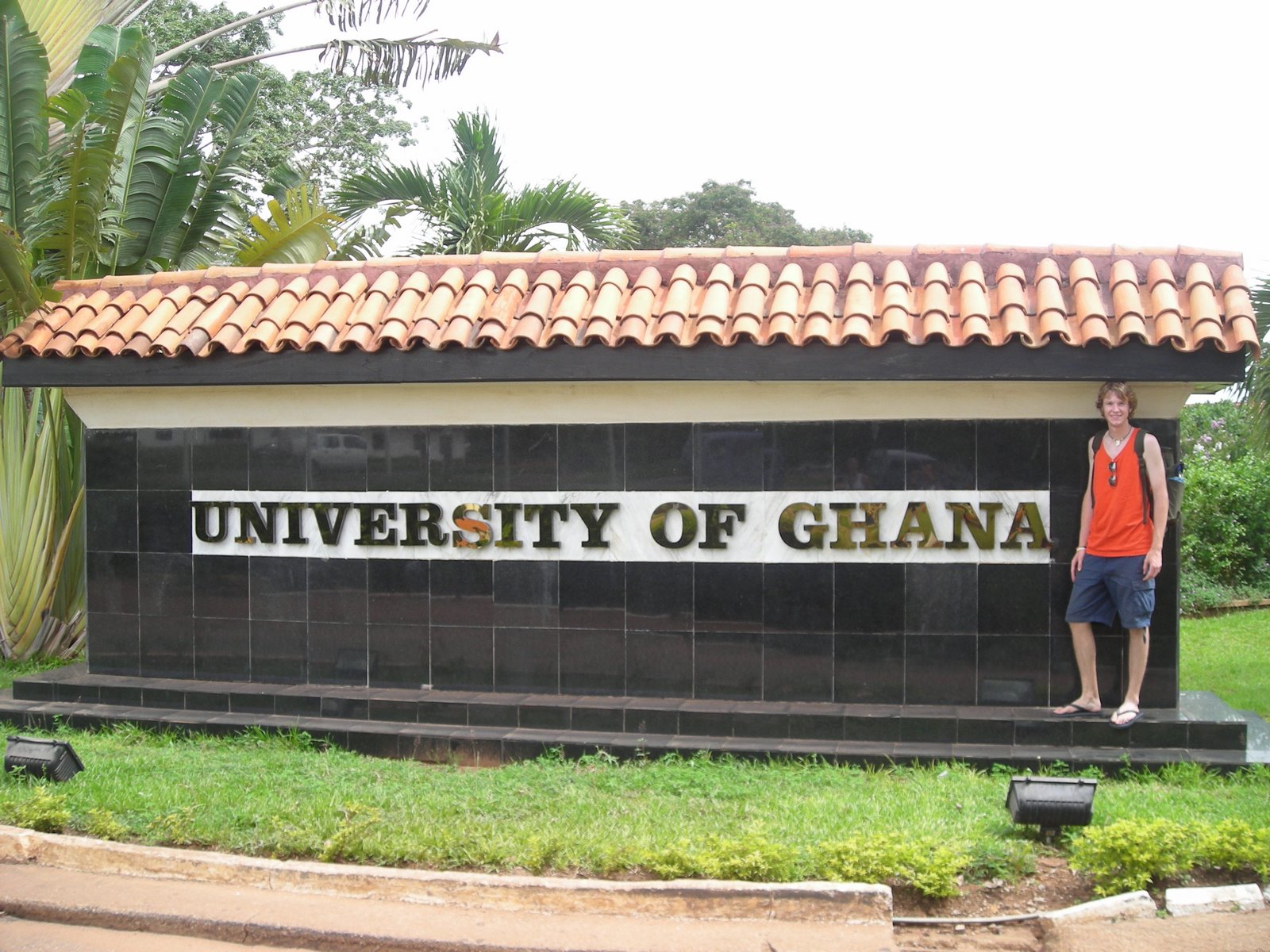
At the University of Ghana.


One of our favorite restaurants to visit, off the beaten path, but well worth a good Ghanaian meal.


Me and Joseph, the most amazing hostel worker ever.

Index of blog post series on Ghana.