definition of development

7 October 2008 Update:
Read a more comprehensive analysis of the definition of development in a more recent post here:
definition of development (revisited): beauty in the palm of your hand.

————————————————————————-

After lecture, and another drum lesson from master drummer Chris, on Monday I gathered a group of people interested in visiting the Peace Corps offices. Six of us worked to get taxis outside of the University with a certain degree of difficulty – probably because no driver knew where it was located. It seems that our group is very good at choosing destinations of which no one has heard. All we knew was that the office was located at 26 W. Cantonments Road – nothing more.

After a great deal of roundabout driving, a couple stops for directions, and some backwards driving (as in driving backwards) we found the offices located on Switchback Road near the house of the Ambassador of Cote D’Ivoire. It turns out with all our driving that we arrived right at closing time for the day with no appointment – I guess that helps. There happened to be a few volunteers at the check-in guard house and thankfully just as we were about to be turned away one of the volunteers claimed that he had gone to school with one of us and he just wanted to show us around.

Alex showed us around the compound and answered any and all questions we had about the Peace Corps. He also shared with us his experience. He is near completing his second year and is located in a very remote farming village in the north of the country. Originally from Nebraska, he was selected for the agriculture and natural resources area. His village is on the cliffs of the north where a ten year war has just ended between neighboring clans. He has started a cashew cooperative with 13 area villages, teaches at a secondary school, works in a hospital, started an HIV/AIDS club, and is attempting to work towards reconciliation between the former warring clans. The Ghana country coordinator had at first called Alex’s assignment ‘hell,’ but he is really enjoying himself and is working very hard to make the most difference that he can. After hours of talking we accompanied Alex to dinner, since we had made him late for a previous dinner engagement – it was ok he said, “they were just high schoolers.” It was really great talking to Alex and hearing his experiences and it really solidifies my plans to join the Peace Corps after college.

This discussion with Alex really made me think about ‘development’ as the word was thrown around a lot that night. Alex has said that he really likes the Peace Corps model because it deals with integration. A volunteer is placed in a village or area and works with the people to improve their situation. This as opposed to some large organization or institution just giving out money to big plans they believe will work. But, what is the definition of development? Who gets to determine what development is? Who is allowed to call one developed or developing or underdeveloped? Is development all based on a desire or push to become Western? Yes, I think in the very recent past it was and really still is to a degree, but for me development holds a different definition. Development for me mirrors positive progress in people’s lives. Development should be based on getting and giving people their basic needs (rights) for survival and life. Even in this regard the almighty ‘West’ needs development.

————–
Read a more comprehensive analysis of the definition of development in a more recent post here:
definition of development (revisited): beauty in the palm of your hand.

Index of blog post series on Ghana.

the nature of africa: rhythm and socialism

The nature of Africa is all about rhythm. Rhythm pervades everything. There is a great love of music that is almost unseen anywhere else. From the very birth of a child there is rhythm in that tiny life. The child enters the world with built in rhythm: crying, kicking, blinking. This child is then exposed to the natural rhythms of the world: frogs croaking, dogs barking, crickets chirping. We all move about our days in rhythm, we talk, chew, sneeze, laugh, go to the bathroom, speak, and walk in rhythm. A child develops this sense of rhythm in Africa as it swings wrapped on its mother’s back – she fetches water, walks, and dances and the child learns rhythm. Rhythm is present even on a less basic level. In many parts of Africa the ritual of greeting someone is very rhythmic – asking the health of the greeter, his family, and his work. This is all done in an almost sing-song rhythm.

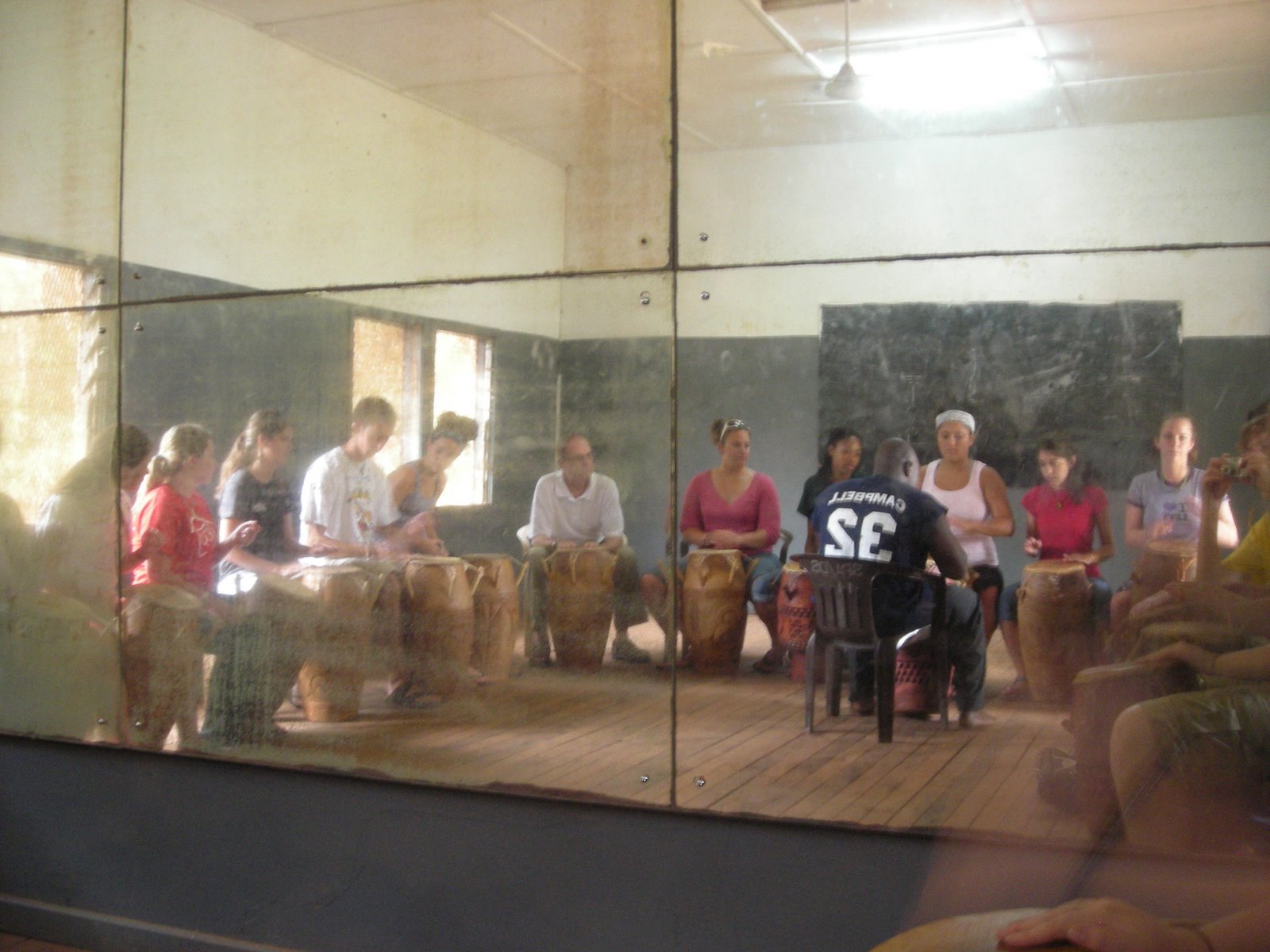
This rhythm is transferred from the natural happenings of the world into the lives of the people through drumming and dance. Drums are a key part of life in Africa. Many communities still use drums for their traditional purpose of calling a community together and sending messages. The tradition of drum and dance is never lost in Africa, that is an aspect that I think will never be lost from the cultures. We have experienced a great deal of this drum and dance tradition as part of our escapades around Ghana and in our course on the art, music, and culture of Ghana. As soon as we arrived in Ghana the rhythm of drums surrounded us. I met the rastas on the second day and began learning from them right from the get go drumming in the market. In Cape Coast we had the performance by the traditional drum and dance group and interacted in the performance with our mostly unrhythmic attempts to dance. More recently we have been coordinating drum and music lessons with our professor and professional music teachers. We had a lesson from the University of Ghana,who is a master drummer, for one of our lectures. We used the traditional Ghanaian drums for this session, they hurt the hands a bit more.

We have also been receiving lessons from Kwasi, who has traveled extensively in the US performing and teaching drumming. He taught and did his dissertation at the University of Michigan. We took the bus to his home which was far from the center of Accra because there is a noise ban. The noise ban was in place from the government so as not to upset the gods before the harvest. Kwasi is an older, stylish and spunky man. He has a nice short afro, dark aviators, creased khakis, and an awesome tie. We start each session with creating random musical rhythms out of words that pop into Kwasi’s head and we often dance around his compound singing and stomping our feet to a rhythm. When we finally got to the drumming we were almost too tired from the dancing workout, you wonder why Africans are so fit – take up some type of African dance. Kwasi was amazing to learn from and was extremely excited to be involved with teaching students music again. He group is supposed to perform for us before we leave. we only have two more days of our course on art, music, and culture.

Along with rhythm consuming life in Africa, there is a certain natural socialism that seems to work quite well. The idea of socialism was attempted across the continent, but it failed – why – because the elites in power were too interested in keeping that power. In much of Africa, specifically in Ghana, people live in secluded hamlets (communes). These hamlets are often isolated, but they remain connected with one another through traditional festivals. In these housing groups there is an idea of communal labor. If your neighbor’s fence has a hole in it the community comes together to work and fix it. This concern for everyone in the community builds the connectivity and social care. This is also evidenced in the ritual greeting and concern for the well being of a fellow community member. Within the hamlet everyone learns how to do every job, everyone knows how to do everything – so everyone helps with everything. There is also a communal yard, court, open space for market, dance, festival, and meeting. I think that this natural socialism helps to build and grow the rhythm of the community.

Professor Dzokoto, lecturing us on the music of Ghana, told us that if you are not part of the community you will not know the rhythm of the community. If you are a stranger to the community you will not know the rhythm of the community. Rhythm pervades all. Kwasi told us that from a young age he began drumming, first on people’s heads. I like to think that I understand that rhythm. As far back as I can remember and as I am told, I was drumming on everything. From my leg, to my desk, to the church pew, to the dinner table – I loved rhythm, rhythm pervades all.

News from Africa:
If you may have missed the news President Bush has placed sanctions on Sudan over Darfur. This marks a great point in his botched presidency. Placing sanctions on companies that operate in Sudan or with Sudan will create a stronger push for a change and hopefully a peace in the Darfur region.

Today the government of Niger dissolved. Yes dissolved, their parliament voted no confidence in the Executive branch because of troubles and corruption in regards to money usage. What this means for Niger I cannot say, but this will definitely be something to keep watch.

Index of blog post series on Ghana.

writing about africa. . . a simple exercise or a skill?

When writing about Africa many times it is difficult to bring the proper perspective or ‘view’. So often people write about Africa with the view, that many of us have come to know, from the myths of Africa. The old myths of a ‘dark’ continent, Heart of Darkness, uncivilized, and savage to the new myths of a continent wrought with poverty, disease, and conflict, these are all too often emphasized in writings about Africa. That, I would say, is a poor representation of Africa, its many countries, and its many peoples. In her blog, Acumen Fund Fellow Jocelyn Wyatt, writes about her training in writing about Africa before being stationed in Kenya for eight months. She tells us of three views often evident in writings about Africa. I will allow her writing to continue this message. And I hope, that I can write about Africa with a critical eye and not with a jaded or an overly simplistic mindset. I hope to understand the intricacies of Africa and not look too far past the idea that all people are more alike than they are different.

From My Year as an Acumen Fellow – 3 Views on Africa:

The Acumen Fund Fellows have been fortunate to meet many inspiring leaders and engage in plenty of thought-provoking discussions over the past four weeks. The question about how to write and talk about Africa has been raised several times. In April, Jacqueline referenced “How to Write About Africa” on this blog and discussed it with the fellows during the first week of orientation. This piece exposes the simplicity of how most people write about Africa and inspired us to think about how to do it in a different way.

View 1 – The Outsider Who Gets It: Gayle Smith, currently a Senior Fellow at the Center for American Progress, and former journalist and senior staff member of the National Security Council and USAID, spoke to the Acumen Fund fellows about her work in Africa and as a member of the U.S. government. Many people don’t understand the appeal of living in the developing world, and I often have trouble articulating it. After living in East Africa for 20 years, Gayle explained it well, It was easier and more satisfying to live there than in the U.S. There’s a sense there’s something bigger than you there. In D.C., there is nothing bigger than any of us. While working for various NGOs in Africa, Gayle saw that there were stories that needed to be told and insisted that the media print them. Gayle’s unique combination as an outsider with extensive experience in East Africa provided her an honest view of the culture, people, politics, and economy and her understanding of the complexities led to her success as a journalist.

View 2 – The Insider Who Exposes It: The book Things Fall Apart by Chinua Achebe is a powerful reflection on the introduction of western culture and colonization to a Nigerian village. When it was published in 1959, it was probably the first book written by an African that most Americans read. Achebe’s novel is honest and extremely critical of the colonial forces who he recognized did not see anything in Africa that was larger than themselves. As an insider, Achebe delivers us well-rounded and real characters and aptly describes the complex forces that pulled Nigerian villages apart.

View 3 – The Outsider Who Simplifies It: In the recently released movie, The Last King of Scotland, a young doctor from Scotland moves to Uganda to work in a rural health clinic. He becomes Idi Amin’s personal physician and gets caught up in the ruthless dictatorship. The film begins with colorful, stereotypical footage of Africa, people singing and dancing on the side of the road, a beautiful African woman seducing a young westerner, and an older white doctor and his wife “saving” a village of Africans at their rural clinic. As the movie goes on, Uganda becomes a much darker, more corrupt, and violent place as Amin’s rule becomes harsher. Even in a ‘flat,’ globalized world, we are frequently exposed to such stereotypical portrayals of Africa: one that is simple, happy and colorful, and the other that is dark, corrupt and violent. While an interesting story with strong characters, in an effort to simplify the context, the film does little to accurately showcase Uganda.

the quest for development; aid to the rescue in ghana

Poverty: a state of being extremely poor; inferior in quality or insufficient in amount; our generation’s greatest problem; the world’s worst disease; a trap. The definition of poverty is one that is not difficult to grasp, yet so many do not understand how or why it plagues our world of riches. Our world is plagued by poverty and, contestably, Africa is the hardest hit due to it’s historical status of being relegated to unimportance. While poverty continues to take lives day after day the power wielding countries, institutions, and agencies argue over a solution. That solution is called development. Leaders, institutions, philanthropists all argue as to how development should be facilitated, what the best facilitator is, and how aid should be implemented. Is aid the best facilitator of economic development to bring an end to poverty?

Almost two years after Ghana’s President received word from the Group of 8 that aid would be increased to Africa, Ghana will celebrate being the first independent African country. Ghana is an African country that was very near economic collapse, but through the process of reform, gained economic stability. The current President is expected to step down after serving two years and it looks as though Ghana’s days of coups and unrest will long be over. Ghana has become an economically stable country by way of economic reform, which brought in foreign aid from the institutions and investment from the rest of the world. This is seen as a limited success as far as African countries. Ghana has shown itself to be a good reformer and much of that success has been attributed to aid. But why is Ghana such an isolated case of the success of aid from institutions?

The Trap or A Missing Right?

Jeffrey Sachs, the director of the Earth Institute at Columbia University, claims that there is a poverty trap and that the only way to get out of it is by climbing up the ladder of development. He states that this is the greatest tragedy of our time; that one-sixth of the world is not even on the development ladder. The reason that one-sixth of the world is not on the ladder is because of the ‘poverty trap.’ They are trapped because of many reasons: disease, isolation, climate, etc., but why? Sachs tells us that this one-sixth is trapped because their families and governments lack the financial means to invest in their own development. The world’s poor need to get a foot up on that ladder, but how? How does one invest in themselves?

Capital is the answer to the poor’s problem – at least that is what Hernando de Soto believes. In his research on the ‘mystery of capital’ de Soto claims to have found that all the poor need is access or ability to use the land and property that they reside on. They have material things, but cannot use their land as a resource to create capital. De Soto says that, “Capital is the force that raises productivity of labor and creates the wealth of nations.” The problem here is that governments have to open up their property systems to the poor and many are not inclined to do so. The processes for land ownership are lengthy and difficult in many LEDCs, so for many people owning property is not worth their time. De Soto fights for an impractical approach to bringing the world’s poor out of poverty. Balaam and Veseth note that de Soto’s argument for property-rights reform could not alleviate LEDC poverty, however such as step may be necessary for the success of ‘the beautiful goal.’

De Soto’s argument is supported in a slightly more practical manner by C.K. Prahalad, who says that there must be a goal to ‘democratize commerce.’ He supports his claim by giving examples of the poor as micro-producers. Prahalad argues that, “We know aid is not the answer to that kind of mass poverty. Subsidies, grants, and philanthropy may have a role to play, but the real solution is local development of the private sector. That requires specific actions that take into account the historical background of the country at hand.” Prahalad makes an excellent point at that there needs to be an understanding of country situations. He tells us that aid has a place, but where is that place?

Property rights are seen by many to be central to investment and the economy of development. Like de Soto they argue for its quick implementation. In regards to property ownership and its use to become developed it seems that Ghana eased from communal to individually owned land system. In the Ghanaian culture property held high importance and even though Ghana had to move from a communal model to individualistic, it was smooth. Property rights were granted to those who had planted or cultivated certain sections of land. This changeover of property rights was facilitated by stable, well-defined laws and customs in regards to the governing of land. The courts also recognized the existence of ‘family land’ and land belonging to larger kinships. This preset tradition of land ownership allowed Ghana to easily transition and permit people to use land as a means of creating capital.

Whose Consensus Should We Use?

Governments can hinder development, people are restricted from development, and societal institutions push the criteria for development. The Washington Consensus is the list by which all must abide in order to receive foreign aid. The Consensus promotes a strong neo-liberal agenda to deregulate economy, privatize government enterprises, create low inflation, low government debt, and open to domestic and international markets. The institutions use the Consensus in a fair amount of disagreement in regards to implementation. The Washington Consensus was a form for economic development that pushed free trade and capital mobility. The issue of free trade versus fair trade is a complete other paper, but the for ‘free’ forces LEDCs to spend funds on making reforms as opposed to implementing programs to serve its people. This causes poverty to continue in LEDC and although the Consensus made an irresistible possibility within reach it also brought the possibility of devastating collapse and risk.

The International Monetary Fund and World Bank are very often criticized and reforms within the institutions are called for. However, outside the institutions stand NGOs who fill the gap and many times create longer-lasting and more effective results for the poor of the world. Easterly is a strong critic of the aid agencies and he makes a very strong and compelling argument against them. Ghana has received a large number of loans and aid from the institutions. Easterly notes that in many recent cases of heavy involvement by the aid agencies end in collapses into anarchy. Stiglitz tells us that the Washington Consensus assumes perfect information, perfect competition, and perfect risk markets – an idealization of reality has little relevance to LEDCs.

Sachs writes about Ghana’s poverty reduction strategy. He notes that the government of Ghana reached the conclusion that a major scaling up of the public investments in the social sector and infrastructure, which estimates a required donor aid around $8 million. The Ghana strategy was well designed and argued, but the donors dropped and rejected the plan. Sachs argues that there needs to be a harmonization of aid. The many bi-lateral aid groups need to work together for larger projects, but for smaller-scale projects a more specified aid is required.

The Downside of Backward

Aid has become a dangerous word in today’s globalized, polarized, prioritized world. Another problem is that aid, as a term, is a very broad topic. For the purposes here, aid refers to financial support to increase economic development. The ‘grandiose’ plan of making poverty history or ending poverty brings about the desire to create the ideal aid agencies, administrative plans, and financial resources. Over the past sixty years the West has pushed reform schemes, agencies, and numerous plans all to end poverty. This has created a massive $2.3 trillion failed push by the aid industry to meet this ‘beautiful goal.’ William Easterly has argued that, “this evidence points to an unpopular conclusion: Big Plans will always fail to reach ‘the beautiful goal.’ Easterly tells us that Planners will always fail and their plans will always fail because they ask the question of what does the end of poverty require of foreign aid? When instead we should be searchers and ask, “What can foreign aid do for poor people?”

Balaam and Veseth tell us that the nature of aid flows has drastically changed from the time of the Cold War until now. During that time less aid was given because of security reasons, but now multilateral aid is channeled through institutions such as the World Bank. In the 1990s the World Bank changed its priorities to “fill in the gaps” due to many projects being funded by the private market and non-governmental organizations (NGOs). This shift made less economically developed countries (LEDCs) more dependent on other sources of funding.

If a LEDC has to depend on another source of funding besides the established institutions, as flawed as they may be, they will most likely look for the easiest way to get that funding. Ghana recently received, in June of 2006, a $66 million loan from China to fund its development projects. This is an extremely different and what some would call ‘backward’ step for Ghana. The Ghanaian experience with foreign aid has been to adopt reforms and partner with the institutions. In this case Ghana has strayed from the accepted conventions of the foreign aid industry. China is seen as a rogue aider in that they are undermining the development policy of the foreign aid institutions. By not placing restrictions on aid usage or democratic reforms, China is taking the foreign aid market by storm, as the World Bank is put out of business. China is not the only supplier of rogue aid, but it is the most prolific. What does this all mean for the aid industry?

It can only mean one thing and that speaks to the effectiveness of the aid institutions and the aid suppliers of the West. Ghana the star of economic reform, democracy in Africa, and years of peaceful independence is seeking rogue aid – there is no place anymore for utopias and institutions and big plans.

Utopia is Not Possible?

If the big plans won’t work than what will? Easterly says that the big problem with foreign aid is that is aspires to a utopian blueprint to fix the world’s complex problems. This is where we must refer back to Easterly and his explanation of a ‘searcher.’ Easterly helps us to understand that, “A planner thinks he already knows the answers; he thinks poverty as a technical engineering problem that his answers will solve. A searcher admits he doesn’t know the answers in advance; he believes that poverty is a complicated tangle of political, social, historical, and technological factors. A searcher hopes to find answers to individual problems only by trial and error experimentation. A planner also believes outsiders know enough to impose solutions. A searcher believes only insiders have enough knowledge to find solutions, and that most solutions must be homegrown.” Easterly pushes for giving more assistance and aid to searchers and not planners because the utopian plan is not possible.

Sachs states that, “One of the weaknesses of development thinking is the relentless drive for a magic bullet.” This is very ironic because at the end of Sach’s book he argues for a big plan to end poverty, a magic bullet? Sachs outlines four main points for what a donor should do. However he seeks to create an overarching plan for all developing countries to escape the poverty trap. Sachs criticizes the aid agencies as well as promotes their reform and continuation. Easterly on the other hand calls for the West to build a willingness to aid individuals rather than governments. He tells us in his book that the ideas thought to be crazy are the ones that work best and reach the people in need of aid. He outlines a plan for how aid should be used for development starting with development vouchers, which the poor could turn in at any NGO or agency for a vaccine, food, health check-up, etc. Easterly strongly emphasizes getting feedback from the poor on development progress and pushes for aid groups to go back to the basics and be accountable for individual, feasible areas of action.

In her Foreign Policy article, Esther Duflo notes that a good many people have qualms about foreign aid, but that we need to fund what works. “Governments and citizens of poor countries resent the us of aid as a means of buying political support, their lack of control over it, the development fads to which it is subject, and the administrative burden that accompanies it.” This idea of funding what works makes sense and many in the development field advocate for a focus on people.

Many people would like to advocate for the big push, an increase in foreign aid, to eradicate poverty throughout the world, however unfortunately the track record of aid institutions and aid in general shows otherwise. If we are to be donors and fighters of poverty, then we need to understand poverty’s complexity and understand that a pragmatic and effective approach is needed. We need to adopt more the idea of Easterly and support the searchers in their quest to actually save lives.

What does this all mean for Ghana? The country will continue to receive large aid packages from the foreign aid institutions for its stability and rogue aid states for their economic successes. Ghana has become a stable economy and even though the Ghanaian people’s pride is very strong they remain chained to the aid institutions and donors when it would be better for sustainability for their development to have their searchers be supported. Aid funding needs to be linked to the implementation of a successful program to avoid waste by governments. Creating an accountability for foreign aid that provides results will justify the increase of aid to LEDC and Ghana. Today’s society has the access and ability to distribute effective aid that actually helps those in need. The greatest problem that we will face is if our government will have the political will to restore confidence in the abilities of foreign aid. Ghana is a success story of Africa as far as economic development and building a stable government, their success was backed by foreign aid from institutions, and yet many of their people remain unserved. The direction and continuation of poverty reduction in Ghana will depend on the country’s ability to recognize and support searchers with effectively implemented aid.

Bibliography:

Anonymous. “Chinese PM announces Ghana loan.” BBC News, 19 June 2006. . (accessed 3 May 2007).

Anonymous. “Proud Ghana still depends on aid.” BBC News, 15 June 2006. . (accessed 3 May 2007).

Balaam and Veseth. Introduction to International Political Economy. Pearson Education Inc, New Jersey: 2005.

Besley, Timothy. “Property Rights and Investment Incentives: Theory and Evidence from Ghana.” The Journal of Political Economy. The University of Chicago Press, 1995. . (JSTOR accessed on 3 May 2007).

De Soto, Hernando. The Mystery of Capital. Basic Books, New York: 2000.

Doyle, Mark. “Can aid bring an end to poverty?” BBC News, 4 October 2006. . (accessed 3 May 2007).

Duflo, Esther. “Fund What Works.” Foreign Policy Magazine, May/June 2007. 43

Easterly, William. The White Man’s Burden. The Penguin Press: 2006.

Naím, Moisés. “Rogue Aid.” Foreign Policy, March/April 2007. . (accessed 3 May 2007).

Sachs, Jeffrey. The End of Poverty. The Penguin Press, New York: 2005.

Stiglitz, Joseph E. Making Globalization Work. W.W. Norton & Company, New York: 2006.

Tsikata, Yvonne M. “Aid and Reform in Ghana.” World Bank. Preliminary Draft Working Paper, May 1999.

Prahalad, C.K. “The World for Sale.” Foreign Policy Magazine, May/June 2007. 50

Index of blog post series on Ghana.

no more foreign aid institutions. . . it’s china

Foreign aid; development assistance; foreign investment; these terms are now gaining another synonym: rogue aid. In an excerpt from the Foreign Policy Blog, rouge aiders are defined as such, “Because their goal is not to help other countries develop. Rather, they are motivated by a desire to further their own national interests, advance an ideological agenda, or sometimes line their own pockets. Rogue aid providers couldn’t care less about the long-term well-being of the population of the countries they ‘aid’.”

China is now the largest rogue aid competitor. The author of the blog entry says, “My friend was visibly shaken. He had just learned that he had lost one of his clients to Chinese competitors. ‘It’s amazing,” he told me. “The Chinese have completely priced us out of the market. We can’t compete with what they are able to offer’.” China can outbid the World Bank in aid lending power! What does this say for the future of the aid community? What does this say for the future of development? When economically powerful, wealthy, nondemocratic countries can circumvent the aid policies of the established lending institutions what can we really expect for development and aid programs? China can outbid the World Bank for a railroad project in Nigeria and sets no stipulation for combatting corruption, it can sign environmentally harmful agreements, it can provide funding without regard to the transparency of governments.

The Foreign Policy article gives three simple answers as to why China and other countries are stepping up their aid game. “[…] money, access to raw materials, and international politics.” These countries are not so concerned to create development or provide aid and help as many people as they can. There are obvious underlying motives to China’s upswing in development aid. This is not to say that China is the first to use rouge aid as a international relations tool. The United States and the Soviet Union used rogue aid to gain the allegiance of dictators. Our world is not in the position now to allow such initiatives to continue. The World Bank and other large aid agencies are monitored closely by watchdog groups, but these ‘rogue’ countries can lend and corrupt and ignore as much as they want.

The greatest threat that I see, and which I wrote about in an earlier post, is the obvious – China is set on getting all that it can from Africa. China has a great lust for Africa’s resources and their thirst is becoming unquenchable. Will Africa be drained and left with people living without basic infrastructure, left empty handed, left to die in ‘under-development.’ There is a quote from the FP article that sums up my thoughts, “Worse, they are effectively pricing responsible and well-meaning aid organizations out of the market in the very places where they are needed most. If they continue to succeed in pushing their alternative development model, they will succeed in underwriting a world that is more corrupt, chaotic, and authoritarian. That is in no one’s interests, except the rogues.”

why the US does not become involved in african conflicts

The title of this entry is a question that very often crosses my mind as I continue to read the news and stay up to date on the various African conflicts across the continent. How can the country with the most power sit idly as conflicts that tear nations and governments apart worsen? How can the country with the most power get involved in its own political war games and ignore the dying?

“If I look at the mass I will never act. If I look at the one, I will.”

Mother Teresa spoke these words and they can possibly lend us an answer to why there is inaction with mass conflict. I found this quote used on the Foreign Policy news page with an article called Numbed by Numbers. The argument of the article is that “people don’t ignore mass killings because they lack compassion. Rather, it’s the horrific statistics of genocide and mass murder that may paralyze us into inaction. Those hoping that grim numbers alone will spur us to action in places like Darfur have no hope at all.” The article says that it is our own human psychology that hinders our action. We are unable to comprehend the numbers and put them into terms of massive human tragedy. The article also notes a study where aid to a young child, when accompanied by large statistics, declined sharply. We cannot comprehend mass human tragedy and apply our actions. Now there are worries that just one more major security incident could create a ‘humanitarian collapse’ in Darfur. I suggest reading the full article on Foreign Policy.

Another possibility of an answer lies in the blog of an American who has just returned from living in Uganda. The conflict, or civil war some say, that is being revealed in Northern Uganda is another conflict in the scope of mass human tragedy. Peace talks were started and stalled last month in Uganda, but are set to re-start in April. The blog entry on March 19th from ‘In an African Minute’ says, “The United States, with very little effort, could drastically increase the possibility of a permanent resolution of the conflict in northern Uganda. Why Washington hasn’t made an effort has been a matter of speculation in policy and development circles since the peace talks began in August 2006.” There is much speculation, especially since the US has been so involved in the continent with ‘anti-terrorism’ measures by giving support to key African countries. ‘Fighting terrorism’ has replaced communism as the US’s new objective in Africa. Ending divisive and destabilizing conflicts in the region is not on the top of the US agenda, if at all.

There are roughly eight conflicts in the African continent affecting nearly 16 million people. Why are these not on the US agenda? We can’t handle numbers, we are blinded by the fight against terrorism, or maybe we just don’t have the Administration with the resolve to act on others behalf when there is no obvious gain for the country or government?

the emerging superpower, by way of africa

By way of Africa, countries become superpowers. By way of Africa, countries gain influence, power, and resources. By way of Africa, exploiters can fuel their desires. And now this is the point where you should ask: “Why?” Well listen my children (not meant as a speaking down to you) and you shall hear of the midnight rise of the new Paul Revere. Instead of racing to sound the alarm of an invasion of British troops, this new Paul Revere races to beat the competition to the resources of the land and people. The new Paul Revere races to establish himself economically and politically in every middlesex town for his bank accounts to be up and full. This new Paul Revere yells to the people to get up and listen to what he can give them and what they can give him in return, he tells them not be get up and to arm against the invasion, but to sit down and join him in this great opportunity.

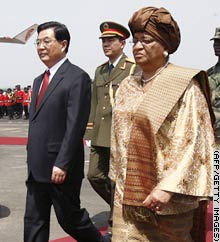
President Hu Jintao of China began his first official 12-day tour of Africa. Jintao began in Cameroon and signed a number of bi-lateral cooperation agreements. Cooperative? Possibly, it is important to note that trade with Africa has increased almost three-fold over the past few years as China searches for resources and markets to fuel its economy. This will be Jintao’s third visit to Africa since his term began in 2003. What many people do not know is that Africa supplies China with one-third of its imported oil. With this power of handing out loans and aid over the next three years, China has been pushed to use its influence on the African oil industry to pressure Sudan on the Darfur issue. Along with this potential issue, China is accussed of selling weapons to Zimbabwe adn flooding African markets with cheap goods that threaten the local producers.

Jintao’s tour takes him to Liberia, Sudan, Zambia, Namibia, Mozambique, and Seychelles. In Sudan, Jintao was given a <a href="http://english.aljazeera.net/NR/exeres/AF777D16-5D77-406D-8045-FCF8714F6BD2.htm
“>red-carpet welcome in the capital of Khartoum. Members of the UN Security Council and numerous activists are calling for Sudan to use this economic influence to push Sudan to end the fighting in Darfur. Sudan has refused demands for a UN peace-keeping force, which it calls ‘neo-colonial.’ Currently China is the number one foreign investor in Sudan and buys oer two-thirds of its oil exports. China is also Sudan’s top political ally with its veto power on the Security Council keeping Sudan from facing heavy burdens. When the Bush Administration named Darfur a genocide and placed heavy sanctions and many Security Council members calling on Sudan to stop the government sponsored killing, Sudan has had to depend on China to buy its exports and support its infrastructure. Surprisingly, ahead of Jintao’s visit, Chinese officials highlighted human rights in Sudan and called for the government to find a solution to Darfur. This act is very uncommon for China, who claims to stay out of internal affairs of other countries. However there are also accusations that along with buying oil in Sudan, China also sells weapons, which calls into question the true strength on China’s words. Are they just meant to appease the international community? Is there any real threat behind that statement? I think not.

During Jintao’s visit to Liberia thousands lined the streets and cheered in arguably what is now Africa’s strongest democracy. Liberia is looking for much needed investment in the war-scarred country. China re-started diplomatic ties in the ‘American stronghold in Africa’ during the Cold War. In Liberia Jintao signed about seven bi-lateral argeements in regards to iron ore, rubber, and timber. “The visit of the president is good for Liberia. China is a super power in its own way. If such a country’s president can visit this small country, it means a lot for us,” said Jimmie Smith, as he painted a stairwell at the Foreign Ministry. This may be true but many people including Africans warn poor African countries of the dangers of making bi-lateral agreements with China if the agreements do not protect their markets from cheap Chinese goods.

In a <a href="http://newsforums.bbc.co.uk/nol/thread.jspa?threadID=5398&&&edition=2&ttl=20070130191949
“>BBC opinion section people were asked to write what they thought China’s role in Africa will do. Many people expressed great hope for the involvement of China building infrastructure and also others noted the problem that China presents with their sale of weapons and their potential to ravage Africa. I hold a degree of both opinions. I am of the belief that China is now creating the last exploitation of Africa, sure they are building stadiums, schools, hospitals, and more, but what good is a hospital without investment in a trained staff, or knowledgable teachers in schools. There needs to be investment in people as much as infrastructure. The end game here is that China is after resources and a place to dump theor goods. This is simple and easy business, China is looking for a large market for its goods so they are more than willing to spend a little to win over their potential buyers – and it is working. It is also a great hope of mine that China’s actions will call up the West to start taking a more pro-active and positive step towards the African continent. The West needs to look beyond its history of exploitation and enslavement and neo-colonialism to be able to focus on helping the people in Africa, who, China may not be willing to invest. Whatever the case, by way of Africa, countries become superpowers – exploitation for resources, neo-colonial business practices. By way of Africa we all need to learn what is most important in this world. Capitalism will fall when our lust for profit out-runs our need for people to live to be able to help us make profit. Structures can be used to create good as easily as they create harm – we are all in this together.

a small bite can topple a giant; malaria


This first story takes me back six years when I first became involved in basic healthcare activism for Africa. This story comes from my mother’s first trip to Uganda in 2001. My family became very good friends with Fr. Joseph from Uganda in the summer of 2000. He dealt with many medical issues in his traveling from village to village fulfilling his priestly duties, but he did not have any medical background. He asked my mother, who is a registered nurse, medical questions when he was here and sometimes called from Uganda to ask the best medical procedure or prognosis. She had found it very difficult since we had such a limited knowledge of what conditions were like in Uganda. So, that following summer my mother made the journey across the ocean to see the medical situation first hand. While she was there the realities were painfully obvious. Fr. Joseph owned a donated Toyota pick-up truck and while my mom was there she traveled around with him on his day to day work. An important note to make is that the pick-up truck doubled as the area ambulance. On one particular day, at a village stop to give mass, a pregnant mother needed transportation to the hospital because there were some complications. The nearest health clinic was seven hours away on the red, dusty, hole ridden ‘roads’. I can only imagine the ride in the back of a pick-up truck, dust thrown about, bouncing along so that a child may have a better chance. En route the pregnant mother went into labor. Still hours from the hospital the mother gave birth to a healthy baby girl and then died. They decided to name the baby after my mother – Baby Elizabeth. A family from the village adopted baby Elizabeth and she seemed to have a good chance in the world. Later the next year we were told that baby Eilzabeth had died. She had contracted malaria and since she lived in such a remote village, she and her family had no access to the $1- $2 medication that could have saved her life. If the access had been there baby Elizabeth might have lived to her fifth birthday, a rare occurance in many African communities due to poverty and disease.

Malaria is a parasite that is carried from human to human by mosquito. Malaria is a very preventable disease, yet kills over a million people each year. Over 90% of malaria deaths occuring in Africa making it Africa’s leading cause of death for children under five. Just recently President George W. Bush has said eight more African countries have joined a $1.2 billion US program to fight malaria. The five-year program works to provide funds to limit malaria’s spread by using insecticides and anti-mosquito bed nets, and also to provide drugs to people already infected. The renewed enthusism for the program has brought the World Bank and billionaire philanthropist, Bill Gates on board. Also on the scene are recent scientific advances, such as progress towards a vaccine, which prove to offer great hope to defeating one of the world’s great killers. A new treatment developed by British scientists collaborating with Kenyan experts is based on a technique for fluid replacement for children ill with malaria. The problem is that intensive care methods, only available at pediatric units in developed countries, is needed to treat infected children.

It is estimated that through partnerships working in Uganda, Tanzania, and Angola – US taxpayers already have helped approximately 6 million people to treat and prevent malaria. There are great hopes for the future prevention and defeat of malaria, but it requires the continued support of people in the developed world. US taxpayers need to push the Bush administration and future adminstrations to remain dedicated to the mission of saving lives affected by preventable disease. President Bush also announced at the Washington Summit on Malaria that the US Volunteers for Prosperity program will be expanded to recruit skilled US volunteers, doctors, and nurses to travel to at-risk countries to train local health care workers. The Gates Foundation has also expanded the number of projects it funds to research new malaria treatments. Likewise, there is a large private sector effort, such as, Nothing But Nets and the Acumen Fund, among others. Check out the blog of an Acumen Fellow working with a mosquito net facotry in Tanzania. There are so many opportunites to donate, to get involved, to volunteer, and to save a life. Check out some of the links posted and make a difference today!

beyond the tragedy, the hope of africa

Africa is far from being without tragedy, but when you look past all the blaring news article headlines you will see that there are many reasons to be optimistic for the future of African and its people. Beyond the Western media’s fixation with the African tragedy there is so much hope and joy that gets pushed under the rug. Why? Is it because there is an othering and the problems and issues are over there? Is it because there is no hope on the ‘dark’ continent? Is it because the West would rather not admit that Africa is ‘developing’ and is really doing well? There are plenty of articles in the news that would deter even the staunchest optimist. Most of Africa lives in extreme and absolute poverty. Crises in Cote d’Ivoire, Sierra Leone, Zimbabwe, Uganda, and a few other countries are far from resolved. The conflict in the DRC has been inflamed by its recent free election results. Uganda is moving closer to a peaceful resolution of its conflict, but the rebels have backed out again. There is growing tension between Somalia and Ethiopia. And now Chadian rebels are storming across the country capturing major cities. The conflict in the western Darfur region of the Sudan is becoming further and further from resolution it seems. The African Union peacekeeping force’s mandate has been extended, but a UN force is still being rejected. All these armed conflicts are frightening, but then there is also many preventable diseases and basic essential needs that kill more people each year. HIV/AIDS is a growing problem and has yet to reach its peak in Africa.

The first great example of African hope is the amazing diversity of ideas and cultures. The people are shaping a better future for themselves and advancements are being made. African culture is thriving. Before we, who are not in Africa, can begin to understand how to assist Africa we have to first understand the intricate links between Africa’s people, culture, and wildlife. Africa’s middle class is growing, African entrepeneurs are becoming more prominent and have incredible ideas and solutions to problems that they know and live with.

On the continent the advances in medicine, technology, and science are taking hold. I remember when I was in Africa almost everyone had a cell phone and could easily stay connected. Advances in medicine are slow to be adopted mostly because of their costly nature, but there are growing efforts to provide services. We all need to remember that Africans are not just vulnerable people, but also solvers of problems. They may live in dire situations, but they still have the capacity to run a more effective program that pinpoints the real issue, which many times Western donors miss. The greatest innovation that I have seen developed so far has been the PlayPump. Discovered and designed by a man visiting South Africa. The pumps are set up to provide children a way to release their energy on a roundabout and also pump clean water for their community. There is a wealth of children’s energy, but a lack of means to use that energy. The water pumped through play is then stored in a 600 gallon container with billboards promoting HIV/AIDS education and other healthy messages. These billboards assist in paying for upkeep and maintenance of the pump. No worries children are not forced to play or pump, they just enjoy playing and that helps their community to have clean water. Water-related diseases are the leading cause of death in Africa and the ‘developing’ world. It is estimated that two out of every five Africans live without a clean water source. With the PlayPump children are able to stay in school instead of getting water. Women and children benefit from less injuries due to carrying heavy water containers over long distance. Women can focus more on their families and children with extra time not spent on water fetching. Some women have been able to start-up small businesses to provide an added income source and more food for their families.

Beyond the calls of corruption, falsified elections, and conflict between candidates, there is an increase in credible leaders in African countries. The first woman leader was elected last year. Leadership is growing as Africans step up to help one another and show their fellow citizens effective ways to improve life. There has also been a venture launched by an African millionaire to combat corruption within African governments. Mo Ibrahim, a Sudanese multi-millionaire, is offering $5 million to African heads of state who deliver security, health, and economic development to its people. The Mo Ibrahim Prize for Achievement in African Leadership was launched on the 28th of November this year. This is obviously a very controversial idea and many have stated that African leaders that are oppressing and killing their people will continue to do just that. Mo Ibrahim has said, “The day we do not need any aid will be the most wonderful day in my life.” The award will be given out as $200,000 for 10 years after the leader is out of office, so that the African leaders will have a life after office. Secretary General Annan has thanked Ibrahim for offering such a generous prize, but many still remain skeptical. Keep a watch on this one, time will tell if it will be successful.

Along with all the innovation and advancement there is also a great opportunity fro those of us in the ‘developed’ Western world. Doing your research, finding a sustainable project to assist, and becoming personally involved in working for Africa provides so many opportunities for personal development and happiness. I can tell you working in Africa is a joy and an amazing way to self-actualize your potential to change the world. Don’t wait, jump in – each year that you wait is a missed opportunity, each day that you do not challenge yourself is a wasted day, each minute is a lost life.