oil to the people?

Nigeria’s economic focus on the trade of oil can be reversed from being its greatest downfall to being its greatest achievement. Currently, Nigeria’s economy is fueled and supported by the energy sector and the international trade system. Nigeria is Africa’s largest exporter of oil, being the number one exporter to China and the fifth largest supplier to the US. However, the corruption of the government, the un-diversified economy, political instability, and poor management has led to an over-dependence on the oil sector. The oil sector currently supplies 20% of Nigeria’s GDP, 95% of its foreign exchange earnings, and 80% of its budget revenues. The oil sector has not led to an end to the crushing poverty of Nigeria and this leads many to join the rebel groups combating foreign involvement and trade. Nigeria used to be a large exporter of food, but with an emphasis on fossil fuels and a growing population, the agriculture sector could not keep up and now the consequences can be seen.

Nigeria’s focus on international trade in oil has developed the problems that Nigeria now faces. International trade is the oldest and most controversial subject within the international political economy. International trade is the production structure of the international political economy, this means it deals with relations between states and non-state actors such as international businesses. Controversy on the international trade structure comes about when the state governments and international businesses grab the economic benefits and limit the negative effects on themselves. This controversy could not be more evident in Nigeria’s case as the government works to fight corruption of politicians, angered rebel groups, and the hunger of foreign governments and investors for raw materials. From Nigeria’s agreements and interactions with other countries in the international political economy we can view Nigeria’s place within the international system.

If you were to look at Nigeria’s international dealings with China and the US, you would notice two different perspectives on international trade. One perspective is China being mercantilist as they work to create bi-lateral agreements and the other, the US, with a push for a more liberal global system to allow multinational corporations access to the market. Hu Jintao, President of China, visited Nigeria for a second time in 2003 and secured four oil-drilling licenses for China in exchange for investing nearly $4 billion in infrastructure projects. In the international trade system, China is looking for a market to place its abundance of cheap goods and Nigeria is looking for a reliable importer of its oil who will also support the country financially. China is also on the search for natural resources to fuel its growing population. Yet the US is also seeking a place to receive oil as it looks to become less dependent on the Americas. US corporate interests are high in the energy sector and the US government has offer much help in the way of democratic reform. However as the world’s powers seek to find sources of energy, the instability of the Niger Delta region of Nigeria causes much concern as both US and Chinese workers are held hostage. This creates a strain on the pricing of production and consumption of oil. Likewise the kidnapping of foreign oil workers creates political tension, which could potentially lead to future problems in trade with Nigeria.

Nigeria now holds a prominent position as the world searches for its fossil fuel fix. With their abundance of oil, Nigeria has the potential to reform its political system and create positive trends from its trade in oil. The flow of oil brings in investors and in turn these investors can be used to build the countries dying infrastructure. As has been evidenced by China’s recent push in Nigeria, countries are willing to invest in Nigeria to have access to its oil. However, investors will not be able to help with ethnic tensions in the oil-producing region. Nigeria will need to solve its internal problems if they are to keep a hold on their oil-trading niche. There is now a significant push to calm those problems through social and economic development programs run by government agencies and multinational corporations. As Balaam writes, “If wealth is power, then trade is both.” Nigeria needs to be sure to use its trading power as both an internal development tool and a foreign policy tool. Nigeria needs its investors and MNCs to focus on more then just their international responsibility to provide oil to consumers. They need to have these international partners assist in focusing on domestic issues in order to be a trading partner.

In February 2007, the Nigeria Oil and Gas (NGO7) Strategic Conference was held. The conference held attendance from over 550 delegates from almost 70 companies in the Nigerian oil and gas market. Interesting to note is that although China has recently become a front-runner in Nigerian assistance, speakers at the conference included country managers and directors from the large US oil companies, however only one from a Chinese company. Was this a political move or are the US companies most prominent in Nigeria at this time? Time will tell.

The greatest hope for Nigeria is foreign investment. With foreign investment focused on development and reforms focused on eliminating corruption Nigeria will be able to become a more important regional and international trader. Investments are increasing in Nigeria. Companies are seeking long-term investment and are especially searching for trade in raw materials. Nigeria holds a huge potential and it needs to use its power in the international political economy to reverse past trends and push for greater development assistance from investors. Along with bringing in foreign investors, Nigeria needs to stress an understanding by investors of local conditions and make partnerships carefully.

the final battle in the continent

The noise will make all else inaudible, not even the whisper of, “here they come,” will be understood. The noise will be unbearable. TICK TOCK, time is running out to stop and realize the impending doom. CHING, money is flowing so fast and smoothly for anyone to truly care and take notice. RATTA-TATTA, RATTA-TATTA, anti-terrorism gunships will tear through the sky and open fire marking holes on the cratered dirt roads, the cargo shipments will crash and the cheap goods will burn as the bombs fall, KABOOM, refugees will run from camp to camp to avoid the madness of it all, AHHHH, disease will run rampant as systems of infrastructure are torn apart, rebel groups and religious sects will race to claim control before they are cut down in the streets, RATTA-TATTA, buildings and factories will be contructed and destroyed all in the same day, BOOM KA-BLAM, the force of trade will combat the force of military imperialism in the last great epic battle for the African continent.

Africa has already faced two huge battles between superpowers on its soil, this I am telling you will be the last and the greatest. The first great battle for Africa was during and after the Berlin Conference of 1884-5. As the Western powers of the day argued and squabbled over land rights to various parts of Africa, the African pie was sliced and later devoured. After the conference many of the Western powers preceded to lay claims to more of the continent slowly moving Africa in to the period of colonialism or maybe a better term would be pure exploitation of land and people. Leopold II of Belgium ravaged the Congo Free State’s people for rubber, the Firestone Tire company established itself in Liberia, Brazil perpetuated the slave trade in Senegal, France’s blatantly promoted colonial racism, the British imposed custom and culture, and the list goes on of colonial atrocities and wrong-doings. The division of the ‘African pie’ led to the failure seen in later years and in the future created by colonialism. The Great Western powers of that age saw Africa only as an opportunity to gain territiory and resources, to exploit being who walked the earth for their own good and nothing else, to be bigger, stronger, and more impressive. However, this was not always the Western European view of Africa.

Africans and Europeans worked and lived as equals in the Ancient and Renissance eras. Europe depended on Africa for its economic stability. In the Greek, Roman, and European Renissance societies ‘blacks’ and ‘whites’ were treated as equals as evidenced in paintings from the time periods. Africa was an ancient center for learning, religion, and wealth (ie: Timbuktu). Ships from the Swahili coast reached farther than any European vessel and the Swahili people mastered sailing techniques before the Europeans. This spread the sale of goods, cultures, and ideas. This is evidenced by porcelain from China embedded in East African tombs and Chinese paintings of an African giraffe, given as a gift to Chinese emperor. This wealth and power of Africa lasted up until Vasco de Gama‘s voyage around the tip of Africa, when he noted the great gold wealth of Africa. This prompted the return of Western fleets to plunder and pillage African Islands and coasts for the wealth and gold.

The Second great battle for Africa came with the end of the Second World War and the rise of the Cold War. With the ‘threat’ of spreading communism through the Soviet Union and the US’s mandate to halt that spread the greatest proxy wars were waged on the African continent. Angola, Mozambique, Rhodeisa (Zimbabwe), Zaire (DRC), Guinea Bissau, Egypt, Somalia, Ethiopia, Uganda, and Benin were all hot spots for the tug-of-war in the continent. <a href="http://www.piedmontcommunities.us/servlet/go_ProcServ/dbpage=page&gid=01350001151109257610111573
“>”When two elephants are either making love or fighting, the grass perishes.
And when the Third World countries become the hotbed of struggle, they suffer.” Most African countries gained their independence during the height of the Cold War and so the terms of independence were dicated by either the Soviet Union or the US. The African people lost the opportunity to set up their own governments and systems. The lasting effects of this are evidenced in the current civil wars and conflicts happening today (ie: Sudan). Many African countries are now moving towards adopting democratic governance and conflict resolution. The ill effects of the Cold War are being reversed and yet there is an ever growing presence of foreign dominance on the continent.

This brief background moves us into the third and what I believe will be the last epic battle in the African continent. This third battle involves the use of neo-colonialism, mercantilist trade, military intervention, and resource exploitation. The battle in the African continent pits China’s production and trade poweress over the US’s seeming military might. At this stage China is winning the battle. With its history of supporting the African independence movements and its current bi-lateral trade agreements set-up in twelve African countries, China is well on its way to taking the continent by storm. The US has seen this rise of Chinese investment in Africa and has come back with actions against terrorism. The new <a href="http://ipsnews.net/news.asp?idnews=36396%22
“>AFRICOM, or Africa Command, is now official. The US has been involved militarily in Africa for a long time. Many believe that since the Somalia 1993 conflict where 18 servicemen died, that the Pentagon is un-interested in Africa. Ethiopia has received extensive US military support in the way of training and supplies. The US has also led efforts to attack Islamist terrorist groups and has used Ethiopia’s support. Many Sahelian countries have recieved support as part of a Trans-Saharan Counterterrorism Initiative focusing on Algeria, Chad, Mali, Mauritania, Niger, Senegal, Nigeria, and Morocco, the US has become more involved in West Africa where US energy interest is growing. The Pentagon is taking on more humanitarian roles usually filled by USAID, however I would argue that this may be a better approach. Adding aid to military support brings good governance and stability of the people. What does bother me is that this is being initiated through the Pentagon and through military means with a goal of US national security as the underlying issue motivating the anti-terrorism actions and support.

While the US works to gain militarily for national interest, China is developing more peaceful trade gains for its national interest. President of China, Hu Jintao, has been touring the continent looking to make investments and partnerships to give the Chinese market a place to trade more. Recently in South Africa, where diplomatic ties of nine years ago have strengthened trade, Jintao announced huge loans for the country, increase in trade, and increases in South Africa’s tourism industry. Agreements were signed in South Africa and Namibia to increase the “brotherly friendship” between the countries. Also recently in Nigeria nine Chinese oil workers were freed from Nigerian gunmen. This comes as President Jintao is touring eight African countries. There was no reported ransom paid. Many foreign workers are held hostage in the Niger Delta as the region wrestles with poverty and an uncaring oil industry. Even as the Chinese are working to increase trade and investment, their workers are not free from the conflicts and issues of the continent.

As the US and China are increasing investments and military actions other countries are joining the battle to gain influence and power in Africa. <a href="
http://allafrica.com/stories/200702020829.html”>Brazil is hot on China’s heels. Brazilian President Luiz Inicio Lula da Silva apologized for almost 400 hundred years of slave trade on a visit to Senegal. Brazil is seen as being in contention with China and India as the next superpower. Engaging Africa is the centerpiece of Lula’s diplomacy. He has visited 13 African countries and has opened 12 embassies in Africa during his term. Brazil is slightly ahead of the game in regards to China with bi-lateral agreements with Ghana, Nigeria, and Mozambique. Lula is interested in “digging beneath the layers of guilt and sorrow to find commercial and geo-political issues.” The German government is also joining the iniative to increase African investment. Germany’s plan is to create <a href="http://blog.foreignpolicy.com/node/3511
“>African Bond markets: “Berlin has presented its initiative, part of its agenda as president of the G8 group of industrial nations, as part of an effort to help African countries to insulate themselves against rapid swings in international exchange rates. However, Thomas Mirow, deputy finance minister, said the move would also address concerns fuelled by Beijing’s policy of granting generous, unconditional loans to African countries as a way of securing access to these countries’ resources and markets.”

So as the country is over-run by Western powers seeking to increase their trade options and other forces are working to gain a military influence I wonder what lasting effect this will have on the continent. As you can gather from my introduction I cannot see this initiative as being completely positive. While China is offering great loans and investment to Africa, but on the flip side China is one of the world’s premier arms suppliers. Countries cannot afford expensive Western arms and so they line up to buy from China. China is heavily invested in Sudan where there is an intense internal conflict, a genocide – fueled by Chinese arms deals. China often ignores the impact of its arms deals. China claims to not mess with the internal affairs of countries, but these arms deals can have massive impacts on internal affairs. However China is concerned with being viewed as a responsible world power, so it may make efforts to invest positively. China, Brazil, Germany, the US, who is next to join in this last rush for the resources of the African continent? Will this last ‘battle’ and investment tear the continent apart?

the emerging superpower, by way of africa

By way of Africa, countries become superpowers. By way of Africa, countries gain influence, power, and resources. By way of Africa, exploiters can fuel their desires. And now this is the point where you should ask: “Why?” Well listen my children (not meant as a speaking down to you) and you shall hear of the midnight rise of the new Paul Revere. Instead of racing to sound the alarm of an invasion of British troops, this new Paul Revere races to beat the competition to the resources of the land and people. The new Paul Revere races to establish himself economically and politically in every middlesex town for his bank accounts to be up and full. This new Paul Revere yells to the people to get up and listen to what he can give them and what they can give him in return, he tells them not be get up and to arm against the invasion, but to sit down and join him in this great opportunity.

President Hu Jintao of China began his first official 12-day tour of Africa. Jintao began in Cameroon and signed a number of bi-lateral cooperation agreements. Cooperative? Possibly, it is important to note that trade with Africa has increased almost three-fold over the past few years as China searches for resources and markets to fuel its economy. This will be Jintao’s third visit to Africa since his term began in 2003. What many people do not know is that Africa supplies China with one-third of its imported oil. With this power of handing out loans and aid over the next three years, China has been pushed to use its influence on the African oil industry to pressure Sudan on the Darfur issue. Along with this potential issue, China is accussed of selling weapons to Zimbabwe adn flooding African markets with cheap goods that threaten the local producers.

Jintao’s tour takes him to Liberia, Sudan, Zambia, Namibia, Mozambique, and Seychelles. In Sudan, Jintao was given a <a href="http://english.aljazeera.net/NR/exeres/AF777D16-5D77-406D-8045-FCF8714F6BD2.htm
“>red-carpet welcome in the capital of Khartoum. Members of the UN Security Council and numerous activists are calling for Sudan to use this economic influence to push Sudan to end the fighting in Darfur. Sudan has refused demands for a UN peace-keeping force, which it calls ‘neo-colonial.’ Currently China is the number one foreign investor in Sudan and buys oer two-thirds of its oil exports. China is also Sudan’s top political ally with its veto power on the Security Council keeping Sudan from facing heavy burdens. When the Bush Administration named Darfur a genocide and placed heavy sanctions and many Security Council members calling on Sudan to stop the government sponsored killing, Sudan has had to depend on China to buy its exports and support its infrastructure. Surprisingly, ahead of Jintao’s visit, Chinese officials highlighted human rights in Sudan and called for the government to find a solution to Darfur. This act is very uncommon for China, who claims to stay out of internal affairs of other countries. However there are also accusations that along with buying oil in Sudan, China also sells weapons, which calls into question the true strength on China’s words. Are they just meant to appease the international community? Is there any real threat behind that statement? I think not.

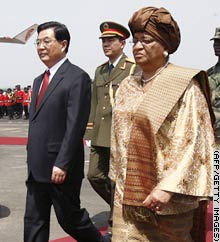
During Jintao’s visit to Liberia thousands lined the streets and cheered in arguably what is now Africa’s strongest democracy. Liberia is looking for much needed investment in the war-scarred country. China re-started diplomatic ties in the ‘American stronghold in Africa’ during the Cold War. In Liberia Jintao signed about seven bi-lateral argeements in regards to iron ore, rubber, and timber. “The visit of the president is good for Liberia. China is a super power in its own way. If such a country’s president can visit this small country, it means a lot for us,” said Jimmie Smith, as he painted a stairwell at the Foreign Ministry. This may be true but many people including Africans warn poor African countries of the dangers of making bi-lateral agreements with China if the agreements do not protect their markets from cheap Chinese goods.

In a <a href="http://newsforums.bbc.co.uk/nol/thread.jspa?threadID=5398&&&edition=2&ttl=20070130191949
“>BBC opinion section people were asked to write what they thought China’s role in Africa will do. Many people expressed great hope for the involvement of China building infrastructure and also others noted the problem that China presents with their sale of weapons and their potential to ravage Africa. I hold a degree of both opinions. I am of the belief that China is now creating the last exploitation of Africa, sure they are building stadiums, schools, hospitals, and more, but what good is a hospital without investment in a trained staff, or knowledgable teachers in schools. There needs to be investment in people as much as infrastructure. The end game here is that China is after resources and a place to dump theor goods. This is simple and easy business, China is looking for a large market for its goods so they are more than willing to spend a little to win over their potential buyers – and it is working. It is also a great hope of mine that China’s actions will call up the West to start taking a more pro-active and positive step towards the African continent. The West needs to look beyond its history of exploitation and enslavement and neo-colonialism to be able to focus on helping the people in Africa, who, China may not be willing to invest. Whatever the case, by way of Africa, countries become superpowers – exploitation for resources, neo-colonial business practices. By way of Africa we all need to learn what is most important in this world. Capitalism will fall when our lust for profit out-runs our need for people to live to be able to help us make profit. Structures can be used to create good as easily as they create harm – we are all in this together.

the US policy on africa

What is the US’s policy on Africa? Do you know? Many people do not and now is your chance to find out. On the US government page on African Policy the first thing I notice is the picture displayed on the top, not just because it is a picture, but because it is President Bush and President Ellen Johnson-Sirleaf of Liberia at a ‘Partners in Democracy’ forum. As you can see Bush is pointing off into the distance and Ellen looks quite fed-up and dismayed. First, is this the US policy on Africa point to the distance and not involve the African leadership. Second, did we forget that Africa is not a country and that there are 54 countries within the continent. Africa as a whole does not have one policy on the US, each different country has a policy – why doesn’t the US have a policy for each country in Africa? Maybe it is just not strategic enough or worth the US’s time? Whatever the case I find the picture very telling of the US goverment approach to Africa. They then jump right into the Darfur conflict and the subsequent peace agreement in the works. This I find very disturbing as all the US government has done for the Darfur conflict is give it lip service and some nicely written statements. After scrolling down the page, to what is almost the bottom, you will find the outline of the US policy on Africa:

“In Africa, promise and opportunity sit side by side with disease, war, and desperate poverty. This threatens both a core value of the United States—preserving human dignity —and our strategic priority—combating global terror. American interests and American principles, therefore, lead in the same direction: we will work with others for an African continent that lives in liberty, peace, and growing prosperity. Together with our allies and friends, we must help strengthen Africa’s fragile states, help build indigenous capability to secure porous borders, and help build up the law enforcement and intelligence infrastructure to deny havens for terrorists. An ever more lethal environment exists in Africa as local civil wars spread beyond borders to create regional war zones. Forming coalitions of the willing and cooperative security arrangements are key to confronting these emerging transnational threats.”

Bush’s Africa policy has three pillars which mostly are comprised of holding lots of meeting with various groups and on different issues affecting African countries (ie: AU, malaria, HIV/ AIDS, growth and opportunity act, etc.) Meetings a indispensible when one does not want to act. I am afraid the US’s policy on Africa is just a bunch of words, no action.

Another great site that I found helpful in my search of US’s African policy was Africa Action. Each year they write a full report on the US policy for Africa. They critique and offer potentials and what needs to happen in years to come. Africa Action opens the report with this quote, “2006 will help clarify whether the compassionate concern for the African continent, worn like a badge by western leaders last year, is a true determinant of Africa policy, or whether it merely masked other, more ‘strategic’ and less ‘benevolent’ impulses and interests.” 2005 was a great year for more focus and interest in African issues. It was a year of more advocacy and awareness about Africa and thus there was more talk of doing something on the continent. I find this is a beautiful quote to begin critiquing the US African policy. What has 2006 shown? It seems that US policy is focused only on strategic advancement and leans no where to the benevolent side. Africa Action begins by outlining the year from Live 8 to Live X. Concerts which raised funds and awareness for Africa to US military sweeping into the continent to be sure America is secure. This comes with the development of the Africa Command as well. This military shift in Bush’s Africa policy obviously speaks to the ‘War on Terror’ focused on intelligence gathering and keeping al-Qaeda out of Africa. Yet even with this upswing of troops and US intelligence in Africa a genocide continues and conflicts spread, threatening regional security.

Another development to note in US policy is the potential of African oil. It is estimated that over $10 billion a year will be invested by the US in African oil activities. Many policy analysts say that the US needs to shift its oil dependence from the Persian Gulf to the Gulf of Guinea, however as many analysts fail to realize, African oil is a creates a great deal of conflict by itself without the US involvement. The US may only intensify conflicts and make themselves a target. Lastly, the Africa Action report notes the slim mention of security in the US Africa policy. With the growing threat to public health and differences on global issues, a great disparity is enlightened between African priorities and American interests. The report also highlights the hypocrisy of the current Administration focused on showing its humanitarian side and not its creeping military and strategic involvements. The US African policy is also not within in the lines of what most Americans would like to see as the US policy towards Africa. The US needs to adapt its policy to involve African leaders and to include the voice of the American people. I encourage you all to read the site on US Africa policy and the Africa Action report. After reading let your politicians know how you feel and what you want to see happening in Africa from the US.

the new military frontlines – africa?

In an article written by a Washington Post blogger and later briefly analyzed and linked to on the Foreign Policy website, the new Africa Command, which has been created to supposedly focus on the globe’s most neglected region, approved by Donald Rumsfeld, will be operational within two months. Some say this mark an important change in US policy more focused on preventative measures rather than Cold War posturing. Currently there are five commands, three of those split the African region. It has been suggested that the creation of the Africa Command will allow a single organization for agencies like the State Department and CIA. Now stop, the State Dept. and CIA? The last time US military was based in Africa was during World War II. More recently the CIA has been involved on the continent throughout the Cold War and, I am fairly certain, currently. Through the US government the CIA did some ‘wonderful’ work: propping up numerous “democratic” dictators (Milton Obote and Idi Amin in Uganda) and assassinating a true democratic leader, Lumumba in Zaire (DRC), and setting another dictator, Mobutu. These are just a few examples of the track record of the US military and CIA on the African continent, not to mention the misguided attempts in Somalia and the fearful neglect of the Rwandan genocide. The US military has many links to rebel movements and the put-down of rebel movements in roughly six African countries since 1990.

The Washington Post blogger, William Arkin, is quoted in the Foreign Policy blog that he does not believe the new Africa Command will be a positive for the continent. The FP piece then asks: “Why?” The obvious answer to that question is just look at what the US government has done or attempted to do in Africa. With the US’s current actions and their ‘putting Africa on the back burner’ (or maybe its not even on the stovetop) I really do not think much has changed. A new command to place the US military and CIA present on the continent cannot be a positive change in policy. The US has provided military support to Sahel countries with known oil resources such as Chad and Ethiopia, but not Sudan. The US military is afraid of actual action on the African continent since the 1993 Somalia mission. A genocide is by far too much for the current administration to handle. Bush on genocide, “Not on my watch.” Try opening your eyes.

Interesting to take note of is China’s Africa Policy released last year. Last year I wrote a post, check it out, about the new African policy focused on helping to build infrastructure regardless of political regime type in exchange for natural resources. A policy without ethics some might say. Is this new Africa Command a front to the recent increase in Chinese aid and involvement on the continent? Keep your eyes on the lookout for US military actions in Africa. Also check out the Times article on the Africa Command.

growing impact; china’s investment in africa, where is the US?

When you think about where your life is going and what you want to do and why you want to do it, do you ever consider the impact your decision will have on others and not just yourself? I am an strong idealist and I with the work that I do I can’t see defining myself as anything else. I dream of a world with universal access to the necessary healthcare that all people need. I dream of a world where co-existance and peace are a norm, I dream of a world where everyone, whether they know it or not, is connected by their actions and decisions. However, I not only dream, but I envision and believe that such a world is a possibility.

At any rate, if you have been reading the news lately you very well have noticed that there are peace talks in Uganda and they seem to have gone very well, since a peace accord was signed late last month. This accord will end two decades of violence and will hopefully lead to a rebuilding and return to positive advances. Peace is growing in the region, yet as it does the crisis and genocide in Sudan continues as reports of indiscriminate aerial bombings by Sudanese government planes was reported today. Reconciliation talks continue in Rwanda, presidential elections in Gambia, and the Liberian president is recognized for her peaceful efforts.

The stability of the continent is growing, but is the western model the best? Is capitalism and democracy the only right way to run a country? Only time will tell, and of growing concern is the role of China in African Affairs. My friend is currently studying in Egypt and has said that he has seen the growing Chinese presence in Egypt within the tourism industry. The growing impact of China in Africa is alarming not for the fact that China is the last remaining communist state, but what is alarming is the policy that China presented in January of this year (2006). Click the title of this post to view the full Policy.

China and Africa have had a long relationship of political support. As China and various African states gained independence the relationship grew and, as China writes, increase in bi-lateral trade and economic cooperation. China outlines a number of cooperations, however as with most documents, everything looks good on paper and it makes me wonder if this is the last sweep and takeover of Africa. China is in search of natural resources and the resource rich African continent is ripe for the picking. With China and Africa’s history and China’s policy to assist any form of government to develop (regardless of a particular government’s disregard for human rights or caring for its people). What I take from this policy is that China will assist African leaders to build their infrastructure in exchange for natural resources. Will China finally suck Africa dry and leave its people to rot with no chances for sustainable development? Will the US or other Western powers not also take on a stronger policy on Africa? Will our leaders continue their policy of turning a blind eye toward the African continent. The US has carried this policy well. With our military failures and the tyrant leaders we propped up all leading to disaster, I feel the US has an even greater responsibility to invest in the continent and assist in its positive development to support its people. I am worried that China will toss aside the African continent like an empty candy wrapper after devouring the delicious chocolate inside before the African people can even rebuild their lives. Again only time will tell, but this is my call to the US government to adopt a strong African Policy based on investment for sustainable development and cooperation, as China has declared to do, but we owe it to the people. I hope to travel back to Africa soon, will I need to know Chinese to get around? (Note: I have nothing against the Chinese language or people, but its government’s history makes me worry)