
beyond the tragedy, the hope of africa

Africa is far from being without tragedy, but when you look past all the blaring news article headlines you will see that there are many reasons to be optimistic for the future of African and its people. Beyond the Western media’s fixation with the African tragedy there is so much hope and joy that gets pushed under the rug. Why? Is it because there is an othering and the problems and issues are over there? Is it because there is no hope on the ‘dark’ continent? Is it because the West would rather not admit that Africa is ‘developing’ and is really doing well? There are plenty of articles in the news that would deter even the staunchest optimist. Most of Africa lives in extreme and absolute poverty. Crises in Cote d’Ivoire, Sierra Leone, Zimbabwe, Uganda, and a few other countries are far from resolved. The conflict in the DRC has been inflamed by its recent free election results. Uganda is moving closer to a peaceful resolution of its conflict, but the rebels have backed out again. There is growing tension between Somalia and Ethiopia. And now Chadian rebels are storming across the country capturing major cities. The conflict in the western Darfur region of the Sudan is becoming further and further from resolution it seems. The African Union peacekeeping force’s mandate has been extended, but a UN force is still being rejected. All these armed conflicts are frightening, but then there is also many preventable diseases and basic essential needs that kill more people each year. HIV/AIDS is a growing problem and has yet to reach its peak in Africa.

The first great example of African hope is the amazing diversity of ideas and cultures. The people are shaping a better future for themselves and advancements are being made. African culture is thriving. Before we, who are not in Africa, can begin to understand how to assist Africa we have to first understand the intricate links between Africa’s people, culture, and wildlife. Africa’s middle class is growing, African entrepeneurs are becoming more prominent and have incredible ideas and solutions to problems that they know and live with.

On the continent the advances in medicine, technology, and science are taking hold. I remember when I was in Africa almost everyone had a cell phone and could easily stay connected. Advances in medicine are slow to be adopted mostly because of their costly nature, but there are growing efforts to provide services. We all need to remember that Africans are not just vulnerable people, but also solvers of problems. They may live in dire situations, but they still have the capacity to run a more effective program that pinpoints the real issue, which many times Western donors miss. The greatest innovation that I have seen developed so far has been the PlayPump. Discovered and designed by a man visiting South Africa. The pumps are set up to provide children a way to release their energy on a roundabout and also pump clean water for their community. There is a wealth of children’s energy, but a lack of means to use that energy. The water pumped through play is then stored in a 600 gallon container with billboards promoting HIV/AIDS education and other healthy messages. These billboards assist in paying for upkeep and maintenance of the pump. No worries children are not forced to play or pump, they just enjoy playing and that helps their community to have clean water. Water-related diseases are the leading cause of death in Africa and the ‘developing’ world. It is estimated that two out of every five Africans live without a clean water source. With the PlayPump children are able to stay in school instead of getting water. Women and children benefit from less injuries due to carrying heavy water containers over long distance. Women can focus more on their families and children with extra time not spent on water fetching. Some women have been able to start-up small businesses to provide an added income source and more food for their families.

Beyond the calls of corruption, falsified elections, and conflict between candidates, there is an increase in credible leaders in African countries. The first woman leader was elected last year. Leadership is growing as Africans step up to help one another and show their fellow citizens effective ways to improve life. There has also been a venture launched by an African millionaire to combat corruption within African governments. Mo Ibrahim, a Sudanese multi-millionaire, is offering $5 million to African heads of state who deliver security, health, and economic development to its people. The Mo Ibrahim Prize for Achievement in African Leadership was launched on the 28th of November this year. This is obviously a very controversial idea and many have stated that African leaders that are oppressing and killing their people will continue to do just that. Mo Ibrahim has said, “The day we do not need any aid will be the most wonderful day in my life.” The award will be given out as $200,000 for 10 years after the leader is out of office, so that the African leaders will have a life after office. Secretary General Annan has thanked Ibrahim for offering such a generous prize, but many still remain skeptical. Keep a watch on this one, time will tell if it will be successful.

Along with all the innovation and advancement there is also a great opportunity fro those of us in the ‘developed’ Western world. Doing your research, finding a sustainable project to assist, and becoming personally involved in working for Africa provides so many opportunities for personal development and happiness. I can tell you working in Africa is a joy and an amazing way to self-actualize your potential to change the world. Don’t wait, jump in – each year that you wait is a missed opportunity, each day that you do not challenge yourself is a wasted day, each minute is a lost life.

today in africa

As you may have heard Sudan has accepted a ‘hybrid’ UN peacekeeping force to help in the conflict torn Darfur region. Secretary General of the UN, Kofi Annan, is awaiting a letter from Sudan and his top aide is warning of an ‘abyss’ of suffering if something doesn’t happen soon. Currently there is a mini-summit of African leaders happening in Libya to discuss Darfur. Also in the Eastern/ Central region, Uganda has taken great steps closer to peace. More is needed to make this peace successful. The Lord’s Resistance Army (LRA) has signed an agreement with the Ugandan Government to cease hostilities and release non-combatants, but more is needed to encourage regular face to face talks because the rebel leadership is still cautious. In the Democratic Republic of the Congo (DRC) the election has been finished and Joseph Kabila, son of Laurent Kabila, has been declared winner with a majority of votes coming from the Eastern region of the DRC. The opposition party has not taken the lose very well and there has been rioting and clashes with police in the DRC capitol of Kinshasa. Kabila has set an ultimatum for when UN peacekeeping forces can remove the rival soldiers from Kinshasa. The droughts in the Horn of Africa (namely Somalia, Ethiopia) and Kenya have ended, but now there has been flooding. It is estimated over 100 have died in the flooding. In France, arrest warrants were issued for nine aides to Rwandan President Kagame. They are accused of involvement in shooting down the plane of the former Rwandan president, one of the events leading to the genocide. Illegal immigration into Europe is worrying many EU leaders as the issue grows with the numbers of Africans seeking a better life in Europe. The HIV/ AIDS epidemic “is getting worse” and African baby deaths are “preventable.”

I know all this news may be a lot to take all at once, but this is what some people live with everyday, every single day of their lives is full of turmoil and strife. However, it is imperative to note that even as crisises grow and troubles spark – Africans love life and enjoying sharing their love with everyone. I can tell you first hand from my experience in Africa never had I seen such poverty and pain, never had I seen such joy and happiness. This news may seem all ‘bad’ news, but what I see is progress. African organizations are working to build stronger relationships, peace is closer than ever in many areas, drought is ending, and people are being held accountable for terrible pasts. I encourage you all to read the news from around the world from many sources and develop a global perspective.

those who are seen without a blur and those who remain invisible

As you may have figured, the previous story is about myself. I can safely say that this story and the events, experiences, and following actions have defined my life. Yes, defined my life. Traveling to Africa four summers ago after conducting a project that allowed me to meet so many incredible people and truly believe that I, and many others, have been able to make a difference in the world, has created the most indelible impression on who I am and what I do.

Therefore this blog will be my expressions of thought set down in text as I continue developing and searching for my path in this great world. I could say that my life is well mapped out, but that would be a lie. All I have are ideas of what I would like to happen, but no one knows for sure what I will do, or where I will go.

This blog has been named ‘When not in Africa…’ because, although I have only been to once, one of the ideas I have for my future is that I will return to Africa very soon (hopefully Ghana, summer 2007) and I do plan to live the majority of my life on the continent of Africa or working for the people that inhabit its lands.

As I write there is one thing that has been on my mind for a long while. About a week ago my grandfather passed away. I was very close to him and although he had been gradually getting more sick and it was not a sudden death, it has still been very hard. I believe that grandparents make up a significant section of the core of our being; a section that parents, friends, role models, and leaders cannot touch; a section where no matter what happens you always know your grandparents’ touch will be with you forever. However, even with all that, I cannot help but think about the countless number of lives lost in the countries of Africa. Every day in Africa, 6,600 people die from and another 8,500 contract the HIV virus – 1,400 of whom are newborn babies infected during childbirth or by their mothers’ milk. Africa is home to 25 million people with HIV – 64% of global infections. There are more than 13 million children in Africa have lost at least one parent to HIV/AIDS; this total will reach 18 million by 2010. (UNAIDS) Every week, it is estimated, in Uganda over 1000 people die in a conflict that has claimed over 100,000 lives in its now 20 year span. In Darfur, with over 400,000 already murdered by their own government, tensions rise over a UN peace-keeping force. Tensions are still fresh in the Congo where countless, thousands of lives are lost unknown to the world. Due to the intensity of the wars and diseases and just plain poverty, children are lucky to make it past their fifth birthdays. (Sorry I do not have the links to all of the relevant news articles.)

Preventable diseases – preventable conflicts – and preventable circumstances end the lives of so many invisible people on the African continent. Invisible people who it seems have no pull in the worldly system of quest for success and competition at any cost. People are people. Whether in Africa or Asia or the Americas, people share the same pain, the same loss, the same wants and fears, people everywhere want to have the ability to live without fear of avertable worries. And as I think of how my grandfather died; surrounded by friends and family, without pain, after living a long and happy and productive life – I cannot help but think about the countless others in the world who do not have such a luxury. At his funeral service I played TAPS, on the bugle which he gave me when I was 10 years old. After playing the solemn tune I could not contain myself and broke down, because as I played I could not help but think of all those others who passed with my grandfather, I thought of how supportive my grandfather was of my work and how he loved every person he met, how he shared something with everyone. As the tears for my grandfather streamed down my cheek, my body shaking with loss, those tears messed with the tears for the world’s invisible people.

hmm, what is this?

Here is the first of many stories:

It all started on a Sunday in July 2000. I was at Mass in the church I had attended all my life, Holy Family Catholic Church, when there was an announcement made that a visiting priest from Uganda would be living in our parish for the summer. He would be offering African drum lessons to anyone who wanted to learn. Since I drummed on everything—including the dinner table, my desk, and the church pew—my mother gave me a knowing look. After Mass, I introduced myself to Father Joseph Birungi and became his first student.

Fr. Joseph spoke with an accent native to Uganda and didn’t always understand my words. But we both understood a smile. We met several times over the summer and he taught me how to drum. But, Fr. Joseph taught me more than drumming. We talked about his home and his people and their great need for basic medical care. He told me of the many deaths of his people due to simple, preventable diseases. He told me of his dream to construct a health center in a remote area of his country. From those lessons, I was inspired to help the people of Fr. Joseph’s community—somehow. I asked him what I could do to help.

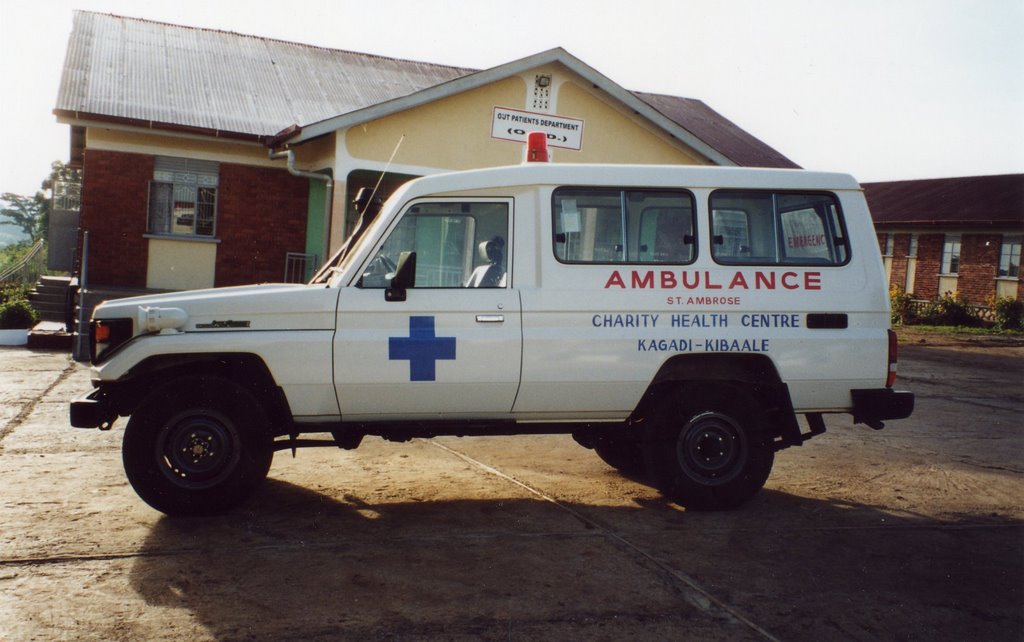
Of course, Fr. Joseph was pleased by my excitement and thoughtfulness, but he also knew I was only a 13 year-old boy. As he told me later, he didn’t expect that I would be able to accomplish much. Nonetheless, he decided to dream big. Fr. Joseph said the new health center would need an ambulance and asked if I could try to get one for him. At first, I thought it would be impossible, but eventually I convinced myself I could do it. The Toyota dealership in Uganda’s capital city of Kampala gave him an ordering price of $50,000! I knew that in order to raise that much money I would need a really great idea. I decided to make life-size foamboard cut-outs of Fr. Joe and ask people in my community to “host” him for a day at their home, business, classroom, meeting, or special event. He would come with a “suitcase” containing information about Uganda and the need for the ambulance, a video message from Fr. Joe, a camera to record a picture of the hosts with Fr. Joe for my scrapbook, and a yard sign to show their participation in my project – and, hopefully, inspire others to participate too. I asked each host for a donation to the ambulance fund and a small medical supply.

Many people helped me prepare the supplies and promote the project, although I initially had to overcome my fear of public speaking. I knew that the no one would know about the need of the Ugandan people if I couldn’t tell them. I spoke to service clubs, school groups, and church congregations—anyone who would listen. Thousands of people responded. I collected 20 boxes of medical supplies and raised over $67,000 in less than 4 months.

I actually traveled to Uganda and went with Fr. Joe to sign the order for the ambulance. During my one month stay I met and lived with the people who would benefit from my project. My trip to Uganda left an indelible mark on me and it is an experience I will never forget. All the people I met were so friendly and, even in their poverty, they wanted to share what little they had. I have seen that all people of the world share the same needs and wants. We are really all more alike than we are different. Everyone needs food, shelter, clean water, and necessary health care. We all want to know happiness, health and love. Parents everywhere want the best for their children and children want to learn and grow. But not everyone gets the same chance for success.

My project helped to provide quality healthcare and emergency transportation to those who would otherwise have no place to go and no way to get there. It brought the world a little closer together as my community realized—and met—the needs of a community across the ocean. Fr. Joseph’s dream became reality when the health center opened its doors in April 2003. His health center treats anyone who comes, regardless of who they are or whether or not they can pay. Hundreds of people have been treated and the ambulance has provided emergency transportation to other facilities when necessary. The ambulance also transports nurses to villages far from the health center to teach disease prevention and provide immunizations. Since the ambulance goal was achieved, I have continued to help by raising awareness and funds—largely at my high school—to help ship a 40-foot container of medical equipment from Michigan to Uganda.

I have been privileged to lead a project that has directly impacted many people living in Uganda. Additionally, the project itself greatly increased awareness in my community about the lack of healthcare and other basic needs. Although my original goal was accomplished, I realized that once I made a connection with the people of Uganda, I couldn’t just walk away. I couldn’t assume that my part was over and that someone else would pick up where I left off. I had seen their faces, held their hands, visited their homes, and eaten with them. I know that I saw the faces of people who are no longer there—and so I continue to tell their story and ask for help.

I have realized that working to help those who are in need in the global community is the best way to show that I care. When I traveled to Africa, I came to understand the many differences in culture that separated the Ugandan community and my community. And even though we were physically distanced, I saw how my project brought us together. I know that I need to continue to work to change the world for the better.

Through my project, I also learned a few important lessons about life. One, it is our deeds, not our words, that change and shape our communities and our world. Second, we must all believe that one person can make a difference. Everyone has the potential to make a difference, but who among us will choose to act on that potential – and what kind of difference will we choose to make? Third, we must first believe in ourselves before anyone will believe in us. And lastly, although one person can make a difference, one person cannot make a difference alone – we need one another to succeed. It takes a group of dedicated people to create change. From my own efforts to promote global understanding, I know that YOU, as one person, can make a difference in the world!