Recipe: Lemon Rosemary Chicken

My wife and I don’t eat a lot of beef, so that leaves us with chicken. Its not always easy to find a new chicken recipe that is different enough to be fun if you eat chicken on a regular basis, but this is on recipe that has turned out to be a staple of our dinner repertoire. It is quick, full of delicious flavors, and very easy to make without having dry chicken.

Ingredients:

  • Chicken Breast (sliced in half helps for quicker cooking)
  • Red Bell Pepper
  • (2) Lemons
  • Olive Oil
  • Garlic (2 cloves)
  • Onion (half, diced)
  • Ground Red Pepper or Cayenne
  • Rosemary

Steps:

  1. Slice the lemons in half and squeeze them into a pan (remove any seeds). Add 3 teaspoons of olive oil.
  2. Dice half of the red bell pepper, half of the onion, and the 2 cloves of garlic – add those to the lemon juice and olive oil.
  3. Place the chicken breasts in the pan with the diced vegetables, lemon juice, and olive oil on medium heat (cut chicken in half length-wise speeds cooking)
  4. Remove chicken after the outsides are cooked. Be sure to scoop the vegetables on top of the chicken breasts. Add ground red pepper and rosemary to the tops of the chicken breasts. Place everything in a glass pan to cook longer at 300 degrees in the oven.
  5. Serve with steamed vegetables, rice, or salad.

The History and Conflict of Food Access in Detroit

The food desert term has been readily applied to Detroit’s food system. However, the majority of academic and other research fails to take a comprehensive look at Detroit’s food system or its history. Following the New York Times article questioning whether the “food desert” term is just media buzz, I decided to share some of my initial findings in Detroit. I began researching Detroit’s food system about a year ago and started surveying grocery stores in Detroit 6 months ago because I could not believe the research coming out of the University of Michigan and other institutions that Detroit was devoid of fresh foods or healthy options. NPR recently published an article titled, What Makes a Food Desert Bloom, but fails to note the importance of food education on healthy eating to accompany increased visibility and access to healthy foods.

Detroit is a Food Desert or Food Swamp?

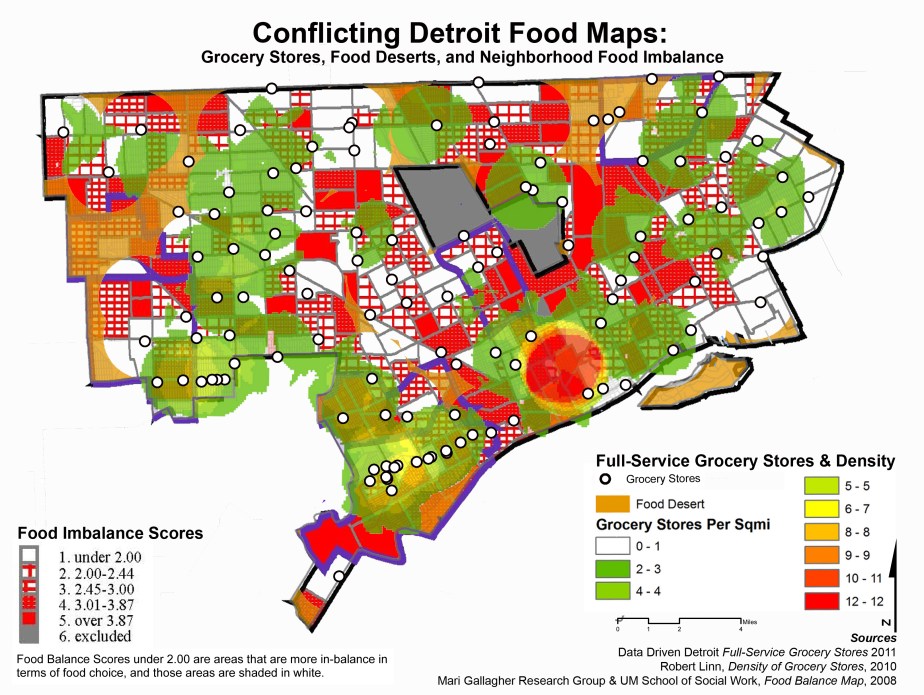
The map image accompanying this post is not the best illustration, but it is a complication of the best data sources on Detroit’s food system. The map represents the flaws and misunderstandings of outside consulting agencies and more general displays of either out-of-date or misguided information. Rob Linn has been creating some excellent maps of Detroit food stores data and now works with Data Driven Detroit. His maps are more current and show a cleaner picture of the actual data in Detroit. The surveys conducted by outside agencies have missed the mark and have published misguiding research to back up the “food desert” claim. The biggest problem with maps is that they are very “planner” focused and it is very easy to make broad claims based on maps. A recent PhD. out of the UM School of Public Health conducted research on African-American’s perceptions of food choice in Detroit and I’m very excited to read her findings. Understanding community perceptions and choices is going to be more important than placing food stores on a map.

Brief History of Detroit’s Food System

Currently, there is only one black-owned grocery store in Detroit where 4 out of 5 residents are African-American (DFPC Annual Report of Detroit Food System, 2009-2010). Detroit is a city with historic racial and economic divisions. These divisions often played out within the food system and its evolution up to today.

Small neighborhood grocery and convenience stores also hired few blacks. […] Few blacks worked where they shopped. Fewer felt any loyalty to neighborhood stores. Only a decade after the survey, inner-city grocery stores were among the most prominent targets of young looters. White-owned and -operated stores were the most prominent businesses in Detroit’s African American neighborhoods and the most convenient symbol of the systematic exclusion of blacks from whole sectors of the city’s economy. (Sugrue, Origins of the Urban Crisis, 113-114)

The title of “food desert” has been both accepted and refuted in Detroit. The majority of academic researchers lean towards labeling Detroit as a food desert, however others have come to that conclusion without adequate research into price and accessibility of foods the term is not helpful. Counting chain supermarkets and the 1 mile radius around those locations doesn’t give an accurate picture of food availability or access to quality fresh foods. Shannon Zenk (PhD ’04) while at the UM School of Public Health reported that Detroit was a food desert based on her research of “chain” supermarkets and their proximity to large numbers of residents. Her research found that, “supermarkets were farther away from African-American neighborhoods with the highest levels of poverty than they were from white neighborhoods with the highest levels of poverty (SPH Findings Spring/Summer 2009). This is an extremely inadequate picture of healthy food access and environment within the city.

Detroit has a long history of local grocers supplying neighborhoods while there have only been a few chain supermarkets to ever exist within the city limits. As of 1954-55, there were 69 supermarkets operated by Kroger, A&P, and other small local suppliers in Detroit. One of these small local suppliers was Food Fair, which in 1955 merged with Lucky Stores which operated as Food Fair markets under the Borman Food Stores Inc. In 1959, Borman bought up other smaller chains (State Super Markets, American Stores Inc., Lipson-Gourwitz Co.) and expanded to 46 stores in Detroit and Ferndale. In 1966, Borman announced the opening of three superstores under the name of Farmer Jack.

Farmer Jack was A&P’s most profitable division after the merger, but by the 2000s was having trouble competing with larger supermarkets like, Kroger, Meijer, K-mart and Walmart. Farmer Jack is recognized as the last chain supermarket to remain in Detroit before A&P put the stores up for sale and all locations closed in 2007. Kroger acquired twenty former locations while independent grocers collectively bought 21.

The flip side of the grocery and chain supermarket story in Detroit’s food system is that of community and urban gardens. Detroit Public School (DPS) student handbooks from the 1950s included a chapter on how to create a community garden. Urban farming and community gardens is a whole aspect of access to healthy food that needs its own post, so I won’t go into it here.


Detroit Food Map: access and environment

Contrary to popular belief and to oft-cited media, I have found that Detroit is not a food desert in its entirety. Detroit has a few neighborhoods and areas that lack a good number of options, but as a whole Detroit is a food swamp or as some say a “food grassland, rain forest, and jungle” (Rob Linn).

The families that I work with across Detroit tell me a similar story. They access food resources from a plethora of sources. One family told me that they try to get to Kroger whenever they can (outside Detroit), but otherwise get good fresh produce from a food bank since the Caregiver is out of work, they participate in the community garden, and visit an independent grocery store when they need to restock staple foods. Other family’s have told me similar stories of utilizing multiple food access points.

A food desert is defined as:

“any area in the industrialized world where healthy, affordable food is difficult to obtain. Food deserts are prevalent in rural as well as urban areas and are most prevalent in low-socioeconomic minority communities. They are associated with a variety of diet-related health problems. Food deserts are also linked with supermarket shortage.” (wikipedia)

Access is a key word when talking about food deserts and this is where many researchers count the number of stores and measure the distance from supermarkets to given populations. However, this often paints an inaccurate picture. There is more to access than the number of stores and how far away they are. Just because a grocery store is close by doesn’t mean that it has a huge fresh foods section or many healthy options. New research has noted that distance to healthy food may be psychological. This is where greater education on healthy food is necessary to create a more direct connection between people and healthy eating. I have been using the Nutrition Environment Measures Survey (NEMS) in order to attempt to get a more accurate picture of access to healthy foods. NEMS criteria focuses on comparing availability, price, and quality of foods between healthy food options and less healthy food options. Access is more than just distance and can include issues with the stores not stocking healthier food options, the quality of healthy foods available, and most importantly the price: is it cheaper to buy a bag of chips?

I have used the NEMS criteria to survey 20 grocery stores in Detroit (see Detroit Food Map) and what I have found has been entirely different from the large body of research that pegs Detroit as a “food desert.” All of the grocery stores had availability of fresh and healthy foods. Some produce sections were bigger than others and some carried more varieties, but all in all fresh foods were available and in good quality. The only items that were regularly low in quality were strawberries and cantaloupe. Likewise, I found in many stores that price could potentially be a hindrance for purchasing a healthier option, particularly with fruits, baked goods, meats, and juices. I spoke with a number of store owners and employees. Many said that they too have had a hard time with the “food desert” label and want people to know that they carry fresh foods. In some stores the owners noted that customers don’t regularly buy the healthier food options (i.e. ground turkey) or their fresh produce is purchased slowly, so it goes bad more quickly.

“It’s not enough. People always want more. We carry everything, many options, but people would rather shop at the super markets: Meijer, Wal-Mart. . . Is it because we don’t have the options? Look around!” – Staff Interview, Independent Grocer 02/02/12

My coworker, who has lived in Detroit her whole life and has been involved in improving the food system, has seen over the past 2 years an increase in farmer’s markets and community gardens in what she thinks is a response to food desert hype. Potentially, Detroit’s independent grocers have done the same and hopefully will continue improving their price, quality, and availability of healthy and fresh foods.

(image source)

Detroit is Not Your Blank Canvas

The rise of art as a means of revitalizing Detroit has become an exciting and controversial topic. I myself have been fairly skeptical and often view “art projects” with a certain about of disdain for their naivete and lack of real impact. Young gentrifiers and artists have called for Detroit to offer them more opportunities and good paying jobs, others have been drawn to the idea of “making” art in Detroit’s emptiness, and some artists have focused on Detroit as a place for only charity.

One well known example of art helping Detroit is the Heidelberg Project, which recently celebrated 25 years. The local artist who launched the project with his Grandfather is well known for taking vacant and litter-filled lots and turning them into “lots of art.” He has made his Eastside neighborhood more attractive with a mission to give young people a different vision of their neighborhoods and Detroit’s blight. Since the project began in it has faced demolition from the city and funding troubles. In 2011, the Center for Creative Community Development (C3D) conducted an economic impact study on the Hiedelberg project. The study found that:

[…] based on the nonprofit Heidelberg Project’s annual budget of $400,000 and an average 50,000 visitors per year, the annual economic impact in Wayne County is about $3.4 million. The exhibit also has led the creation of an estimated 40 jobs […]. The local economic impact — in areas of Detroit around Heidelberg — is about $2.8 million.

I have to be honest, I didn’t imagine that a neighborhood of art made from found objects could have had any impact bigger than the houses that it occupied. The Heidelberg Project is now in the process of building an art center to house the non-profit, its workshops, and other creative events. If anything the Heidelberg Project has shown that art can revitalize a community from the bottom-up.

However, there haven’t been any art projects that I have seen mirroring the example of the Heidelberg Project (have you? let me know in the comments). Most come from the outside; new arrivals to Detroit planning to make a mark on the “barren” city through art. The problem is that revitalizing Detroit needs more rooted efforts, art doesn’t always lead to economic impact, Detroit isn’t empty, and charity alone won’t solve the problems.

What about beautifying neighborhoods, painting houses that people do live in, or supporting community arts education programs?

The Allure of Revitalizing Detroit

Detroit has become a new kind of mecca for young people who want to make a difference and turn Michigan’s economy around. It has become “cool” to move to Detroit and work for a non-profit or other organization. This is all well and good and exciting, as long as young people who move to Detroit recognize that Detroit isn’t just about “saving” and doing whatever you want. There is a common misconception that Detroit is an empty landscape based on all the epic pictures dilapidated buildings taken by budding photographers, while the city has a lot of vacant properties and empty buildings downtown, the city is not empty or devoid of people. The people who remain in the city need to be engaged, included, and consulted on any project – citywide or neighborhood-based.

This often brings in the G-word: gentrification. I have written about my experiences living in Detroit, considering if I was a gentrifier, and calling for greater understanding of the city’s racial history and the privilege that many young artists bring into Detroit. Recently, Huffington Post Detroit, published a long article by Tommy Simon who wrote as a “young gentrifier” struggling to get by, but failed to realize that there is a large population in Detroit that has been struggling for much longer. He called for a stronger creative economy in Detroit that could provide senior level jobs for himself and his friends by noting that other young gentrifiers in other cities don’t have it this bad.

“Because I grew up in the suburbs and was mystified by the allure of being a part of the revitalization of Detroit. […] And while I hope I do not have to argue the importance of a city providing employment, I will clarify that I am not simply talking about any job, but a job that allows a young person like myself to put my education and creativity to good use.”

To me this represents the disconnect between wanting to revitalize Detroit and understanding that it isn’t a simple creative endeavor. In the name of “revitalization” artists can’t overlook existing efforts or forget to engage a neighborhood community. An excellent example of this is the fight over an “art house” in North Corktown.

“The art house people didn’t buy it, pay taxes, or intend to live in it,” said Samul. “They were just going to use it to play in.”

Often what the “Detroit is empty” misconception means for “art” is a disregard for existing Detroit efforts and communities in the name of revitalization. In this case the art house was framed as gentrification, but in the end the “art house” best represented the failure of art to connect to community. For any artists, this should be a lesson in talking to key community stakeholders before getting creative.

Art = Employment?

The Detroit Creative Corridor Center (DC3) is working on incubating and developing a creative economy in Detroit. In recent years there has been an upswing of art centers in Detroit from College for Creative Studies and the School for Creative Studies to MOCAD and Art Detroit Now  to the Detroit Design Festival (DDF) and Arts Corps Detroit, along with a long list of Detroit creative endeavors that have made art an important aspect of Detroit’s growth and image. The Knight Foundation released its list of grant winners of initiatives in Detroit that are “advancing contemporary life.” Among them were 2 groups working to advance the creative side of Detroit’s recovery, LOVELAND Technologies and the Mt. Elliot Makerspace.

But, does art and creative investment really drive jobs and economic growth?

For each dollar the state of Michigan spends on arts and culture, $51 goes back into the state economy. In Detroit alone, the 28 organizations included had total direct expenditures of more than $127 million and employed 2,657 staff. (source: about Report from ArtServe Michigan)

Art and the creative sector can no longer be ignored when talking about Detroit’s future growth. The impacts that have been measured thus far show that through programs like the Heidelberg Project the city and sometimes neighborhoods benefit from art.

“Vibrancy is probably the best proxy we have for the quality of place,” Coletta says. “Quality of place is essential for attracting and retaining human capital. And human capital is essential to the economic well-being of communities.” (source)

Art can no longer be ignored as an economic impactor, but if art can build vibrancy and revive communities it begs the question: for whom does art revive communities? For gentrifiers? For suburban weekend visitors? For the 1 million tourists who come to Detroit?

Artists need to consider their privilege, communities need to be engaged by artists interested in revitalizing Detroit, and art projects need to have a more direct impact for Detroit’s neighborhoods.

———-

From my quick and far from extensive research I have found very few instances of art and creativity benefiting Detroiters, neighborhoods, and those in need. One of my other favorite examples of a creative project that has actually impacted the Detroit community is the Empowerment Plan a versatile street coat/ sleeping bag created by a CCS student, Veronika, but developed in close cooperation with Detroit’s homeless population. As the project grew Veronika was able to employ some of the homeless individuals who helped her with the initial ideas.

Blue Helmets ineffective compared to US troops in Central Africa?

After operations in Somalia ended badly in 1993, the US seemed to have full blown “Black Hawk Down” syndrome when it came to military intervention on the African continent. Many have cited the Somalia event among other reasons for the Clinton Administration’s failure to act during the Rwandan genocide of 1994. However, the US has been involved in militarizing the African continent since the Cold War: propping up warlords, funding resistance movements, and even assassinating the newly (democratically) elected head of state of modern day Democratic Republic of Congo (DRC), Patrice Lumumba. Currently, the Obama Administration has shown no reason for restraint in sending troops to engage in African conflicts.

The UN has had a high degree of failure when it comes to peacekeeping missions in Africa. Largely due to limited mandates, UN troops in Rwanda, Darfur, and the DRC have been ineffective. The UN has had 15 deployments related to African conflicts, 8 of which are ongoing. The critical question is are UN peacekeepers more effective than US military interventions?

Darfur/ South Kordofan/ South Sudan

Sudan has presented a host of conflicts that seem to have baffled US and UN diplomats alike. Some have called for greater military intervention, but the US has focused on non-military negotiations and peace deals. The conflicts in the Sudanese region are largely based on the Sudanese government attacking other ethnic groups and attempting to maintain control of the remaining regions under their jurisdiction. The SPLA has become the main military of South Sudan and has an affiliate in Sudan (North) SPLM-N.

US

During the 2008 US Presidential race, on the campaign trail in 2007, Joe Biden called for a force of 2,500 US troops to end the genocide in Darfur. Hillary Clinton and John Edwards supported a plan for a peacekeeping force. Barack Obama called for a no-fly zone in Darfur and divestment from corporations supporting the Sudanese regime. Bill Richardson personally met with the Sudanese president to push for a peacekeeping force.

It is a little known fact that the Sudan People’s Liberation Army (SPLA) leader, John Garang, was trained at Fort Benning and that,

“The US government decided, in 1996, to send nearly $20 million of military equipment through the ‘front-line’ states of Ethiopia, Eritrea and Uganda to help the Sudanese opposition overthrow the Khartoum regime.” (Source)

President Bush was lauded for his role in the Comprehensive Peace Agreement (CPA) that ended the North-South civil war in 2005 which led to the popular vote dividing Sudan and South Sudan. However, there is no mention of the US’s military role in fueling the conflict.

The US has played a significant diplomatic role in the Sudanese region. There has been a lot of talk and agreements and support for peacekeepers, but there has been little accomplished in the way of ending the long running conflict between various groups. Could George Clooney get the US to send troops into Sudan?

UN

The UN has four current missions in the Sudanese region: UNAMID, UNMIS, UNISFA, UNMISS. The first of which, UNAMID, began operating in Darfur in 2007. Since, then 51 peacekeepers have been killed. Reports continue that the Sudanese government is targeting civilians.

Following the creation of South Sudan, a conflict arose over the area of South Kordofan in Abeyi. The  UN added missions in Abeyi to mitigate conflict in South Kordofan (UNIFSA) as well as a mission for South Sudan in general (UNMISS). By all accounts Darfur was a major failure of UN action and South Kordofan represented an equally prominent failure. Reports noted that UN troops stood by while Sudanese troops killed unarmed civilians.

In the Sudanese region, the UN has failed to end the killing of hundreds of thousands of people more than once and has suffered casualties of its own forces since becoming involved in the region. It is easy to quickly say that UN peacekeepers in the Sudanese region have failed, but would Joe Biden’s 2,500 US troops have done any better instead of the UN-AU peacekeeping force?

Actors:

  • Sudanese government troops
  • UNMIS (UN mission, 2005)
  • UNAMID with AU forces (UN-AU mission in Darfur, 2007)
  • SPLA (Sudan People’s Liberation Army)
  • SPLM-N (Sudan People’s Liberation Movement – North)
  • SLM/A – Sudan Liberation Movement/Army
  • JEM – Justice and Equality Movement
  • UNMISS (South Sudan, 2011)
  • UNIFSA (S. Kordofan, Abeyi, 2011)

Uganda/ Democratic Republic of Congo

The DRC has seen a high degree of conflict, which increased following the CIA assassination of Patrice Lumumba in 1961 and the US backed Mobutu coming to power for the next 32 years. Mobutu supported the Hutu militia (FDLR) responsible for the 1994 Rwandan genocide. The FDLR has been given refuge by the political establishment in DRC first with Mobutu and later with current President Joseph Kabila utilizing the FDLR to combat intervening forces (i.e. Rwanda & Uganda in 1996, 1998).

US

Since 2008, US military advisors have been on the ground in DRC helping to train the Congolese army (FARDC) to better maintain control of various regions of the vast country. It is unclear why military advisors were sent in the first place. Potentially it was a move by the US to counteract Chinese development programs targeting natural resources extraction.

The US has largely been absent from the conflicts of the DRC until recently. In 2011, President Obama announced that 100 US troops would be headed to Uganda to act as military advisors in the campaign to flush out the LRA leader, Joseph Kony. However, Kony and the LRA aren’t in Uganda anymore, they have been hiding out and operating from the DRC since 2006. New reports have come out saying that US troops are operating from bases in 4 countries are tracking down the LRA from bases in Uganda, South Sudan, DRC, and the Central African Republic.

The fact that the US is willing to devote military assets to routing a single militant group is extremely significant especially since there have been numerous bad actors operating in the region for decades and US actions in African conflicts haven’t been forthcoming. Since Ugandan president Yoweri Museveni took power and ensured that he kept getting elected, there have been 22 armed groups that have been formed to combat the government. Museveni has perpetuated the North-South ethnic divide held over from British colonial rule. As much as the LRA needs to be routed, Museveni needs to be engaged by the US to step down and allow real democracy to occur.

UN

UN troops have been operating in the DRC since 2008, but have often had to bend to the will of area militias. What real power does the MONUSCO have in the DRC? More recently, in 2009 and 2012, MONUSCO has been cooperating with FARDC (the Congolese army) on joint missions to take down the FDLR and other militant groups, including the LRA. On March 14th, a senior officer of the FDLR surrendered to the UN forces.

The UN mission in DRC has the largest budget of any peacekeeping mission, but is notably underfunded and ill-equipped. The main problem is the vastness of the mountainous region and the multiple militant groups that need to be negotiated with or militarily engaged. It just can’t manage all the space with the man power that it has, therefore it is unable to protect the population because it is just unable.

Some have credited MONUSCO with ending the violence in some of the regions of DRC as well as organizing successful country-wide elections. Potentially the UN missions is gaining ground in the conflict?

Support from both the UN mission and US military advisors is somewhat concerning since FARDC has been involved in some of the worst human rights violations in the conflict.

Actors:

  • FARDC (Congolese army)
  • MONUSCO (UN mission, 2010)
  • General Nkundu – split from Congolese army to lead Tutsi forces against FDLR
  • FDLR – former Interhamwe responsible for Rwandan genocide
  • Rally for Congolese Democracy (RCD) – backed by Rwanda
  • LRA (Lord’s Resistance Army) – from N. Uganda
  • UPDF (Uganda People’s Defense Force)


Will  the US replace the UN as primary peacekeepers in Africa? 

UN peacekeeping forces have tried to take on the Sudanese government and militias in the DRC, but have failed to keep peace or intervene in the killing of civilians. The UN almost always comes out with a statement condemning the killing of civilians by this or that group. Many peacekeepers have been killed in the various missions and there are only a few positive impacts noted from those missions. UN missions are notoriously plagued by underfunding, under-trained troops and a lack of adequate equipment.

In the past year the US has militarily intervened in 7 African countries with and without mandates or international support. They have trained the FARDC forces, which are now completing joint missions with MONUSCO to route militant groups. It seems as if Obama has taken up the Bush Doctrine to militarily intervene whenever he feels like it. Contrary to the UN missions, US military actions are rarely under-funded, troops are highly trained, and there is no lack of equipment.

On a side note, how can both the US and the UN overlook the atrocities committed by national armies (Sudanese government, FARDC, UPDF)? In these conflicts the UN/US create the narrative for who is the good guy and who is the bad guy, but there is a need for nuance. I understand that it isn’t possible to engage all sides and I can only hope that the UN/US missions are working to end atrocities committed by national armies, since those atrocities have often fueled conflicts further.

The UN is stretched and the US has the ability to send elite troops into conflict zones to rescue its citizens (Somalia). Can the US’s quick military interventions, anti-terrorism trainings, and military advisors create a more effective peace than the UN? After the LRA is eliminated will the US pick the next militant group to hunt down? Too many questions arise when analyzing military interventions. There is always cause for concern when conflict regions see an influx of militarization from the UN, US, and other countries with foreign policy interests.


samaritan’s dilemma: privilege & root causes

The world is full of incredible opportunities to do good. Many of us are raised with a background that informs us to serve others, particularly the “less fortunate.” Yet we face an ever increasing dilemma that requires us to check out prejudices at the door and delve deeper, beyond the surface of social issues.

We face these issues when encountering individuals in our own communities and when we choose to donate to well meaning organizations internationally (or work for them).

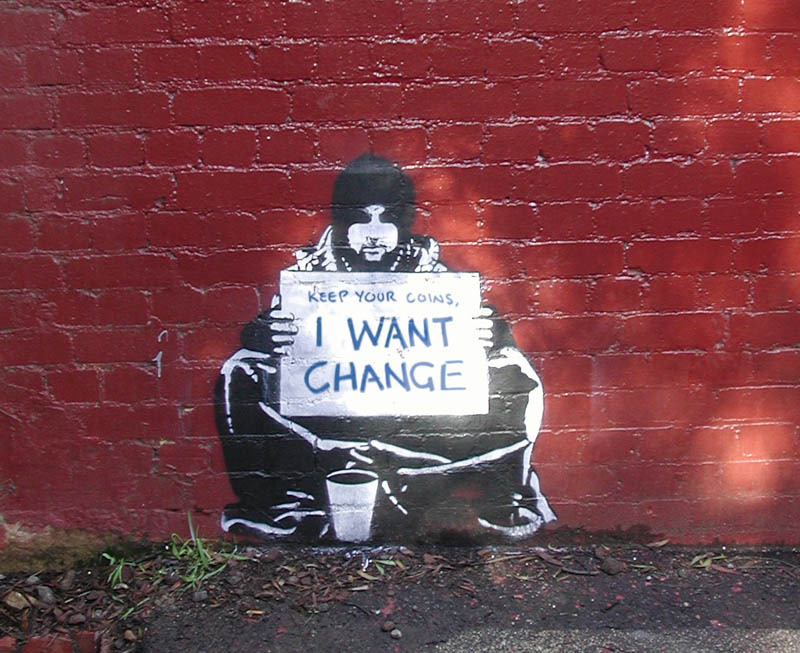
If you give a beggar money. . .

The homeless population and beggars around the world cause many to feel incredibly uncomfortable. We have mixed  emotions for a population that we feel equally empathetic and uncertain towards. Many religious texts tell us to serve the poor, clothe the naked, feed the hungry, etc., but we’ve all heard the horror stories of people who have faked being homeless or have been warned of giving money for fear that it might be used for drugs or alcohol.

“The ‘homeless’ guy I gave $5 to yesterday just paid to get on the bus- holding Starbucks and skates. Holiday generosity stock depleted.”

This seems to be credible dilemma, but it only skims the surface of the issue. How are we to know a stranger’s story? Is their predicament related to race and privilege, maybe societal power structures have adversely affected opportunities in their poor communities?

While at a social justice conference in Detroit with colleagues from around the country we were approached by a woman asking for money. It was a moment of questioning for all of us. Do we act as good social change agents and give some money or do we take a step back? In the end we all denied that we had any cash to give. Our discussion after that encounter came to the conclusion: “its always hard to know the best thing to do.”

What happens to your good intentions if you see them tomorrow?

Is it just a function of our privilege that we expect our small donation to a “less fortunate” person to change their life? Do we expect that since we took the time to be nice, that they will then no longer need to ask for more?

I’ll begin this section with a story.

A woman is approached by a middle-aged African-American couple in her quiet white suburb. They say their car broke down and they just need some money for bus fare to get home. She offers to give them the bus fare and give them a ride to the bus stop, but they say they’d just like the bus fare. A couple of days later, she sees the couple again at a department store telling the same story. The store employees scowl and say the couple is often there asking for money. This angers the woman and she feels cheated. Why does the couple have to cheat people who just want to be nice?

The real question should be: “What are the social implications that cause them to need to beg for money every day to get by?” Its all too easy to chalk up our failed giving expectations to a few bad apples, but there is often more to think about than the oversimplification of just one bad person.

Where did the person come from? What was their community like? Are these common issues that correspond with discrimination based on income level or race?

All of these questions are critical to being able to understand the root causes to the issues that people face. Very often there are dynamics of privilege and power at play. Historically, African-Americans have come from areas where they have been marginalized due to their race, which predisposes them to reduced opportunities in education and career, which can lead to lower incomes and continued discrimination.

Personally, I often struggle with the dynamics of being approached on the street and so I often neglect to give anything. Occasionally, I give a small amount to individuals who seem to be genuine, but that’s all too easy for me to pass judgment with my privilege. I guess I would prefer to donate to local organizations that work with the homeless instead of doing my own cash grants on the street.

Good intentions + organizations = addressing root causes?

The quick answer is “NO!”

We can’t begin to imagine that our choices to “do good” will completely change systems or flip our societal order in favor of the poor or racially discriminated. There is much more work to be done than handouts and volunteering if we are going to change entire systems and see change in our lifetimes. Social change takes many people working together over generations to make real and lasting impacts.

It is unfortunate that even humanitarian organizations can either be fake or completely off base. Here the samaritan’s dilemma becomes two-fold. What organizations should you donate your money to? and how do you know where (or to whom) that money is going?

Often service and development organizations fail to take the time to map out the root causes of the issues they work on and get trapped in actions that don’t address the root cause. To say that a beggar is homeless and on the street because they are addicted, lazy, or incompetent is an oversimplification. To say that a multi-country conflict is fueled by a single man shows a serious lack of historical understanding. We have to take the time to learn more and think critically about the social issues that we would like to amend and the people who we would like to help.

We cannot keep picking at the fruits of the social issues we see, we must start chopping at the trunks (institutions & policies) that perpetuate the root causes.

Implications for HIPAA & Health Practitioners under the new Google Privacy Policy

Much worry, fear, and writing has already come out about Google’s new catch-all privacy policy. I for one am not surprised that they have finally created one privacy policy for their entire suite of services. Honestly, I had already assumed that Google was sharing information across its platforms about me. The one idea that really stood out to me in Google’s new privacy policy is that items in your Gmail and Google Voice would no longer be technically private. Working in a clinical research setting at a university-based School of Medicine with clients who are ensured confidentiality, I am worried. Isn’t Google violating HIPAA in some cases by sharing this information that we believe to be private?

Google and HIPAA

I am not the first to write about Google’s new privacy policy in relation to HIPAA (Health Insurance Portability and Accountability Act). The most important piece in understanding Google’s policy in regards to HIPAA is that Google says that it is not bound by HIPAA.

“Unlike a doctor or health plan, Google Health is not regulated by the Health Insurance Portability and Accountability Act (HIPAA), a federal law that establishes data confidentiality standards for patient health information.” (via Google)

This is unfortunately true. If you visit the Health and Human Services (HHS) website those bound by HIPAA are health care providers, health plans, and health care clearing houses. Google is none of these entities, so therefore it gets by. There is no way that any court of law would hold Google accountable in a HIPAA related case. Google is a private company that offers free services to users. By using their services, you don’t necessarily have the rights to control what happens to the services.

“if you’re not paying for something, you’re not the customer; you’re the product being sold” (via lifehacker.com)

Implications for Individuals

Many, including Congress, have come out against Google’s new privacy policy and especially as it relates to HIPAA and health information. Representative Mary Bono Mack worries that Google could track sensitive health information.

“[…] say you do a Google search for cervical cancer and you forget to sign out. Are you being tracked across all of the other products, and if so, that’s a violation of HIPPA. We’ve gone to great lengths in our society to protect people’s medical information. That question was raised.”

Google’s response is that those individuals can use Google services, like Google Search, without having to log in to their account. However, if you are also a Gmail user and maybe you email with your doctor’s office then Google has that information more directly linked to your personal data. Does Google violate HIPAA in that case? No, because they say (to paraphrase), ‘you don’t want us to track you, then don’t login.’

For individuals, the solution is to diversify online services or stop using Google. If you don’t want your information tracked and collected by one entity start using a different email service, use Word instead of Google Docs, and if you don’t want information linked to your specific Google account, don’t login and search for everything you want to know about. That isn’t to say that other companies don’t also track and collect our data, but at least it won’t all be in one place. The hard part is that Google is good at what it does and for many, myself included, it will be hard to let go of the ease of Google services.

Implications for Health Practitioners

For Practitioners the story is more convoluted. I work for a clinical research grant where clients are ensured of the confidentiality of their information, however I am a Google user; a dedicated citizen of the Google Nation. I love their services and the ease of connecting the information that I want to use. As a result I use Gmail to communication on sensitive client matters with my Supervisors and I use Google Voice to talk and text with the clients. With the new Google privacy policy, all this information fair game for them to index and share across their platforms.

Based on the correspondence between Google and Congress as well as their stated policy that they aren’t bound by HIPAA, the responsibility falls on the shoulders of the health practitioners. In our clinical research program every client gets a number to ensure the confidentiality of their data. I use client numbers with everything that I do on Gmail and Google Voice, but sometimes background information about clients is sent to my Gmail that could reveal their identities.

Recently the School of Medicine where I am working hosted a workshop for researchers to benefit from Google tools, such as Google Docs. I emailed the individual in charge of the workshop to ask how Google’s new privacy policy might affect the way researchers use Google services. The individual seemed to be less concerned than I and said she understood it as a, “take it or leave it” policy. If you are a researcher dealing with private health information and bound by HIPAA, then there are serious implications for using Google tools for your research project. Google may state that it is dedicated to the privacy between sender and recipient, but that doesn’t mean that your data isn’t fair game for Google to catalog and use for their own purposes.

The solution for practitioners is: Don’t use Google services or share confidential information within Google services because you have no way of ensuring confidentiality.

Tina Fey: international development is like. . . improv

“When you create something out of nothing, the first rule is to agree.” – Tina Fey

I’m not sure Tina Fey would attribute her words about improv as wisdom for international development, but there is a truth to the statement that can’t be ignored. Tina Fey might just be the best international development expert there is today and we all might need a little more improv training.

When we engage in development projects we are often creating something out of nothing. That is not to say that there is nothingness all around that needs to be “developed,” but many times development projects are creating new systems, organizations, norms, and terms of engagement. Before we can move into agreeing with our actual development project, we need to first take a step back and agree with the fact that we are outsiders, visiting unknown places, and often with no understanding of the history or culture of the people we are creating something with.

My Professor in my Capstone course in international development shared an excellent framing of how outsiders can engage in development work. I’m not sure if this concept can be attributed to her, but I have shared it many times since that course.

As development practitioners, aid workers, and humanitarians we can act in three unique roles, we can be:

Mirror – We can reflect back to a community what we see as an outsider. This can be beneficial  in letting others know how they are perceived and can lead to growth in areas that may have been overlooked by individuals who live with situations every day.

Echo – We can be a voice for a community that may be unheard or unknown. We can echo their concerns in our own communities and within the institutions that we work. We can extend their efforts further than they might be able, due to social or economic constraints.

Bridge – We can build connections between communities. We can assist development projects in landing grants and resources from outside institutions or organizations. We can create networks of support where they can be most beneficial for the community that we are working for.

At the very heart of development work, whether it is in a developing country or inner city, we must first remember to meet people where they are at. We cannot impose our understandings of reality on another if we hope to be successful. We must first take the time to learn the reality, culture, and everyday life of the community. Before we can start working to make something out of nothing, we must then follow the first rule of improv: to agree.

Obama’s Africa Policy is Military Policy

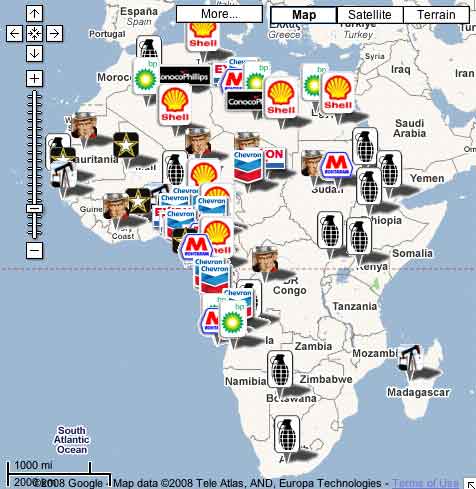
Oil and US Military Activities in Africa

Many people had high hopes for Obama’s presidency having a serious focus and positive impact on the African continent (including myself). The policies of past presidents relegated Africa to a single, monolithic policy for a continent of 55 countries. Under Bush, AFRICOM launched and a renewed focus on military engagement became the norm for US Africa Policy with the US military providing anti-terrorism training and the military implementing humanitarian aid projects typically conducted by USAID.

As Obama was campaigning as a Senator, I thought he had great potential to make changes in US Africa Policy. In 2007, I wrote:

Just last year the Illinois Senator went on an African tour visiting South Africa, Kenya, Ethiopia, and Chad – discussing the issues of the HIV/AIDS epidemic, the growing violence in Darfur, refugees from the Sudan conflict, the Kibera slums, and Africa becoming a new haven for terrorists. I wonder if he is in favor of the Africa Command? Obama presents a great hope for American political reform and rebirth, but also Obama presents a great hope for Africa and bringing about a more focused and effective and involved US African Policy that is not afraid to invest in the continent. (Written 01/06/2007)

President Obama began his presidency repairing the world’s view of the US after the extremely negative view the world population held of Bush and his wars in the Middle East. In 2009, Obama gave compelling speeches in Ghana and Egypt. To me, these speeches seemed to signify that the Obama Administration was going to engage countries in Africa as individual actors and place engagement in Africa as a higher priority.

My hopes aren’t as strong as Obama begins his campaign for a second term. It is no mystery that Obama’s focus has been on domestic issues during the last 4 years. Beyond the far reaching impacts of political unrest and change across North Africa and the Middle East, Obama’s Africa Policy has been kept at an arms length. Hillary Clinton has done a commendable job of managing the US’s image abroad, but Obama’s Administration has not engaged the continent the same way he has spoken to and about Africa.

How has Obama fared since his Africa Tour of 2006? What advances have been made in US Africa Policy? Here are the issues since 2006:

HIV/AIDS

Arguably the most prominent accomplishment of Obama’s term was passing Healthcare Reform. Much of his time and effort was focused on fighting, compromising, and pushing for this legislation. The strong domestic focus is expected, but its seems Obama only mentions HIV/AIDS on World AIDS Day. This past year (2011) Obama had a strong story and spoke of a growing commitment to “The End of AIDS.” However, we have also seen Congress push to slash our humanitarian aid budget to even less than 1% while at the same time the Global Fund is in a funding crisis. Bush often mention PEPFAR in his State of the Union speeches, but Obama never has. This may have just been political, Bush needed to deflect attention from his unpopular war-mongering and Obama needed to draw in his base of supporters for the upcoming election. Obama has said publicly that he will defend the US funding for PEPFAR and the Global Fund. Many people note that if Obama is elected to a second term he will likely be involved in more international issues. This seems to be one on Obama’s radar for future involvement.

Darfur, Sudan

While serving in the Senate, Obama was a staunch advocate for ending genocide in Darfur. After elected, he appointed strong anti-genocide advocates to key posts: Susan Rice, UN Representative for the US, and Hillary Clinton, Secretary of State. During Obama’s term, the world’s newest country was formed: South Sudan. Both Obama and Clinton have made statements affirming US support for the new country of South Sudan. Obama has made strong statements that South Sudan and Sudan need to move past long standing differences if they are to both prosper, but the reality on the ground is another story. The violence and bloodshed has not ended. Rhetorically I ask, why have no troops been sent to Darfur or South Sudan?

Slums

During his Africa Tour, Senator Obama visited the Kibera slum in Kenya. The AFRICOM 2011 statement of purpose notes the great need for increased economic support in Africa to bring stability and growth. This past year has seen revolutions and uprisings against governments across Africa, from human rights protests in Uganda, to full revolution in Egypt, armed conflict in Libya, land protests in South Africa, to #OccupyNigeria decrying the oil industry’s grip on the country. The slums in full view of skyscrapers are a common sight in many of the developing world’s major cities. Global inequality is not being ignored any longer and populations are taking things into their own hands. Obama has been known to be in close personal contact with African heads of state. US investment in Africa has not been as well publicized.

In 2011, Ambassador Demetrios Marantis spoke about the US’s Africa trade and investment policy. Marantis highlighted the small-scale, project by project, country by country investment related to the African Growth and Opportunity Act (AGOA) as well as the Millennium Challenge Corporation (MCC), but it seems that the glaring issues with these programs raised during the Bush administration have not been addressed. Marantis also spoke of the US’s efforts to sign bi-lateral trade agreements, 7 total, which will increase private investments. If you ask me this is a poor response and demonstrates a lack of imagination and innovation towards African engagement.

Terrorism

This has been by far the most prominent area of the Obama Administraion’s Africa Policy. Out of all issues focused on in Africa, the military intervention and on the ground action seems to be the “go to move” for African engagement. Since 2003, the US military has been conducting anti-terrorism trainings with many African militaries in the West African Sahel region, working to mitigate Al-Qaeda in the Islamic Magreb (AQIM). The US military has also been involved in the Somali conflict, helping Kenyan troops to protect their border and engaging Al-Shabab, these efforts have not been without civilian casualties. Recently, US special forces went into Somalia to rescue aid workers held by a Somali pirate group.

Obama authorized the US military to run support missions in Libya, carrying out the majority of flight missions attacking Libyan military installations. The US military presence was significant even though the UK and France were leading the mission. More recently in October 2011, Obama announced he would be sending around 100 troops to Uganda to assist in fighting the Lord’s Resistance Army (LRA) responsible for a long running conflict affecting Northern Uganda and neighboring regions.

This year, the bombing skills of Boko Haram have improved quickly and the Nigerian and US militaries believe AQIM is teaching militants in Nigeria to make better bombs. The attack on the US Embassy has lead the US to commit military efforts to helping the Nigerian government fight Boko Haram.

What will 2012 Bring?

Some have called these various efforts the “Pentagon’s shadow war in Africa,” however nothing has been veiled in shadows. The US holds nothing back to show it is there to militarily support African countries. The US Africa Policy has been revealed to be a focus on mitigation of terrorist groups that seem to be gaining ground and ensuring regional security before other economic or humanitarian efforts are increased.

“Africa is not big in Washington, there is no constituency that cares about Africa that much,” said Kwaku Nuamah, a Ghanaian professor at American University in Washington.  “I did not think the traditional contours of American foreign policy were going to change because there was somebody in the White House with ties to Africa, but of course a lot of people expected that.”

Like all presidents, Obama has many words and equally many unfulfilled commitments. As Obama is focused domestically, it has been the US military that has demonstrated his Africa Policy. Obama has chosen the sword over the pen in implementing policy across the continent and I can only continue to hope, like others, that a second term for Obama will mean more non-military engagement in Africa. This all goes without noting the US’s competition with China in Africa. . .

the limits of human research

*Please note, the names and details of program participants have been changed to ensure anonymity.

After working with one of my first families, we’ll call the teen Larry, I began to feel limited by the research aspect of my current program. Since it is a research program testing various protocols for successful weight loss, my options and actions were often limited in what I could or could not do to help the family. At the time Larry was the heaviest teen in the program. I remember he was late for our first session at his house because he had missed the bus. I saw him walking down the street and knew immediately that he was who I was waiting for. Larry had knee and ankle problems as well as hypertension at age 15. At the time he was the heaviest teen in the whole program.

I built a strong rapport with the family and really enjoyed going to their house twice a week to work with them. Larry‘s weight fluctuated often, spiking and dropping dramatically from week-to-week. The family often attributed it to the medications that he was taking that cause him to retain water. However, over the first half of the 6 month program, Larry had lost about 20 lbs. from his starting weight. His Mom reported losing about 25 lbs. from participating and helping Larry during the program. She no longer needed to regularly wear oxygen and could walk more often than she was previously able.

In the last two months, Larry began to gain the weight back. Since his weight fluctuated so much it was hard to tell if he was really gaining a significant amount or if it was just related to the medications. By the final session of the 6 month program Larry had returned to his starting weight. His weight loss is considered significant and for him to gain it back is a red flag for larger problems. Research shows that when lost weight is gained back quickly it is much more difficult to lose again. His Mom was worried, he was confused, and I was unsure what to do. I gave the family additional information about other programs that Larry could participate in, but focused on affirming the skills that they had learned and the successes they had over the last 6 months.

It was during the following couple of weeks, which turned into months, that I really began dissecting Larry‘s dilemma. He was a very bright student, had some nice friends who helped him be active, and a very caring mother and grandmother. He took on more responsibility than most because his Mom wasn’t very mobile and yet he was unable to maintain his success in the program. I began to think back to other issues that the family dealt with during the program. The major one that jumped right out for me was their access to food. Larry and his Mom were getting food assistance and usually shopped once a month when the Grandmother could drive them to Meijer, which was located in another city. The family mostly ate frozen dinners that Larry could heat up in the microwave.

Beyond Larry and his family’s motivations, their social and economic situation became their largest barrier. Since they couldn’t afford to purchase healthier foods because they would go bad before the month ended, they were somewhat stuck to buy foods that were cheap and could be frozen. Their lack of money to be able to be more financially stable affected their food security in a similar way. Larry also reported eating a lot more at the beginning of the month. This is common among families using food assistance. One study found

“[…] a corresponding decrease of 10 to 15 percent in food consumption over the course of the month, suggesting some recipients may eat well for the first couple weeks after they’ve shopped and then run low on food near month’s end. This kind of ‘binge–starvation’ cycle has been linked to changes in metabolism, insulin resistance and, ultimately, increases in BMI.” (2004)

Larry‘s Mom would often report that he had eaten all of some food after they returned from the grocery store. Further research has identified connections between obesity and food stamps. The research found that the majority of food assistance receipts went shopping once a month, right after the food assistance amount is credited.

“Obesity cannot be totally pinned on food stamps,” says Jay Zagorsky, a research scientist at The Ohio State University’s Center for Human Resource Research and lead author of the study, “but it certainly is related to how the program is structured.”

In this situation, regardless of how committed the family was to weight loss and helping Larry manage his obesity, they were economically stuck in a cyclical nutrition pattern that would negatively affect his weight no matter his level of motivation. Socio-economic factors will win out over motivations every time, no matter the intentions. This is where human research is limited because the cause for failure is not pegged on the systematic inequality related to racial minorities and food assistance programs, but rather it is placed on Larry and his family for being unable to keep up with the program guidelines.

I keep reminding myself that this research will be applied to other programs in the future. Those programs will be able to replicate tactics that were most helpful and hopefully help even more adolescents in programs with more room to address multiple issues: medical, social, and economic.