displacement

Surrounded by the dead and decaying behemoths of industrialization and the monsters of the modernized, civilized, material world, as cars and trucks alike race down the expressway next door, we, the youth, stop to build a cardboard tent city in a once barren parking lot in the middle of the massive, jutting, Chicago jungle. In that empty and barren parking lot of Soldier Field, we filled the void with our hearts, our minds, and our bodies to raise awareness and bring an end to a war. With the warring interests of commercializm, business, capitalizm, and the fast paced, go-go american society, we will break for a brief twenty-four hour period to be displaced. Displace me!

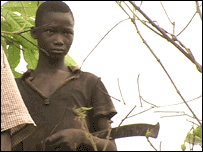
Next week I will be entering my third decade of being, staying alive. Now you may wonder how can that be such a feat in today’s world, but there are so many places where this luxury is not present. On the other side of the world, a place many people relegate to disease, conflict, and poverty, there is a war that has paralleled my time alive on this earth. In that time so many have lost their lives, most of them children, but yet here I am, here I stand – alive and well and trying to understand what they have experienced in all those years when I had no idea.

The civil war in Northern Uganda is entering its twenty-first year. The longest running war in Africa is seeking an end, and soon! Roughly ten years ago the people of Northern Uganda were given 24 hours to pack up and leave their homes to enter Internally Displaced Peoples (IDP) camps. The government thought this would be a solution to the conflict with the rebel Lord’s Resistance Army (LRA). However, all it did was exacerbate the situation and increase the amount of death and suffering caused by the war. Last night, in 15 major cities across the US, people gathered to remind US and world leaders that there are over 1.5 million displaced Ugandans suffering from a nearly invisible war. No one should be invisible, no one’s troubles should go unknown for so long, no war should continue for such a long time. I can only imagine those my age in Uganda who know nothing but war, who know no home except for an IDP camp, who only know a life of suffering. If this war could end from a handful of the american populace displacing themselves, then we will truly know the power of people who care.

a phamaceutical not bent on profit?

Do you see it there on the horizon? Hope is dawning and the situation seems to be less grim in this radiating light. Diseases run rampant in Africa, plan and simple, there is no health infrastructure to deal with the burden of preventable diseases. Meningitis for example can kill a child in Africa in less than six hours, while we can sit here in our ‘developed’ world knowing that the vaccination is right around the corner office.

The largest drug company in Europe, GlaxoSmithKline (GSK) announced a new drug for sole use in Africa to fight meningitis. The drug will be introduced with prices that will never have potential to cover the research or production costs. Experts and critics see this as a huge change in big companies changing their business practices to be more compassionate. Some critics say it isn’t enough, but I’d say this is an enormous and important positive step in the right direction. The company does not expect to make a profit. In a quote from the BBC article: “We have found a pretty clever way to fund therapeutic solutions for the developing world without essentially sacrificing the more traditional research we do on diseases around the world,” said the GSK chief executive Jean-Pierre Garnier.

This new approach comes about as last year big companies tried to sue South Africa over its purchase of cheaper, generic drugs to combat diseases. From the public outcry the big companies decided to back down amidst a PR disaster and the knowledge that their current practices were not going to cut it. They had to come to the realization that the old way of conduction business had to change. Now big firms are partnering with smaller firms in India and China and they are researching the ‘neglected diseases.’

This is an amazing positive in the way of saving lives. Changing the way companies do business can save lives. Currently four out of the twelve major companies have centers focusing on major diseases like HIV/AIDS, Tuberculosis, and Malaria. This is seen as the first big step following a number of small steps in the direction of doing something more for the ‘developing’ world.

forever enslaved: past and present

We will be forever enslaved by the deeds of the past. There is no way that we can separate ourselves from the historic wrong-doings of our ancestors. I like to think that there is only the present and that everything hinges on the present course and action. That idea is true I feel, but we cannot forget the past and we cannot discredit working towards the future. Last month there was a rememberance of slavery at the Elmina Castle in Ghana. Hundreds of locals gathered, the British Council and UK representatives were present and the crimes committed and journeys of slaves were remembered. In the BBC article Baroness Amos, who expressed pride at being a member of the African Diaspora, said transatlantic slave trade had been “responsible for some of the most appalling crimes perpetrated by humankind against its own citizens.”

Elmina Castle, which was built by Portuguese traders in the late 1400s before being taken over by the Dutch and later the British, was capable of holding 1,000 male and female slaves at one time. I feel like commemorations like these are repeated in different parts of Africa and yet they remain only symbolic gestures where words are spoken and the only actions that follow is that of representatives traveling back to their respective countries. This is where the idea that everything hinges of the present action is needed. If we are truly dedicated to healing past crimes and reversing the effects of those actions, then how can we remain inactive?

Even as we commemorate and remember and honor those enslaved and those affected by slavery – it continues to be a prevalent issue even today. The Ivory Coast (Cote d’Ivoire) is the world’s leading producer of cocoa. When you explore deep into the cocoa plantations you will come across a frightening discovery: forced child labor – slaves. These children are enslaved, forced to harvest cocoa, kept out of school, not treated for wounds recieved from working, and kept from their families. As the BBC reports: “In 2001, under pressure from the US Congress, the chocolate manufacturers promised to start eradicating forced child labour. They failed to meet an initial deadline of 2005, were given until 2008, and now patience is running out.”

We see slavery in new forms, much as we see colonialism in new forms. Child soldiers are recruited and brainwashed to fight in conflicts of which they know nothing. Many of these conflicts are perpetuations of the ‘developed’ world’s desire for some commodity or resource. We see slavery in an economic form as well. Women selling their bodies in order to feed their families, people taking on dangerous jobs to provide for their families – this economic slavery is very much linked to the actions of the past that have come to fruition now. Economic conditions as well as past historic incidents keep us enslaved. Those of us with privilege are enslaved to the deeds of our ancestors and governments, those who are forcible held and those who suffer from economic are enslaved by the systems that are so often perpetuated by our privileged wants. We are forever enslaved by our actions – whether they were in the past, or are happening present day – we are enslaved by our deeds. Are you prepared to own your actions when the time comes?

the politics of genocide

Genocide continues, people continue to be murdered, lives continue to be lost. The next month will mark the anniversary of the Darfur Peace Agreement. The crisis in Sudan’s western region of Darfur is only getting worse. The Sudanese government claims to be making it easier for aid groups to provide humanitarian support, yet aid groups are at times allowed to work and later denied. Under-staffed and under-supported African Union troops are being threatened and killed. The US deputy secretary, John Negroponte, sees this as the last opportunity to bring in a hybrid UN-AU peacekeeping force as hope seems to be running out for a solution. As Negroponte travels to Sudan he will be bringing the message that Washington’s patience has run out. Ban Ki-moon says that he thinks a misunderstanding with the Sudanese government is holding up the peacekeeping force.

The Sudanese economy has boomed with the backing of China, but now China is knocking. China has strengthened military ties with Sudan and so far has been behind the blockage of a peacekeeping force in Sudan. As a permanent member on the Security Council, China has vetoed previous efforts to put peacekeepers in Darfur. Currently there is a 7000 troop AU force trying to secure an area the size of France with limited supplies and no mandate. However, China is now urging Sudan to accept a peacekeeping force. For the past two years China has vetoed sanctions and peacekeeping forces for Sudan. Now as the 2008 Bejing Olympics are fast approaching more pressure has been placed on China to resolve the Darfur crisis. From the New York Times article: “But in the past week, strange things have happened. A senior Chinese official, Zhai Jun, traveled to Sudan to push the Sudanese government to accept a United Nations peacekeeping force. Mr. Zhai even went all the way to Darfur and toured three refugee camps, a rare event for a high-ranking official from China, which has extensive business and oil ties to Sudan and generally avoids telling other countries how to conduct their internal affairs.”

Pressure from the Olympics has been the tipping point for Chinese authorities. There are efforts to call the 2008 Olympics the ‘Genocide Olympics’ from prominent advisors to the Chinese goverment dealing with the Olympics. The Olympics are a great source of pride for the Chinese people. The growing pressure over Darfur has made the Chinese worry that the crisis is hurting their image. This large push is coming from the activist community and hollywood, where people are saying that China needs to be a responsible partner in the Olympic Games. There is still plenty of time before the 2008 Olympics for China to persuade Sudan or accept sanctions.

african economic growth and oil

The UN has reported that Africa’s economic growth is increasing, slow and steady, but frail. They are predicting that the continent’s economies will grow almost 6% in 2007. However the report states that if African countries are to continue to grow they will need to diversify their economic output and invest more in infrastructure. The top growing econmies include: Mauritania (19.8%), Angola (17.6%), and Mozambique (7.6%). The report points out that the economic growth rests on a very fragile base and there are still conflicts to face. The HIV/AIDS crisis has killed much of Africa’s workforce. Countries need to open their borders to trade, invest in their infrastructure, and insulate themselves against external shocks. If these predicted growth percentage’s come true in 2007 this will be the continent’s fourth year of growth. Zimbabwe was the only economy to contract in the last year by 4.4%.

The Foreign Policy blog notes that the landlocked Rwanda will be the prime spot for multinational corporations to invest. The article states: ‘Kagame, who has been president since 2000, is viewed as an honest, business-savvy man opposed to corruption, unlike many other African leaders. Consequently, American businessman Dan Cooper, who has been pitching Rwanda to U.S. corporations, describes the Maryland-sized country as “the most undervalued ‘stock’ on the continent and maybe in the world’.” However Freedom House listed as not free, the hope is that this economic upswing will benefit the citizens.

Africa is gaining economically even as Zimbabwe’s inflation reaches 1,600% and Angola calls off talks with the IMF. China continues to invest in countries regardless of political or human rights standings. Africa’s countries have a lot to deal with if they are to continue their strong economic upswing. The recent signing of many bilateral trade agreements will hurt these economically developing countries. Many countries still have conflicts to clean up before more growth can happen. Rwanda is recovering from genocide, but seems to be gaining a foorhold in the economic system. Oil, don’t forget about oil. It is my belief that oil will be the greatest hope for African countries to become economically stable and advanced, as long as the resource is used wisely. Africa’s hope is growing, but so is the resource lust of emerging economic giants.

when genocide spreads

The genocide in Darfur is not contained by the Sudanese borders. Back in February the UN warned that Chad, which borders Sudan’s western region of Darfur, could become the scene of the next genocide if action is not taken soon. The UN has recommended peacekeepers to the border countries of Sudan to halt the spread of the killing. The janjaweed is penetrating further and further into Chad to attack refugees in camps. The UNHCR (UN High Commission for Refugees) has expressed worries that the spillover from Darfur will exacerbate the ethnic tensions. The janjaweed had started the violence, but now Chadian locals have joined in and increased the magnitude of the conflict and the killing.

The Central African Republic, Chad, and Sudan had signed a <a href="http://news.bbc.co.uk/2/hi/africa/6367545.stm
“>pact to not support rebels responsible for the conflict on each countries’ territory. The regions of western Sudan, eastern Chad, and northern CAR are in a circular conflict of fleeing refugees and aggressive militias. The conflict is based on land use and access to water, an issues that has been translated into ethnic tension.

So who is really effected by this conflict, who is it that faces terror everyday while we watch the local news? Oxfam has a page dedicated to the faces of this conflict. For the most part this conflict has the face of a child. So many children have been orphaned, so many have seen the terrors of war, so many have been effected by the conflict. A quote from the Oxfam page: “You don’t have to explain to these children what war is – they’ve lived it.” Check out the Oxfam page link and learn about the face of the conflict. The children, the future of Africa need the support to build a new peace.

the greatest youth movement in history: mandela’s disciples

The beginning of arguable the greatest youth activism movement all began with twelve. Twelve young boys inspired by the ideas of Nelson Mandela left on a journey that would change their lives and so many others for years to come. This is the story of how Nelson Mandela’s movement began. Social movements often have symbolic leaders, but they are really comprised of thousands, thousands and thousands of local leaders and supporters. The first of these unsung heroes came from Bloemfontein. Most people have never heard of Bloemfontein, but they have heard of Soweto or Johannesburg or Cape Town. Bloemfontein is where the twelve came from.

After recently seeing the documentary ‘The Twelve Disciples of Mandela’ I began to learn about the real history of the anti-apartheid movement and its deep roots in youth activism. “Less well known is the experience of a generation of young men who left their country clandestinely to build the African National Congress (ANC) and spread its liberation message in places as far-flung as Dar Es Salaam, Belgrade, London, Havana and New York. Left to their own devices, hunted by the Afrikaner regime (and considered terrorists by the U.S. government), lacking legal status and often socially isolated, these foot soldiers of the anti-apartheid cause forged ahead as one of the century’s great freedom struggles stretched into 30 years of brutal conflict.” – this is the brief synopsis that is given about the compelling documentary. The film outlines the struggles for independence all across the continent and tells of how this group of twelve students blazed the trail for so many freedom fighters starting in the 1960s.

Beginning in 1952 the anti-apartheid campaign was defined as the ANC staged its first act of civil disobedience against the pass laws. In 1958 the Bantu education policy was imposed, where basically black South Africans were taught nothing of value, except how to serve their white counterparts. This is the where the journey of the twelve began. The burned their pass cards in response to the Bantu education law and set out on what would be a quest that would alter their lives forever. With the passage of the Bantu education, riots sprung up in Sharpville in 1960, where many innocents were killed and the concept of human dignity was questioned. As quoted from one interview, “[…] whether educated or uneducated, all realized they had to rise up against the system.”

The twelve began their journey from a jump point in Botswana, where many left and were deported back to start again. They had a desire to reach the newly independent Ghana. My class, ‘Africa and the World’ watched a documentary today on the rise of nationalism in Africa and how Ghana represented a great hope for the rest of the continent. Ghana’s independence raised hope everywhere especially in South Africa. The twelve sought education to build the movement and some made it to Tanganyika (before Tanzania was formed) through Sudan, where they met Mandela. They began studies in the capitol, Dar es Salaam. Others traveled to Cuba to be trained militarily and were mobilized for the October crisis. Around 1967, some members of the twelve made it to the US to continue studies in journalism, where the ANC was considered a communist, terrorist group. At Lincoln and Temple University members of the twelve grew in knowledge to fight apartheid.

1976 – the Soweto student marches and massacre, “We still have a long way to go.” This one event led to the uprising of young people all over the world in a hope for peaceful change. David Basilson stated in his documentary on the rise of nationalism that, “Freedom will bring peace.”

The ‘Twelve Disciples of Mandela’ documentary was extremely compelling and educational with its history aspects. The story of this youth movement is told by a son of one of the twelve. Thomas Allen Harris tells the story of his stepfather, Benjamin Pule Leinaeng, who met his mother in the Bronx while studying journalism. He always remembered his stepfather in his depression and drinking and often rebelled against his authority, but nothing prepared Harris for his father’s funeral in South Africa, which was the inspiration for the documentary. “In Bloemfontein, however, Harris discovered an image of Lee dramatically different from that of the moody, foreign stepfather. He was especially affected by the recollections of two of Lee’s associates, Moses Medupe (Dups) and Mochubela Seekoe (Wesi), who were among the group of 12 students, including Lee, who left Bloemfontein in 1960. Dups and Wesi spoke fondly of Lee as a young man and described what life was like for blacks in Bloemfontein under apartheid and during the long years of exile. Family and friends who gathered at the funeral to eulogize Lee spoke of a brave and cheerful youth setting out to battle apartheid, a comrade who never wavered in that struggle even as it wore him down. They all told stories of the ANC’s beginnings in Bloemfontein, in the heart of Afrikaner country, and of the terrible repressions that drove the organization underground and to establishing centers of resistance outside the country.”

This documentary runs through all these stories and more. Interviews with original members of the twelve and those who supported them inspires, recreations of actions taken by the twelve captivate, and the history of a young generation inspired to fight oppression motivates the mind to take action even today. Youth trapped in an oppressive world were able to battle the odds and pave the way for so many others to make a difference for South Africa, what is holding us back now?

no more foreign aid institutions. . . it’s china

Foreign aid; development assistance; foreign investment; these terms are now gaining another synonym: rogue aid. In an excerpt from the Foreign Policy Blog, rouge aiders are defined as such, “Because their goal is not to help other countries develop. Rather, they are motivated by a desire to further their own national interests, advance an ideological agenda, or sometimes line their own pockets. Rogue aid providers couldn’t care less about the long-term well-being of the population of the countries they ‘aid’.”

China is now the largest rogue aid competitor. The author of the blog entry says, “My friend was visibly shaken. He had just learned that he had lost one of his clients to Chinese competitors. ‘It’s amazing,” he told me. “The Chinese have completely priced us out of the market. We can’t compete with what they are able to offer’.” China can outbid the World Bank in aid lending power! What does this say for the future of the aid community? What does this say for the future of development? When economically powerful, wealthy, nondemocratic countries can circumvent the aid policies of the established lending institutions what can we really expect for development and aid programs? China can outbid the World Bank for a railroad project in Nigeria and sets no stipulation for combatting corruption, it can sign environmentally harmful agreements, it can provide funding without regard to the transparency of governments.

The Foreign Policy article gives three simple answers as to why China and other countries are stepping up their aid game. “[…] money, access to raw materials, and international politics.” These countries are not so concerned to create development or provide aid and help as many people as they can. There are obvious underlying motives to China’s upswing in development aid. This is not to say that China is the first to use rouge aid as a international relations tool. The United States and the Soviet Union used rogue aid to gain the allegiance of dictators. Our world is not in the position now to allow such initiatives to continue. The World Bank and other large aid agencies are monitored closely by watchdog groups, but these ‘rogue’ countries can lend and corrupt and ignore as much as they want.

The greatest threat that I see, and which I wrote about in an earlier post, is the obvious – China is set on getting all that it can from Africa. China has a great lust for Africa’s resources and their thirst is becoming unquenchable. Will Africa be drained and left with people living without basic infrastructure, left empty handed, left to die in ‘under-development.’ There is a quote from the FP article that sums up my thoughts, “Worse, they are effectively pricing responsible and well-meaning aid organizations out of the market in the very places where they are needed most. If they continue to succeed in pushing their alternative development model, they will succeed in underwriting a world that is more corrupt, chaotic, and authoritarian. That is in no one’s interests, except the rogues.”

she’s taking on more water; the zimbabwean titanic

As a ship with a hole takes on water, so too does a state or government sink with a corrupt and ineffective government. Zimbabwe is sinking, many have noted this before, but presently its plunge to the depths seems to be even more imminent. President Mugabe of Zimbabwe is losing control of his country and is losing support from his allies. Zambian President Mwanawasa has called the Zimbabwean state to be like a <a href="http://news.bbc.co.uk/2/hi/africa/6475851.stm
“>titanic and the BBC notes that, “he said the country’s economic difficulties were forcing its citizens to leave like passengers jumping from the sinking ship to save their lives.” Zambia had previously been a proponent of quiet diplomacy. However, now even South Africa’s criticism is increasing, but has not voiced outright criticism of the Zimbabwean government. The United Kingdom has stated that the solution to the issue of Zimbabwe will be found within Africa. This statment may be gaining strength as the economic crises continue and the devaluation of the Zimbabwean currency continues and fuel costs soar. The final paragraph of this BBC article states, “More than 80% of Zimbabweans are living in poverty, with chronic unemployment and inflation running at more than 1,700% – the highest in the world.”

Yesterday President Mugabe attended <a href="http://news.bbc.co.uk/2/hi/africa/6499059.stm
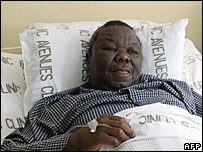
“>’crunch talks’ in Tanzania as the southern African leaders seek to find a solution to Zimbabwe. Many African leaders see Mugabe as a hero for standing against colonial rule, however I am not so sure that a defiance of colonial rule includes not serving your people and allowing them to suffer. As these talks occurred, the headquarters of the leading opposition to Zimbabwe’s government was raided by police. This has become a common theme. The Zimbabwean government has continually attacked any opposition, demonstration, or dissent. Mugabe arrived at the Tanzanian summit and as he did it appeared as though the police had begun a new crackdown on the opposition. The Movement for Democratic Change’s leader, Morgan Tsvangirai, was among 20 people detained in a police raid yesterday. Some of those arrested were accused of fire-bombing, but Tsvangirai was not among them. The opposition is seen by the Zimbabwean administration as a Western puppet to overthrow Mugabe. The Information Minister told the BBC, “You [the West] are too much concerned with your Tsvangirai because he is your puppet and you make him an international hero.”

Mugabe, who has ruled Zimbabwe since 1980, now says that he favors elections next year. Mugabe had previously said that he would like to postpone elections until 2010 to extend his term, yet his own party, the Zanu-PF party, has stated that they were, “”anxious to get another candidate”. Gone in a year? Possibly, losing support of his own party, his people, and now his own resolve seems to be failing. When dissent is not allowed, opposition is forceable put down, and people are not permitted to voice concern with their government then how can you expect your boat to float?

However I am just a Westerner writing about what I have seen and what I have read. Don’t take it from me. Check out this blog entry from the This is Zimbabwe blog. The entry linked to is a clip from the South African news about the issue of Zimbabwe.