Death, donations, and doing good

The ice bucket challenge was undoubtedly a media and fundraising success for the ALS Association. For many people this was an opportunity to “do good” and call out their friends on social media to do the same. Skepticism mounted as social media feeds were inundated with ice bucket participant videos.

Plenty Consulting looked at the data and found that daily donations to the ALS Association (ALSA) remained the same even as the number of ice bucket challenge participants grew exponentially. Donations to the ALS Association were 35% higher than last year, but were all the non-donating participants missed fundraising opportunities or simply “do good” imposters? Perhaps it is helping to foster a culture of giving?

Vox published a widely shared bubble chart (above) that demonstrated which diseases kill the most people compared to which diseases get the most donations. This chart is flawed in the sense that comparing one-time fundraisers, such as a Breast Cancer Walk, isn’t enough to capture which diseases get the most overall funding.

Others took a more statistical approach to their skepticism. One individual (redditor SirT6) chose to look at NIH funding and disability-adjusted life years (logarithmic) to compare some of the top diseases that get funding compared to their impact on lifespan.

I think both measures in the above chart are flawed in that NIH funding is a poor indicator of where the general public is donating and also it is nearly impossible to compare the suffering and impact of each individual disease through adjusted life years.

Instead I chose to identify the largest charity for each of the top 15 diseases that kill people in the US (excluding #5 unintentional accidents) based on the 2011 National Vital Statistics Report from the Centers for Disease Control (CDC). A few charities took on multiple diseases, such as the American Heart Association (AHA) working on heart disease (#1) and stroke (#4) or the American Lung Association (ALA) covering lower respiratory disease (#4), pneumonia (#8), and lung inflammation (#15). By searching the most recent IRS Form 990 from each charity I looked at their Total Revenue (fiscal year) as well as the percent of the Total Revenue that came from Contributions (fundraising, grants, etc.). I figured this gives the best indication of where both individuals and other foundations or nonprofits are giving their donations. I then compared each disease/ cause of death in its “per 100,000” prevalence rate.

disease-donors

The size of the bubble represents the percentage of total revenue that comes from donations. The big take away here is that some of the most deadly diseases are getting larger amounts of funding. However, there are a handful of diseases that definitely aren’t getting enough (i.e. Septicimia), but are three times as deadly as ALS. Lung diseases really aren’t getting a lot of donations, but seem to remain highly funded regardless. In my research for this I was surprised to find that HIV/AIDS per 100,000 rate is less than ALS at 2.5. In particular areas, such as Detroit, HIV/AIDS is a much larger problem, but it is good to see that advances in treatment and prevention have lowered the national rate.

The majority of charities depend on contributions and donations to fund their efforts, pay salaries, and cover expenses. It is difficult to say what percentage is used for prevention activities or for finding a cure, but very obviously not all diseases are funded equally. Likewise, not all diseases contribute to the deaths of people at the same rates. Does that mean some should get more funding over others?

Map: Detroit Design Festival and the Myth of the Blank Canvas

Alex B. Hill's avatarDETROITography

ddf_locations

The long and short of this post title is that artists are among the first line of gentrifiers. It is true artists often have very lower incomes, transient housing, and suffer from a lack of understanding from a majority of the public – however, most, if not all, artists come into various cities and urban settings with a great amount of privilege. Choosing to attend art school is privilege number one when others often lack the ability to pursue art at mostly expensive, private schools. The map shows that over the years the Detroit Design Festival (DDF) has become more concentrated in specific areas as well as increased the number of hosted “happenings” or events in those concentrated areas.

In Detroit you can see this blessing and curse all bound up in the idea of “doing something good” in the city’s “blank canvas” of opportunity. While artists attempt to be…

View original post 299 more words

Map: Historic Detroit Neighborhoods 1884

Alex B. Hill's avatarDETROITography

silas_nhoods

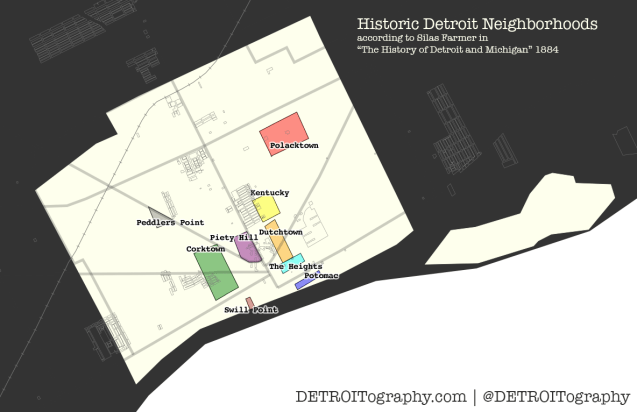
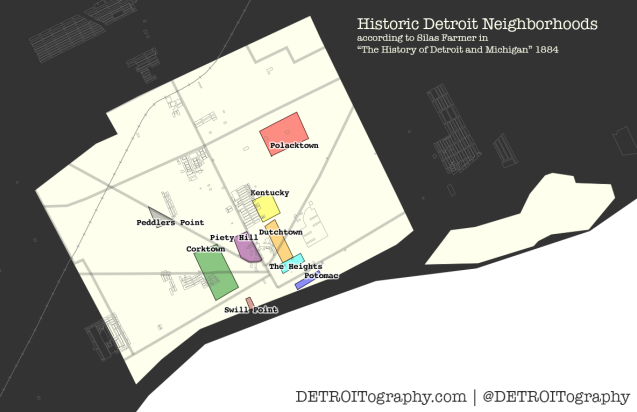
From “The History of Detroit and Michigan” by Detroit’s first cartographer, Silas Farmer.

Excepts on each neighborhood:

“This the larger portion of the territory on Fifth and Sixth Streets, for several blocks each side of Michigan Avenue, is called Corktown, because chiefly occupied by people from the Emerald Isle.

The eastern part of the city, for several blocks on each side of Gratiot Avenue beyond Brush Street, for similar reasons is often spoken of as Dutchtown, or the German quarter.

That part of the city lying a few blocks north of High Street and between Brush and Hastings, is known as Kentucky, from the number of colored people living there.

A walk a few blocks east and north of this locality terminates in the heart of Polacktown, where many Poles reside.

The portion of the city just west of Woodward Avenue and north of…

View original post 335 more words

Map: Detroit Water Affordability

Alex B. Hill's avatarDETROITography

detwater_affordability

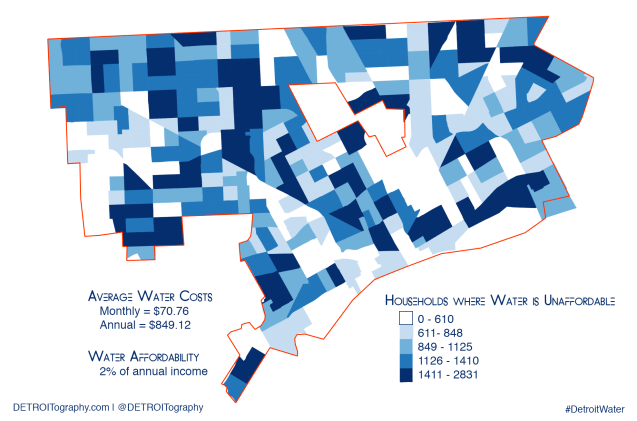
The standard for affordable water is set by the Environmental Protection Agency (EPA). The EPA attempts to stress equity and consideration for low-income individuals. In 1995, the EPA set the first water affordability rate at 2% which is considered a “large economic impact.” Unfortunately, the Detroit Water and Sewerage Department (DWSD) among other non-governmental actors disagree with the EPA and have different ideas as to how to pay for and maintain this basic human need and natural resource.

Detroit’s water rate was increased by 8.7% in July 2014 effectively making an average monthly water bill at $70.76 (or $849.12 annually). In order for this $850 annual rate to fit within the EPA’s standard of “affordability” a household would need an annual income of around $40,000. Anyone aware of the situation in Detroit and Census data could tell you that the majority of households in Detroit do not have that level…

View original post 70 more words

Data, People, and Water: the need for people-centered innovation in Detroit

“Orr on Wednesday said more needs to be done to differentiate the legitimate residential accounts from those connected to blighted and abandoned properties, or occupied by squatters or used as drug houses — conduct that the city doesn’t want to facilitate.” – Detroit News

Following the most comprehensive survey of Detroit property to date, Motor City Mapping, the above quote from Emergency Manager Orr should be a moot point. It would take less than a few hours to check a list of delinquent water accounts against a list of “vacant” or “unoccupied” properties across the city. Mayor Mike Duggan and Detroit’s new Chief Information Officer (CIO) Beth Niblock seem to be on board with opening up the city’s data as well as utilizing more technology to better provide services to residents.

Here is my short list of data that should have been utilized to better serve Detroit residents as opposed to penalizing them or resorting to scare tactics.

1. Motor City Mapping: In the most comprehensive citywide parcel survey ever conducted, a host of Detroit data focused organizations have compiled an incredible set of data and they have released it openly to the public. As Detroit works to revolutionize its technologies how did it miss the boat in utilizing this recent, widely publicized data survey. Again, it would take less than a few hours to check a list of delinquent water accounts against a list of “vacant” or “unoccupied” properties.

2. Census Bureau Data: Detroit residents are over 30% unemployed and 40% living below the poverty line. Many residents of Detroit are individuals who have been unable to leave, but have made it through Detroit’s toughest times. Detroit is a man-made disaster zone that has evolved slowly over the course of six decades. The city and the problems that residents face lay bare the inadequacies of our current systems to serve all residents. Neither the city government nor the emergency manager can rely on punitive actions to do any good for current or future Detroit residents.

3. District Managers and Community Networks: The DWSD contracted out door-to-door residential water shutoffs to a profit driven corporation. Any community organization in the city will tell you that mailing notices to residents is not enough. Many community organizations utilize a network of contacts and pay street teams to spread the word about community programs. Would it have really been that hard to do some basic canvassing to get people set up with assistance instead of just shutting off water completely? Why weren’t the new District Managers utilized?

Emergency Manager Orr and Mayor Duggan truly need to take a lesson from Detroit Mayors past who instead of making harmful decisions chose to serve the needs of residents first. Mayor Pingree utilized vacant land to feed the hungry and launched new programs for the poor during the 1893 economic depression. Mayor Murphy supported 400 acres of gardens and turned old factories into housing for the homeless during the Great Depression.

At this time of Detroit “revitalization,” when will Detroit’s decision-makers demonstrate that keeping people (both wealthy and poor) in the city will be better for Detroit’s future. Instead of these harmful actions, the Detroit government needs to push for greater people-centered innovation to serve all residents.

Map: Top 40 Delinquent Commercial Water Accounts in Detroit

Alex B. Hill's avatarDETROITography

detwater

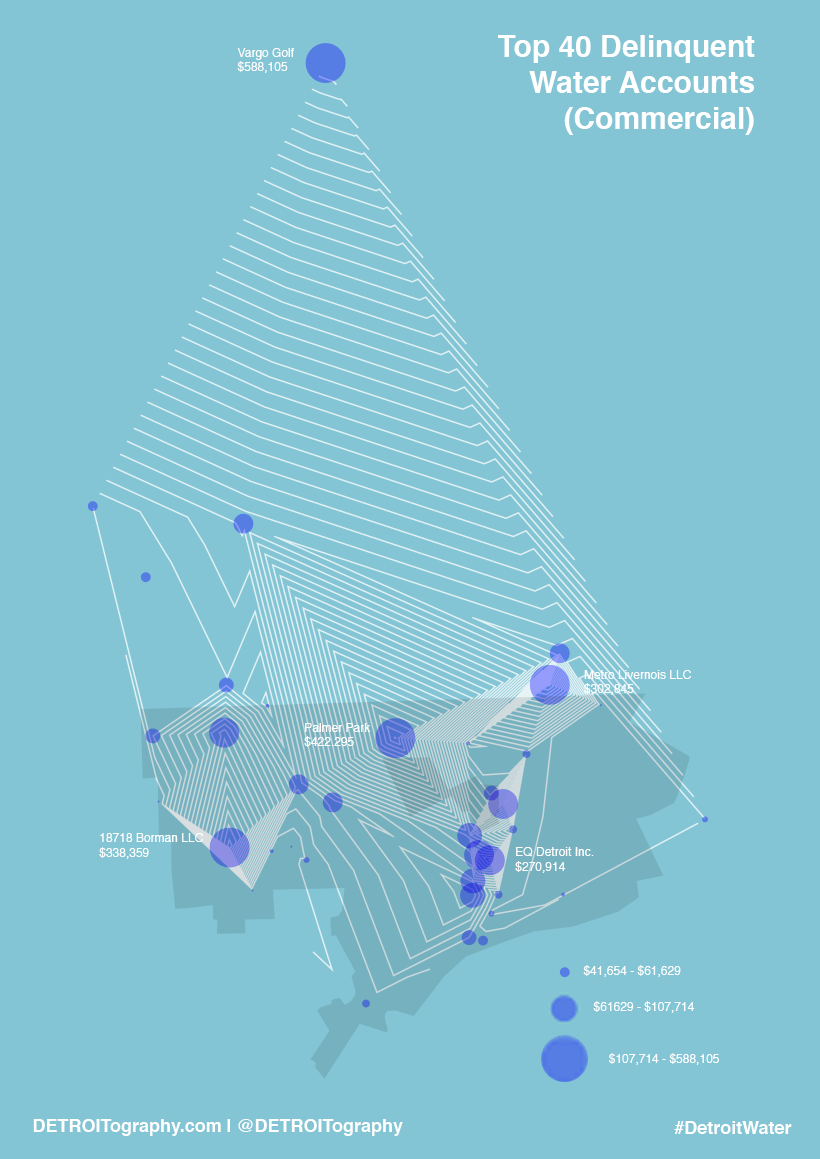
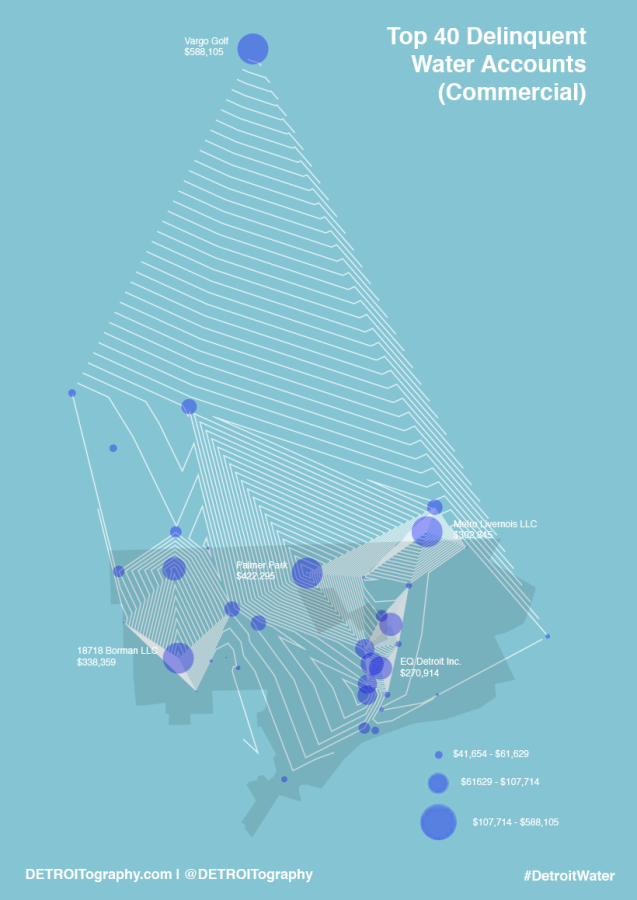
A list was finally published of some of the top commercial water customers with delinquent accounts. They have ranged from companies who have been in trouble in the past with Michigan’s Licensing and Regulatory Affairs (LARA) to individuals who seem to have attempted business ventures that failed. What is most surprising is that among the top 40 delinquent commercial accounts there is a cluster in Midtown and Downtown – the newly named “Innovation District.”

The Detroit Water and Sewage Department (DWSD),a not-for-profit by Michigan mandate, estimates that 18,073 commercial accounts make up about $26 million of the deficit or almost a quarter of accounts past due.

We looked into a few of these corporations and found some odd things:

  • Vargo Golf – with the highest amount past due, manages six golf courses in metro Detroit with three in the City of Detroit – Palmer, Rouge, and Chandler.
  • Borman LLC was…

View original post 125 more words

Map: Colleges and Universities in Detroit

Alex B. Hill's avatarDETROITography

college_univ2

In recent years Detroit has seen an influx of college and university satellite sites. Notably, the University of Michigan (UM) Detroit Center opened in 2005 while the Michigan State University (MSU) Detroit Center opened in 2009. Detroit has been host to a number of colleges and universities from its founding. As Michigan’s largest city and former state capitol, Detroit held the greatest number of highly educated individuals. In 1817, Justice Woodward wrote up plans for the University of Michigania (Catholepistemiad) with 13 departments. The building was constructed at Bates and Congress, but due to disagreements over educational ideas, controversy with the land, and general mismanagement, the university never really took off. Land that had been previously earmarked for a new Michigan state capitol soon became the new University of Michigan in Ann Arbor under the leadership of Henry Tappan in 1837. UM’s proximity to Detroit has afforded many…

View original post 606 more words

Map: the Smells of Detroit’s Midtown Loop

Alex B. Hill's avatarDETROITography

smells_midtown_loop

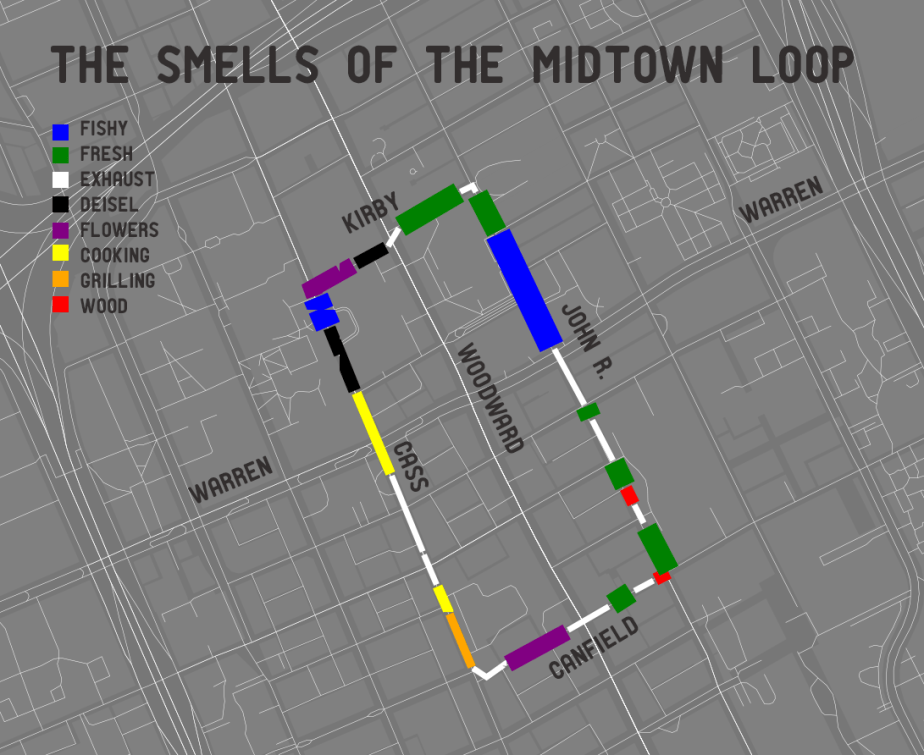
I’ve really wanted to do some psychogeography and while this is not the best example it did allow me to be more present in my walk around the Midtown Loop, a 2 mile placemaking project to improve the walkability of Detroit’s cultural institutions. Instead of doing the straight and scientific geography lines of the route I decided to record the smells that I experienced. Not all of them very pleasant.

My walk started at Hancock and John R. and moved counter clockwise. After crossing Warren and immediately at the Michigan Science Center the strong smell of fish hit me. It lasted quite a while and I assume is an issue with the sewers. The corner at Kirby and John R. is where the College of Creative Studies (CCS) and the Detroit Institute of Arts (DIA) have well manicured lawns. After crossing Woodward I took in the smells of exhaust and…

View original post 177 more words

Data: Detroit Homicide Reporting Doesn’t Add Up 2009 – 2013

Alex B. Hill's avatarDETROITography

homicide_data

I’ve been actively engaged in tracking homicides in Detroit for a few years now thanks to the efforts of Cham Green and the independent Detroit Crime and Homicide Group, which has spent the last years combing news articles, Detroit Police Department (DPD) major crime reports, and checking these against FOIA requested homicide numbers. There is no other comprehensive or working system to keep track of crime and homicide in the City of Detroit.

The Detroit Free Press requested homicides in 2011 as part of a FOIA. The data they obtained went back to 2008 with about a dozen cases from 1970 and 1980s. Needless to say, the FOIA made it evident that the City of Detroit was seriously lacking in its ability to keep track of crimes and report them in an accurate and timely manner. I can’t say that I’m surprised with the regular cost cutting within the DPD…

View original post 397 more words