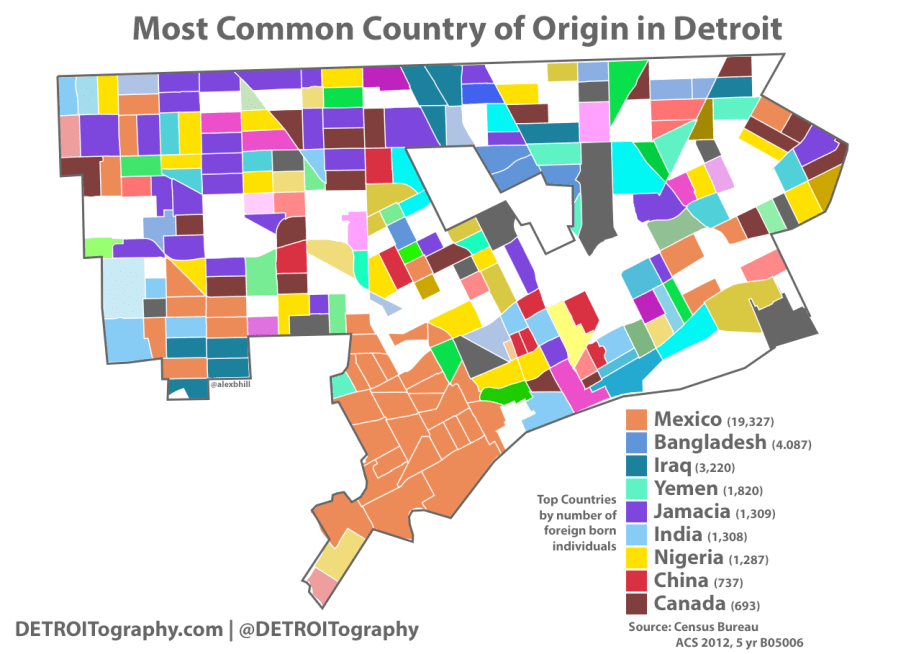
Map: Most Common Country of Origin in Detroit

Alex B. Hill's avatarDETROITography

DETforeign_born

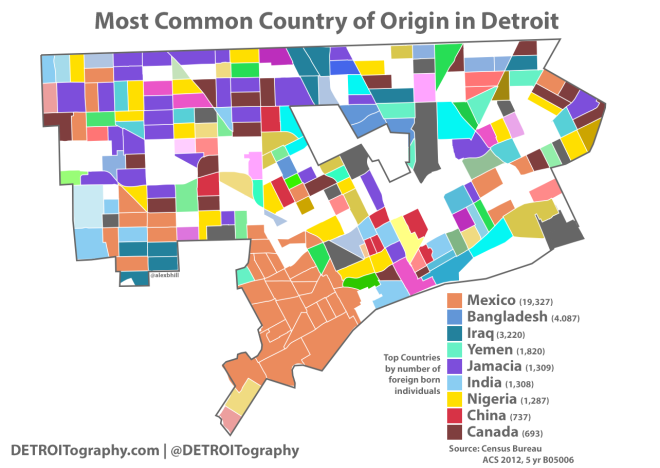
At first glance, this map is a mess to look. However, I made an artistic choice to keep all of the colors because I thought it gave a nice impression of Detroit as a colorful quilt of different countries, people, and backgrounds. The idea came from Slate‘s series of maps on “most common country of origin” by States. I pulled Census data for all census tracts within the City of Detroit and manually went through selecting the dominant country of origin (n=49) for each tract (n=323).

The dominant country of origin was by far Mexico with 19,327 residents across 40 census tracts. Bangladesh was represented by the second highest number of residents, but they were very concentrated in just 3 tracts. Jamacia came in second, dominating 29 tracts. Canada (19 tracts) and Nigeria (17 tracts) followed. Canada could also be found all across the city from Westside to Downtown to edges…

View original post 114 more words

Minimalist Map of the Detroit People Mover

Alex B. Hill's avatarDETROITography

peoplemoverminimal2

Image source

I came across this simplified Glasgow transit map and thought that would be an interesting idea to apply to Detroit’s ultra simple downtown “public transit” system. I choose some highlights of each station stop based on the station guides (no guarantees). The People Mover was constructed in 1987. Detroit was one of four cities selected to receive this “new” transit system as part of the “Downtown People Mover Program,” yet Detroit has one of the two remaining people movers from that program. Last year was the 25th anniversary of the Detroit People Mover.

EDIT: 12/03/13 Lafayette Coney Island added

View original post

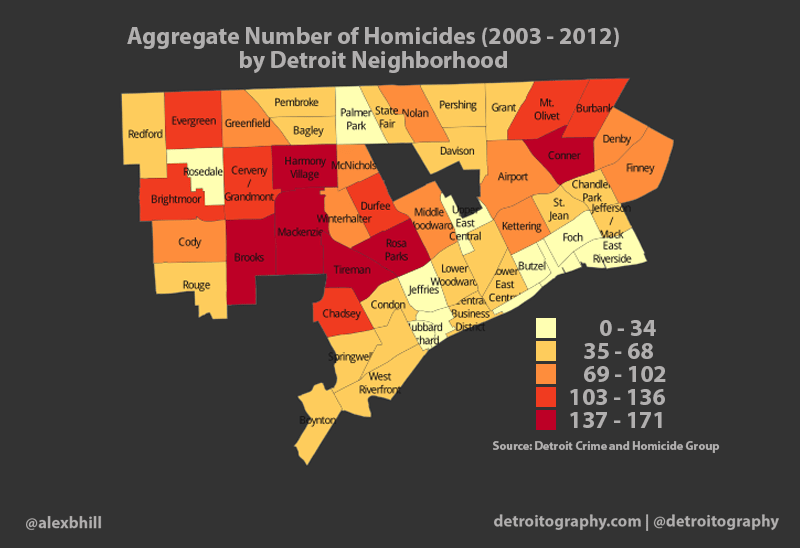
Homicide, Gun Violence, and Epidemiology in Detroit

More about the above map HERE

The Detroit Police Department (DPD) has been making strides to improve their operations, including: cracking down on internal corruption, adopting data-driven crime tracking, and utilizing innovative approaches for crime prevention. When Chief James Craig was hired he brought back a data-driven model of policing that tracks where crimes happen, by whom, as well as where police patrols are deployed. This is an important step forward for the DPD to manage the large land area of Detroit while utilizing statistics to plan police asset allocations. Being aware of crime trends and locations is critical to understanding how best to improve safety in Detroit. Last year DPD and Crime Stoppers held a gun buy back event in Detroit and early this year it was reported that a Federal investigation by the ATF (Bureau of Alcohol, Tobacco, Firearms and Explosives) collected a number of illegal guns after setting up a fake barbershop in Detroit. The ATF’s primary goal was to identify key “trigger pullers” in the community who are committing violent crimes.

“What we need to understand gun violence is a #publichealth approach.” – David Satcher #APHA13

— Prevention Institute (@preventioninst) November 4, 2013

These data-driven and community focused approaches are critical to making Detroit safer as well as utilizing police and community resources more effectively. Innovative and effective approaches to crime prevention are desperately needed in Detroit. A crime prevention approach rooted in public health is gaining traction in reducing homicides in other major US cities. The Cure Violence program uses a public health/ epidemiology approach to identify “trigger pullers” who contribute to the spread of homicide and crime in communities by sending violence “interrupters” who are former gang members into the streets to intervene. The Man Up! program in Brooklyn uses this same approach and saw 363 days without a shooting or killing this past year.

My own research shows that homicides in Detroit follow a disease diffusion pattern across the city. Emanating from two key hotspots while continuing and spreading from those areas throughout the year with over 80% of Detroit homicides committed by gun.

It was announced today that $1.6 million will be granted to fund, “36 AmeriCorps volunteers to analyze crime statistics and help neighborhood block clubs and other groups learn how to report crime, keep an eye on the neighborhoods and how to avoid becoming victims.” The Free Press article notes that the program has been in effect in Midtown and East Jefferson over the last three years and they have seen a 44% reduction in crime. Funding ($722,000) for the program comes from the Kresge Foundation, Skillman Foundation, Henry Ford Health System, Jefferson East Inc., and Detroit Medical Center. Does this signal Detroit taking on a public health approach to crime and violence? I sincerely hope DPD and funders push for more public health strategies for crime and homicide prevention.

If anything this is welcome news over involvement from the Manhattan Institute (proponent of increasing incarceration rates to reduce crime) and the expansion Stop-and-Frisk in Detroit. There can be only positives in getting residents and police officers to meet on common ground instead of police officers wantonly stopping and frisking innocent Detroit residents. Hopefully the involvement of Foundations, Health Systems, and community advocacy groups can continue to improve the DPD approach to crime prevention.

Boulevard, Avenue, Road, and Street in Detroit

Alex B. Hill's avatarDETROITography

detroit_roads

Over the last three years working as a community health worker in Detroit, I have logged over 80,000 miles on my tiny car with the majority of those miles being from getting around Detroit to meet with clients, families, and community events. After a while I became really interested in street naming.

I first saw this street name mapping idea from Bill Rankin’s work in Vancouver to the Derek Watkins applying a similar effort to the Portland – Seattle area. I was finally given my last push and decided to create this map after following Bostonography. The piece that took the longest was finding a good file of Detroit streets (finally acquired one from my GIS professor this summer).

In order to understand the layout of Detroit “streets” you really have to know Detroit’s history. The different groupings of “street” names shows the development of Detroit and its…

View original post 583 more words

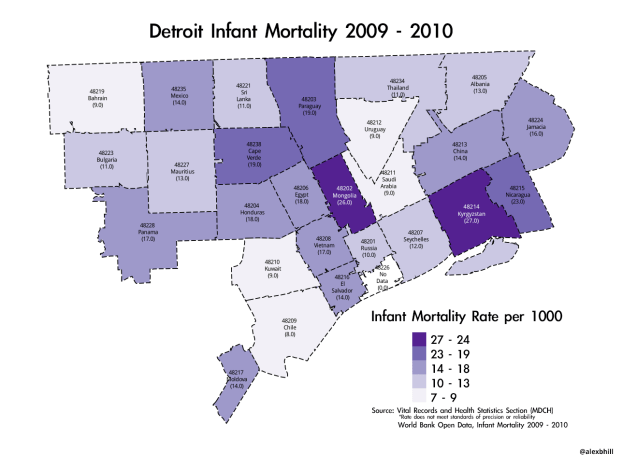
Detroit Infant Mortality Map 2009 – 2010

Alex B. Hill's avatarDETROITography

detinfantmortality

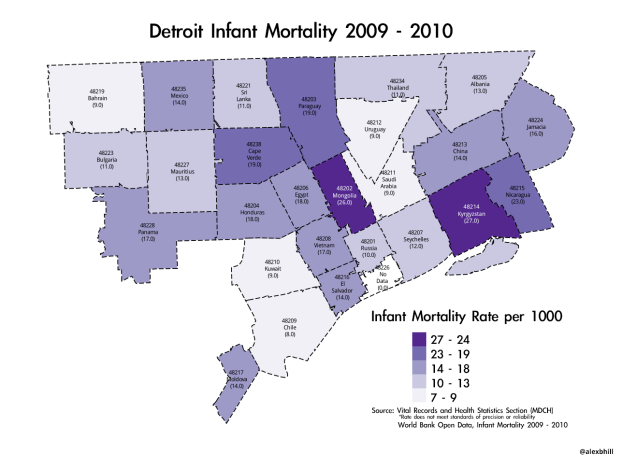
Infant mortality has been a persistent problem in Detroit that accompanies racial health disparities, low income, and environmental factors. This map compares infant mortality rates per 1000 to those of other countries around the world.

The Women Inspired Neighborhood Network (WINN), formerly Sew Up the Safety Net is a collaborative program with the major health systems in Detroit and has had incredible success in educating mothers and improving infant lives in a short time period.

See also: William Bunge’s infant mortality map 1969.

View original post

Stop-and-Frisk Adds to History of Police Abuse in Detroit

1943riot_police_stop

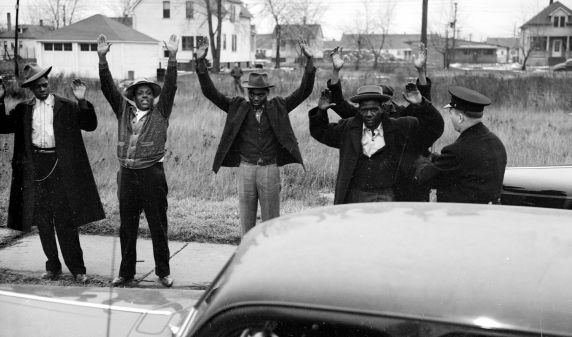
Adopting a “Stop-and-Frisk” policy is not the answer for Detroit. Stop-and-Frisk is a policy where police stop an individual, question them, and then frisk them to see if they are carrying drugs or guns. Police departments in both London and New York City (NYC) have utilized Stop-and-Frisk policies in recent years and both have seen racially biased abuses as well as wasted effort on a majority of innocent residents (90% innocent from NYCLU report). Representatives from the Manhattan Institute, who are consulting the Detroit Police Department (DPD) note that Detroit has always been a Stop-and-Frisk jurisdiction. One could argue that Detroit has also always been a jurisdiction of police abuse.

From rebellion to riots and attempts to rein in crime in a declining city, every police policy has been marked by police brutality. The deep divide between Detroit residents and the police department can be traced back to the 1943 race riot. During the 1943 riots, police violently cracked down on black residents, killing thirteen. The rebellion of 1967 saw similar incidents of police brutality as the nearly all white police force violently attacked the black population. These two events deepened the mistrust between the DPD and the black population. As a result violent crime reportedly doubled between 1965 and 1970. With the auto industry in decline and violence increasing, thousands of white residents migrated to the suburbs in what is well known as “white flight.” In response to the increasing crime, the DPD founded S.T.R.E.S.S. (Stop the Robberies and Enjoy Safe Streets) in 1970 and over its two and a half year existence was known for its brutal tactics, was responsible for 22 killings, and hundreds of unwarranted arrests of Detroit’s black residents until it was suspended in 1972.

Between 1990 and 1998 the DPD was estimated to be responsible for killing at least 10 people a year. The highest rate of any police department in the US. Many of these police homicides were labeled “justifiable,” however a number of police officers were put in jail as a result of community activism and legal convictions for police officers with unfounded “justifiable” homicides. The DPD has a history of under-reporting homicides and other cities have been cited for categorizing more “justifiable homicides” in order to decrease their homicide rates and appear to be safer. In many cases the reporting police officer may deem a homicide “justifiable” simply based on their own prerogative. In 2011, justifiable homicide was up by 79% while 2012 marked the highest year for homicides since 2007.

Earlier this year, Mayor Bing announced that the Gang Squad (featured in National Geographic’s “Inside Detroit’s Gang Squad”), best known for killing a young girl during a raid, would be disbanded and the officers would be placed in the precinct offices to help increase the number of patrol officers on the street. Ron Scott, with the Detroit Coalition against Police Brutality, told NPR that the gang squad is so rough, 30% of police brutality complaints are about the squad. “They were thugs,” Scott said. “Nothing but thugs.”

In a joint press conference, the Michigan ACLU, the Council on American-Islamic Relations, the Detroit Coalition Against Police Brutality, the Arab-American Civil Rights League, and the National Action Network, condemned the Stop-and-Frisk plan citing the issues with the policy in New York. “We don’t want STRESS 2.0,” Dawud Walid, director of the Michigan chapter of the Council on American-Islamic Relations told the Detroit News. Ron Scott, director of the Detroit Coalition Against Police Brutality, said that his organization has already received dozens of complaints about police improperly stopping residents (Detroit News). Stop-and-Frisk only perpetuates the pattern of police abuse against black residents seen since the 1940s and will do nothing to improve citywide or community crime prevention outcomes. Detroit needs an effective policing strategy that doesn’t needlessly profile or harass innocent residents.

Image source: Walter P. Reuther Library (28651) Riots, Sojourner Truth, Housing, Arrests, 1942

Detroit Transit Alternatives Map: Toward Public – Private Partnerships

Alex B. Hill's avatarDETROITography

det_alt_trans

I’ve been thinking about transportation in Detroit and how a number of alternatives to DDOT and public transit have been blossoming. Most recently I was surprised and excited by the University of Michigan (UM) launching a new, free shuttle service between its Ann Arbor campus and the UM Detroit Center in Midtown. The plan will also include shuttle routes to Eastern Market, Cultural Center, Southwest, and Downtown.

Most recently, the city has seen the development of The Detroit Bus Company which launched to “reinvent” how Southeastern Michigan gets around by offering rides to students to get to after school programs and helping suburbanites get into the city without a congested commute. Before there was the Detroit Bus Company, the College of Creative Studies was running a free shuttle for students around the city. A few years ago Wayne State University (WSU) teamed up with DMC and Henry Ford Health System…

View original post 364 more words

Map of the Week: Slave Populations in 1860

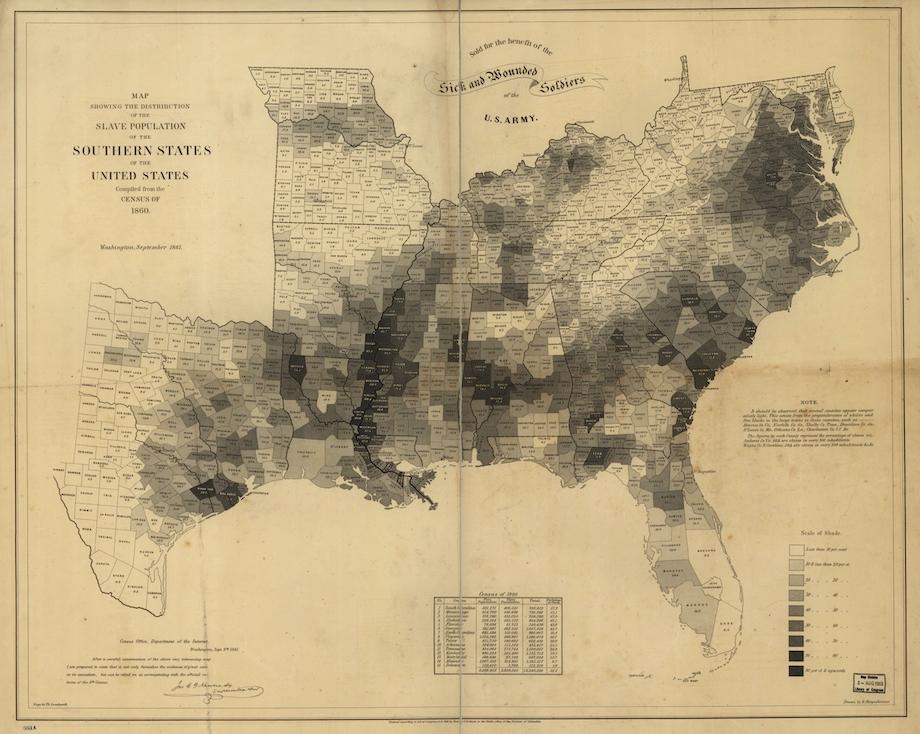
“Map showing the distribution of the slave population of the Southern states of the United States. Compiled from the census of 1860. Drawn by E. Hergesheimer. Engr. by Th. Leonhardt.” Library of Congress, American Memory Map Collections.

Thanks to Rebecca Onion at Slate Magazine for finding this map. This is an incredible visualization of our nation’s history and development of slavery as well as the political motivations of the Confederate southern states. This map could also give a nuanced visualization of the history of disenfranchised populations in the US and how that relates to present day disparities.

An Intelligent Transit Center for Detroit’s Future

I won’t claim to be an expert on Detroit transit history, but public transit is a major issue in Detroit that no one living in or visiting Detroit can ignore. I just took my wife and my best friend for the first time on the Detroit People Mover (DPM). We parked near Cobo to avoid a Tiger’s game and the accompanying traffic/ parking insanity, then we took the DPM to Broadway station to grab dinner at Small Plates. The whole ride I kept thinking about the critical link between the amount of parking available downtown and the lack of reliable public transit.

Want to increase public transit? Get rid of parking

Parking could be an entire rant of its own, but I want to focus on public transit. Detroit’s most well known piece of industrial “ruin porn” is Michigan Central Station (MCS), originally owned by the New York Central Railroad and built by the same architectural firm that constructed Grand Central Station in New York City. The building was supposed to exude elegance and grandeur, but was marked as an oddity due to the disconnect between the three-story train station against a backdrop of an eighteen-story nondescript office tower.

A Real Public Transit System

The trains arrived in Michigan Central terminal and a passenger could decide to catch a streetcar down Michigan Avenue to downtown or choose to take a horse-drawn carriage (later replaced by taxis). At its peak in 1914, nearly 200 trains left the station each day and in the early 1940s over 4,000 passengers rode the trains daily. Henry Ford even had his own private car that he took between New York and Detroit. During the following years of World War II, streetcars were mandated over buses in order to conserve gasoline and rubber. These were the glory days of public transit in Detroit, when you could catch a regular train to Chicago or New York and had the option to take a working network of streetcars throughout the city. Michigan Central Station was a working transit center for the city. In the 1950s, rail travel dropped off significantly with the rise of the auto industry and the construction of the highways. By 1956, all of the streetcars had been converted into Ford coach buses. In 1975, MCS was sold to the newly formed Amtrak, but they couldn’t maintain the costs associated with the massive building with so few passengers and again sold MCS in 1985. With less than a dozen trains a day, the last train left for Chicago from MCS in 1988. Now the building sits on the historic registry, but is unsalvageable and unfeasible as a transit center any longer.

Detroit’s public transit system has been plagued by issues for years. Transit received a boost in 2005 when the Detroit Economic Growth Corporation (DEGC) announced plans for the Rosa Parks Transit Center, which would run alongside the Michigan Avenue People Mover station. The magnificent tensile roof structure wasn’t awarded a contract until 2007 and was finally completed in 2009. Unfortunately, it seems that the only long term planning that occurred was to place it next to a People Mover station. The Rosa Parks Transit Center is located in an odd section of downtown that does not lend itself to integration with a larger citywide or regional transit system. Detroit’s downtown has an iconic hub-and-spoke street design making it fun to look at on a map, but difficult to maneuver for public transit. Likewise, Rosa Parks Transit Center was not constructed to act like other transit centers in large cities.

In other large cities, which Detroit is arguably no where near similar, transit centers are located roughly an average 2 miles away from the city’s main tourist attractions. New York City is allowed to be different because of its high density and small area.

CITY TRANSIT MODES ATTRACTION DISTANCE
Chicago Union Station Amtrak, Metra Rail, “L” Rail, City Bus, Bike Share Navy Pier 2.4 mi
Washington D.C. Union Station Amtrak, Metro Subway, City Bus, Bike Share White House 2.4 mi
New York City Grand Central Amtrak, Subway, City Bus, Bike Share Times Square 0.8 mi
Detroit Rosa Parks City Bus, People Mover Rail Comerica Park/ Grand Circus 0.7 mi
PAST
Detroit Michigan Central Amtrak, Streetcar Rail, City Bus Comerica Park/ Grand Circus 2.0 mi
FUTURE
Detroit New Center Amtrak, M1-Rail, City Bus, Bike Share Comerica Park/ Grand Circus 2.5 mi

A good example of the lack of long term planning is the filming of movies downtown (i.e. Transformers 4). The Rosa Parks Transit Center was shutdown during filming due to its proximity to downtown. This begs the question, do we really think nothing else will happen in downtown Detroit that might cause a disruption of transit service? My bet is “No” we hope there will be a myriad of events and happenings downtown that will bring in crowds of people on a regular basis. Then why was a transit center planned in the middle of downtown? There needs to be distance between attractions and transit centers to make public transit systems a viable  alternative. The other key factor for a transit center is that they are multi-modal: Amtrak + local rail + bus system + bike-share, etc. Thankfully, Megabus also uses the Rosa Parks Transit Center as a pickup and drop-off point.

A New Transit Center in New Center

This all leads me to my pitch for a new and intelligent transit center for Detroit. The New Center area marked by the Fisher Building is a perfect area to house an intelligent transit center. There is plenty of space for parking, an existing large workforce that needs to commute, and an Amtrak train station – not to mention it will also be situated along the new M1-Rail line, which also meets up with DDOT bus stops. After mashing up transit pathways for DDOT, SMART, DPM, and the new M1-Rail I came to the conclusion that expanding the existing Amtrak station across the tracks would make sense to bring together a multi-modal transit system for the city where you could catch a DDOT bus off the M1-Rail or take the M1-Rail downtown to the People Mover or return to Detroit using the Amtrak and choose how you want to get home.

DETtransit_map

As I was preparing to write all these ideas down, I came across this video from America2050, which proposed a high-speed rail connecting Chicago and Detroit (developing “megaregions“) and depicted a new fictional transit center located exactly where I had imagined it should be! A new transit center in New Center matches what other large cities have with a multi-modal center located roughly 2.5 miles away from a city’s main attraction. New Center is also a nice way point between the suburbs, offices in New Center, and attractions downtown allowing people to utilize it for multiple reasons.

Working public transit is critical for more than just tourists and businesses. Residents, young people, and especially the working poor rely on public transit to be able to get jobs and keep them. A working public transit system has the potential to increase employment which in turn helps decrease poverty and crime. In an odd way public transit makes urban revitalization benefit people across a city.

Update 10/10/13

I have recently learned that the parking lot where I am proposing a new transit center near New Center is currently managed/ owned by MDOT/ DDOT. This could not be a more perfect scenario. There is no need to obtain the land or convince a business to hand it over for a transit project, it is already owned by the transit authorities.