the drunken sailor of life

What do you do with the drunken sailor who swabs the deck of the ship that’s sails will never billow, that’s mast will never quiver in the gales, that’s hull will never leave its port, what do you do with a life left to nothing and no one, left and right, up and down, down, down into the earth that ship will travel to the center of the earth, all fire and brimstone, burning in the heart of one man, a man left to his own unrestrained devices of passion, time and passion are all you need to get by in the world today, the former passes by so quickly, the later we never seem to run out, without the gauge saying you tried too hard, move on, move on float to a new port where your ropes are not forever tied down and lashed to another, another day, another time, another year of the fire unkindled, unburdened by logs weighing down on the soul caught up in a raging inferno of the still unknown, what do you do with the sailor so drunk that he cannot stop but leap into the incineratory flames, oh how the ship catches fire so quickly, so easily it burns for it has been dried out from the sea that kept it going, the love and care is all gone and the drunken sailor swabs on and on and on, desperately using the sea to replenish the ship’s shimmer and shine, it is all burned away, what do you do with the drunken sailor so early in the morning when there exists no need anymore on a ship that will never set sail and discover a new world of wonders.

Too many people wander this life in a type of drunken stupor. With vision mired by the woes of the world and the sadness of so many forgotten people, they continue about their daily routine without attempting to break away and really see what the world is about. They remain trapped in their jobs, the day to day, pay the bills, submit the project, drive through rush hour, people remain trapped in their lives. Passion passes by without any outlet, dreams float away without any actualization, minds leave us where we left off without any progress. Don’t get drunk off of the liquor of our systemized world. Embrace your dreams, your passions – life is too short to remain at the office all your life. Drop the sail of your potential and catch the winds of change! Discover the wonders that are missed in the hustle.

This is a piece of creative writing that I did during a sleepless night as a first year college student. It really holds a strong place in my train of thought today. As I try to not get lost in the day to day, of going to school and getting all my stuff done to be able to pass and get good grades, and I attempt to keep my passion fired up for helping African communities in need of basic healthcare. This is a problem that I witness all too often. People forget what the real cause is for which they are fighting.

iraq, a humanitarian crisis as much as darfur?

Is the Iraq conflict now seen as a humanitarian crisis as much as the more well-known Darfur genocide? How can the two be compared. For starters we can look at US commitments to both conflicts. Back in 2000 when Bush was handed a press release about the Rwandan genocide, he wrote, “not on my watch” in the margin. In 2003 we became involved in Iraq to fight terrorism? The polls now tell us taht Americans would rather be involved in Darfur than Iraq. Why? Maybe because we would rather save lives than assist in their destruction. David Bosco of the LA Times writes of the ugly truths in his blog on the Foreign Policy website. Recent UN findings have totaled over 34,000 Iraqi deaths in just 2006. “The death toll for Darfur has become a political football, but the U.S. State Department’s most recent estimate is that 200,000 people have been killed by the violence since it began in 2003, and over 2 million people have been displaced,” writes Bosco. However the estimates vary and many state that over 400,000 have been murdered in Darfur. Bosco wants is trying to make us think of the possibilities of our actions in both Iraq and Darfur. Is it too late in either case? Is one life more valuable than another? His closing statement sums it all up, “Yet, while it’s not clear to me that the U.S. military is doing “no good” in Iraq, absent a more realistic regional strategy from the White House, what little it is accomplishing by staying is probably not worth the costs.”

Accompanying the cry for US military action in Darfur is a push to divestment from Sudan, much like what was done during apartheid South Africa. The US congress has called for sanctions and divestment, yet has ‘suprisingly’ taken no action to move divestment along. Yet again the US policy on Africa entails the action of a pen to paper. There have been numerous campaigns and petitions within the government and also outside the government to pressure the US government to drop interests in Sudan. Check out the full report by Africa Action (here).

More recently the insecurity of the region is driving out aid to millions as aid agencies leave to ensure their own safety. This will only intensify the humanitarian crisis already pushed beyond the tipping point. This crisis has met the drowning victim under the sinking boat level. We need to be the skilled rescue divers who can turn turn this conflict around through actions on the ground in the US and Darfur. There have also been reports that the Sudanese government continues to bomb the people of Darfur without holding back.

Yesterday I attended an amazing Hip Hop concert sponsored by the Spartans Taking Action Now: Darfur (STAND) chapter at Michigan State University. MSU was just one stop on the national Save Darfur Tour. It was a great show with a fair attendance. The artists such as Alexipharmic and Freestyle spoke to the real issue at hand and our potential to make a difference. Besides being the best performers of the night, in my opinion, they also understood the complexity of the Darfur genocide. Freestyle of the Arsonists was an amazing performer. He had great beats with great lyrics and knew how to really involve the crowd of mostly stiff white college kids who had no idea what hip-hop was all about. I am not going to lie I was standing there in my shirt and tie (after coming from meetings all day) putting my hand in the air and feeling the beats. That made me think – what is the color of hip-hop? I concluded that hip-hop obeys no set rules so therefore it is not an only-black, or only-white thing. Freestyle also spoke to the myth that hip-hop is dying. Let me tell you hip-hop is alive and well, check out the artists of underground hip-hop and learn the history and ideal behind the movement. Hip-hop is not dead, I have seen it alive and well, knocking on the front door of my consciousness and directing my compass of compassion to empower the world!

who do you think you are? (identity, constructivism, and colonialism)

I am not an African, I am not an American, I am not white, I am not black, I am not a Michigander, I am not a catholic, I am from no country, I am of no nation. I like to consider myself a global citizen, a person of the world. The constructed boundaries of countries hold no bearing in my mind, I see no lines drawn upon the earth and I believe that no falsely imposed blockade of governments can hold me back. We are all people of this world and being so we all hold the same basic hopes and dreams. Everyone wants enough food to eat, clean water to drink, a shelter to be warm or safe, education for themselves and their children, and most importantly to be loved by one another. There are no boundaries when people care.

So you may be thinking, this guy is a crazy social constructivist and an idealist – sure if you’d like to use the language of old, white, men with too much time spent on picking at the elements of human nature, then sure I am a social constructivist and an idealist.

A recent article in the BBC: Identity: Who do you think you are? explores the changing roles of ‘African’ identity. Soon Ghana will be holding its 50th Anniversary of becoming independent from colonial rule. If you do not know the history of Africa and colonialism, the continent was divided at the Berlin Conference of 1884-5 by the leaders of Europe. These leaders gave no attention to ‘nations’ of people, or ethnic groups or lands held, or really anything that would pertain to the continent besides gaining the most property. This led to the division of nations within countries.

What I believe is the most important excerpt from the BBC article follows:

“People should be able to move freely and transcend all forms of mental and physical boundaries. Family and national belongings should not be used to divide us but to better understand each other and bridge our gaps because we have a lot that unites us. I have become a black man in Europe but I try to move beyond that and not to let others impose their will on me. I am what I am because of circumstances and choices I make in life. I believe I am my own country: the clothes I wear are my national flag; the song I sing in the shower is my national anthem and all my body parts are the different departments and ministries of my government. The social ministry goes to the eyes, mouth and ears. The home affairs ministry functions through the heart and the brain and my sexual organs have the most important portfolio covering foreign affairs. To be a human being is to understand oneself by understanding others. This can only be achieved by creating relationships with other fellow humans on the basis of true humanism: one love; one heart and one destiny.”

Who do you think you are? This question I feel goes along very well with YP4’s question of ‘What do you stand for?’ Do you identify with family, ethnicity, religon, region, or country? Who are you and what do you stand for?

out of africa

This morning I was listening to some hip hop music and the artist, Saul Williams‘ “African Student Movement” song came on. Part of the chorus is a repitition of ‘African people’, which for some reason kept sticking in my head. Earlier that morning I had read an article on National Geographic about the discovery of a 36,000 year-old skull proving the 2nd migration of the human race out of Africa.

This discovery proves that at around 50,000-70,000 years ago modern humans left Africa to populate Eurasia. This is still in a theory stage, but the evidence is growing in support of the ‘Out of Africa’ Theory. Essentially this means that Africans populated the world. I also learned this theory in one of my required university science courses. I found it very interesting and extremely thought provoking given the history of the US and ‘race’. Just 60,000 years ago people from East Africa spread to the Middle East, Asia, Australia, and Southern Africa. We are all Africans!

When Saul Williams is calling for African people to work together and join to build equality – he is really calling to us all. Our home is Africa! Now don’t get me wrong I am a privileged ‘white’ male with what some would say is no connection to Africa. Wrong, I feel more at ease and comfortable with my ‘black’ and African friends, I love Africa, the people, culture, and especially music. I feel for the plights of the people and work to change that. I have a strong connection to Africa and now that connection is proven even stronger. I am an African (not in the literal sense, I don’t mean to offend anyone) before and above anything else.

the pearl of africa, tarnished and shined

Once called the pearl of Africa by Winston Churchill, Uganda was seen as the great hope for Africa with its beauty and its believed secure government. However, as a recently viewed documentary has made me realize, that nickname is not far off and no where close. The documentary, Reporting Africa, which I just watched in my Africa and the World course looked at the way the West was reporting Africa or rather how the West was not reporting on Africa at all. The documentary was made in 1987, the year I was born, and the realities of Western media in Africa are nearly the exact same. The reporters all recognized the disparity in news coverage and were very dedicated to bringing out the blaring issues and hopes of Africa. They began their travels in Kenya and then headed on to Uganda where they were covering the new government of Yoweri Museveni and the AIDS crisis in the state run hospital. The reporters were from CNN, BBC, and a local independent journalist. As they likely would today, the reporters faced government delays and approvals and denials.

They first covered the AIDS crisis and the government hospital’s denial that it was a large threat or problem. The doctors turned them away and failed to recognize that people were dying from the disease. However there were both sides to the story and the reporters also found recognition of the realities. One doctor recognized that although there were no ‘reported’ cases of AIDS yet, people were dying and he also recognized that action was needed. The reporter also praised the Uganda government’s unique openness about the disease. The other story they covered was the new government of Museveni. After covering the history of Uganda from Idi Amin, who transported Uganda into the Western mind with his brutality, to his even worse predecessor, Milton Obote. The world only began to understand Obote’s horrible impact after Museveni invited Western media to see the killing fields of Uganda.

Yet, even today, the Ugandan pearl is still in conflict with Museveni’s rule. As his government began so too did its opposition movement. It is very interesting to view the Uganda of 1987 from the documentary and the Uganda we know today. The woman credited with founding the long-running resistance movement in northern Uganda, Alice Lakwena died today from illness while exiled in Kenya. She claimed to channel the Holy Spirit and told soldiers that her magic would protect them from government bullets. The predecessor or her movement was Joseph Kony, who claimed to be a relation of hers and could also use magic. Lakwena’s 7000 fighters nearly reached the capital, Kampala, before being beaten by government forces in 1988. Kony has built a resistance that hinges on the abduction of children to fill its ranks forcing many children to commute at night to larger city centers and bus parks to be safe from abduction. Kony calls for a government run by the Bibical Ten Commandments, yet his perpetuation of the conflict seems to be out of order with the commandments.

Peace talks have been underway in southern Sudan to work towards a peaceful end to the fighting in Acholi land, northern Uganda. There are now threats from Kony’s fighters, the Lord’s Resistance Army, that they are fed up with the stalled talks and want to return to Uganda. They are not welcome in south Sudan and are prepared to re-enter Uganda, which the government of Uganda says will start the fighting again. The Ugandan forces say that they will attack and fire on any rebels that try to enter Uganda from Sudan. This has frightened aid agencies in Uganda working to rebuild. The peace agreement in August was seen as a hope to end the 20-year conflict that has torn so many lives apart. The LRA has said it may send fighters back soon, but was not reached for comment. Kony is wanted by the International Criminal Courts as both sides accuse each other of breaking agreements.

As always there is hope. An organization that I learned about just two years ago is working to raise awareness about this forgotten conflict. Invisible Children was started by a group of three college-age aspiring film makers who decided to travel to Sudan and make a documentary about the civil war between the North and South, however, on their journey they came across the Ugandan conflict. They first met night commuters as they walked miles for safety and packed themsleves into shelter for the night. They were moved and inspired by their experience and now their documentary has been viewed across the country and world. Besides raising awareness, Invisible Children also runs programs to assist those affected. Their premier program is with bracelets. The bracelets are made from materials from Uganda, crafted by people who otherwise have no employment, and sold in the US with a story of a person affected by the conflict. Through this program Invisible Children has allowed numerous people to rebuild their lives and has enabled many children to get an education. Even with great conflict and pain comes great hopes for the future. Check out the Invisible Children site and get involved.

what kind of a person are you?

This is a bit of creative writing I did a while ago. I just recently re-read it and felt very moved by my recent experiences and the re-reading of this piece. Enjoy.

People every so often stumble upon the truth, reality hits them much like a 18-wheeler hits a deer, but most, pretty much all, pick themselves up and hurry off as if nothing at has happened, they choose to perceive reality as they want to instead of taking it at face value, they pick themselves up even with their skulls fractured by impact and their sides torn open by the 18-wheeler’s grill, they limp away for they have seen what many choose not to, and by accident, no one wants to see the truth, the reality of our world, no one wants to be hit by a 18-wheeler of truthiness, no one really wants to know –  for human kind cannot bear too much reality if any at all, we cannot take the beating and then get up and continue living in the present, it is only about how terrible it was in the past and how great the future will be, never about the here and now, never about the truth of the matter, or the reality of the time, but those are dangerous pieces in our great game of life, the past can be so dark and forgotten or so sharp and painful and clear, the future always so unknown and often frightening or exciting, both past and future slightly border on the mysterious, yet in the present it seems, in the game bent on profit and gain, which tend to be the myths of success, there is an entire new level of the game, a game of invisible people that always seem to be left out or skipped over, we, humanity only hear about those invisible in the past when it is too late and they are gone, or in the future when they will most likely be gone, but in the present is where they truthfully reside, broken and dying, starving and hungry, lost and forgotten, we who would be human kind would rather perceive it to be too late and in too far in the past to care or too far in the future to worry about and that is where our dilemma picks up again, those who venture into the forests off of the game board, meet the deer already hit by the realities of poverty, disease, hunger, and corruption, are torn apart from eye to heart by the 18-wheeler of knowledge and understanding – of truth and reality, how can one not be moved by such a 18-wheeler, such a forceful truck of emotion, a very good question to be posed and one where the answer lies within each individual, what kind of a person are you?

ka-boom-ratta-tatta. . . airstrikes in somalia

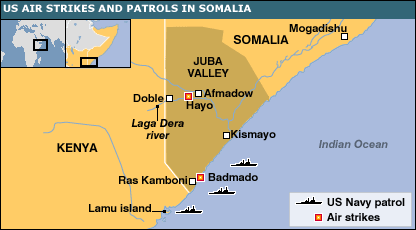
Now you have a small snapshot of the truth. The US has reportedly carried out two airstrikes in Somalia and has conducted raids on al-Qaeda targets tied to the 1998 bombings of the US Embassies in Kenya and Tanzania. The Pentagon has denied that any of this is happening, however witnesses have seen firsthand and the denials by the Somalian and US government make these events seem undeniably true. The Somalian President, Abdullahi Yusuf, told journalists that the US, “has a right to bombard terrorist suspects who attacked its embassies in Kenya and Tanzania.” The targets were Islamists driven to the wedge between the sea, patrolled by the US Navy and the Kenyan border, which is heavily guarded. The airstrikes were followed by gunships attacking the al-Qaeda targets. This is the first US military offensive in an African country since the 1993 Somalia operation. See the complete NPR article and report from witnesses in Mogadishu here. To try and claim that the US has no hand in this operation or that it never happened is obsurd. There has been an obvious build-up in the region (ie: new Africa Command, live military exercises in Cape Verde and neighbors, tracking Somalian ‘terrorists’). I had written a post last year about the threat of Chinese economic attack to gain natural resources, but now I am even more worried for the US military’s involvement in the name of fighting terror. What will the US do to Africa? Hasn’t the West already done enough military ill from the past? Where is our Africa policy headed now? Unilateralism again?

Update: The Pentagon has claimed the attack, but will not release their success. Somali elders say 19 were killed. White House Spokesman, Tony Snow: “This administration continues to go after al-Qaeda,” he said. “We are interested in going after those who have perpetrated acts of violence against Americans, including bombings of embassies in Kenya and Tanzania.”This is after hte US said it would send only money, no troops or military to help stabilize the Somalian conflict. Check out the BBC Article.

Update 09.10.07: Somali hatred of the US has been rekindled by the recent airstrikes and it is reported that 27 civilians were killed, no al-Qaeda were among the dead. It will be very interesting to see what direction the US government and military takes on African conflicts in the name of fighting terrorism.

Update 09.11.07: Supposedly the US has not claimed the attack. However residents of the two areas attacked saw US gunships involved.

the US policy on africa

What is the US’s policy on Africa? Do you know? Many people do not and now is your chance to find out. On the US government page on African Policy the first thing I notice is the picture displayed on the top, not just because it is a picture, but because it is President Bush and President Ellen Johnson-Sirleaf of Liberia at a ‘Partners in Democracy’ forum. As you can see Bush is pointing off into the distance and Ellen looks quite fed-up and dismayed. First, is this the US policy on Africa point to the distance and not involve the African leadership. Second, did we forget that Africa is not a country and that there are 54 countries within the continent. Africa as a whole does not have one policy on the US, each different country has a policy – why doesn’t the US have a policy for each country in Africa? Maybe it is just not strategic enough or worth the US’s time? Whatever the case I find the picture very telling of the US goverment approach to Africa. They then jump right into the Darfur conflict and the subsequent peace agreement in the works. This I find very disturbing as all the US government has done for the Darfur conflict is give it lip service and some nicely written statements. After scrolling down the page, to what is almost the bottom, you will find the outline of the US policy on Africa:

“In Africa, promise and opportunity sit side by side with disease, war, and desperate poverty. This threatens both a core value of the United States—preserving human dignity —and our strategic priority—combating global terror. American interests and American principles, therefore, lead in the same direction: we will work with others for an African continent that lives in liberty, peace, and growing prosperity. Together with our allies and friends, we must help strengthen Africa’s fragile states, help build indigenous capability to secure porous borders, and help build up the law enforcement and intelligence infrastructure to deny havens for terrorists. An ever more lethal environment exists in Africa as local civil wars spread beyond borders to create regional war zones. Forming coalitions of the willing and cooperative security arrangements are key to confronting these emerging transnational threats.”

Bush’s Africa policy has three pillars which mostly are comprised of holding lots of meeting with various groups and on different issues affecting African countries (ie: AU, malaria, HIV/ AIDS, growth and opportunity act, etc.) Meetings a indispensible when one does not want to act. I am afraid the US’s policy on Africa is just a bunch of words, no action.

Another great site that I found helpful in my search of US’s African policy was Africa Action. Each year they write a full report on the US policy for Africa. They critique and offer potentials and what needs to happen in years to come. Africa Action opens the report with this quote, “2006 will help clarify whether the compassionate concern for the African continent, worn like a badge by western leaders last year, is a true determinant of Africa policy, or whether it merely masked other, more ‘strategic’ and less ‘benevolent’ impulses and interests.” 2005 was a great year for more focus and interest in African issues. It was a year of more advocacy and awareness about Africa and thus there was more talk of doing something on the continent. I find this is a beautiful quote to begin critiquing the US African policy. What has 2006 shown? It seems that US policy is focused only on strategic advancement and leans no where to the benevolent side. Africa Action begins by outlining the year from Live 8 to Live X. Concerts which raised funds and awareness for Africa to US military sweeping into the continent to be sure America is secure. This comes with the development of the Africa Command as well. This military shift in Bush’s Africa policy obviously speaks to the ‘War on Terror’ focused on intelligence gathering and keeping al-Qaeda out of Africa. Yet even with this upswing of troops and US intelligence in Africa a genocide continues and conflicts spread, threatening regional security.

Another development to note in US policy is the potential of African oil. It is estimated that over $10 billion a year will be invested by the US in African oil activities. Many policy analysts say that the US needs to shift its oil dependence from the Persian Gulf to the Gulf of Guinea, however as many analysts fail to realize, African oil is a creates a great deal of conflict by itself without the US involvement. The US may only intensify conflicts and make themselves a target. Lastly, the Africa Action report notes the slim mention of security in the US Africa policy. With the growing threat to public health and differences on global issues, a great disparity is enlightened between African priorities and American interests. The report also highlights the hypocrisy of the current Administration focused on showing its humanitarian side and not its creeping military and strategic involvements. The US African policy is also not within in the lines of what most Americans would like to see as the US policy towards Africa. The US needs to adapt its policy to involve African leaders and to include the voice of the American people. I encourage you all to read the site on US Africa policy and the Africa Action report. After reading let your politicians know how you feel and what you want to see happening in Africa from the US.

africa’s long to-do list?

In a recent article posted on the BBC By Ofeibea Quist-Arcton, a National Public Radio reporter in Accra, the issues of Africa and challenges to face in the new year are highlighted. However I would say that it is nothing new or exciting to a person who follows the news of Africa daily. The article notes the conflicts across the continent from Niger Delta, to Somalia, to Darfur, to Northern Uganda. Quist-Arcton notes the coming elections in many countries and the worries of violence at the polls. The reporter does well to examine the challenges in the future and the causes of problems in the past. However, this African reporter seems to have very little hope for the new year, except for a few lines near the end hope is finally noted – the country of Ghana turns 50 and the 2010 South African World Cup is on its way. Is that the only hope for the continent? I think not. I hope that I have noted some positives for Africa in 2007. I do not wish to hide the realities and so the positives are accompanied with the negatives, but there is always hope. Check them out here:

finally, something good happens in that country

something new for the new year

interesting things to note in the new year for africa

a promise fulfilled, land rights deferred, the new UN, and spreading violence