why there is no doctor: conclusion & works cited (12)

The sea of gravestones near Zonkizizwe was almost unimaginable. I would not have believed it myself if I had not seen it firsthand. This scene conveys the real implications and impacts of HIV/AIDS on a health care system and a country that has been stripped, divided, and neglected by apartheid.

While I often asked why there is no doctor, I was able to track down a traditional medicinal doctor who seemed to see no patients as well as the private clinic doctor who did not seem to care about providing real health care to the residents of Zonke. Writing has been done on where there is no doctor and what to do when there is no doctor, but the number one question in South Africa is why there is no doctor. This question is answered through history: apartheid, oppression, denial, and failure to recognize a crisis. The reality of apartheid health policies continuing to affect Black populations and responses to HIV/AIDS can be seen firsthand in the Zonkizizwe informal settlement.

Health was a weapon of apartheid and it worked. Denying medical access and training to the Black majority has kept the population in submission even 16 years after the end of apartheid. The critical period of 1993-2000 saw the new democratic government with its hands tied behind its back. There was no way that the health care system could be so dramatically scaled-up to meet the human and social needs of the HIV/AIDS crisis. As Seedat stated in Crippling a Nation, 1984, “Health in South Africa is inseparable from the economic, political and social structure of the apartheid state.” The health and HIV/AIDS realities that can be seen Zonkizizwe are direct result of apartheid’s legacy. HIV/AIDS in South Africa is not a direct result of apartheid policies, but the impact of HIV/AIDS and the health care system of South Africa is still inseparable from its apartheid past.

Works Cited
Beinart, William. “Labour Migrancy and Rural Production: Pondoland c.1900-1950.” In
Black Villagers in an Industrial Society, edited by Philip Mayer, pp. 81-108. Cape Town: Oxford University Press. 1980.

Boseley, Sarah. “Mbeki Aids denial ‘caused 300,000 deaths.” Guardian News UK. 26 November 2008. .

Chirwa, Wiseman Chijere. “Aliens and AIDS in Southern Africa: The Malawi-South Africa Debate.” The Royal African Society. African Affairs 97:53-79, 1998.

E. O. Nightingale, K. Hannibal, H. J. Geiger, L. Hartmann, R. Lawrence and J. Spurlock. “Apartheid Medicine. Health and Human Rights in South Africa.” Committee on Health and Human Rights, Institute of Medicine, National Academy of Sciences. Vol. 264 No. 16, October 24, 1990.

‘Forced removals in South Africa 1977-1978’, paper prepared by IDAF for the United Nations Centre Against Apartheid, No. 44/78, Oct. 1978, p.9.

“HIV and other STDs. Chapter 3, Part 1” Population Reports. Population Information Program, Center for Communication Programs, The Johns Hopkins School of Public Health. Volume XXIV, Number 3. November, 1996.
http://www.infoforhealth.org/pr/J45/j45chap3_1.shtml.

“HIV & AIDS in South Africa: The history of AIDS in South Africa.” Avert.
http://www.avert.org/aidssouthafrica.htm.

J Yawitch, Betterment. “The myth of homeland agriculture” SAIRR: Johannesburg, 1981, p.86.

Kon, Zeida R. and Nuha Lackan. “Ethnic Disparities in Access to Care in Post-Apartheid South Africa.” American Journal of Public Health. December 2008, Vol. 98, No. 12.

Lodge, Tom. “The RDP: Delivery and Performance” in “Politics in South Africa: From Mandela to Mbeki”, David Philip:Cape Town & Oxford, 2003.

Lurie, Mark N., Brian G Williams, Khangelani Zuma, David Mkaya-Mwamburi, Geoff P Garnett, Michael D Sweat, Joel Gittelsohn, Salim SAbdool Karim. AIDS:17 October 2003 – Volume 17 – Issue 15 – pp 2245-2252.

Packard, Randall. White Plague, Black Labor: Tuberculosis and the political economy of health and disease in South Africa. University of California Press, 1989.

Palitsza, Kristin. “A Burden that Will Only Become Heavier.” Inter Press Service News Agency. May 28, 2006. http://www.ipsnews.net/africa/nota.asp?idnews=33396.

Posel, Dorrit. “Have migration patterns in post-apartheid South Africa changed?” 4-7 June 2003.
http://74.125.95.132/search?q=cache:4Oor9pRwaTkJ:pum.princeton.edu/pumconferenc e/papers/1-Posel.pdf+the+economic+of+apartheid,+labor+migrations&cd=1&hl=en&ct=clnk&gl=us&client=firefox-a.

Seedat, Aziza. Crippling a Nation: Health in Apartheid South Africa. International Defence Aid Fund for Southern Africa, London, April 1984.

“The Demographic Impact of HIV/AIDS in South Africa – National and Provincial Indicators for 2006” Centre for Actuarial Research, South African Medical Research Council and Actuarial Society of South Africa. November 2006.

“The uprooting of millions, forced removals.” For their Triumphs’ and Tears. ANC, 1983.
http://www.anc.org.za/books/triumphs_part1.html#3back1.

UNAIDS 2006 Report on the Global AIDS Epidemic, Chapter 4: The impact of AIDS on people and societies
http://www.unaids.org/en/KnowledgeCentre/HIVData/GlobalReport/2006/default.asp.

UNAIDS 2008 Report on the Global AIDS Epidemic. http://www.unaids.org/en/KnowledgeCentre/HIVData/GlobalReport/2008/.
Appendix A

appendix a: timeline of health care and hiv/aids in south africa

1913 – “Tropical workers” migrating bring in high prevalence of tuberculosis (Packard, 230)
1919 – Public Health Act places government control over mission health centers (Seedat, 63)
1930 – Mines experience shortage of workers (Packard, 229)
1934 – 2000 “tropical workers” brought into SA on experimental basis (Packard, 230)
1937 – The number of “tropical workers” increases dramatically after government ends ban on recruiting mine workers above 22nd parallel (Packard, 230)
1948 – National Party takes control and apartheid laws are enacted
Health budget is drastically cut (Seedat, 63)
Over 40,000 “tropical workers” are entering SA (Packard, 230)
1950 – Population Registration Act required S. Africans be segregated into three racial categories
Group Areas Act establishes separate residential areas for different racial groups, “forced removals” began of those living in the “wrong” area
1951 – Bantu Authorities Act established “homelands” (Bantustans) taking away SA citizenship and rights
Prevention of Illegal Squatting Act began destruction of basic health services developed by individuals in the “wrong” areas
1960 – Black townships became areas of concentrated population far from towns and city centers
*Sharpeville massacre kills 69, wounds 187 protesting the pass laws
1963-1964 – Rivonia Trials
1970 – South African Department of Health takes over control of all health services from ‘local’ governments, including mission and church hospitals (Seedat, 69)
1973 – Department of Bantu Administration and Development begins takeover of all mission hospitals in the Bantustans (Seedat, 69)
1976 – Soweto uprising kills 23, wounds 500 in protest of Bantu Education policies
1976-1981 – Four “homelands” (Bantustans) de-nationalize 9 million Black South Africans
1982 – First case of AIDS diagnosed in SA, increased charges in governmental health services (Seedat, 71)
1983 – Doctors in the Department of Medicine at Baragwanath describe overcrowding and shortage of staff as having reached a ‘breaking point’ (Seedat, 65)
1985-1989 – SA declares ‘state of emergency’
1986 – First AIDS Advisory Group established to aid the government’s response to the growing problem
1990-2003 – Most rapid increase in HIV prevalence rates
1990 – Mandela released from imprisonment
First antenatal survey estimates that between 74,000 and 120,000 people are living with HIV
1991 – Apartheid laws repealed
1992 – Referendum on de Klerk’s policy
Mandela addresses the newly formed National AIDS Convention of South Africa (NACOSA)
Free National AIDS Helpline established
1993-1999 – Internal labor migration increases significantly, specifically among women
1993 – National Health Department reported the number of HIV infections had increased by 60% in the previous two years and was expected to double over the year
1994 – First democratic elections held, Mandela wins
Minister of Health accepts the basis of the NACOSA strategy as the foundation for the government’s AIDS plan
1995 – International Conference for People Living with HIV and AIDS was held in South Africa, Deputy President Mbeki acknowledges the seriousness of epidemic
South African Ministry of Health announces that 850,000 people (2.1% of population) are believed to be HIV-positive
1998 – Treatment Action Campaign is launched
2000 – Department of Health outlines five-year plan to combat HIV/AIDS
International AIDS Conference in Durban, new SA President Mbeki denies HIV causes AIDS, cites poverty as cause
2002 – SA High Court orders government to make nevirapine available
Government remains hesitant to provide treatment to people living with HIV
2003 – Government approves plan to make antiretrovirals (ARVs) publicly available
2004 – ARV treatment program launches in Gauteng Province
2005 – One service point in each of the 53 districts established for AIDS related care and treatment
HIV prevalence reported at 30.2% – a steady increase since 1990
2006 – Former Deputy President Jacob Zuma claims taking a shower prevented HIV transmission after “having sex” with an HIV-positive woman
UN Special Envoy on HIV/AIDS, Stephen Lewis attacks SA government at International AIDS Conference in Toronto over ARV treatment access
2007 – Mbeki is forced to resign, interim president appoints Barbara Hogan as Health Minister, activists welcome the change and expect greater government commitment to HIV/AIDS
An estimated 1,400,000 orphans of HIV/AIDS in SA
2009 – Apology for Mbeki ARV policy
Development of health services/ access to health services is a major issue in 2009 elections

why there is no doctor: harsh realities in zonkizizwe (part 2) (11)


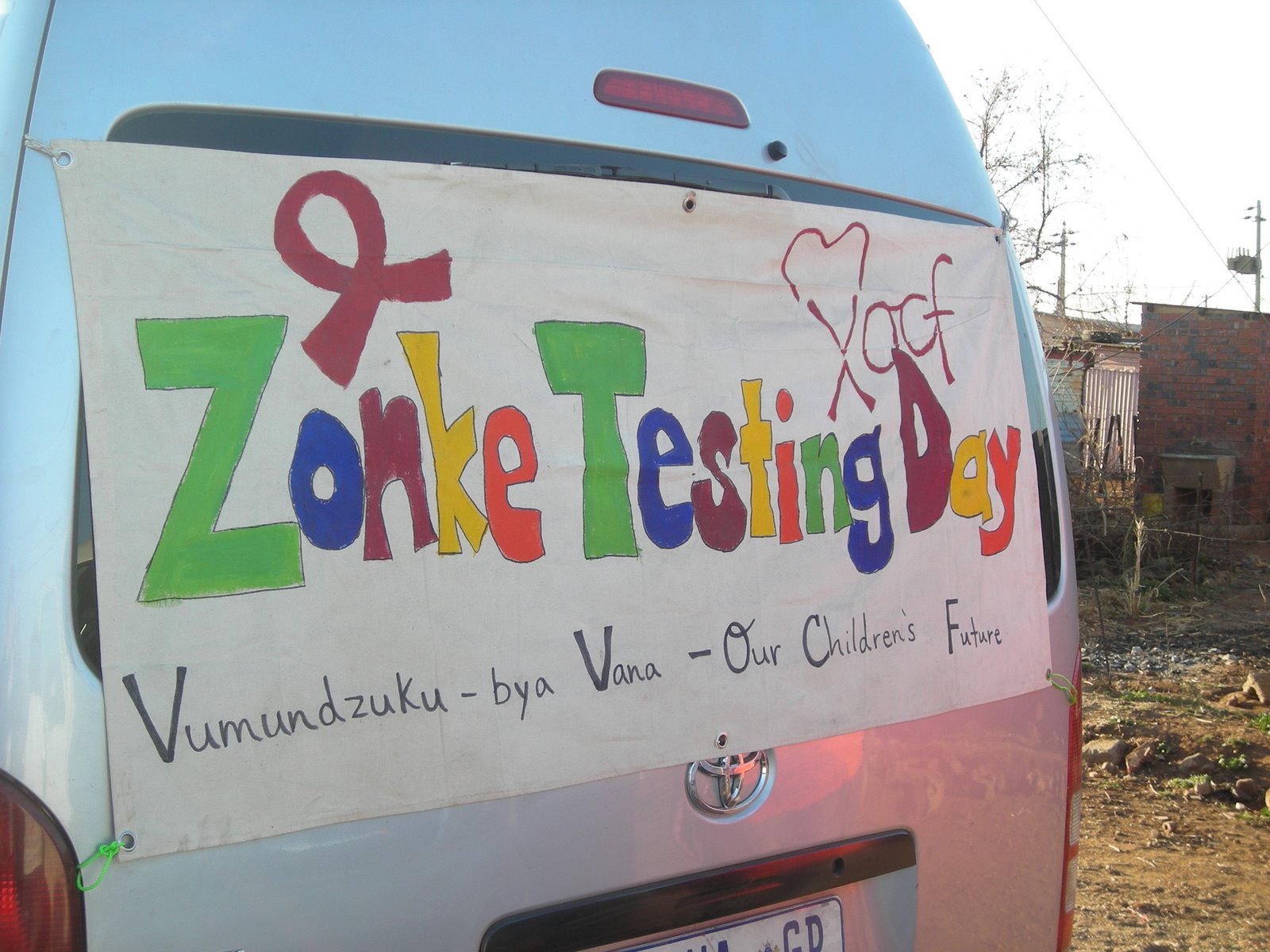
(photo: Zonke Testing Day banner on the back of a van used to transport people to the clinics)

While working in Zonke, a fact that shocked me was that an HIV-positive person can only access ARV treatment [for free, otherwise it is very expensive] if their CD4 count is below 200. This is official South African government policy and numerous studies have shown that accessing treatment earlier has greater long-term health benefits as ARVs are meant to be taken life-long. A World Health Organization (WHO) study in 2008 outlined four clinical stages of HIV progression. The WHO recommends that when a patient hits stage three with a CD4 count below 350, life-long ARV treatment should be started. Starting patients earlier negates complications later. However, in South Africa once the CD4 count goes above 200 again, treatment is stopped, which allows for greater complications and the need for new strains of ARVs. This year a push to increase the CD4 count threshold for treatment was rejected by the National Health Council on the grounds of affordability (85).

Prof Robin Wood, director of the Desmond Tutu HIV Centre at the University of Cape Town, is among the clinicians who have been calling for the South African government to raise the standard of treatment set out in its guidelines. However, he pointed out that better guidelines would be meaningless without improving the quality of care and access to services (86).

Professor Wood brings everything back to perspective. Anyone can call for greater access and more treatment, but if there is no distribution system for health services and care then what is the point. It would be like having a big supply of pizzas and no delivery drivers. This is the problem in many former “homelands,” townships, and informal settlements. There are inadequate or non-existent delivery systems for health services and treatment and so in areas where the HIV/AIDS crisis is most critical, there is no system to address the problem.

Today was the 2nd half of Prevention in the HIV/AIDS course. The kids are incredibly receptive with questions, comments, and the desire to learn more. We will be covering Treatment and resources this Friday. Celumusa did a great job of translating and really getting the course lessons through to the kids. Later in the evening she talked with us – her passion and drive to get people tested and aware and knowledgeable is amazing and so admirable with all she has been through. She is so excited about a Zonke testing day, the HIV/AIDS class, working with the staff and community to make more people talk and not be afraid to talk. Today she told the kids that she was HIV positive and they all did not believe her at all – they asked her to cross her heart that she was not lying. I could tell from the first class that the kids were learning much more than they had before beyond what HIV and AIDS stands for (87).

Much of the work at the center and the work that needs to happen in Zonke is HIV testing. Once tested you can learn how to take care of yourself, your children, and your community. When I asked Celumusa why people don’t test she said that people don’t know that they can live with HIV. So many people are involved in risky behaviors, she said, they have family members die from HIV/AIDS, but don’t test themselves. She also noted that pregnant mothers are tested and are given tablets, but not told their status. Testing is critical and we began working on this by planning a Zonke Testing Day for July 31st.

As I began organizing for the Testing Day, I came into contact with more of the health services available in Zonke. There are a number of traditional doctors and surgeries in Zonke. I can only imagine that this is because there is such a lack of other health services. Celumusa and others have bad perceptions of traditional medicine: evil, it kills people, and the traditional healers are crazy people. I was still having no luck finding any doctors, until I finally caught a traditional doctor in his office. He ran a clinic that was more Western than others and was supposedly trained by the government in traditional healing, but his office was empty every time I visited – no patients (88). Why are there no doctors?

Across the road from his office was a private clinic run by a group of Indian doctors. I also had a difficult time finding them, as did many Zonke residents. I was able to visit the private clinic only when Celumusa had to schedule an appointment for her baby. The private clinic had become her last option that she was sure to see a doctor. This says a lot for the health care system in Zonke (and other overcrowded settlements and townships left over from apartheid era) that the poor will pay to see a private doctor because the government health services are unreliable. Celumusa said they always give injections at the private clinic. Yet again I wonder about the quality of care. The clinics give painkiller tablets and the private clinics give injections (antibiotics?). If care is inadequate and access to ARV medication is beyond the ability of most, then the extended scenes of cemeteries become less shocking.

In the past 2 weeks, 3 people have passed because of HIV and AIDS that we have been directly informed of because the Buthelezi family has been close to the deceased – a father, an aunt, and a neighbor. Living in an HIV positive community is so different when you can fully understand the impact of just one life (89).

It was as if I had seen the walking dead. The prospect of death is so intertwined with life in Zonkizizwe that the author who wrote that South Africans attend more funerals than weddings was supported by my experiences this summer. The hardest hitting example was with the passing of the father of one of the families at the center. Three of the children attended the center. The oldest was 17 years old and was taking care of her frail father as he withered away, making sure her younger brother and sister were going to school, and attending school herself. This small family had already lost their mother to HIV/AIDS. The burden of disease was not met by the health care system or any the government response. The burden of disease rests completely on those who are affected and they do not have the resources to help themselves.

A critical aspect of combating the effects of HIV/AIDS in South Africa is education. As one of my goals over summer I developed an HIV/AIDS curriculum, based off of the Peace Corps Lifeskills curriculum, that the youth could share with the friends and families as peer educators. The spreading of knowledge is a powerful first step in giving people the resources they need to prevent HIV/AIDS. It is especially important when there exists no other means to access this information. The Zonkizizwe schools are under-funded and teachers are under-trained. This translates to the lack of a teacher for the Lifeskills curriculum and therefore the lack of knowledge on sexual health and HIV/AIDS. VVOCF is beginning to fulfill a service where the government is horribly failing.

All of our kids were tested, plus about 20 others. In all over 60 people tested. […] The community and guardian support was incredible. There were a few positives that we expected from already young mothers […] and unexpected bad news surprise […] Many good surprises came out of the day as we learned of many negative cases that were expected to confirm our worst nightmares (90).

Year – Number of HIV Tests (*from clinic 2)
2006 – 128
2007 – 246
2008 – 412

The success of solutions driven by citizens was best evidenced by the culmination of the HIV/AIDS peer education courses, health classes, and the death of a father in an area wide testing day. I had taken the lead in organizing the testing day with the clinics, MSU study abroad volunteers, and various local organizations. Because of the stigma attached and sensitivity of the issue I was a bit nervous when the day came. July 31st 2008, the first Zonke Testing Day was a day of success fueled by the youth at the center. And while the numbers of people testing have made steady increases, the reality remains that the majority of those who need treatment after testing will not have access. Many in the generation just older than these youth mocked or scoffed at the testing day, but our kids were set on it.

We really are building a new generation of freedom fighters – not afraid of stigma, talking about sex, ready to be tested, and not about to turn a blind to HIV/AIDS. These young people stood today with a powerful support base of each other evidenced by yesterday’s action and the larger community is taking notice. The youth continue to give me hope and pride in being allowed to take part in such a community action (91).

The realities of Zonkizizwe paint a vivid picture of the effects of apartheid on health care for the majority of the South African population. The health system operating in Zonke is the ground zero of the failures of post-apartheid government policy to address the far-reaching impact of HIV/AIDS.

Notes:
85. “South Africa: Funding shortfall threatens treatment programme.” IRIN/PlusNews. 2 April 2009. http://www.irinnews.org/report.aspx?ReportId=83762
86. Ibid.
87. Hill, Alex B. Journal Entry. 30 June 2008.
88. Ibid, 17 July 2008.
89. Ibid, 6 June 2008.
90. Ibid, 31 July 2008.
91. Ibid.

Coming next: Conclusion

why there is no doctor: harsh realities in zonkizizwe (part 1) (10)


(photo: Clinic #1 in Zonkizizwe, serving zones 1-4)

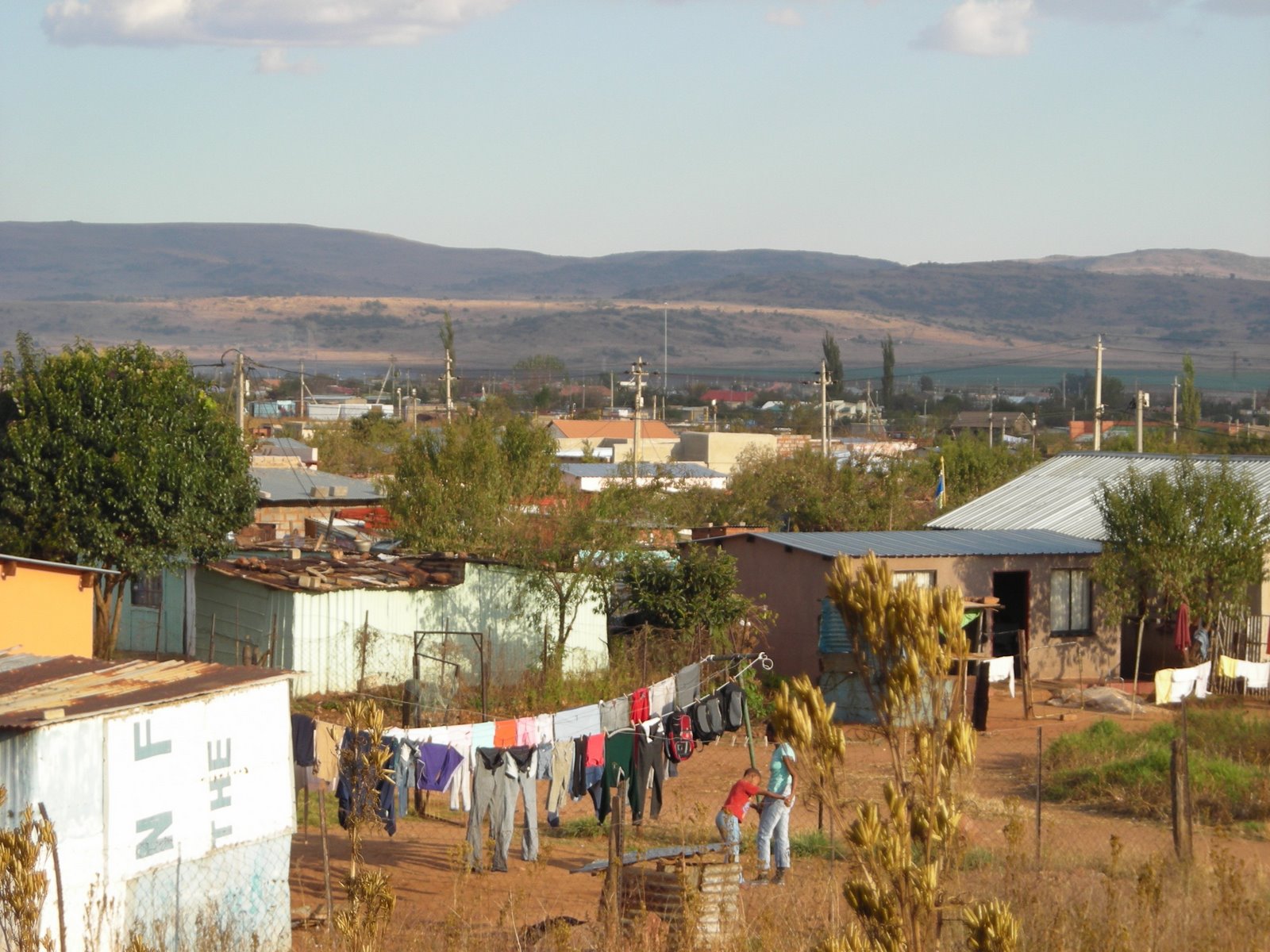
From May to August of 2008, I interned with an organization called Vumundzuku-bya Vana ‘Our Children’s Future’ (VVOCF). The organization is located in Zonkizizwe (Zonke), an informal settlement south of Johannesburg closest to Germiston. The informal settlement is best described as a peri-urban area much like a shantytown with convenience stores. Some live at a lesser degree of poverty than others, but everyone is impacted by HIV/AIDS.

I […] learned more about the extent of HIV/AIDS in Zonke. The intern coordinator reminded us that the statistic of students at MSU that have an STD is 1 in 4. We are only lucky that HIV/AIDS did not enter the mainstream population. Here in Zonke 1 in 4 people is HIV positive. The family at the center is more so affected by HIV/AIDS and now they work to care for children who come the center affected by the virus. There is still a very high stigma and a terribly ineffective ARV program. Many people refuse to get tested or even consider the idea. Each child at the center either has HIV […] has lost parents from AIDS or related illnesses or has not yet been tested to know. There are many who should be tested, but are not. […] It has come to my attention that much of what the government does here looks good on paper and on banners, but there is a huge, massive disconnect in implementation (78).

Zonkizizwe is a snapshot of post-apartheid health care development failures. It was founded when a group of displaced people set up shacks on a farmer’s land so that they could live closer to potential places of work. Many times the South African government tried to remove them, but they kept rebuilding. This is a story different than that of the Black townships or Bantustan “homelands.” Zonkizizwe was an area not meant to be inhabited by anyone, let alone poor Blacks. Understandably the story of health care here is one of an even greater lack of access. Informal settlements had no budgets of their own to even attempt to build their own health infrastructure and even if they did it would likely have been destroyed during forced removals. Under apartheid, health services would have been incredibly difficult to come by.

Everyone waves from their steel-corrugated shacks, children smile and get excited, parents and elders are welcoming – looking out over the shanty town roof tops that extend as far as the eye can see in each direction, you can’t help but wonder that within this poverty and desolation mixed with laughter and happiness – what potential can be harnessed, what community action can be inspired to make South Africa’s future brighter by and for those who live here (79).

My goals as an intern with VVOCF were HIV/AIDS education, HIV/AIDS peer educator training, and assistance with nonprofit organizational development. I was very glad to be able to focus my strengths and interests in the work I did. I also worked to formulate a rough community health assessment based on my interactions with people at the VVOCF center, neighbors, visits to the clinics, and interactions with Zonkizizwe residents.

Now Zonkizizwe has two primary health care clinics to serve its roughly 250,000 people. Health services are all free through government funding, including immunizations and treatments. However, the issue does not become access to treatments, but rather quality of care. The director of VVOCF, Celumusa, said that all the health clinics do is give out painkiller tablets for everything (80). She said she often just goes to the chemist [pharmacist] to tell them what is wrong and get something that will actually help. This appears to be a direct outcome of apartheid health policy. The lack of trained medical professionals, notably doctors, leaves local health workers with no better option than handing out painkillers. Quite possibly the training of these health workers remains inadequate as well. Zonke is an area much in need of the RDP’s action, but all that can be seen here are RDP building supplies for new houses.

“You can see people die, sitting at Natal-spruit.” – Celumusa (81)

The closest hospital to Zonke is in Natal-spruit, about a 30-40 minute taxi ride away. If you live in Zonke, this is the closest place to get ARV medications since the clinics are “not certified” yet to distribute (82). There is another hospital nearby, but the taxi fare is more costly and it takes longer to get there. Residents of Zonke don’t necessarily have the time or money to take a day to travel to the hospital even if it is critical to their health. Those who go to Natal-spruit notice a different level of care. People die waiting, people in great pain are not attended, people in need of good health care cannot access it. At Heidelberg I was told the staff rush to help you and are much more caring (83). The Natal-spruit hospital is set to be closed soon and a new hospital will be built in Extension 6, which is in Sandonga, much closer to Zonke. Maybe with this new hospital the level of care and access to care will increase, especially in regards to ARVs accessibility.

Notes:
78. Hill, Alex B. Journal Entry. 15 May 2008.
79. Ibid, 13 May 2008.
80. Ibid, 6 June 2008.
81. Ibid, 29 May 2008.
82. Ibid, 10 June 2008.
83. Ibid.

Coming next: Harsh Realities in Zonkizizwe (part 2)

why there is no doctor: post-aparthied health, the burden continues to get heavier (9)


(photo: View of Zonkizizwe with mountains in the background)

The South African health care system was in crisis during the apartheid years and that fact has not changed almost 15 years later. According to the American Association for the Advancement of Science and the Physicians for Human Rights organization, the South African health care system not only limited access to health services for Blacks, but also created an environment in which abuses could and did occur (70). The Bantustan homelands have been incorporated back into the unified free South Africa and these areas remain the most underserved. These areas had their own separate health departments under apartheid with 300 local authorities in charge (71). Now these separate departments are under the authority of 9 different provincial health services leaving health care in South Africa fragmented.

In essence there were, and still are, two different health care systems in South Africa. One system is public and accessed by the majority of the population. The other system is private and subsidized for the few who can afford it. During apartheid the majority of the health budget went into developing this private health system for those living in urban areas and those privately insured (72). This disparity remains true today, as Blacks still have limited access to health services. Economics also continues to drive this disparity as most doctors choose to enter into the private system for better pay and better facilities.

The lack of an adequate health care system for the majority of the population as a result of apartheid policies has exacerbated the ability of medical practitioners in responding to the HIV/AIDS crisis. “HIV patients might soon account for 60 percent to 70 percent of hospital expenditure in medical wards,” says HEARD researcher Nina Veenstra (73).

Already, about half of all patients admitted to hospitals in South Africa seek care for HIV-related illnesses, while the numbers of HIV-positive patients in paediatric wards are even higher, she added. […] As the numbers of AIDS patients grow, there will be a greater demand for skilled health workers, medication and hospital facilities.
South Africa already suffers a shortage of health workers, due in large part to unattractive working conditions. Many posts for health workers remain vacant, notes a study by a national research organisation, the Durban-based Health Systems Trust (HST) (74).

The HST and other researchers have estimated that only 13% of all patients who are in need of ARV treatment are receiving it (75). This is in large part because of the lack of health workers. Where apartheid denied Blacks adequate training for medical professions, there is now such a lack of health workers that a government ARV treatment plan can’t even be carried out because there are such limited human resources (76). Along with the lack of health workers, a recent study found that 13% of health workers who passed away between 1997 and 2001 died of HIV/AIDS-related diseases (77).

Notes:
70. Kon, Zeida R. and Nuha Lackan. “Ethnic Disparities in Access to Care in Post-Apartheid South Africa.” American Journal of Public Health. December 2008, Vol. 98, No. 12, 1.
71. Ibid.
72. Ibid.
73. Palitsza, Kristin. “A Burden that Will Only Become Heavier.” Inter Press Service News Agency. May 28, 2006. http://www.ipsnews.net/africa/nota.asp?idnews=33396
74. Ibid.
75. Ibid.
76. Ibid.
77. Ibid.

Coming next: Harsh Realities in Zonkizizwe (part 1)

why there is no doctor: what happened to reconstruction and development? (8)


(photo: This office in Zonke is responsible for RDP work – not much happens here)

Beyond AIDS denialists creating inadequate treatment programs, the rebuilding and scale-up of South Africa’s health care system has been very slow since the ending of apartheid. The main driver of scale up of health service infrastructure was the ANC’s Reconstruction and Development Programme (RDP). In its first White Paper of 1994, the RDP noted: “Health services are fragmented, inefficient and ineffective, and resources are grossly mismanaged and poorly distributed. The situation in rural areas is particularly bad” (66). Between April 1994 and the end of 1998, the RDP built 500 new clinics which gave an additional 5 million people access to primary health care facilities (67). The RDP had an incredible set of goals to match the incredible odds the country was up against, but many still had criticisms. Many note that the successes of the RDP are overshadowed by the enormity of the HIV/AIDS crisis.

Critics of the RDP argue that access to healthcare only improved slightly under the RDP and that, even with moderately improved access, standards at many medical institutions declined rapidly. They cite, in the first place, that usage of healthcare facilities increased by just 1.6% between 1995 and 1999, and that even these modest improvements have been eclipsed by the advance of the AIDS pandemic and other health epidemics such as malaria. Between 1995 and 1998 life expectancy of South Africans fell from 64.1 years to 53.2 years, with AIDS patients sometimes occupying up to 40% of beds in public hospitals. This, say critics, is indicative of a “public health system… in crisis” rather than one undergoing positive transformation. Equally troubling has been declining quality of services […] for example, that in Soweto 950,000 patients attended primary healthcare clinics in 1994 where they were seen by 800 nurses — but by 2000 the number of patients had spiraled to about 2,000,000 while the number of nurses had fallen to just 500 (68).

The difficulties of apartheid have transferred over as the country has attempted to rebuild. There remain serious deficiencies in trained health workers, even regressions. More people are using health services, but more health services are not readily available. More and more people need access to treatment for HIV/AIDS, but the inadequacies in health service infrastructure combined with denial policies have limited that access. The RDP White Paper only had one small section on AIDS, Section 2.12.8 reads:

Sexual health and AIDS. A programme to combat the spread of sexually transmitted diseases (STDs) and AIDS must include the active and early treatment of these diseases at all health facilities, plus mass education programmes which involve the mass media, schools and community organisations. The treatment of AIDS sufferers and those testing HIV positive must be with utmost respect for their continuing contributions to society. Discrimination will not be tolerated. AIDS education for rural communities, and especially for women, is a priority (69).

The numbers speak for themselves and the RDP has failed to achieve its intended goals. The biggest difficulty seems to be that the RDP and health infrastructure were not taken seriously. When the new ANC government was elected the RDP was its own department, but then slowly was scaled back to its own program and now RDP programs exist within other governmental departments where priorities are not on health services or HIV/AIDS.

Notes:
66. “Health Care.” The Reconstruction and Development Programme. White Paper, 1994.
67. Lodge, Tom. “The RDP: Delivery and Performance” in “Politics in South Africa: From Mandela to Mbeki”, David Philip:Cape Town & Oxford, 2003.
68. Ibid.
69. “Health Care.” The Reconstruction and Development Programme. White Paper, 1994.

Coming next: Post-Apartheid Health: the Burden Continues to get Heavier

why there is no doctor: denial is the first step (7)


(photo: downtown Zonkizizwe, South Africa)

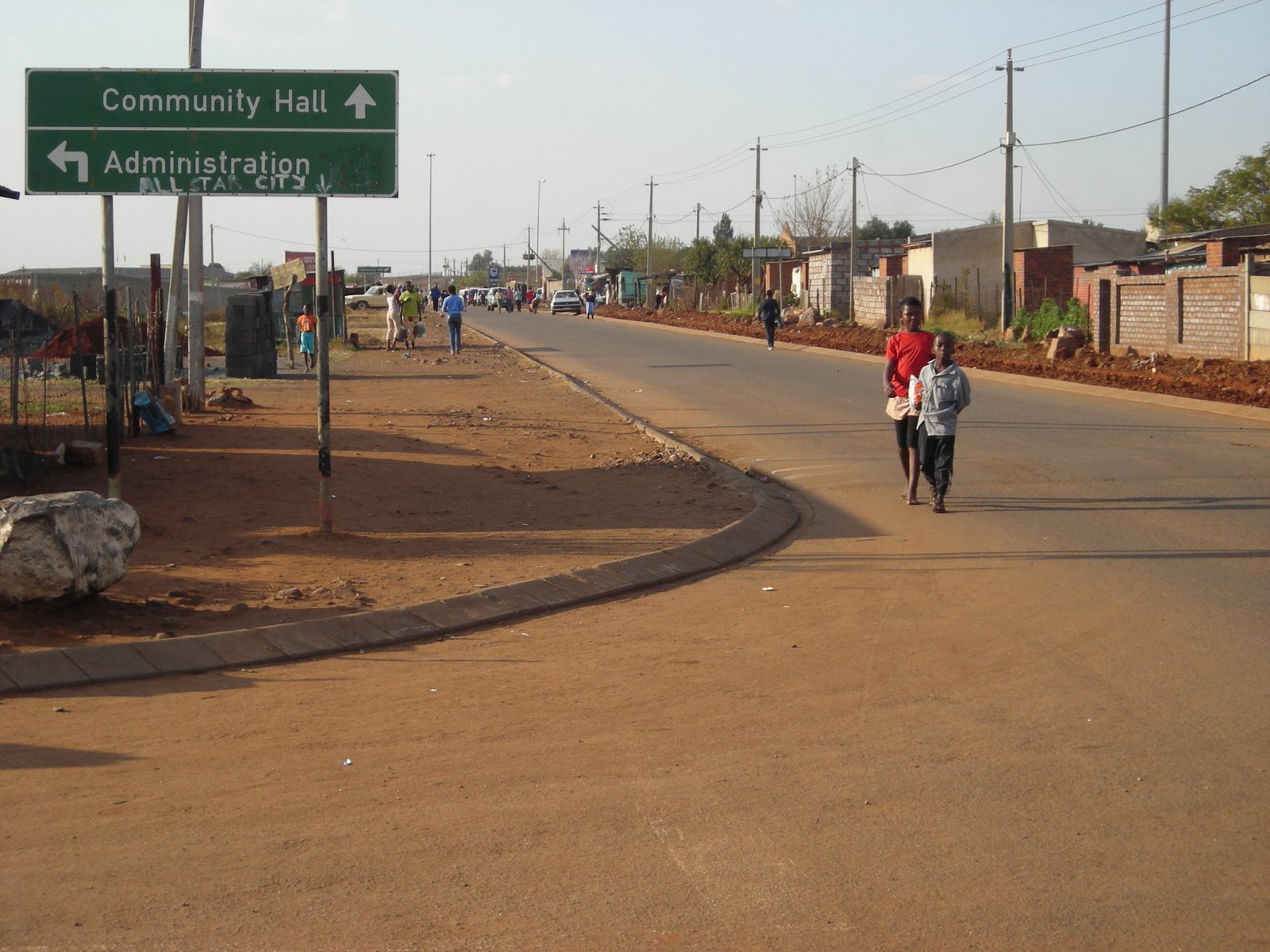
Since the early 1990s, Mbeki had turned his back on scientific evidence linking HIV as the cause of AIDS. Mbeki’s stance on the cause of AIDS is the largest contributing factor in the South African government’s failure to scale-up treatment. In 2000, Mbeki called together a group of scientists including a group of ‘dissident scientists’ to discuss the cause of AIDS (55). Later that year at the International AIDS Conference in Durban, he spoke publicly rejecting the accepted science that HIV causes AIDS and instead focused on the need to alleviate poverty in Africa as a way to combat AIDS (56). He said the cause was poverty, bad nourishment, and general ill health while also noting that more Western medicine was not what Africa needed (57).

Since his public statements, Mbeki and the South African government have been hit by a backlash of criticism from the international community and Mbeki has remained silent on the topic. The year 2000 was the same year that the Department of Health launched a five-year plan to combat HIV/AIDS. However, Mbeki’s statement and the lack of strong governmental support led to much “foot-dragging” (58). Mbeki had turned down grants, funding, and free medicines to scale-up the treatment program as a result of his denial. Now a recent Harvard study has placed impact numbers with Mbeki’s denial claims. The authors of the study estimate that more than 330,000 people died unnecessarily in South Africa and that 35,000 babies could have been protected from HIV-infection as a direct result of Mbeki’s HIV/AIDS policy and denial (59).

In 2002, with international pressure growing, the South African High Court ordered that nevirapine, which combats the spread of HIV from mother-to-child, be made available (60). Sadly despite offers of free and cheap antiretrovirals (ARVs), the South African government was hesitant to offer the medicines and only distributed in two test sites. In 2003, the government approved a plan to make antiretrovirals publicly available and by 2005 there was at least one service location for AIDS-related illness in each of the 53 districts (61). However the program did not reach enough people and the HIV prevalence rate among pregnant women was recorded at 30.2%, a steady increase since 1990 (62). The treatment program was beyond inadequate.

The case for HIV/AIDS treatment and prevention suffered another blow at the hands of South African government leadership in 2006. Former Deputy President Jacob Zuma went on trial for the rape of an HIV positive woman and claimed that having taken a shower afterwards protected him from HIV transmission (63). This only heightened international outrage and pressure on South Africa’s HIV treatment programs. At the 2006 International AIDS Conference in Toronto, UN Special Envoy on HIV/AIDS Stephen Lewis, called the South African government “obtuse and negligent” (64). By the end of the year the government had announced that it was drafting a framework to tackle AIDS and pledged to increase public access to antiretrovirals (65).

Mbeki was ousted from his ANC leadership position in September of 2008 and the interim president appointed Barbara Hogan as the Health Minister. Many saw this as a major turning point in South Africa’s HIV/AIDS policy, especially as the government is working to get antiretrovirals to as many people as possible. Unfortunately, Zuma is set to win the upcoming presidential election and has not made any apology for his false statement on HIV prevention.

Notes:
55. “HIV & AIDS in South Africa: The history of AIDS in South Africa.” Avert.
http://www.avert.org/aidssouthafrica.htm
56. Boseley, Sarah. “Mbeki Aids denial ‘caused 300,000 deaths.” Guardian News UK. 26 November 2008.
http://www.guardian.co.uk/world/2008/nov/26/aids-south-africa
57. Ibid.
58. Ibid.
59. “HIV & AIDS in South Africa: The history of AIDS in South Africa.” Avert.
http://www.avert.org/aidssouthafrica.htm
60. Ibid.
61. Ibid.
62. Ibid.
63. Ibid.
64. Ibid.
65. Ibid.

Coming next: What happened to Reconstruction and Development?

Access all entries in this series: Index

why there is no doctor: hiv/aids in south africa (6)


(photo: Local staff and interns at VVOCF in Zonkizizwe)

The first case of AIDS was diagnosed in South Africa in 1982 among the gay community (47). The apartheid government took minimal actions in response to the virus’ coming. This could be in part due to the violent political turmoil as well as discrimination against the gay community. In 1986 the AIDS Advisory Group was established to respond to the epidemic (48), but nothing of significance can be associated with the Group. HIV/AIDS quickly spread to the heterosexual populations and by 1990 antenatal tests showed that up to 120,000 people were living with HIV/AIDS (49).

It wasn’t until after apartheid laws were repealed that a government response was crafted. In 1992, the same year that a referendum was held on apartheid policies, Nelson Mandela addressed the National AIDS Convention of South Africa (NACOSA), which was to develop a national strategy to cope with the epidemic (50). The National Health Department reported in 1993 that HIV rates had increased by 60% in the last two years and this number was expected to double in the next year (51). This was the groundwork that apartheid had lain for the rapid spread of HIV/AIDS in the next seven years.

The period from 1993-2003 marked the freedom of mobility of more people, which was evidenced by the increase in internal labor migration patterns as well as a severe increase in HIV prevalence. Seedat’s book is rightly named “crippling a nation” because when the government was stabilized and working to develop a response to the HIV/AIDS crisis it was already too late. The HIV/AIDS crisis was poised to take its toll from the detrimental apartheid policies that limited health services, medical training, forced mass migrations of people, and established environments prone to high-risk behaviors.

During this time period, a number of government actions were meant to stem the increasing prevalence rates. In 1994, the Ministry of Health adopted its first national AIDS strategy based off of NACOSA’s work (52). Unfortunately the plan was considered inadequate, poorly planned, and disorganized. In 1995, the International Conference for People Living with HIV and AIDS was held in South Africa and then Deputy President Thabo Mbeki acknowledged the seriousness of the epidemic (53). That same year the Ministry of Health announced that 850,000 people (2.1% of the population) were living with HIV (54). In 1998, The Treatment Action Campaign (TAC) launched partly in response to the failures of the South African government to provide adequate resources to people affected by the crisis.

Notes:
47. “HIV & AIDS in South Africa: The history of AIDS in South Africa.” Avert.
http://www.avert.org/aidssouthafrica.htm
48. Ibid.
49. “HIV & AIDS in South Africa: The history of AIDS in South Africa.” Avert.
http://www.avert.org/aidssouthafrica.htm
50. Ibid.
51. Ibid.
52. Ibid.
53. “HIV & AIDS in South Africa: The history of AIDS in South Africa.” Avert.
http://www.avert.org/aidssouthafrica.htm
54. Ibid.

Coming next: Denial is the First Step

why there is no doctor: scapegoating "tropical workers" (5)


(photo: At the Lesotho border)

As early as 1913, international migrant workers have been brought into South Africa to fill out the labor supply, especially in the mines (42). These workers were called “tropical workers” because they came from countries like Malawi and Mozambique that had more tropical climates and diseases. The mines faced a labor shortage starting in the 1930s and by 1934 over 2,000 “tropical workers” had been brought in on an experimental basis (43). The South African government had difficulties with “tropical workers” bringing in disease and spreading it before 1930 and so there was a certain stigma associated with international laborers. Early tropical workers were blamed with bringing tuberculosis and spreading it within the mines. However, working conditions in the mines and biological susceptibility were not taken into account. Regardless, tropical workers were associated with tuberculosis and that reasoning led the South African government to be wary about reintroducing tropical workers in 1934. The success of these workers and lack of increased disease inspired the South African government to lift the ban on hiring workers above the 22nd parallel in 1937 (44). With the lift of the ban, the numbers of tropical and international migrant workers increased significantly.

Tropical workers entering South Africa numbered 40,000 by 1948, the start of apartheid (45). Between 1988 and 1992, around 13,000 tropical migrant workers from Malawi were repatriated because over a two year period 200 of them had tested positive for HIV (46). The tropical worker who was scapegoated for the spread of tuberculosis was now labeled as the culprit for the spread of HIV to South Africa. Later it was understood that the South African mining industry was working on stabilizing its mining labor supply and HIV/AIDS was used as a way to clear out international migrant workers.

Nevertheless, the increase in numbers of tropical or international migrant workers to South Africa expanded the area where high-risk behavior related to HIV/AIDS could have an impact. The international migrant worker movements from the mines to their home countries and any locations in between likely contributed to the increased prevalence of HIV similar to studies that have proven the same for internal labor migrations. The reach of apartheid’s policies stretched beyond South Africa’s borders and contributed to the deepening of the HIV/AIDS crisis within the country as well as the southern African region.

Notes:
42. Packard, Randall. White Plague, Black Labor: Tuberculosis and the political economy of health and disease in South Africa. University of California Press. 1989, 229.
43. Ibid, 230.
44. Ibid.
45. Ibid.
46. Chirwa, Wiseman Chijere. “Aliens and AIDS in Southern Africa: The Malawi-South Africa Debate.” The Royal African Society. African Affairs 97:53-79, 1998.

Coming next: HIV/AIDS in South Africa