malaria awareness day

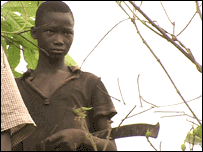
April 25th, the first US Malaria Awareness Day. An award winning photographer, Chien-Chi Chang, traveled to Uganda to give image to the story that is very often never heard, to give a face to the people who are never seen. This is not just another award winning privileged person traveling to get pictures or a story because these images and story are accompanied by a call for action. The images were used to raise awareness and promote involvement with Malaria No More. This is an organization that is fueled by celebrity involvement and received great attention from American Idol, but this is an issue and conflict that does not require you to be a celebrity to make a difference. Everyone is a celebrity in their own right.

On the <a href="http://newsforums.bbc.co.uk/nol/thread.jspa?threadID=6178&&edition=2&ttl=20070426013440
“>BBC’s news forum where people can write in their thoughts, many people called for a change in government actions and in people’s actions. Governments need to provide more funding for their health sectors and people need to depend less on their governments. I would add that we here need to understand that governments are not the ones who will make the greatest impact, when individuals support other individuals more lives will be saved.

In her blog, Acumen Fund Fellow, Keely Stevenson, writes about a socially responsible company in Tanzania working to provide bed nets. AtoZ uses a simplified, cheaper manufactoring process to make more bed nets for less. The company then charges a nominal fee to get the bed nets to people who will actually use them. Many times when organizations just hand out bed nets they end up as fishing nets or table cloths, but when there is a small fee – people who actually want them to use them will be supplied with them. This has been credited with bringing malaria deaths down in Tanzania.

Malaria is a preventable disease that claims the lives of over <a href="http://news.bbc.co.uk/2/hi/africa/6591169.stm
“>one million people, 90% of them in Africa. Using a bed net is said to reduce a pregnant woman’s birth complications and potential miscarriages by one third. A treated bed net costs about $4 and can save the lives of so many people is it is used. There have been numerous studies on the impact of malaria on mothers, children, and others – but the simple and known truth is that using a treated bed net can save your life and your family’s. There is no reason that malaria should kill so many people each year, our government should be stepping up its efforts, governments in Africa need support so that they can support their health sectors, and we here need to step up our efforts. Making bed nets more available and more affordable is the answer to a preventable disease without a cure.

Read up on malaria here.

the quest for development; aid to the rescue in ghana

Poverty: a state of being extremely poor; inferior in quality or insufficient in amount; our generation’s greatest problem; the world’s worst disease; a trap. The definition of poverty is one that is not difficult to grasp, yet so many do not understand how or why it plagues our world of riches. Our world is plagued by poverty and, contestably, Africa is the hardest hit due to it’s historical status of being relegated to unimportance. While poverty continues to take lives day after day the power wielding countries, institutions, and agencies argue over a solution. That solution is called development. Leaders, institutions, philanthropists all argue as to how development should be facilitated, what the best facilitator is, and how aid should be implemented. Is aid the best facilitator of economic development to bring an end to poverty?

Almost two years after Ghana’s President received word from the Group of 8 that aid would be increased to Africa, Ghana will celebrate being the first independent African country. Ghana is an African country that was very near economic collapse, but through the process of reform, gained economic stability. The current President is expected to step down after serving two years and it looks as though Ghana’s days of coups and unrest will long be over. Ghana has become an economically stable country by way of economic reform, which brought in foreign aid from the institutions and investment from the rest of the world. This is seen as a limited success as far as African countries. Ghana has shown itself to be a good reformer and much of that success has been attributed to aid. But why is Ghana such an isolated case of the success of aid from institutions?

The Trap or A Missing Right?

Jeffrey Sachs, the director of the Earth Institute at Columbia University, claims that there is a poverty trap and that the only way to get out of it is by climbing up the ladder of development. He states that this is the greatest tragedy of our time; that one-sixth of the world is not even on the development ladder. The reason that one-sixth of the world is not on the ladder is because of the ‘poverty trap.’ They are trapped because of many reasons: disease, isolation, climate, etc., but why? Sachs tells us that this one-sixth is trapped because their families and governments lack the financial means to invest in their own development. The world’s poor need to get a foot up on that ladder, but how? How does one invest in themselves?

Capital is the answer to the poor’s problem – at least that is what Hernando de Soto believes. In his research on the ‘mystery of capital’ de Soto claims to have found that all the poor need is access or ability to use the land and property that they reside on. They have material things, but cannot use their land as a resource to create capital. De Soto says that, “Capital is the force that raises productivity of labor and creates the wealth of nations.” The problem here is that governments have to open up their property systems to the poor and many are not inclined to do so. The processes for land ownership are lengthy and difficult in many LEDCs, so for many people owning property is not worth their time. De Soto fights for an impractical approach to bringing the world’s poor out of poverty. Balaam and Veseth note that de Soto’s argument for property-rights reform could not alleviate LEDC poverty, however such as step may be necessary for the success of ‘the beautiful goal.’

De Soto’s argument is supported in a slightly more practical manner by C.K. Prahalad, who says that there must be a goal to ‘democratize commerce.’ He supports his claim by giving examples of the poor as micro-producers. Prahalad argues that, “We know aid is not the answer to that kind of mass poverty. Subsidies, grants, and philanthropy may have a role to play, but the real solution is local development of the private sector. That requires specific actions that take into account the historical background of the country at hand.” Prahalad makes an excellent point at that there needs to be an understanding of country situations. He tells us that aid has a place, but where is that place?

Property rights are seen by many to be central to investment and the economy of development. Like de Soto they argue for its quick implementation. In regards to property ownership and its use to become developed it seems that Ghana eased from communal to individually owned land system. In the Ghanaian culture property held high importance and even though Ghana had to move from a communal model to individualistic, it was smooth. Property rights were granted to those who had planted or cultivated certain sections of land. This changeover of property rights was facilitated by stable, well-defined laws and customs in regards to the governing of land. The courts also recognized the existence of ‘family land’ and land belonging to larger kinships. This preset tradition of land ownership allowed Ghana to easily transition and permit people to use land as a means of creating capital.

Whose Consensus Should We Use?

Governments can hinder development, people are restricted from development, and societal institutions push the criteria for development. The Washington Consensus is the list by which all must abide in order to receive foreign aid. The Consensus promotes a strong neo-liberal agenda to deregulate economy, privatize government enterprises, create low inflation, low government debt, and open to domestic and international markets. The institutions use the Consensus in a fair amount of disagreement in regards to implementation. The Washington Consensus was a form for economic development that pushed free trade and capital mobility. The issue of free trade versus fair trade is a complete other paper, but the for ‘free’ forces LEDCs to spend funds on making reforms as opposed to implementing programs to serve its people. This causes poverty to continue in LEDC and although the Consensus made an irresistible possibility within reach it also brought the possibility of devastating collapse and risk.

The International Monetary Fund and World Bank are very often criticized and reforms within the institutions are called for. However, outside the institutions stand NGOs who fill the gap and many times create longer-lasting and more effective results for the poor of the world. Easterly is a strong critic of the aid agencies and he makes a very strong and compelling argument against them. Ghana has received a large number of loans and aid from the institutions. Easterly notes that in many recent cases of heavy involvement by the aid agencies end in collapses into anarchy. Stiglitz tells us that the Washington Consensus assumes perfect information, perfect competition, and perfect risk markets – an idealization of reality has little relevance to LEDCs.

Sachs writes about Ghana’s poverty reduction strategy. He notes that the government of Ghana reached the conclusion that a major scaling up of the public investments in the social sector and infrastructure, which estimates a required donor aid around $8 million. The Ghana strategy was well designed and argued, but the donors dropped and rejected the plan. Sachs argues that there needs to be a harmonization of aid. The many bi-lateral aid groups need to work together for larger projects, but for smaller-scale projects a more specified aid is required.

The Downside of Backward

Aid has become a dangerous word in today’s globalized, polarized, prioritized world. Another problem is that aid, as a term, is a very broad topic. For the purposes here, aid refers to financial support to increase economic development. The ‘grandiose’ plan of making poverty history or ending poverty brings about the desire to create the ideal aid agencies, administrative plans, and financial resources. Over the past sixty years the West has pushed reform schemes, agencies, and numerous plans all to end poverty. This has created a massive $2.3 trillion failed push by the aid industry to meet this ‘beautiful goal.’ William Easterly has argued that, “this evidence points to an unpopular conclusion: Big Plans will always fail to reach ‘the beautiful goal.’ Easterly tells us that Planners will always fail and their plans will always fail because they ask the question of what does the end of poverty require of foreign aid? When instead we should be searchers and ask, “What can foreign aid do for poor people?”

Balaam and Veseth tell us that the nature of aid flows has drastically changed from the time of the Cold War until now. During that time less aid was given because of security reasons, but now multilateral aid is channeled through institutions such as the World Bank. In the 1990s the World Bank changed its priorities to “fill in the gaps” due to many projects being funded by the private market and non-governmental organizations (NGOs). This shift made less economically developed countries (LEDCs) more dependent on other sources of funding.

If a LEDC has to depend on another source of funding besides the established institutions, as flawed as they may be, they will most likely look for the easiest way to get that funding. Ghana recently received, in June of 2006, a $66 million loan from China to fund its development projects. This is an extremely different and what some would call ‘backward’ step for Ghana. The Ghanaian experience with foreign aid has been to adopt reforms and partner with the institutions. In this case Ghana has strayed from the accepted conventions of the foreign aid industry. China is seen as a rogue aider in that they are undermining the development policy of the foreign aid institutions. By not placing restrictions on aid usage or democratic reforms, China is taking the foreign aid market by storm, as the World Bank is put out of business. China is not the only supplier of rogue aid, but it is the most prolific. What does this all mean for the aid industry?

It can only mean one thing and that speaks to the effectiveness of the aid institutions and the aid suppliers of the West. Ghana the star of economic reform, democracy in Africa, and years of peaceful independence is seeking rogue aid – there is no place anymore for utopias and institutions and big plans.

Utopia is Not Possible?

If the big plans won’t work than what will? Easterly says that the big problem with foreign aid is that is aspires to a utopian blueprint to fix the world’s complex problems. This is where we must refer back to Easterly and his explanation of a ‘searcher.’ Easterly helps us to understand that, “A planner thinks he already knows the answers; he thinks poverty as a technical engineering problem that his answers will solve. A searcher admits he doesn’t know the answers in advance; he believes that poverty is a complicated tangle of political, social, historical, and technological factors. A searcher hopes to find answers to individual problems only by trial and error experimentation. A planner also believes outsiders know enough to impose solutions. A searcher believes only insiders have enough knowledge to find solutions, and that most solutions must be homegrown.” Easterly pushes for giving more assistance and aid to searchers and not planners because the utopian plan is not possible.

Sachs states that, “One of the weaknesses of development thinking is the relentless drive for a magic bullet.” This is very ironic because at the end of Sach’s book he argues for a big plan to end poverty, a magic bullet? Sachs outlines four main points for what a donor should do. However he seeks to create an overarching plan for all developing countries to escape the poverty trap. Sachs criticizes the aid agencies as well as promotes their reform and continuation. Easterly on the other hand calls for the West to build a willingness to aid individuals rather than governments. He tells us in his book that the ideas thought to be crazy are the ones that work best and reach the people in need of aid. He outlines a plan for how aid should be used for development starting with development vouchers, which the poor could turn in at any NGO or agency for a vaccine, food, health check-up, etc. Easterly strongly emphasizes getting feedback from the poor on development progress and pushes for aid groups to go back to the basics and be accountable for individual, feasible areas of action.

In her Foreign Policy article, Esther Duflo notes that a good many people have qualms about foreign aid, but that we need to fund what works. “Governments and citizens of poor countries resent the us of aid as a means of buying political support, their lack of control over it, the development fads to which it is subject, and the administrative burden that accompanies it.” This idea of funding what works makes sense and many in the development field advocate for a focus on people.

Many people would like to advocate for the big push, an increase in foreign aid, to eradicate poverty throughout the world, however unfortunately the track record of aid institutions and aid in general shows otherwise. If we are to be donors and fighters of poverty, then we need to understand poverty’s complexity and understand that a pragmatic and effective approach is needed. We need to adopt more the idea of Easterly and support the searchers in their quest to actually save lives.

What does this all mean for Ghana? The country will continue to receive large aid packages from the foreign aid institutions for its stability and rogue aid states for their economic successes. Ghana has become a stable economy and even though the Ghanaian people’s pride is very strong they remain chained to the aid institutions and donors when it would be better for sustainability for their development to have their searchers be supported. Aid funding needs to be linked to the implementation of a successful program to avoid waste by governments. Creating an accountability for foreign aid that provides results will justify the increase of aid to LEDC and Ghana. Today’s society has the access and ability to distribute effective aid that actually helps those in need. The greatest problem that we will face is if our government will have the political will to restore confidence in the abilities of foreign aid. Ghana is a success story of Africa as far as economic development and building a stable government, their success was backed by foreign aid from institutions, and yet many of their people remain unserved. The direction and continuation of poverty reduction in Ghana will depend on the country’s ability to recognize and support searchers with effectively implemented aid.

Bibliography:

Anonymous. “Chinese PM announces Ghana loan.” BBC News, 19 June 2006. . (accessed 3 May 2007).

Anonymous. “Proud Ghana still depends on aid.” BBC News, 15 June 2006. . (accessed 3 May 2007).

Balaam and Veseth. Introduction to International Political Economy. Pearson Education Inc, New Jersey: 2005.

Besley, Timothy. “Property Rights and Investment Incentives: Theory and Evidence from Ghana.” The Journal of Political Economy. The University of Chicago Press, 1995. . (JSTOR accessed on 3 May 2007).

De Soto, Hernando. The Mystery of Capital. Basic Books, New York: 2000.

Doyle, Mark. “Can aid bring an end to poverty?” BBC News, 4 October 2006. . (accessed 3 May 2007).

Duflo, Esther. “Fund What Works.” Foreign Policy Magazine, May/June 2007. 43

Easterly, William. The White Man’s Burden. The Penguin Press: 2006.

Naím, Moisés. “Rogue Aid.” Foreign Policy, March/April 2007. . (accessed 3 May 2007).

Sachs, Jeffrey. The End of Poverty. The Penguin Press, New York: 2005.

Stiglitz, Joseph E. Making Globalization Work. W.W. Norton & Company, New York: 2006.

Tsikata, Yvonne M. “Aid and Reform in Ghana.” World Bank. Preliminary Draft Working Paper, May 1999.

Prahalad, C.K. “The World for Sale.” Foreign Policy Magazine, May/June 2007. 50

Index of blog post series on Ghana.

displacement

Surrounded by the dead and decaying behemoths of industrialization and the monsters of the modernized, civilized, material world, as cars and trucks alike race down the expressway next door, we, the youth, stop to build a cardboard tent city in a once barren parking lot in the middle of the massive, jutting, Chicago jungle. In that empty and barren parking lot of Soldier Field, we filled the void with our hearts, our minds, and our bodies to raise awareness and bring an end to a war. With the warring interests of commercializm, business, capitalizm, and the fast paced, go-go american society, we will break for a brief twenty-four hour period to be displaced. Displace me!

Next week I will be entering my third decade of being, staying alive. Now you may wonder how can that be such a feat in today’s world, but there are so many places where this luxury is not present. On the other side of the world, a place many people relegate to disease, conflict, and poverty, there is a war that has paralleled my time alive on this earth. In that time so many have lost their lives, most of them children, but yet here I am, here I stand – alive and well and trying to understand what they have experienced in all those years when I had no idea.

The civil war in Northern Uganda is entering its twenty-first year. The longest running war in Africa is seeking an end, and soon! Roughly ten years ago the people of Northern Uganda were given 24 hours to pack up and leave their homes to enter Internally Displaced Peoples (IDP) camps. The government thought this would be a solution to the conflict with the rebel Lord’s Resistance Army (LRA). However, all it did was exacerbate the situation and increase the amount of death and suffering caused by the war. Last night, in 15 major cities across the US, people gathered to remind US and world leaders that there are over 1.5 million displaced Ugandans suffering from a nearly invisible war. No one should be invisible, no one’s troubles should go unknown for so long, no war should continue for such a long time. I can only imagine those my age in Uganda who know nothing but war, who know no home except for an IDP camp, who only know a life of suffering. If this war could end from a handful of the american populace displacing themselves, then we will truly know the power of people who care.

a phamaceutical not bent on profit?

Do you see it there on the horizon? Hope is dawning and the situation seems to be less grim in this radiating light. Diseases run rampant in Africa, plan and simple, there is no health infrastructure to deal with the burden of preventable diseases. Meningitis for example can kill a child in Africa in less than six hours, while we can sit here in our ‘developed’ world knowing that the vaccination is right around the corner office.

The largest drug company in Europe, GlaxoSmithKline (GSK) announced a new drug for sole use in Africa to fight meningitis. The drug will be introduced with prices that will never have potential to cover the research or production costs. Experts and critics see this as a huge change in big companies changing their business practices to be more compassionate. Some critics say it isn’t enough, but I’d say this is an enormous and important positive step in the right direction. The company does not expect to make a profit. In a quote from the BBC article: “We have found a pretty clever way to fund therapeutic solutions for the developing world without essentially sacrificing the more traditional research we do on diseases around the world,” said the GSK chief executive Jean-Pierre Garnier.

This new approach comes about as last year big companies tried to sue South Africa over its purchase of cheaper, generic drugs to combat diseases. From the public outcry the big companies decided to back down amidst a PR disaster and the knowledge that their current practices were not going to cut it. They had to come to the realization that the old way of conduction business had to change. Now big firms are partnering with smaller firms in India and China and they are researching the ‘neglected diseases.’

This is an amazing positive in the way of saving lives. Changing the way companies do business can save lives. Currently four out of the twelve major companies have centers focusing on major diseases like HIV/AIDS, Tuberculosis, and Malaria. This is seen as the first big step following a number of small steps in the direction of doing something more for the ‘developing’ world.

forever enslaved: past and present

We will be forever enslaved by the deeds of the past. There is no way that we can separate ourselves from the historic wrong-doings of our ancestors. I like to think that there is only the present and that everything hinges on the present course and action. That idea is true I feel, but we cannot forget the past and we cannot discredit working towards the future. Last month there was a rememberance of slavery at the Elmina Castle in Ghana. Hundreds of locals gathered, the British Council and UK representatives were present and the crimes committed and journeys of slaves were remembered. In the BBC article Baroness Amos, who expressed pride at being a member of the African Diaspora, said transatlantic slave trade had been “responsible for some of the most appalling crimes perpetrated by humankind against its own citizens.”

Elmina Castle, which was built by Portuguese traders in the late 1400s before being taken over by the Dutch and later the British, was capable of holding 1,000 male and female slaves at one time. I feel like commemorations like these are repeated in different parts of Africa and yet they remain only symbolic gestures where words are spoken and the only actions that follow is that of representatives traveling back to their respective countries. This is where the idea that everything hinges of the present action is needed. If we are truly dedicated to healing past crimes and reversing the effects of those actions, then how can we remain inactive?

Even as we commemorate and remember and honor those enslaved and those affected by slavery – it continues to be a prevalent issue even today. The Ivory Coast (Cote d’Ivoire) is the world’s leading producer of cocoa. When you explore deep into the cocoa plantations you will come across a frightening discovery: forced child labor – slaves. These children are enslaved, forced to harvest cocoa, kept out of school, not treated for wounds recieved from working, and kept from their families. As the BBC reports: “In 2001, under pressure from the US Congress, the chocolate manufacturers promised to start eradicating forced child labour. They failed to meet an initial deadline of 2005, were given until 2008, and now patience is running out.”

We see slavery in new forms, much as we see colonialism in new forms. Child soldiers are recruited and brainwashed to fight in conflicts of which they know nothing. Many of these conflicts are perpetuations of the ‘developed’ world’s desire for some commodity or resource. We see slavery in an economic form as well. Women selling their bodies in order to feed their families, people taking on dangerous jobs to provide for their families – this economic slavery is very much linked to the actions of the past that have come to fruition now. Economic conditions as well as past historic incidents keep us enslaved. Those of us with privilege are enslaved to the deeds of our ancestors and governments, those who are forcible held and those who suffer from economic are enslaved by the systems that are so often perpetuated by our privileged wants. We are forever enslaved by our actions – whether they were in the past, or are happening present day – we are enslaved by our deeds. Are you prepared to own your actions when the time comes?

the politics of genocide

Genocide continues, people continue to be murdered, lives continue to be lost. The next month will mark the anniversary of the Darfur Peace Agreement. The crisis in Sudan’s western region of Darfur is only getting worse. The Sudanese government claims to be making it easier for aid groups to provide humanitarian support, yet aid groups are at times allowed to work and later denied. Under-staffed and under-supported African Union troops are being threatened and killed. The US deputy secretary, John Negroponte, sees this as the last opportunity to bring in a hybrid UN-AU peacekeeping force as hope seems to be running out for a solution. As Negroponte travels to Sudan he will be bringing the message that Washington’s patience has run out. Ban Ki-moon says that he thinks a misunderstanding with the Sudanese government is holding up the peacekeeping force.

The Sudanese economy has boomed with the backing of China, but now China is knocking. China has strengthened military ties with Sudan and so far has been behind the blockage of a peacekeeping force in Sudan. As a permanent member on the Security Council, China has vetoed previous efforts to put peacekeepers in Darfur. Currently there is a 7000 troop AU force trying to secure an area the size of France with limited supplies and no mandate. However, China is now urging Sudan to accept a peacekeeping force. For the past two years China has vetoed sanctions and peacekeeping forces for Sudan. Now as the 2008 Bejing Olympics are fast approaching more pressure has been placed on China to resolve the Darfur crisis. From the New York Times article: “But in the past week, strange things have happened. A senior Chinese official, Zhai Jun, traveled to Sudan to push the Sudanese government to accept a United Nations peacekeeping force. Mr. Zhai even went all the way to Darfur and toured three refugee camps, a rare event for a high-ranking official from China, which has extensive business and oil ties to Sudan and generally avoids telling other countries how to conduct their internal affairs.”

Pressure from the Olympics has been the tipping point for Chinese authorities. There are efforts to call the 2008 Olympics the ‘Genocide Olympics’ from prominent advisors to the Chinese goverment dealing with the Olympics. The Olympics are a great source of pride for the Chinese people. The growing pressure over Darfur has made the Chinese worry that the crisis is hurting their image. This large push is coming from the activist community and hollywood, where people are saying that China needs to be a responsible partner in the Olympic Games. There is still plenty of time before the 2008 Olympics for China to persuade Sudan or accept sanctions.

african economic growth and oil

The UN has reported that Africa’s economic growth is increasing, slow and steady, but frail. They are predicting that the continent’s economies will grow almost 6% in 2007. However the report states that if African countries are to continue to grow they will need to diversify their economic output and invest more in infrastructure. The top growing econmies include: Mauritania (19.8%), Angola (17.6%), and Mozambique (7.6%). The report points out that the economic growth rests on a very fragile base and there are still conflicts to face. The HIV/AIDS crisis has killed much of Africa’s workforce. Countries need to open their borders to trade, invest in their infrastructure, and insulate themselves against external shocks. If these predicted growth percentage’s come true in 2007 this will be the continent’s fourth year of growth. Zimbabwe was the only economy to contract in the last year by 4.4%.

The Foreign Policy blog notes that the landlocked Rwanda will be the prime spot for multinational corporations to invest. The article states: ‘Kagame, who has been president since 2000, is viewed as an honest, business-savvy man opposed to corruption, unlike many other African leaders. Consequently, American businessman Dan Cooper, who has been pitching Rwanda to U.S. corporations, describes the Maryland-sized country as “the most undervalued ‘stock’ on the continent and maybe in the world’.” However Freedom House listed as not free, the hope is that this economic upswing will benefit the citizens.

Africa is gaining economically even as Zimbabwe’s inflation reaches 1,600% and Angola calls off talks with the IMF. China continues to invest in countries regardless of political or human rights standings. Africa’s countries have a lot to deal with if they are to continue their strong economic upswing. The recent signing of many bilateral trade agreements will hurt these economically developing countries. Many countries still have conflicts to clean up before more growth can happen. Rwanda is recovering from genocide, but seems to be gaining a foorhold in the economic system. Oil, don’t forget about oil. It is my belief that oil will be the greatest hope for African countries to become economically stable and advanced, as long as the resource is used wisely. Africa’s hope is growing, but so is the resource lust of emerging economic giants.

no more foreign aid institutions. . . it’s china

Foreign aid; development assistance; foreign investment; these terms are now gaining another synonym: rogue aid. In an excerpt from the Foreign Policy Blog, rouge aiders are defined as such, “Because their goal is not to help other countries develop. Rather, they are motivated by a desire to further their own national interests, advance an ideological agenda, or sometimes line their own pockets. Rogue aid providers couldn’t care less about the long-term well-being of the population of the countries they ‘aid’.”

China is now the largest rogue aid competitor. The author of the blog entry says, “My friend was visibly shaken. He had just learned that he had lost one of his clients to Chinese competitors. ‘It’s amazing,” he told me. “The Chinese have completely priced us out of the market. We can’t compete with what they are able to offer’.” China can outbid the World Bank in aid lending power! What does this say for the future of the aid community? What does this say for the future of development? When economically powerful, wealthy, nondemocratic countries can circumvent the aid policies of the established lending institutions what can we really expect for development and aid programs? China can outbid the World Bank for a railroad project in Nigeria and sets no stipulation for combatting corruption, it can sign environmentally harmful agreements, it can provide funding without regard to the transparency of governments.

The Foreign Policy article gives three simple answers as to why China and other countries are stepping up their aid game. “[…] money, access to raw materials, and international politics.” These countries are not so concerned to create development or provide aid and help as many people as they can. There are obvious underlying motives to China’s upswing in development aid. This is not to say that China is the first to use rouge aid as a international relations tool. The United States and the Soviet Union used rogue aid to gain the allegiance of dictators. Our world is not in the position now to allow such initiatives to continue. The World Bank and other large aid agencies are monitored closely by watchdog groups, but these ‘rogue’ countries can lend and corrupt and ignore as much as they want.

The greatest threat that I see, and which I wrote about in an earlier post, is the obvious – China is set on getting all that it can from Africa. China has a great lust for Africa’s resources and their thirst is becoming unquenchable. Will Africa be drained and left with people living without basic infrastructure, left empty handed, left to die in ‘under-development.’ There is a quote from the FP article that sums up my thoughts, “Worse, they are effectively pricing responsible and well-meaning aid organizations out of the market in the very places where they are needed most. If they continue to succeed in pushing their alternative development model, they will succeed in underwriting a world that is more corrupt, chaotic, and authoritarian. That is in no one’s interests, except the rogues.”

she’s taking on more water; the zimbabwean titanic

As a ship with a hole takes on water, so too does a state or government sink with a corrupt and ineffective government. Zimbabwe is sinking, many have noted this before, but presently its plunge to the depths seems to be even more imminent. President Mugabe of Zimbabwe is losing control of his country and is losing support from his allies. Zambian President Mwanawasa has called the Zimbabwean state to be like a <a href="http://news.bbc.co.uk/2/hi/africa/6475851.stm
“>titanic and the BBC notes that, “he said the country’s economic difficulties were forcing its citizens to leave like passengers jumping from the sinking ship to save their lives.” Zambia had previously been a proponent of quiet diplomacy. However, now even South Africa’s criticism is increasing, but has not voiced outright criticism of the Zimbabwean government. The United Kingdom has stated that the solution to the issue of Zimbabwe will be found within Africa. This statment may be gaining strength as the economic crises continue and the devaluation of the Zimbabwean currency continues and fuel costs soar. The final paragraph of this BBC article states, “More than 80% of Zimbabweans are living in poverty, with chronic unemployment and inflation running at more than 1,700% – the highest in the world.”

Yesterday President Mugabe attended <a href="http://news.bbc.co.uk/2/hi/africa/6499059.stm
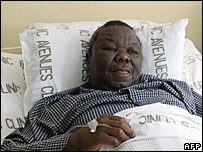
“>’crunch talks’ in Tanzania as the southern African leaders seek to find a solution to Zimbabwe. Many African leaders see Mugabe as a hero for standing against colonial rule, however I am not so sure that a defiance of colonial rule includes not serving your people and allowing them to suffer. As these talks occurred, the headquarters of the leading opposition to Zimbabwe’s government was raided by police. This has become a common theme. The Zimbabwean government has continually attacked any opposition, demonstration, or dissent. Mugabe arrived at the Tanzanian summit and as he did it appeared as though the police had begun a new crackdown on the opposition. The Movement for Democratic Change’s leader, Morgan Tsvangirai, was among 20 people detained in a police raid yesterday. Some of those arrested were accused of fire-bombing, but Tsvangirai was not among them. The opposition is seen by the Zimbabwean administration as a Western puppet to overthrow Mugabe. The Information Minister told the BBC, “You [the West] are too much concerned with your Tsvangirai because he is your puppet and you make him an international hero.”

Mugabe, who has ruled Zimbabwe since 1980, now says that he favors elections next year. Mugabe had previously said that he would like to postpone elections until 2010 to extend his term, yet his own party, the Zanu-PF party, has stated that they were, “”anxious to get another candidate”. Gone in a year? Possibly, losing support of his own party, his people, and now his own resolve seems to be failing. When dissent is not allowed, opposition is forceable put down, and people are not permitted to voice concern with their government then how can you expect your boat to float?

However I am just a Westerner writing about what I have seen and what I have read. Don’t take it from me. Check out this blog entry from the This is Zimbabwe blog. The entry linked to is a clip from the South African news about the issue of Zimbabwe.