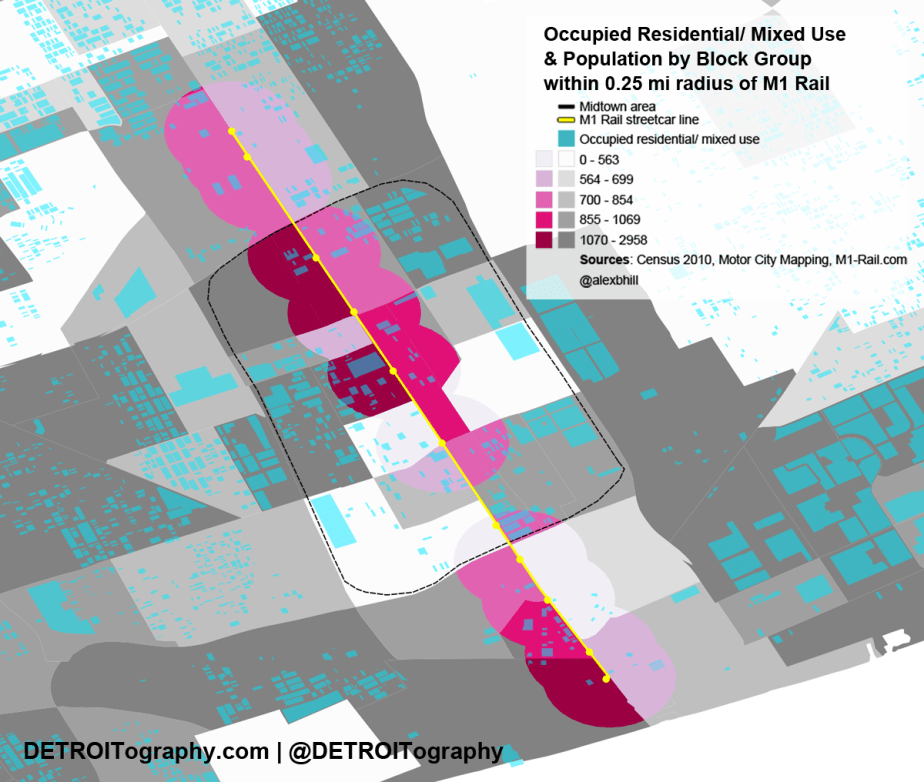
Map: Will the M1 Rail Streetcar Serve Detroit Residents?

Alex B. Hill's avatarDETROITography

m1rail_pop

The impact of the M1 Rail 3.3 mile-long streetcar has been an ongoing debate and a number of community organizations have voiced concerns that the M1 Rail does little to serve actual residents of Detroit. The M1 Rail project essentially says the same thing. M1 Rail is looking to serve the “choice rider” to facilitate getting around Downtown and Midtown’s attractions. The private funders joined forces after seeing the failure of public transportation during the Super Bowl in 2006. It is safe to say that the M1 Rail was not conceived of as a transportation option for residents, but rather for visitors.

“[…] the project will affect pedestrians, people in wheel chairs and bike riders. Ironically, the project will also impact bus riders, most of whom will have relatively little use for the trolley.“ (source)

The residential density along the M1 Rail is minimal at best compared to…

View original post 239 more words
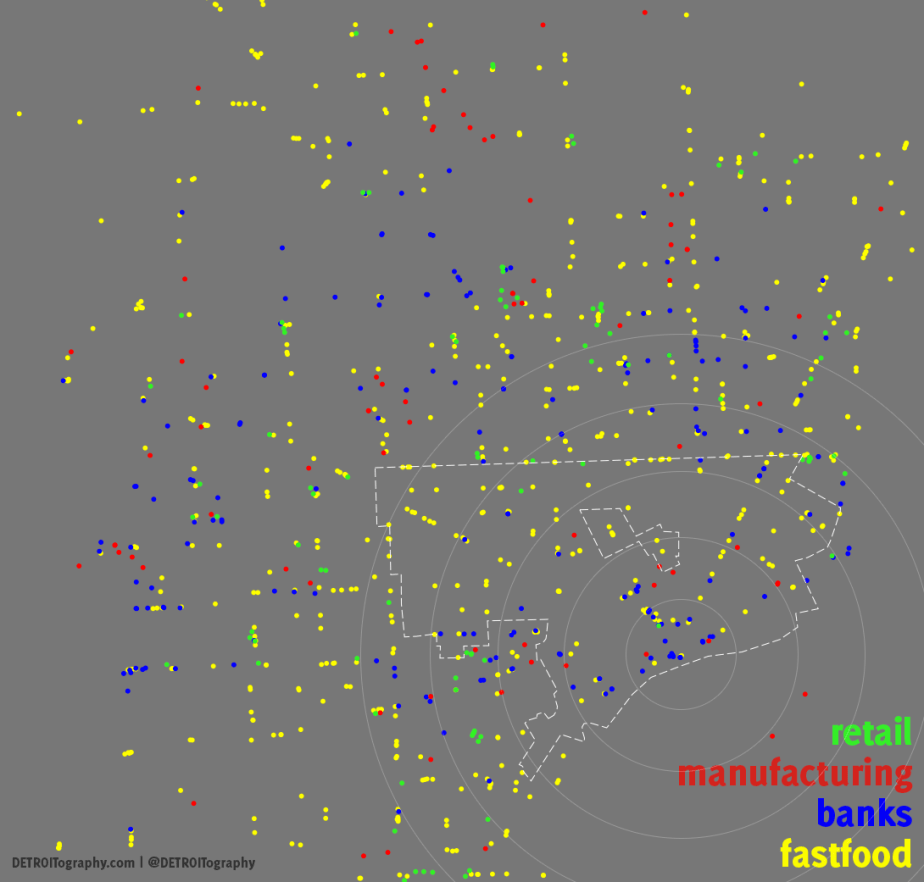
Map: The Empty Business Rings of Detroit

Alex B. Hill's avatarDETROITography

det-rings

I began five years ago looking intensely at the grocery store conundrum in Detroit. There were handfuls of academic writings and news articles about how national and chain grocers abandoned the inner city, in Detroit and other notable cities. This abandoning of the urban core is a phenomena is best understood in terms of chain supermarkets, but the practice and theory applies to many other retailers and business types too. It is also important to look at what kinds of businesses have stayed or expanded in the same space.

det-rings-4

Retail

Detroit completely lost its Downtown commercial retail businesses in the half century decline of the city. The commercial core never recovered and even Hudson’s largest department store was torn down. The process of building a series of suburban malls followed the new city planning trend and places like Northland Mall, Southland Mall, and Oakland Mall sprang up. Grocery retail has…

View original post 305 more words

Map: Attainment of Higher Education in Detroit

Alex B. Hill's avatarDETROITography

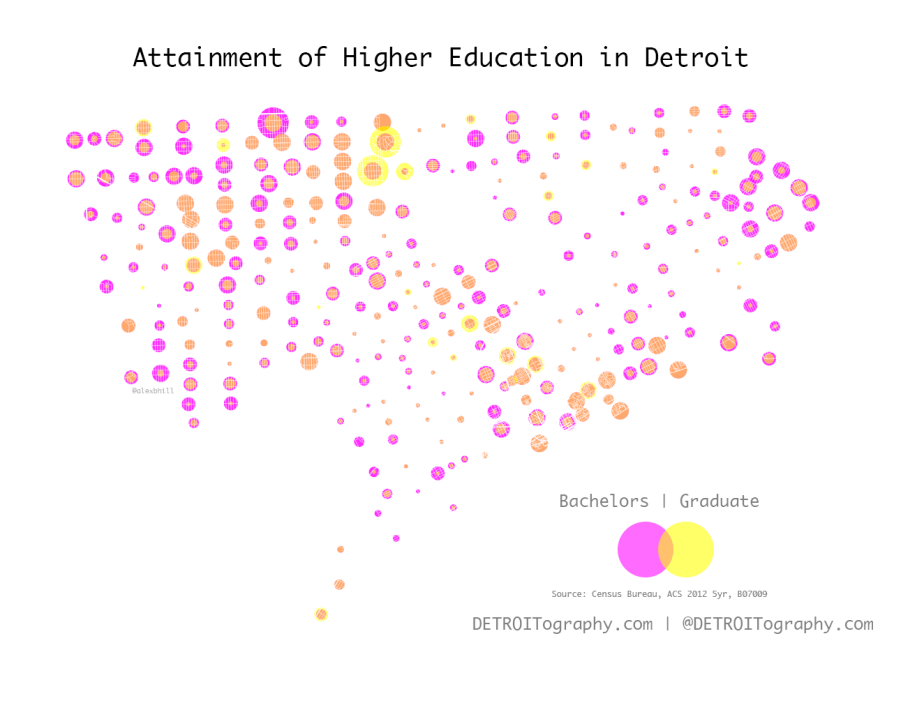
det-higher-ed

I’ve been doing a lot of thinking lately about higher education in Detroit. The pattern that can be seen here with more individuals with degrees on the West side is mirrored in other categories such as income. There are approximately 32,805 individuals with a Bachelors degree and 22,185 individuals who have a Graduate level degree. That’s a total of 54,990 people with higher education degrees or about 12% of Detroit’s population compared to 101,749 people with less than a High School education. Michigan’s population has an average 25.5% Bachelor’s degree attainment. Compared to other cities often grouped with Detroit we see: Philadelphia, PA 23%, Oakland, CA 37.9%, Cleveland, OH 14%, Chicago, IL 33.6%, and Baltimore, MD 22.6%.

Detroit has 11 different institutions for higher education (see map) and at one point in its history as Michigan’s largest city, it once held the most highly educated population in the…

View original post 63 more words

Map: Detroit Design Festival and the Myth of the Blank Canvas

Alex B. Hill's avatarDETROITography

ddf_locations

The long and short of this post title is that artists are among the first line of gentrifiers. It is true artists often have very lower incomes, transient housing, and suffer from a lack of understanding from a majority of the public – however, most, if not all, artists come into various cities and urban settings with a great amount of privilege. Choosing to attend art school is privilege number one when others often lack the ability to pursue art at mostly expensive, private schools. The map shows that over the years the Detroit Design Festival (DDF) has become more concentrated in specific areas as well as increased the number of hosted “happenings” or events in those concentrated areas.

In Detroit you can see this blessing and curse all bound up in the idea of “doing something good” in the city’s “blank canvas” of opportunity. While artists attempt to be…

View original post 299 more words

Map: Historic Detroit Neighborhoods 1884

Alex B. Hill's avatarDETROITography

silas_nhoods

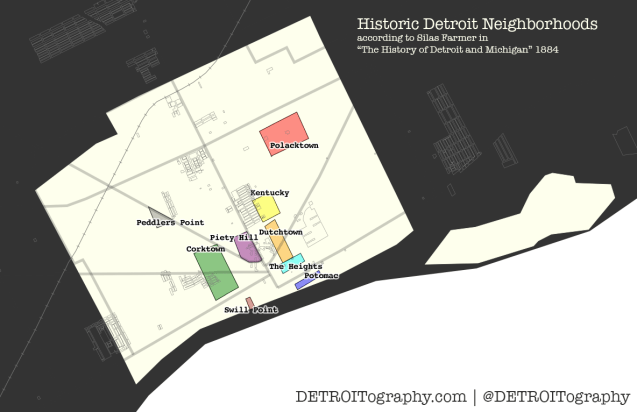
From “The History of Detroit and Michigan” by Detroit’s first cartographer, Silas Farmer.

Excepts on each neighborhood:

“This the larger portion of the territory on Fifth and Sixth Streets, for several blocks each side of Michigan Avenue, is called Corktown, because chiefly occupied by people from the Emerald Isle.

The eastern part of the city, for several blocks on each side of Gratiot Avenue beyond Brush Street, for similar reasons is often spoken of as Dutchtown, or the German quarter.

That part of the city lying a few blocks north of High Street and between Brush and Hastings, is known as Kentucky, from the number of colored people living there.

A walk a few blocks east and north of this locality terminates in the heart of Polacktown, where many Poles reside.

The portion of the city just west of Woodward Avenue and north of…

View original post 335 more words

Map: Detroit Water Affordability

Alex B. Hill's avatarDETROITography

detwater_affordability

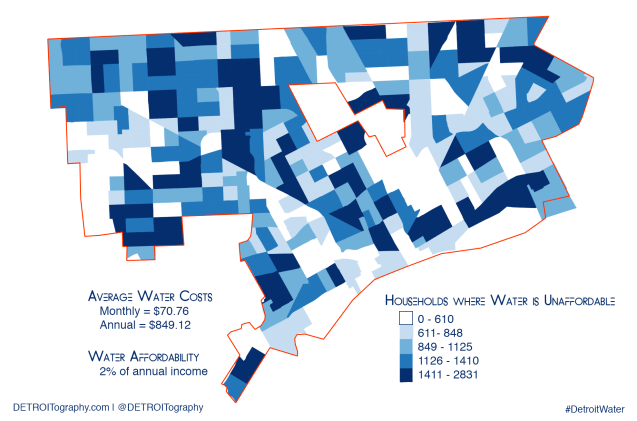
The standard for affordable water is set by the Environmental Protection Agency (EPA). The EPA attempts to stress equity and consideration for low-income individuals. In 1995, the EPA set the first water affordability rate at 2% which is considered a “large economic impact.” Unfortunately, the Detroit Water and Sewerage Department (DWSD) among other non-governmental actors disagree with the EPA and have different ideas as to how to pay for and maintain this basic human need and natural resource.

Detroit’s water rate was increased by 8.7% in July 2014 effectively making an average monthly water bill at $70.76 (or $849.12 annually). In order for this $850 annual rate to fit within the EPA’s standard of “affordability” a household would need an annual income of around $40,000. Anyone aware of the situation in Detroit and Census data could tell you that the majority of households in Detroit do not have that level…

View original post 70 more words

Map: Top 40 Delinquent Commercial Water Accounts in Detroit

Alex B. Hill's avatarDETROITography

detwater

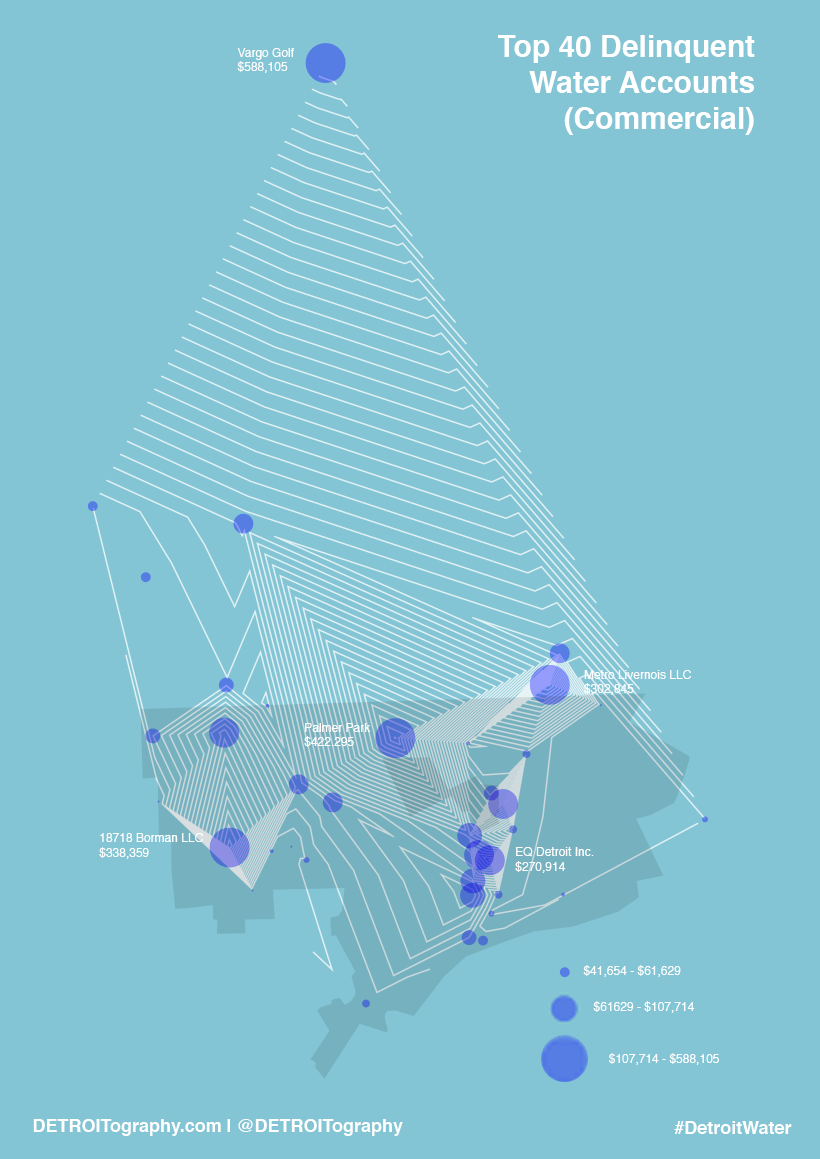
A list was finally published of some of the top commercial water customers with delinquent accounts. They have ranged from companies who have been in trouble in the past with Michigan’s Licensing and Regulatory Affairs (LARA) to individuals who seem to have attempted business ventures that failed. What is most surprising is that among the top 40 delinquent commercial accounts there is a cluster in Midtown and Downtown – the newly named “Innovation District.”

The Detroit Water and Sewage Department (DWSD),a not-for-profit by Michigan mandate, estimates that 18,073 commercial accounts make up about $26 million of the deficit or almost a quarter of accounts past due.

We looked into a few of these corporations and found some odd things:

  • Vargo Golf – with the highest amount past due, manages six golf courses in metro Detroit with three in the City of Detroit – Palmer, Rouge, and Chandler.
  • Borman LLC was…

View original post 125 more words

Map: Colleges and Universities in Detroit

Alex B. Hill's avatarDETROITography

college_univ2

In recent years Detroit has seen an influx of college and university satellite sites. Notably, the University of Michigan (UM) Detroit Center opened in 2005 while the Michigan State University (MSU) Detroit Center opened in 2009. Detroit has been host to a number of colleges and universities from its founding. As Michigan’s largest city and former state capitol, Detroit held the greatest number of highly educated individuals. In 1817, Justice Woodward wrote up plans for the University of Michigania (Catholepistemiad) with 13 departments. The building was constructed at Bates and Congress, but due to disagreements over educational ideas, controversy with the land, and general mismanagement, the university never really took off. Land that had been previously earmarked for a new Michigan state capitol soon became the new University of Michigan in Ann Arbor under the leadership of Henry Tappan in 1837. UM’s proximity to Detroit has afforded many…

View original post 606 more words

Map: the Smells of Detroit’s Midtown Loop

Alex B. Hill's avatarDETROITography

smells_midtown_loop

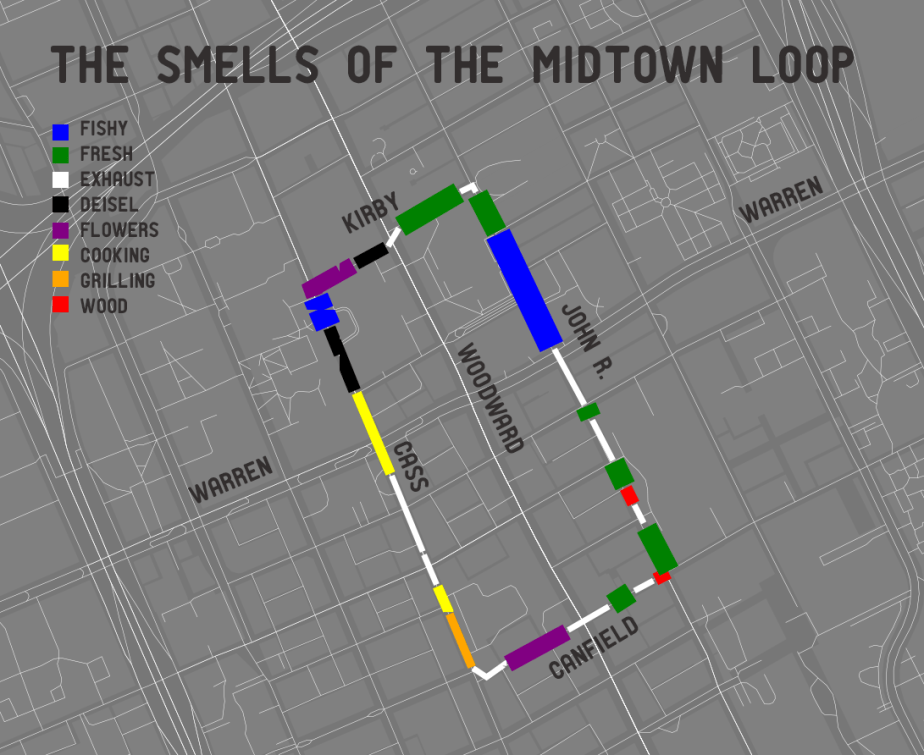
I’ve really wanted to do some psychogeography and while this is not the best example it did allow me to be more present in my walk around the Midtown Loop, a 2 mile placemaking project to improve the walkability of Detroit’s cultural institutions. Instead of doing the straight and scientific geography lines of the route I decided to record the smells that I experienced. Not all of them very pleasant.

My walk started at Hancock and John R. and moved counter clockwise. After crossing Warren and immediately at the Michigan Science Center the strong smell of fish hit me. It lasted quite a while and I assume is an issue with the sewers. The corner at Kirby and John R. is where the College of Creative Studies (CCS) and the Detroit Institute of Arts (DIA) have well manicured lawns. After crossing Woodward I took in the smells of exhaust and…

View original post 177 more words