young, white, and in detroit: gentrification implications

http://current.com/e/88996181/en_US
Video from: Feministing – Detroit, Gentrification and Good-ass Political Hip-hop

“First-stage gentrifiers” are economically- and socially-marginal “trend setters”. Sociologically, these people are young and have low incomes while possessing the cultural capital (education and a job), characteristic of the suburban bourgeois. They often reside in communal (room-mate) households, and are more tolerant of the perceived evils of the city—crime, poor schools, insufficient public services, and few shops.

Am I a gentrifier? I’m young, educated, low-income, and living in a house with 3 other young people. Uh oh! Since moving to Detroit I have considered what socio-economic consequences I could have on the current population and cityscape. My fiance and I have had many discussions about gentrification and what it means for Detroit. The definition I will be using:

Gentrification denotes the socio-cultural changes in an area resulting from wealthier people buying housing property in a less prosperous community. Consequent to gentrification, the average income increases and average family size decreases in the community, which may result in the informal economic eviction of the lower-income residents, because of increased rents, house prices, and property taxes. This type of population change reduces industrial land use when it is redeveloped for commerce and housing. In addition, new businesses, catering to a more affluent base of consumers, tend to move into formerly blighted areas, further increasing the appeal to more affluent migrants and decreasing the accessibility to less wealthy natives.

I live in the University District, which like most of Detroit is now a majority black community, but that wasn’t always the case. The District has a long history from farmland to annexation with the city, to development as a model community where, “homes could never be sold to or used by persons other than ‘of white or Caucasian race.'” Following the riots of 1967 and full blown white flight to suburban areas, black families began moving into the neighborhood. I live in a home who’s family has a long history of living in the area, contributing to the community, and working with the labor movement.

Being a gentrifier in Detroit has a serious implication when tied to the city’s past. That implication is born of the history of racial segregation and violence in the city of Detroit and the Detroit metro area. Public policy and popular perception of black people systematically marginalized and segregated populations based on race. The extended outcome of those causes can be seen with Michigan’s “blackest” city: Detroit residing a stone’s throw away from its “whitest” city: Livonia. Because of this historical disenfranchisement of the black community in Detroit, gentrification is all that much more a hard topic in a city facing difficult economic development.

Young Detroit

Recently NPR carried a story from Model D, an online news magazine that seeks to create a new narrative for Detroit (they also wrote about gentrification in 2005). The story was about a Detroit neighborhood soccer (futbol) league. Initially I thought it was incredible, but then realized that this was a snapshot of the growing gentrification of Detroit as I noticed in the video that nearly all of the participants were young and white. Many were there for the excitement of working in Detroit for non-profits and other social ventures. A band of “first-stage” gentrifiers? On the flipside how is Detroit supposed to innovate and grow without an influx of young and creative people? How can Detroit bring in excited youth, who are often white and more established, without fueling gentrification or the continued disenfranchisement of the majority black population?

Gentrification is happening mostly in areas around Wayne State University, the historic Corktown neighborhood, and neighborhoods near the Riverfront. The argument that these empty places in Detroit aren’t displacing anyone lacks a long-term vision. The city is beginning to see an increase in the number of “first-stage” gentrifiers and simply what follows is a second and third stage where eventually the first and second stage gentrifiers are displaced themselves by lawyers, physicians, and bankers. While all stages of gentrifiers are displacing the “native” populations of these areas by way of their socio-economic power. Is gentrification a natural fluctuation of the urban landscape? Can gentrification do any good?

Is Gentrification Growth?

No, if you look at the face value of gentrification and its broad economic impact, then sure gentrification is growth. However, when you factor in community and the effects on people – gentrification never equals growth, rather displacement.

Nothing good can come of gentrification. There is a minimal increase in tax dollars being sent to the city government, but that has little impact when (for now) the business dollars are being invested and collected in the suburbs surrounding Detroit. Communities don’t grow and get stronger, communities are changed by economic force through gentrification.

Looking Forward

The important step for Detroit now is to strengthen its community organizations and engage would be gentrifiers to support neighborhood development. Downtown redevelopment only benefits those with social mobility and that is not the majority of the Detroit population. Detroit’s black community has seen years of oppression and gentrifiers come in with a load of unearned privilege and resources.

First-stage gentrifiers (young, white, educated) can change the course for Detroit and instead work to be “allies in development” – partnering for stronger community organizations in black communities and actively engaging in local community efforts: shopping locally, attending block club meetings, and utilizing their privilege to highlight the progress that has been happening by native Detroiters as opposed to outsiders coming in with grand ideas for development.

If Detroit (and Michigan) is going to make it there can no longer be a black and white divide. There needs to be engagement from both populations where black communities have strong neighborhoods and white migrants recognize their privilege and work to assist community development that is already getting started. Get to know your neighbors and community, don’t create enclaves of white privilege, and support your community leaders!

“Detroit’s future is its neighborhoods” – Reframe Detroit

grand rapids can’t afford for detroit to fail

One of the recent articles from “Assignment Detroit” in Fortune Magazine attempts to say that Detroit needs to learn from Grand Rapids. The content that follows in the article goes on to prove that Grand Rapids is not like Detroit at all.

The article was titled, “A Michigan Success Story” with the tagline: “Its not the kind of view you expect these days in downtrodden Michigan”. It seems they can never give a clear message about Michigan or Detroit. Its a success, but downtrodden. Its working hard, but never making the mark. Let’s jump right in – so it is true, Grand Rapids is growing, has retained young people, and has significant investment in higher education and medical services – but that does not mean Detroit can replicate the business successes of this tiny West Michigan city.

Grand Rapids is not similar to Detroit. They had different industries, different populations, and different mean levels of income. From the article:

“thanks to a combination of business leadership, public-private cooperation, and the deep pockets of local philanthropists.” 

This picture is not as visible in Detroit, the deep pockets of philanthrophy don’t reach as far in a significantly larger city with a larger population (ever with Detroit’s population decline). Retired Chairman and CEO of Old Kent Bank, John Canepa is quoted saying,

“But Grand Rapids had an unusual set of assets. The wealth in this city in proportion to its size is extraordinary.” 

The Amway corporation and family, DeVos (whose name appears on far too many things in Grand Rapids), Steelcase and Meijer.

“The founders of those companies and their descendants still reside in Grand Rapids area, and match their deep roots with deep pockets of philanthropic dollars.” 

The article’s author is defeating his own argument with each quote he gets from local Grand Rapids leaders. They recognize that there were some similarities in how the decline in industry had effects on both cities, but are not as naive to think that what worked for Grand Rapids will work for Detroit.

Unemployment in Grand Rapids is still very high and not surprisingly this disproportionately affects minority communities. Detroit is a city of minorities, unlike Grand Rapids that holds its roots in the white, anglo-saxon, protestant traditions with traceable histories, long roots to local areas, propped by family assets and connections. The city government of Grand Rapids is also facing serious budget cutting and is working with unions to decrease benefits.

Grand Rapids is the “greenest city in the US” with more LEED-certified buildings per capita. This could also be attributed to the growing trends in environmental sustainability and the wealth that exists in Grand Rapids. Where Detroit can take a lesson is in offering more opportunities for Green Jobs. The Grand Rapids Community College just opened excellent training courses for various “green” industries. I will begin writing more about “green” solutions in following posts.

Detroit doesn’t have the hard cash wealth that Grand Rapids has, but it does have other rich assets when it comes to new ideas and initiatives for improvement. As in Grand Rapids, these ideas don’t come from the government or its funds.

A last final and important take-away from the article was a quote from Mayor George Heartwell, “we can’t afford to see Detroit fail. But if Grand Rapids recovery took two decades, how long will it take Detroit?”
No one can afford for Detroit to fail.

Bringing African Perspectives into US Activism (#USSFafrica)

Thursday and Friday I attended many of the Africa focused workshops – most were very exciting and engaging. They really brought the African perspective into the ideas of the US Social Forum and made delegates think about the US role in issues affecting communities on the African continent.

24 Thursday 10am-12pm

African Unity Towards What? (Pan-Africanism & Nationalism is not enough!) by: University of Kmt

I still haven’t exactly figured out this group and what they do. They run the Kmt Press which publishes books and journals, but all of their sessions that I attended were focused on teaching with an African historical perspective. Their missions states that they are dedicated to educating the new generation of African leaders. Interesting that they are in Detroit and I wonder if they know of the Detroit Public School (DPS) Initiative starting in 1992 where Africa was integrated into school curriculums from math to literature. 

24 Thursday 1-3pm

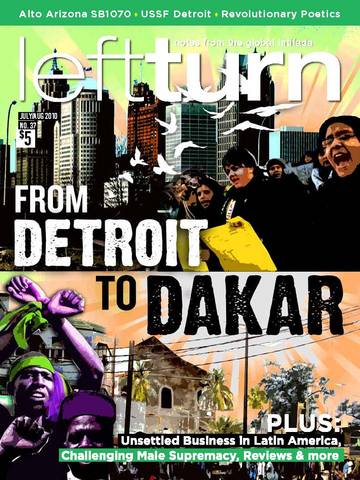
Prioritizing Africa & the African Diaspora Agenda from Detroit to Dakar (D2D) by: Priority Africa Network (PAN)

This People’s Movement Assembly was geared towards bringing African perspectives into the US Social Forum and continue the discussion as preparations are made for the 2011 World Social Forum in Dakar, Senegal. The room was full of delegates from many African countries, Detroit, and US Africa Advocacy groups. 

Briggs Bomba, Director of Campaigns at Africa Action, spoke strongly about building solidarity with those most affected in Africa. He said, “corporate led globalization has harshest effects on those in the perifery, the underdeveloped.” He reminded us that all of us the privilege to attend conferences like these and make the policies need to prioritize the communities most affected.

A delegate from South Africa spoke eloquently about the social apartheid of displacement – ideologically, locations, in decision-making and governments; in voting process lack of people power and transformational action, and in the social mainstream. “We cover many issues, but it is the same struggle. We come from different areas, but share common experiences.” (i.e. colonialism)

Some top issues that came out of the PMA:

  • Militarization in the Congo (DRC)
  • HIV & STDs from Detroit to Africa
  • political economy – effects seen in everyday Africa
  • African defense (defend communities), liberation (not yet liberated), and autonomy

An exciting and dynamic session that really makes me excited for the World Social Forum in Dakar!

24 Thursday 3:30-5:30pm

The New Africa Command & U.S. Military Involvement in Africa by: African Security Research Project (aka: Daniel Volman)

This session was an interesting overview of AFRICOM by some leading scholars on the topic of US national security interests in Africa. The attendees were less diverse than the Detroit to Dakar session and most people came to learn more because it looked interesting and had studied Africa to some small degree in the past. 

Most interesting was when the discussion turned to private military contractors (PMCs) in Africa responsible for fighting wars in Libera, Southern Sudan, and Somalia. A Ugandan delegate actually talked about being trained by PMCs in Iraq to then return and fight the Lord’s Resistance Army in Northern Uganda. Great to hear the perspective of the Ugandan delegate and Dan Volman as well as to see so many people interested in learning more about African issues!

25 Friday 1-3pm

Power-sharing Deals in Africa: Implications for Democracy – The Case of Zimbabwe & Kenya by: Africa Action

This was by far the most organized session that I attended at the US Social Forum. The Africa Action team did an amazing job of gathering great speakers, formatting the session, and bringing people into the room for the discussion. Many African voices were heard from delegates representing Zimbabwe and Kenya. 

In both cases of power-sharing, the speakers agreed that the power-sharing deal was a sigh of relief that stopped the fighting and opened their doors to the international community and economy again. However, they also all recognized that power-sharing was a positive in the short-term, but can be positive as in the case of South Africa when Mandela and de Klerk signed a power sharing deal until the national democratic elections.

Here are some take-aways:

  • A weak state can and will be manipulated (i.e. Museveni in Uganda – waiting for a similar situation as Kenya and Zimbabwe soon, elections next year)
  • “The people” are separated from the power – people-centered in needed
  • Power-sharing allows for lessened tensions and time to create national unity towards something better
  • Coalition governments show defeat of “people power”

Crossposted from SCOUT BANANA

Gray Panthers, Youth in Action, and the Non-Profit Industrial Complex (live blogging #USSF)

Here are summaries of some of the workshops I attended today:

Organizing Across Communities: Age & Youth in Action by the Gray Panthers of Metropolitan Washington

A workshop run by a sweet group of older (wise) people focused on bridging the gap of age in activism and building an intergenerational movement. Gray hair = gray panthers. Some critical thoughts on organizing with age in mind: 

  • #1 = Build Common Values!
  • utilize mentors – teach activist history, learn from older movements and successes
  • Listen! old and young listening to each other
  • Build skills – young activists can learn from old
  • Mutual RESPECT
  • Both young and old, ask each other for what is needed

Movement Building: Storytelling, Framing and Messaging by: Dream Act

Caught this workshop at the end with YP4 2008 Fellow, Sonia Guinansaca! Working with the Dream Act, Sonia spiced up the Youth Space (Basement of Cobo Hall near Michigan Rooms) with some excellent tips on telling your story to build support. She focused on making your cause personal. Awesome work! 

Growing Wings – Evolving out of the Nonprofit by: The Movement Strategy Center (MSC)

Tackling the concept of the Non-Profit Industrial Complex elegantly with a fun skit, one of the key members of the MSC who helped build the YP4 blueprint curriculum, Jidan Koon and colleagues from Serve the People, APAL, and Anak Bayan packed the 7th floor room of the Wayne State University Student Center. The building’s shifting and shaking could not deter the young leaders’ voices as they talked about operating within and without non-profits. Some key concepts to take away: 

  • Meet people where they are: house meetings, coffee shops, events at clubs
  • Connect to project with field trips
  • Create a collaborative/ cooperative organizational model
    • delegate responsibility
    • distribute leadership
    • collective decision-making/ agreements
    • build family/ organization culture of helping each other
    • create voluntary levels of involvement
  • Have a 40/60 gender rule to keep balance

reporting from "ground zero" (live blogging US Social Forum #USSF)

The United States Social Forum launched in 2007 based on the successes and excitement of the World Social Forums. The year 2010 is being marked by various regional events like the US Social Forum to take the place of the World Social Forum. So the fact that Detroit was chosen to host the US Social Forum (USSF) is very exciting.

As exciting as it is, it also happens to enable numerous aspects of privilege. As over 10,000 people converge on Detroit, people often to refer to the city as “ground zero” for the economic crisis. The weekend before the USSF, Young People For (YP4) held their regional training at the Renaissance Center for their Midwest fellows. I attended the opening event with alumni and partners to meet the new class of fellows. Like the World Social Forum, YP4 is breaking their national training into regionally based events. Many of the fellows noted that before they came to Detroit they had thought of the city as a place NOT to visit. With a view over the riverfront, looking across at Canada, many mentioned that they had no idea Detroit was so beautiful. Others commented that they had no idea Detroit had a downtown and tall buildings.

These large convergences of people bring Detroit into a brighter light and change the perceptions of many. There are plenty of things to be worried about in Detroit, but not just because it is “Detroit.” Likewise, as the city fills with activists and radicals of all shades, the majority of Detroit residents are unaware of what is even happening. YP4 Director, Rebecca Thompson, informed us that many of her family members in Detroit and friends had no idea that the USSF was happening the next day. I’ve worked with a few local Detroit organizations that canvassed some neighborhoods to let people know about the USSF, but the impact was minimal at best. How can this happen? How can residents of a city, businesses, and even some government not know that 10,000 people are coming to their city to infuse it with new ideas, people, and solutions to social problems?

This could be a result of the slightly disorganized activities of the USSF organizing committee. I won’t go into the stories that I have heard of the power struggles between organizations working to put this event together, but it is worth noting that thoughtful improvement can be made. A thought that occurred to me the other day was: What if the USSF was organized with local groups tackling specific issues host a topic and organize like-minded groups across the nation so that this conference is less focused on talking and more on building potential solutions that Detroit organizations can use and others can take home?

After hanging around, surveying the organizations tables with my girlfriend (Nichole :-D), we headed about 2 miles away for the march. We were a bit behind and stopped in the shade to watch the chanting crowd go by. At the length of almost 8 city blocks (or more) it was an incredible sight to see in a city often referred to as a “ghost town.” And yet privilege came out again as local Detroiters asked, “What is going on?!” and the Detroit Red Cross asked me, “Do you know what all these people are doing?” YP4 staffer, William noted that if this was in DC, everyone would know with posters, twitter updates like crazy, and just the general buzz.

Unfortunately residents of Detroit are not as privileged to be as connected as those in DC. Likewise, residents, in the case of the USSF, have not been a focus of organizing or informing. This has become a common theme that I have noted within government and other activities to rebuild Detroit. Focus on the people who are actually in Detroit! The activists who come for this weekend may hold some new ideas about the city, but in the end they will leave and what will be left for the city of Detroit?

your thumbprint stays the same

Over the course of your life you will grow and your fingerprints will grow along with you, except for your thumbprint. Michigan is much like your fingerprints and Detroit is the thumbprint. As the state has grown (sometimes negative growth), Detroit has remained the same, “trapped” if you will, in its post-automobile slump. Alright, so I know Detroit isn’t in the thumb of Michigan, but it was nice analogy. Beyond the images of Detroit’s destruction lie the seeds of real growth. The economic situation of Detroit isn’t all lost and the state doesn’t need to sign on to stimulating reforms to make it happen.

Few people seem to grasp that the economic situation of Detroit reflects that of the state of Michigan. Where, unfortunately, politics plays a larger role. For many years there has been an unspoken clash between the former economic power that was Detroit and the political power that is Lansing. With Detroit’s decline, no region of Michigan has been able to match and replace the city’s production power and “driving” economic engine. To the rest of the world Michigan is Detroit and until politicians in Lansing recognize that fact – then the state may be doomed. However, the issue goes far beyond image, as I wrote before. One important point made in Professor Ritchie’s post, Is Michigan a Third World Economy?, is the need for “strong political leadership” which is missing in both Detroit and the state of Michigan as a whole.

The one thing that I have found to be a constant in Detroit is the sense of community. From people who live in the city at large, the various enclaves and districts of the city, and the groups and organizations that work to make Detroit a better place. Unlike any other major city, this sense of community needs to be fostered and developed. The city needs to stop trying to bring in people from the suburbs and from outside the city. There needs to be a greater focus on the people who are already here. Living the struggles of Detroit and working to make the solutions.

Thankfully there are examples from initiatives in other struggling cities across the US to give direction as to how Detroit can begin to thrive again. The Governor and many experts have talked about innovative industries. Detroit and dense city centers like it can capitalize on the new “green” industry. But will “green” be enough to “save” Detroit? Hardly, and the third installment about Detroit will highlight solutions happening and the people who are pushing to make their communities better.

detroit is gotham without a batman

batman_truck

Michigan’s “third” world city, as it is often referred to, is a place where community stands out over commerce. It is best known as a place you would not want to visit and best recognized (on the big screen) through scenes of armageddon and the end of the world as opposed to its architectural prowess; qualified as “the nation’s finest.” Since the race riots of 1967, and earlier, the city has never been able to recover its image. Continually in movies and the news Detroit is marked as a pit of a city resembling in some parts a war torn city where bombs have reduced neighborhoods to rubble. Where is this gothic city’s batman? How is it that Detroit matches the “third” world?

I will answer the second question first.

Since August I’ve been living and working in Detroit focusing on youth empowerment and community service/ engagement. What I have seen has been this common image of a destroyed Detroit, but I have also had the privilege of seeing some of the incredible initiatives launched by the communities and people of Detroit. I have to disagree with the many who would say Detroit is “third” worldly. The majority of its population may fall far below the poverty line, but it is absurd to describe the city as a “third” world.

The recent Time Warner “Assignment Detroit” journalists “embedded” in the city have taken to writing similarly scathing articles of Detroit and have perpetuated the destroyed image of Detroit. Example from the New York Times: Ruin with a View. There are a few organizations attempting to recover and reclaim the image of Detroit from these corporate story weavers, notably Inside Detroit tasked with getting more people to know about Detroit: “they know it, they love it.”

Many people that I have worked with talk about the similarities between the developing “third” world and Detroit. Poverty has many similarities and often looks the same from the outside, but poverty has many stories and the circumstances are never the same. My friend Cory recently described what is and has been happening in Detroit as a man-made disaster. I couldn’t agree more. It is no hurricane, flood, or earthquake, but definitely comparable: from rapid industrialization, capitalism, racial tensions and white flight to relying on a solitary automobile industry, even the long running political climate in Detroit has been a contributing factor. “Third” world is just another negative descriptor for the city and an attempt to glamorize the city’s economic decline.

Stay tuned for the my answer to the first question this week (to be continued. . .)

* Note: I am not really giving “answers,” but my thoughts based on learning about and being located in Detroit over the past year. I wouldn’t dream of giving Detroit answers after just one year.