indicators of econ-obesity growth

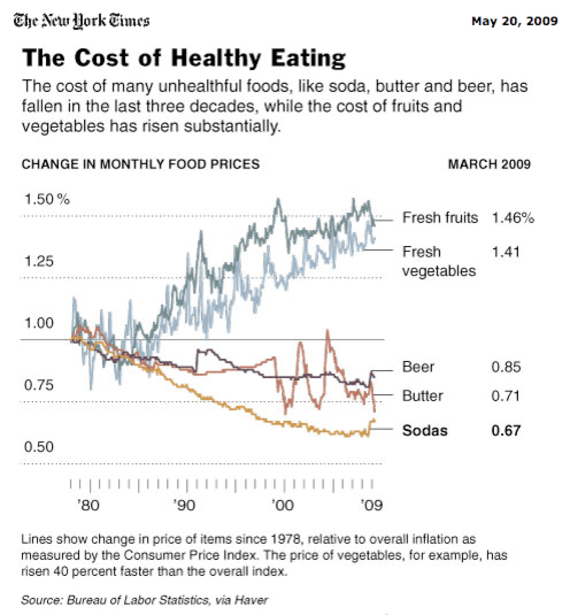
Obesity is still on the rise. In many cities there have been decade-long campaigns to improve healthy food access, spread information about health risks, and new national efforts to get children active – are they not working? Latest estimates predict that by 2030 almost half the adult population will be obese. Recently, the CEO of the Robert Wood Johnson Foundation (RWJF) wrote in the Washington Post about their latest report and the future impact of obesity on our economy. She noted the decline of productivity and increasing health care costs associated with obesity. While we often think about fast food, inactivity, and individual choices related to being obese, how often do we consider the economic causes and effects?

Obesity is Not a Choice

I have never met anyone who said that they specifically chose to suffer the health effects of being obese because they thought it would be a great way to live. However, beyond personal choices, obesity can be correlated with a number of social and environmental factors, namely: poverty, urban areas, as well as minority and low-income populations.

Just as individuals cannot choose their parents, they also cannot choose their life circumstances, which unfortunately can sometimes hinder efforts to live a healthier lifestyle. Research has shown that rising rates of obesity disproportionately affect Black and Hispanic populations. This demonstrates a confluence of factors with roots in racially motivated housing policies, lack of social mobility due to historical discrimination, and the absence of adequate health services for these communities.

Impoverished communities are filled with companies looking to take advantage of the marketplace of poverty. Dollar menus, frozen dinners, and corner store snacks – not to mention the advertising which helps build a psychological belief that it is quicker and cheaper to eat unhealthy foods.

In short, obesity is just as much an economic reality as it is a need for healthier lifestyles. It represents a by-product of mass producing foods to reduce costs and increase profits. People do not choose to live in poverty nor do they choose to be obese. Economic constraints on top of fast food advertising drives a culture of  unhealthy eating.

Tax the Fat

The debates have raged about recent plans to tax the size of soda pop in New York City or in other countries the tax on fatty foods. There is a growing field of research on behavioral economics, which argues that people will choose the option that is most beneficial to themselves.

This is, however, not always true. People do not always make the most rational decision especially when it comes to their food and eating habits. Increasing the economic burden on people who typically choose unhealthy foods is not necessarily the best option. If a tax is placed on high-calorie or high fat foods it allows the food and beverage companies to continue avoiding responsibility. It isn’t about personal freedom, it is about being able to compete in a marketplace where the cards are constantly stacked against the poor.

Food and beverage companies will still find a cheap way to produce their products that works around any tax or restrictive policy. These companies have a primary goal to make a profit. If making that profit means burdening the population with unhealthy foods and the long-term health effects, they have no qualms. This is where people generally argue that it is about personal choice. This is partly true, but also relates to my first argument that you can’t always choose your life circumstances. All around the world now people are struggling with obesity and healthy eating. Food and beverage corporations are able to take advantage of global income and food disparities to generate their profits.

Behaviors Always Win

Using a “fat tax” to increase the economic difficulty of buying unhealthy food is doing no good when there is a psychological war on TV and advertising campaigns.

“It’s the behavior stupid!”

We can talk all day about the responsibilities that corporations have to give people healthy foods as well as the responsibility of individuals to keep themselves healthy, but in the end it all comes down to behavior. When I say behavior I’m talking about the eating habits that people have learned since their childhood, the behavior influenced by the food commercials seen on TV, the behavior informed by the massive portion-sized, “give me what I paid for” food culture.

When we are constantly bombarded by images of juicy burgers, steaming pizzas, and actors telling us how amazing it is to get quick, cheap food – we will eventually believe it. Food and beverage companies employ their own teams of psychologists to be able to manipulate their advertising to be the most convincing. These companies have found out the best ways to exploit the disparities that people face in order to get more people to buy their unhealthy foods. Don’t have time to make dinner? Bring your kid through the drive-through. Buying groceries on a budget? Get 3 for $5 cases of pop or 2 for $5 bags of potato chips.

When it all comes down to what will or won’t work, people need to understand what they are up against, they need to be informed on what foods will benefit their health, and they also need to be able to have the tools to make healthy lifestyle changes. While many food companies watch their profits grow, many individuals watch their weight grow due to their own economic disparities. Helping people address these learned behaviors and economic barriers will help to reduce health care spending and increase the productivity of our economy.

De Troit a la Mondrian

Alex B. Hill's avatarDETROITography

mondrian_detroit

While looking at the 2010 census data on population density and the percentages of change between 2000 and 2010, I kept imagining the Detroit census tract grid in the style of Dutch painter, Piet Mondrian. He began painting his primary color grid works while studying in Paris.

Then I saw this Mondrian world map and went for my own version of Detroit’s percentage of population change.

View original post

Ebola, Disease Outbreaks, and Inadequate Health Systems

I vividly remember the Kagadi Hospital run by the Ministry of Health. In 2002, I was visiting the communities that would benefit from an ambulance fundraiser project. That evening the need for emergency transportation in the Kagadi-Nakuulabye area of the Kibaale District could not have been made more clear to me. Driving back to our housing one evening, our pickup truck was flagged down to help at the scene of a bicycle accident where two riders had collided head on in the dark. One man was bleeding from his ears and obviously needed advanced medical attention. We drove him, lying in the pickup truck bed, to the Kagadi Hospital only to be turned away because the staff said they didn’t have any supplies to treat the man. I remember looking into the hospital windows and seeing nothing but empty walls.

It came as a shock to read news of the Ebola outbreak in that very same area where I had visited 10 years ago: Kagadi, Kibaale District. My first thought was that the health care system couldn’t possibly respond quickly enough, but hopefully things had improved over the last decade. Reports noted that the Red Cross, Doctors Without Borders, CDC, and the World Health Organization (WHO) were assisting with the response. This was a positive sign since the area is rural, difficult to travel to, and as far as I knew lacking a strong health care system.

“This outbreak is occurring in the same area where the Red Cross is already responding to the growing crisis caused by the influx of Congolese refugees fleeing violence in their country” said Charlie Musoka, Regional Operations Coordinator for the International Federation of the Red Cross.

On top of dealing with the Ebola outbreak, the Ugandan Red Cross was also managing the influx of refugees into the country. My initial thought was that Ebola is easily transmitted by close contact between people and usually kills 90% of those infected. With the regular movement of people across the Uganda/ DRC border it could be just days before an Ebola outbreak occurs in the DRC.

Shortly after the Ebola outbreak, news broke that the Ugandan Ministry of Health needed Sh3 billion to be able to contain and manage the disease and necessary health care facilities. I was also contacted by the local health center in Kagadi and told that were having difficulty responding to the outbreak as well. My fears seemed to have been true and the health system was feeling the pressure of responding to an Ebola outbreak in an area where there was very little health care capacity.

Roughly, two weeks after the request for supporting funds by the Ugandan Ministry of Health, the Ebola outbreak is reported as contained in Uganda and a Ugandan team would be sent to the DRC to help contain the new outbreak there. Reports said that it was a different strain of Ebola, but the first reports were in a Uganda/DRC border town that is a regular crossing point between the two countries. I had worried about the lacking health care system in Uganda, but the health care system in the DRC is in an even more strained. There are limited health care workers and facilities, which are usually filled by casualties from the ongoing violent conflict in the region.

Early this month, the WHO declared Uganda Ebola free after there were no new cases reported after August 3rd (24 confirmed cases, 17 deaths). The facilities in Kibaale District remain on alert, but the larger Ebola crisis is in the DRC. The WHO confirmed the Ebola outbreak is a different strain (see map above) and not connected to the Ugandan outbreak, however there have already been 72 confirmed cases and 32 deaths. Health workers were reported infected in the Ugandan outbreak, but in the DRC so far 23 of the 32 deaths have been health care workers. Representatives of Medicines sans Frontiers note that the death of health care workers at hospitals scares people away from seeking treatment and they are more likely to continue the spread of Ebola. It seems that the DRC has been less equipped to deal with the Ebola outbreak or its just the nature of the area where the outbreak occurred that made it easier to spread.

Both of these examples of Ebola outbreaks in a remote region of Uganda and in a transit town in the DRC demonstrate the critical need for adequate health care systems and health care workers. Before conflict started in the DRC, the health care system was already underfunded and in need of investment. The United Nations reported that militias raided almost all of the health care facilities in rural areas where 70% of the populations lives. The conflict also disrupted transportation and everyone must travel by foot to get treatment. NGOs have tried to invest in the health care system, but Doctors Without Borders report regular attacks on their compounds. In Uganda, there has been similar conflict, but greater investment in the health system. However, a recent report highlighted the inadequate staffing and space in many key hospitals. In some areas there is 1 doctor for every 178,000 people. Due to financial constraints the Ugandan government has banned recruitment of health care workers.

No one can afford to not invest in health care capacity building. In these two countries it seems that health crises need to be managed by outside NGOs with additional funding. How can the international community better work to build the capacity of individual country’s health care systems?

Major outbreak of AT&T disables population, no end in sight

Recently, I have come down with a serious case of AT&T. The last time this happened was in 2010 and both times it lasted over 3 weeks. What is AT&T and how can one acquire it, simply by attempting to access reliable internet service from the telecom giant known as American Telephone & Telegraph company.

Here were my common Symptoms:

  • Desire to tear out hair when hearing digital voices
  • Outbursts when encountering elevator music
  • Serious mental fatigue from being on hold (often referred to as “fried brain”)
  • Aversion to calling any “helpdesk”

My most recent case of AT&T lasted for 3 weeks and ended in a very unsatisfactory conclusion. From that experience I decided to do some number crunching to compare my cases in 2010 and 2012. The measures I used were:

  1. Number of people involved in my case (direct contact)
  2. Personal time spent: on hold, waiting for technicians, and during technician visits
  3. Internet speeds promised by representatives and speeds actually accessed (only 2012)

My first measure was based on how many people that I was in direct contact with regarding my case of AT&T. Direct contact is defined as an in-person technician contact or human-over-the-phone conversation. My case in 2010 involved a high number of people because AT&T had not yet developed its digital voice system to direct “helpdesk” calls to the right place. As a result I had to talk with many people and be transferred often during my 2010 case. In 2012, the number of people I spoke with didn’t spike until my issues involved billing and my call was dropped twice (9/28). I know there were also a higher number of people dealing with my 2012 case from the main office and technical team, but had no way to track those numbers.

The company has given greater control and access to representatives to be able to deal with “helpdesk” issues, reducing the number of transfers. I am happy that I don’t have to deal with as many people, but this seems to have increased the personal time that I need to spend dealing with my case because it never reached the right people and my problem persisted.

Unfortunately, in both cases, my personal time spent managing my cases was abhorrent. My case in 2010 took almost 20 hours to reconcile with the majority of this time being spent on hold or in transfer. In 2012, my personal time went over 24 hours after being asked to block a 12 hour window for a technician to be able to come and work on my line. My 2012 case involved AT&T “chronic facility issues” which sounded like a systemic issues with poor quality internet connectivity.

It wasn’t until after the 6th technician who came out to my house told me to call billing that I was then informed that the internet speed promised during my first call (08-24-12) was completely impossible because my area was on “lock” for 6 mbps.  Three weeks, 24 hours, and the first representative I talked with couldn’t even tell me accurately what was available in my area? Shouldn’t this be basic?

A healthy dose of prevention could have saved me a lot of trouble and the company a lot of money in both my 2010 and 2012. I was compensated $370 in 2010 and roughly $280 in 2012 (not including technician pay). This telecom giant needs to be more receptive to customer needs and increase the reliability of both their “helpdesk” system to tell customers honest information and their technical systems for delivering good internet.

A study has found that American consumers are paying higher prices for slower connections. It’s an epidemic and truly there is no end in sight.

Recipe: Sweet Potato Quinoa Burgers

This new recipe comes by way of my little sister which she found on a food blog, whose author ate at this restaurant in Grand Rapids, MI and found the original recipe on a cooking website.

When my little sister first made them for us they turned out to be massive patties of vegetable goodness falling everywhere out of the bun. I swore there must be a way to make them stick together better. My wife and I attempted a second time with the leftover veggie mixture for a longer cooking time, but again they fell apart. The third time (pictured) I sprayed more oil on the grill pan and made the patties a little bit smaller. After reading through the food blog and cooking website I think I’ve discovered my error. The cooking website notes to use:

“Pour a generous amount (8” depth) of grapeseed, canola, or vegetable oil in the bottom of a large skillet.  Heat the skillet to high heat, taking care not to let the oil smoke.”

Basically, you need to fry the patties so that they will stick together – not as healthful as I hoped. I’m thinking using a bit of egg in the mixture will help it congeal and keep the vegetable goodness less fried.

Here is the recipe that we adapted from the two listed online.

Ingredients:

  • 2 cups of diced onion
  • 2 minced garlic cloves
  • 2 cups of cooked lentils
  • 2 cups of cooked quinoa
  • 1.5 cups of mashed sweet potato (about 2 sweet potatoes)
  • 1 cup grated carrot
  • 1 cup chopped kale
  • 1.5 cups of oats (any kind)
  • 0.5 teaspoon ground cumin
  • 0.5 teaspoon ground coriander
  • 1 tablespoon of curry powder

Steps:

  1. Pre-cook the lentils and quinoa.
  2. Mix all the ingredients in a large bowl. We used our food processor to blend everything together into a nice sweet potato “dough.” Let the mixture set in the fridge for 1 or 2 hours.
  3. Saute the onions and garlic until the onions become clear.
  4. Make the burger patties from the mixture. They can be as big as you want because they won’t shrink when cooked.
  5. Place a thin layer of oil on a pan to cook the patties (we’ll try to cut down on the oil as much as we can – feel free to be as liberal as you need). We used a grill pan, but I think the uneven grill surface caused the burgers to separate more during the cooking process. A flat pan would be best.
  6. Cook each side of the patty for 3-4 minutes.
  7. Serve with ketchup, hot sauce, or I prefer a dab of hummus on top.

Hot Air Balloon First Anniversary

Alex B. Hill's avatarEight Twelve Eleven

259702_10102432769981274_1176341848_o

Nichole had the most amazing idea to go hot air ballooning for our First Anniversary. She found a place in northern Michigan near Traverse City where you float over the Traverse Bay in the early morning.

We made the long drive, but it was well rewarded by a perfect dinner at Amical in Traverse City. The most amazing seafood that we both thought had ever graced our stomachs. Nichole still wants to go back again. If you are in Traverse City, this is a place not to miss.

We camped out at Interlochen State Park along with numerous family reunions and pop-up trailers. We needed to purchase firewood before we reached the campsite and I was sure there would be some for sale along the way. We passed a few places, but never saw them in time to stop. Finally, we came upon an old white ranch style home with…

View original post 391 more words

Global Malnutrition and the Politics of Food

Whether they are starving or eating too much, children around the world are malnourished. A full belly doesn’t necessarily mean that a child is getting proper nutrition from the food that they eat. Obese children are just as nutritionally deficient as children who have bloated bellies from hunger. The result is a global generation of unhealthy children who will experience a shorter life expectancy than normal from complications with their health and related diseases. The double burden of malnutrition is seen in both a complete lack of access to food and an overabundance of unhealthy foods.

A recent World Health Organization (WHO) report stated that combating five major health factors could eliminate millions of premature deaths. Among those top five is childhood nutrition. Lacking nutritious food has serious implications for health, but consuming too much food without nutritional value, which contributes to obesity, is more likely to lead to a premature death. For the first time in 15 years, children in the US have a lower life expectancy than their parents. By the same token, children in countries defined as “developing” have faced low life expectancies for many years, but what they eat (or don’t eat) is less likely to kill them. Who would have imagined that being overweight is more likely to kill you than being underweight?

On the flip side of childhood nutrition is the near complete lack of access to food in developing countries. There were any number of crises this past year that qualified the “need” for food aid from “developed” countries. Floods, earthquakes, droughts, famines, etc. – but what is the state of food aid? Is it excellent nutritious assistance in difficult times? Bill Easterly and the Aid Watch blog ask: “Can the story on US food aid get any worse?,” noting that the US continues to support relief agencies that use a corn-soy food blend that doesn’t even meet the 1960s international nutrition standards of food aid. Children in developing countries don’t necessarily die from a lack of nutritious food, but rather from the diseases that attack their weakened immune systems. The food we eat is a first line of defense by keeping the rest of our body systems healthy. Some of the best examples of the importance of food and health come from Paul Farmer, who often says that, “the treatment for hunger is food.” Many times food is overlooked as a critical treatment in health crises, which makes it that much more important to invest in nutritious alternatives for food aid and support local farmers around the world.

Unfortunately here in the US, corporations have a firm grip on what we eat. There are a small number of major factory farming corporations that produce our food. They use coercive actions and their money to keep control of farmers and the food industry. This hurts our families and communities here in the US and contributes to the nutritional inadequacy of what Americans eat, but it also has far reaching implications in developing countries. Because of the control by US corporations of the food industry and the US government’s subsidies for farmers, food prices have been rising steadily around the world. This impact is hitting small farmers in developing countries hardest as they struggle to find markets to sell their produce and support their families. These small farmers can’t compete with US farmers who are government subsidized or the US corporations who are mass producing and shutting them out. Even as people in developing countries struggle to buy food to eat, one in six Americans are struggling with hunger. This is largely a result of the economic downturn and has affected more than just those already considered poor in the US. It is estimated that nearly one billion people do not have access to a secure source of food around the globe.

While the fact that many Americans struggle with food security is shocking, the spike in rates of obesity demonstrates the pressing need for communities to rethink how they eat and live. Obesity gives a blatant visual representation of how much control we have lost when it comes to our food. The WHO states that “globesity” is spreading across the globe and millions will suffer if we don’t make changes. A recent study conducted by Wayne State University showed that one third of infants in the US are obese or at risk for obesity. This allows us to easily assume that an obese infant will become an obese adult. Hunger and food security are extremely important issues when it comes to talking about health and nutrition. Many who suffer being underweight have suffered through natural disasters, but the immediate threat to children and the global population is the man-made disaster of being overweight.

Thankfully there are many people who are working to fix the food industry, support local farmers, and promote healthy eating to children in schools. President Obama recently signed the Child Nutrition Bill to increase access to healthy foods in schools. Where there have been numerous policy barriers nationally and internationally, this is a step in the right direction to bring policies in line with the health needs of our global population. We must commit to supporting the basic health of our children if we care about a building a healthy future.

Originally featured and posted at,  Americans for Informed Democracy on 18 January 2011.

Detroit’s Per Square Mile: Inequality from Space

Firstly, this was not my idea, but I wanted to test it out in Detroit. Tim De Chant posted on Per Square Mile that inequality can be visualized from space via satellite images on Google Maps/Earth. He previously wrote about the concept that the lack of urban trees represented the absence of wealth in certain areas of a city.

“Research published a few years ago shows a tight relationship between per capita income and forest cover. The study’s authors tallied total forest cover for 210 cities over 100,000 people in the contiguous United States using the U.S. Department of Agriculture’s natural resource inventory and satellite imagery. They also gathered economic data, including income, land prices, and disposable income.” (source)

The research basically stated that with an increase in income the demand for trees increased likewise decrease in income showed a decrease in demand for trees. As De Chant writes, the authors found that trees were seen as a luxury item.

This all made the gears turn in my head about how this research and De Chant’s image grabs from Google satellite imaging applied to Detroit.

48205 Osborn (“Deadliest” Zipcode)


I choose 48205 because, “The neighborhood of 44,000 residents accounts for 6 percent of the city’s population, but was home to 15 percent of its murders and 13 percent of its shooting victims.”

48221 Palmer Woods

I used to live in this zipcode, in the University District. I would often run around the Palmer Woods neighborhood because I was fascinated by how different running south past 6 Mile Rd. and running north above 7 Mile Rd. could be such different environments. Census data pegs this zipcode as one of the highest income areas of the city.

The idea seems to work well in Detroit neighborhoods, however the Greening of Detroit is working hard to plant more trees every day in both wealthy and poor neighborhoods.

“Between 1950 and 1980, around 500,000 trees were lost in Detroit to Dutch elm disease, urban expansion and attrition. During that same time period, economic constraints prohibited the city of Detroit from replacing those trees. […] In 1989, Detroit, a typical American city, was losing an average of four trees for every one planted.”

The organization is estimated to have planted over 65,000 trees since its inception in 1989.

Polio Eradication Efforts: Militant or Ineffective?

Follow the Polio outbreak in real time with HealthMap

Smallpox has been globally eradicated since 1980, so why is the eradication of Polio so much more difficult? The World Health Organization (WHO) recently released that the Global Polio Eradication Initiative (GPEI) would be conducting a new targeted 15 country effort to vaccinate 72 million children in Africa. The new campaign follows numerous failed efforts of the past and reemerging outbreaks. Why does the African continent remain prone to Polio outbreaks that spread rapidly? Why did the organized campaign to eradicate Smallpox take only 21 years while Polio is going on almost 40 years?

Since 1796, when cowpox was used to protect humans from Smallpox, eradication efforts have taken place. It wasn’t until the WHO intensified the eradication of smallpox in 1967 that efforts were coordinated around the world. The Smallpox Eradication Program (SEP) was jointly run by the WHO, CDC, and National Ministries of Health in various countries. Doctors and epidemiologists from the US volunteered to help with the efforts. In many instances US volunteers were overbearing and controlling of their local counterparts. A report by Paul Greenough documented the use of intimidation and coercion in the final stages of the SEP. Foreign volunteers were sent to kick down doors (literally), force vaccination of those who refused, and fix the mistakes of local staff members (1995). These coercive tactics evoked resistance from local communities, but the SEP prevailed. The SEP was run in a structured, militant fashion, where individual human rights were overridden for the global public good. Similar issues with resistance have been seen in Polio eradication efforts, but responses to resistance have not been as militant. Could this be why Polio has continued to resurface?

The earliest documented case of Polio in Africa is traced back to 1580 B.C. in Egypt and still the virus continues to spread across the continent. The eradication of Polio relies heavily on National Immunization Days (NIDs), but these events are ineffective because they aren’t comprehensive vaccination efforts, positive cases are missed and some children aren’t vaccinated causing continued Polio outbreaks. Organized Polio eradication efforts began when the World Health Assembly launched the Expanded Programme on Immunization (EPI) in 1974, a program implemented through the NIDs . In 1988, the World Health Assembly said that by the year 2000 Polio would be eradicated and they launched the Global Polio Eradication Initiative (GPEI) to make it happen. Many prominent people and organizations put their support behind the program including Rotary International and Nelson Mandela, who in 1996 launched the “Kick Polio Out of Africa” campaign which vaccinated 420 million children. In the 90s, the UN Secretary General negotiated peace treaties to vaccinate in war-torn Liberia and Sierra Leone. Most recently in 2004, 23 African countries coordinated NIDs focused on Polio vaccination.

After all these efforts, Africa remains the only continent where Polio remains alive and well in multiple countries. A series of studies completed across West Africa showed that due to misconceptions about the vaccine, lack of adequate funding and corruption at the local level, and ineffective immunization campaigns, Polio has persisted on the African continent (Melissa Leach & James Fairhead, 2007). The year 2007 marked an outbreak of 25 cases in Angola which spread to 28 cases in the Democratic Republic of the Congo (DRC). In 2008, after an outbreak in northern Nigeria, where there have been vaccination conspiracy theories, spread to a dozen other countries, the WHO made Polio eradication their “top operational priority.”

Armed with a “more effective” version of the oral vaccine, the new GPEI organized effort across 15 countries hopes to eradicate Polio for good. However, just yesterday the New York Times wrote that the WHO reported 104 deaths and 201 cases of paralysis from Polio in the DRC. Is the renewed GPEI effort, launched Oct. 28, 2010, even working? Is eradication even a desirable goal at all, if past experience with Smallpox Eradication Program requires militancy?

Originally written for Americans for Informed Democracy (Dec. 4, 2010), where I wrote as a Global Health Analyst.