privilege is a key determinant of health

In our world of abundance there are growing areas of scarcity, our urban cities. These growing areas of scarcity once used to be bastions of wealth, but are now best known for their decaying infrastructures and lack of resources.

In some cases urban cities have faced industrial decline, in others its an issue of poor residents being marginalized. Either way, the health disparities that accompany low-income and minority communities is abhorrent.

One of the top health indicators related to privilege that can be seen in these communities is access to healthy food options. From Los Angeles to Detroit to Philadelphia, various communities lack basic nutritional resources like fresh produce and as a result have been disproportionately hit by health conditions related to lifestyle such as diabetes, high blood pressure, and obesity.

In the Ramona Gardens projects of Los Angeles, residents have to travel 3 miles by bus to reach the closest supermarket for fresh produce. The other small shops in the community just can’t stock as much as larger stores because they don’t sell the same quantities or they would have to charge higher prices. The health impacts such as hypertension and childhood obesity noted by a free clinic in the community show how critical access to healthy food options can be. The Ramona Gardens project is a great example of privilege playing a role in the health of low-income and minority communities by way of accessibility of resources.

photo credit: Dr. Hillier (NPR)

Similar issues have been found in black, low-income communities of Philadelphia. Like many urban areas, grocery stores fled to the suburbs where there was more space for larger stores and safer neighborhoods, not to mention higher paying customers. As a result of a community mapping survey, almost 20 supermarkets have opened in Philadelphia with the help of state funding. This brought access to healthy food for many low-income communities in the city.

As recently as 2007, large grocery stores have pulled out of Detroit. Not many have attempted to stay and Farmer Jack was the last standing. Detroit is often called a “food desert” because it lacks a major chain supermarket. The problem is not necessarily a lack of supermarkets, but rather the scarcity of healthy food options. Martin Manna, the Executive Director of the Chaldean American Chamber of Commerce of Southfield said,

“There usually is a market within walking distance of nearly every area of Detroit. It might not be a supermarket. That might be why there are so many people eating potato chips rather than wholesome foods in Detroit.”

Other Detroit residents have noted the lack of options at Detroit stores. Some stores claim to be serving a “black clientèle,” but  Gordon Alexander, who lives on the East side, says its just an excuse for stocking bad quality goods. This is a perfect example of racial privilege compounding income disparities when it comes to healthy food options in Detroit.

Our world of abundance needs to be able to serve everyone. There should be no reason that low-income communities struggle to purchase fresh produce or healthier foods. We can’t allow fast-food chains to make profits in the “marketplace of the poor” and add to the health disparities of minority communities. If anything, we should be able to find a way to offer healthy food to all citizens of our country regardless of race, income level, or location.

Featured on Americans for Informed Democracy Blog where I’m contributing as a Global Health Analyst.
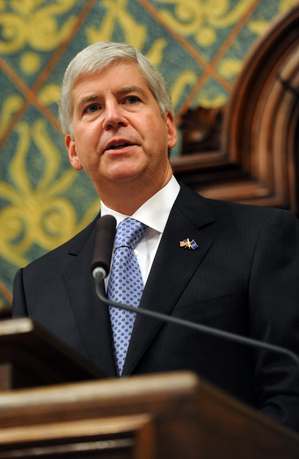
Open Letter to Rick Snyder: from a concerned customer

“The reinvention of Michigan must not leave anyone behind.”
– Rick Snyder (Inaugural Address, Jan. 1, 2011)

Dear Governor Snyder,

Michigan has a long history with big corporations, many which have recently come under severe scrutiny. My generation has watched as numerous corporations from Enron to GM have put their own interests first and have hurt many communities, families, and people in the process. What Michigan needs is not tax breaks and improvements for corporations, but rather improvements for communities of people who are the heart and soul of our state.

I’m not sure where your economic and development theories come from, but a “shock doctrine” just won’t work (just ask Jeff Sachs what the long-term benefits to the Bolivian economy were). There is no way that Michigan’s economic slate can be wiped clean for whatever changes you want to push. Economic development is never independent of history or social consequences. The success of neoliberal economics in further marginalizing populations that are already marginalized is appalling.

In the name of the economy, you have submitted a budget plan that not only further marginalizes populations in need, but also allows for a future of corporate control in our state (emergency financial managers). Taxing pensions of the elderly, cutting incentives for the middle class, slashing tax credits for the working poor, eliminating health benefits for same-sex partners, and crippling the powers of unions and public employees are all powerful representations of your social agenda being masked by your “economic” reforms. There will soon be 2 classes in Michigan, the wealthy and everyone else.

Time and again, in economic development models implemented in communities around the world the need is not for an environment where corporations can thrive, but rather an environment where communities can build and create. People need to be empowered to grow their own communities and create opportunities for collaboration. If you truly believe that Michigan needs an “era of innovation” then you need to look closer at policies that will have long-term impacts for the state.

One long-term impact that you should highly consider is supporting an ‘ideas economy’ through higher education. Young people are struggling enough as it is to graduate with the least amount of debt possible and then find a job (one likely not in Michigan). Adding a 15% cut to higher education funding (on top of 18% cuts since 2002) will cause young people to consider more options outside of Michigan and force universities to fire numerous faculty and employees. How will our universities remain “world class” with these cuts?

Writing as a young person born and raised in this great state, I am concerned with your chosen direction. Reinventing Michigan shouldn’t rely on failed economic models and policies of the past. Your campaign of hollow words paired with your short-sighted economic reforms demonstrates your lack of commitment to the State of Michigan and its people, who you are leaving behind in great numbers.

bicycles are for global health

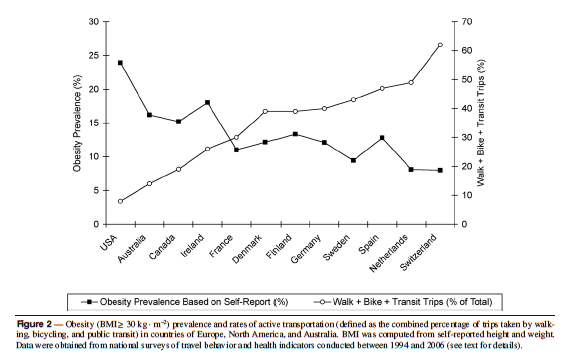
In many cities across the US, cycling is growing in popularity and local governments are working to implement bike-friendly urban planning initiatives, but is it growing fast enough? The US ranks first in the world for percentage of population that is obese (34% for adults age 20 and older). Not surprisingly, the US also ranks near the low end for bicycle usage with 1% or less of its population using a bicycle.
Graph (above, Figure 2) from: Bassett, Jr., et al.,

Walking, cycling, and obesity rates in Europe, North America, and Australia, Journal of Physical Activity and Health, 5, 795-814

Bicycles have been around for a long time. There is a sketch for an early bicycle design in one of Leonardo da Vinci’s pupils’ notebooks from 1493. Over the years bicycles have been upgraded and modified, moving from being a luxury of the wealthy to the transportation of the masses. The advent of cars slowed bicycle usage in industrialized countries, but in less economically developed countries bicycles are still a primary mode of transporting people and goods. Likewise the production of bicycles has remained nearly double that of cars.

For many countries bicycles are at the front lines of public health, they just may not realize it. The US has been watching a steady rise in obesity rates as a result of inactivity and unhealthy diet choices. Many states and cities are working to implement programs to increase bike usage including: Rails to Trails projects, Bike sharing in Washington DC and Nashville, as well as increased bike lanes linking residential areas to commercial zones. These programs will all have a big impact of the health of the US population. The CDC states that the number on strategy for increasing physical activity is shifting from car trips to walking or biking. Bicycling Magazine notes that new bicycle commuters can expect to lose up to 13 pounds their first year of biking to work.

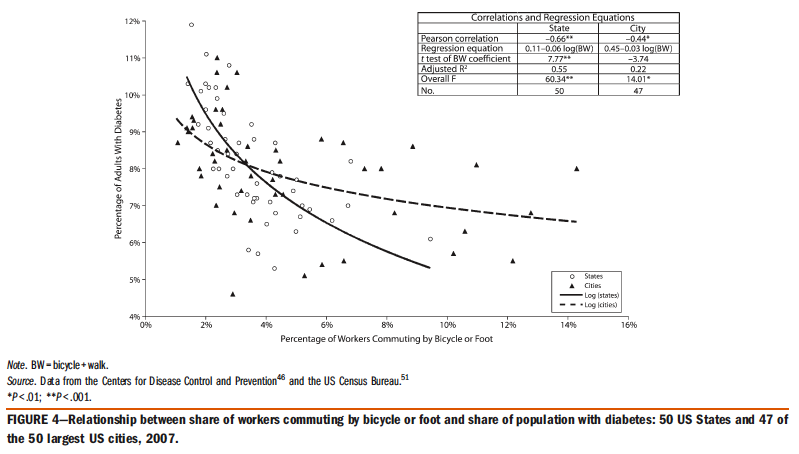
Graph (above, Figure 4) from: Pucher, J., et al., 2010

Walking and cycling to health: A comparative analysis of city, state, and international data, American Journal of Public Health, published online ahead of print

The benefits are huge, but that doesn’t always make it easy for people to jump right on a bike. A recent study led by Dr. John Pucher of Rutgers University found a direct correlation between percentages of adults with diabetes and percentages of commuters biking or walking to work in 47 of the 50 largest US cities (Walking and Cycling for Health, August 2010). To state the obvious, the increase in programs that promote bike usage and the increase in people biking will have a very positive effect on the health of populations

However, the US isn’t the only country working to get its citizens moving. Copenhagen (Denmark), known for being a biking city, launched “You won’t believe it… You’re safer on the bicycle than on the sofa!” A campaign run by the city’s Public Health office, their goal was to get more people biking to work instead of taking their car for a short trip. The campaign told Copenhagen residents, “Lack of movement in everyday life is harmful to health, while physical activity keeps the body healthy. Daily exercise for at least 30 minutes prolongs life by up to 5 years, and cycling can thus help to prolong life.” Even as a strong biking city even Copenhagen felt the need to better educate and mobilize its population. As can easily be guessed Denmark has a low rate of obesity at 9.5%.

In “developing” countries of the world obesity rates aren’t the greatest health risk, nor is low physical activity often a common unhealthy lifestyle. The health risks in “developing” countries are often related to access to health services and emergency transportation. Surely this isn’t an area where bicycles can have an impact!

In many low resource setting around the world, Community Health Workers (CHWs) travel from village to village, home to home to deliver health education and services. In many places CHWs rely on bicycles as their only means of getting from one place to another. Bikes Without Borders highlights the work of CHWs in Malawi utilizing bikes to increase their effectiveness and to help more people. Bicycles for Humanity collects almost 50,000 bikes a year and sends them to organizations that distribute them most often to healthcare workers and women. Since women do a majority of traveling in “developing” countries, a bike can help them to transport themselves, water containers, and goods to market.

Bicycles have even been modified to serve as ambulances in areas where there is no emergency transportation. The Bicycle Empowerment Network (BEN) in Namibia has implemented a very effective model for faster transportation where there is none. Drivers of the bicycle ambulances come from local organization and they receive training on use and maintenance.

Whether it is in the post-industrial cities of the US, modern cities of Europe, or in some of the world’s poorest regions, the simplest transportation technology can have huge impacts on the future health of our population.

Featured on the Americans for Informed Democracy Blog, where I’m blogging as a Global Health Analyst.

ambulances run in the family

Lights and sirens, high speeds down the expressway, ER doctor drama on top of insane accidents, not to mention Grey’s Anatomy – behind all the loud noises, dramatic depictions, and hit television shows there is a lot to learn before entering the world of emergency medicine.

On September 1st (the same day Nichole started her MPH classes!), I began an Emergency Medical Technician (EMT) course with Huron Valley Ambulance in Ann Arbor. I have longed to have more advanced medical knowledge and skills and this seemed like the perfect avenue. The story of my medical interests begins with my grandpa.

During World War II my grandpa, Myron Schlott, served as a Navy Medic serving in the Aleutian Islands, visiting Hawaii and Australia, and finally on a submarine. In the above picture he is standing on the right with his arms crossed. Behind him is the ambulance that he drove. My grandpa was an important figure in my childhood, Scouting, and in the development of who I am today.

My grandpa was also a strong supporter of my project to fund an ambulance for a rural health center in Uganda. From that project and my trip to Uganda I gained a serious understanding of the need for emergency transportation and medicine in Uganda and at home.

Since the 5th grade I’ve been first aid and CPR trained through the Red Cross and the Boy Scouts, which included: wilderness survival, back country first aid, and cold weather survival training. Last year I completed a Wilderness First Responder (WFR) course with the Wilderness Medical Associates (WMA) and thoroughly enjoyed it.

I knew this was the right next step for me when my fiancee, Nichole, told me that I was getting excited about taking vital signs and blood pressures. Thankfully I have only had rewarding experiences with ambulances thus far and I can only see it continuing to be positive.

A desire to help others was instilled in me at an early age and I can only imagine that is why I have a strong desire to get more involved in medicine.

How many of you reading this are currently involved in or studying health care, medicine, etc.? What are you doing and where?

young, white, and in detroit: gentrification implications

http://current.com/e/88996181/en_US
Video from: Feministing – Detroit, Gentrification and Good-ass Political Hip-hop

“First-stage gentrifiers” are economically- and socially-marginal “trend setters”. Sociologically, these people are young and have low incomes while possessing the cultural capital (education and a job), characteristic of the suburban bourgeois. They often reside in communal (room-mate) households, and are more tolerant of the perceived evils of the city—crime, poor schools, insufficient public services, and few shops.

Am I a gentrifier? I’m young, educated, low-income, and living in a house with 3 other young people. Uh oh! Since moving to Detroit I have considered what socio-economic consequences I could have on the current population and cityscape. My fiance and I have had many discussions about gentrification and what it means for Detroit. The definition I will be using:

Gentrification denotes the socio-cultural changes in an area resulting from wealthier people buying housing property in a less prosperous community. Consequent to gentrification, the average income increases and average family size decreases in the community, which may result in the informal economic eviction of the lower-income residents, because of increased rents, house prices, and property taxes. This type of population change reduces industrial land use when it is redeveloped for commerce and housing. In addition, new businesses, catering to a more affluent base of consumers, tend to move into formerly blighted areas, further increasing the appeal to more affluent migrants and decreasing the accessibility to less wealthy natives.

I live in the University District, which like most of Detroit is now a majority black community, but that wasn’t always the case. The District has a long history from farmland to annexation with the city, to development as a model community where, “homes could never be sold to or used by persons other than ‘of white or Caucasian race.'” Following the riots of 1967 and full blown white flight to suburban areas, black families began moving into the neighborhood. I live in a home who’s family has a long history of living in the area, contributing to the community, and working with the labor movement.

Being a gentrifier in Detroit has a serious implication when tied to the city’s past. That implication is born of the history of racial segregation and violence in the city of Detroit and the Detroit metro area. Public policy and popular perception of black people systematically marginalized and segregated populations based on race. The extended outcome of those causes can be seen with Michigan’s “blackest” city: Detroit residing a stone’s throw away from its “whitest” city: Livonia. Because of this historical disenfranchisement of the black community in Detroit, gentrification is all that much more a hard topic in a city facing difficult economic development.

Young Detroit

Recently NPR carried a story from Model D, an online news magazine that seeks to create a new narrative for Detroit (they also wrote about gentrification in 2005). The story was about a Detroit neighborhood soccer (futbol) league. Initially I thought it was incredible, but then realized that this was a snapshot of the growing gentrification of Detroit as I noticed in the video that nearly all of the participants were young and white. Many were there for the excitement of working in Detroit for non-profits and other social ventures. A band of “first-stage” gentrifiers? On the flipside how is Detroit supposed to innovate and grow without an influx of young and creative people? How can Detroit bring in excited youth, who are often white and more established, without fueling gentrification or the continued disenfranchisement of the majority black population?

Gentrification is happening mostly in areas around Wayne State University, the historic Corktown neighborhood, and neighborhoods near the Riverfront. The argument that these empty places in Detroit aren’t displacing anyone lacks a long-term vision. The city is beginning to see an increase in the number of “first-stage” gentrifiers and simply what follows is a second and third stage where eventually the first and second stage gentrifiers are displaced themselves by lawyers, physicians, and bankers. While all stages of gentrifiers are displacing the “native” populations of these areas by way of their socio-economic power. Is gentrification a natural fluctuation of the urban landscape? Can gentrification do any good?

Is Gentrification Growth?

No, if you look at the face value of gentrification and its broad economic impact, then sure gentrification is growth. However, when you factor in community and the effects on people – gentrification never equals growth, rather displacement.

Nothing good can come of gentrification. There is a minimal increase in tax dollars being sent to the city government, but that has little impact when (for now) the business dollars are being invested and collected in the suburbs surrounding Detroit. Communities don’t grow and get stronger, communities are changed by economic force through gentrification.

Looking Forward

The important step for Detroit now is to strengthen its community organizations and engage would be gentrifiers to support neighborhood development. Downtown redevelopment only benefits those with social mobility and that is not the majority of the Detroit population. Detroit’s black community has seen years of oppression and gentrifiers come in with a load of unearned privilege and resources.

First-stage gentrifiers (young, white, educated) can change the course for Detroit and instead work to be “allies in development” – partnering for stronger community organizations in black communities and actively engaging in local community efforts: shopping locally, attending block club meetings, and utilizing their privilege to highlight the progress that has been happening by native Detroiters as opposed to outsiders coming in with grand ideas for development.

If Detroit (and Michigan) is going to make it there can no longer be a black and white divide. There needs to be engagement from both populations where black communities have strong neighborhoods and white migrants recognize their privilege and work to assist community development that is already getting started. Get to know your neighbors and community, don’t create enclaves of white privilege, and support your community leaders!

“Detroit’s future is its neighborhoods” – Reframe Detroit

measuring poverty beyond a dollar a day

(Photo credit: Allianz Knowledge Partnersite)

How do you measure the worth or suffering of someone’s life? We’ve all seen the ads where a white man walks through desolate streets as malnourished children cling to his hands. He tells us that we can help and that these children can be helped for just a dollar a day. So why do these commercials play year after year if all that is needed is a dollar a day?

The truth is that a dollar a day tells you very little about those children, the reason for their lack of nourishment, or the history or their countries, communities, and families. For years international agencies and non-governmental organizations (NGOs) have been using the Human Development Index (HDI) created by the United Nations Development Program. The HDI is a set of statistics used to rank a country based on “human development” (i.e. mortality rates, life expectancy, etc.) The original idea was to “to shift the focus of development economics from national income accounting to people centered policies.”

The HDI and its statistics built such programs as the Millennium Development Goals (MDGs) and many had criticisms. Some argued that the HDI was still too nation focused or that measuring material wealth could never promote “human development” thus ending poverty. Just yesterday the Oxford Poverty and Human Development Initiative (OPHI) of Oxford University and the Human Development Report Office of the UNDP announced a new way to measure poverty called the Multidimensional Poverty Index (MPI). Director of the UNDP Human Development Report Office, Dr. Jeni Klugman, said. “The MPI provides a fuller measure of poverty than the traditional dollar-a-day formulas.” She noted that the MPI assesses critical factors at the family level and it will be used to compliment the HDI by examining broader aspects of well-being.

As our understandings of the root causes of poverty increase so must our means of measuring its affects. While some are focused on pulling our heart strings with “dollar a day” lines, the larger development institutions are working to become more innovative in their approaches to measure poverty.

While the MPI is a positive step in the right direction, it seems that it will still be very broadly focused and may still lose the “people centered” perspective. As large development institutions focus and innovate measures for poverty, why have they not just asked those most affected?

batman wears green in detroit

(Photo Credit: ComicVine)

There was a time when Batman acquired the super human powers of Green Lantern, no joke. Imagine the combined powers of Batman’s wit and charm paired with the power of Green Lantern’s ring which can alter the physical world and is as powerful as the wearer’s willpower and imagination.

Those interested in tackling the difficulties of Detroit can take a lesson from this partnership of sorts, a sharing of resources, and a use of imagination to solve social problems. I’ve written about some issues happening in Detroit, some background, and so the next few blog posts will be focused on highlighting some critical solutions that Detroit needs to implement as well as some creative programs already in place.

Number one on the list is job retraining for skilled labor in green building and technologies. For places like Detroit (and Flint) there is huge potential for centers of education to refocus their resources to offer training that contributes to the green economy. Countless case studies have shown that programs that target low-income communities with green job trainings take a serious jab at fighting poverty, reducing crime, and building communities (Sustainable South Bronx SSBx; Green for All). Detroit is a great setting for these trainings because of the density of community colleges and universities. The city is also a critical location where there is a need to increase home energy efficiency: heating, cooling, etc.

For Detroit, building an “inclusive green economy” Detroit can work to reverse its history of class divide, reduce crime, and innovate industry all at the same time. At a time when jobs are needed, poverty is rampant, and new ideas for growth are a must, investing in education and training makes the most sense.

I wrote previously that this is one area that Detroit can learn from Grand Rapids, and it has. Grand Rapids Community College offers a wind energy program. The city itself is number one in LEED-certified green buildings. How far off could this be for Detroit?

In the Roosevelt Institute’s Midwest 2.0 Journal, author Cory Connolly (Pg. 17) highlights the statistics for a bright future in green careers for Michigan. He writes that 72% of energy professionals believe that there will be a shortage of workers in the green economy in the next 5 years (Apollo Alliance). Many Michigan education institutions have started some programs, but the state is well behind. Cory focuses on integrating career based trainings at the high school level through existing infrastructures. By creating partnerships with green industries and fresh young workers the unemployment numbers for Michigan could drop significantly. California is invest 20 million in a program just like what Cory describes.

In the same journal, Valerie Bieberich (pg. 15) lays out the attractiveness and ease of bringing green jobs to the Midwest. The most critical point that Valerie makes is that the Midwest has a strong worker base and resource base for green industries. For states like Michigan the infrastructure already exists and unemployment is high – workers are ready for green jobs! Michigan has already seen two green energy firms start their work in Battle Creek and more recently Holland.

In Detroit, green job training is become more readily available. Detroiters Working for Environmental Justice is an organization pushing the green economy forward with a number of green jobs training and programs focused on making Detroit green.

Wayne County Community College (WCCC) is offering three tiered green jobs training courses in: energy efficiency, weatherizing certification, recycling, and green building certifications. It is an extremely comprehensive program targeting unemployed residents who have at least a high school diploma. This is an excellent example of the type of program needed to reverse the negative growth that Detroiters have seen.

grand rapids can’t afford for detroit to fail

One of the recent articles from “Assignment Detroit” in Fortune Magazine attempts to say that Detroit needs to learn from Grand Rapids. The content that follows in the article goes on to prove that Grand Rapids is not like Detroit at all.

The article was titled, “A Michigan Success Story” with the tagline: “Its not the kind of view you expect these days in downtrodden Michigan”. It seems they can never give a clear message about Michigan or Detroit. Its a success, but downtrodden. Its working hard, but never making the mark. Let’s jump right in – so it is true, Grand Rapids is growing, has retained young people, and has significant investment in higher education and medical services – but that does not mean Detroit can replicate the business successes of this tiny West Michigan city.

Grand Rapids is not similar to Detroit. They had different industries, different populations, and different mean levels of income. From the article:

“thanks to a combination of business leadership, public-private cooperation, and the deep pockets of local philanthropists.” 

This picture is not as visible in Detroit, the deep pockets of philanthrophy don’t reach as far in a significantly larger city with a larger population (ever with Detroit’s population decline). Retired Chairman and CEO of Old Kent Bank, John Canepa is quoted saying,

“But Grand Rapids had an unusual set of assets. The wealth in this city in proportion to its size is extraordinary.” 

The Amway corporation and family, DeVos (whose name appears on far too many things in Grand Rapids), Steelcase and Meijer.

“The founders of those companies and their descendants still reside in Grand Rapids area, and match their deep roots with deep pockets of philanthropic dollars.” 

The article’s author is defeating his own argument with each quote he gets from local Grand Rapids leaders. They recognize that there were some similarities in how the decline in industry had effects on both cities, but are not as naive to think that what worked for Grand Rapids will work for Detroit.

Unemployment in Grand Rapids is still very high and not surprisingly this disproportionately affects minority communities. Detroit is a city of minorities, unlike Grand Rapids that holds its roots in the white, anglo-saxon, protestant traditions with traceable histories, long roots to local areas, propped by family assets and connections. The city government of Grand Rapids is also facing serious budget cutting and is working with unions to decrease benefits.

Grand Rapids is the “greenest city in the US” with more LEED-certified buildings per capita. This could also be attributed to the growing trends in environmental sustainability and the wealth that exists in Grand Rapids. Where Detroit can take a lesson is in offering more opportunities for Green Jobs. The Grand Rapids Community College just opened excellent training courses for various “green” industries. I will begin writing more about “green” solutions in following posts.

Detroit doesn’t have the hard cash wealth that Grand Rapids has, but it does have other rich assets when it comes to new ideas and initiatives for improvement. As in Grand Rapids, these ideas don’t come from the government or its funds.

A last final and important take-away from the article was a quote from Mayor George Heartwell, “we can’t afford to see Detroit fail. But if Grand Rapids recovery took two decades, how long will it take Detroit?”
No one can afford for Detroit to fail.