Second Anniversary of Picturesque Rocks & Isles

Alex B. Hill's avatarEight Twelve Eleven

photo (5)Nichole put together a great island hopping, northern Michigan; Pure Michigan anniversary itinerary! We both love northern Michigan (mostly in the summer, but also for skiing occasions), so it was going to be great!

Sunday

We drove up to Petoskey State Park where we would camp near the beach for the week. Our campsite was nicely located across from a water spigot and a short walk to the showers and the BEACH!

photo (6)We were able to sit on the beach along Little Traverse Bay and watch the beautiful Michigan sunset every night if we wanted. My little red Aveo was packed tight with all our gear and bikes on top. We set up camp and fell asleep to the sound of Lake Michigan lapping the shore just on the other side of the sand dunes.

Monday (2nd Anniversary!)

We woke up to the sounds of a more lively Lake Michigan…

View original post 923 more words

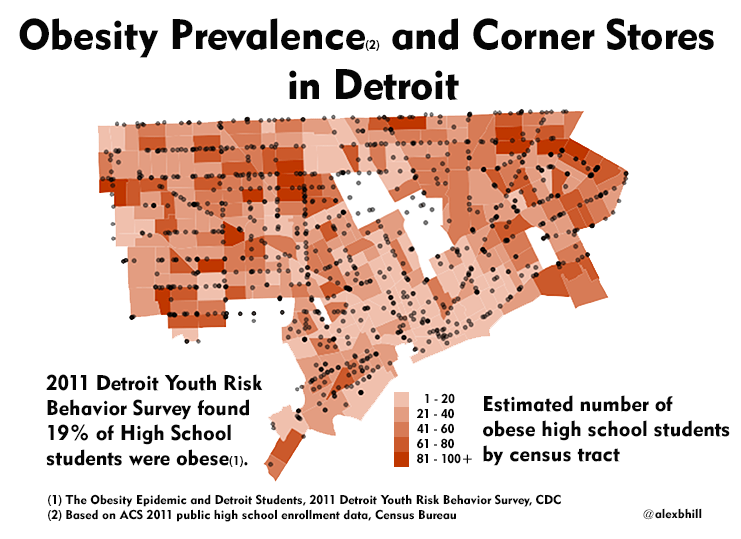
Map: Obesity and Corner Stores in Detroit

Alex B. Hill's avatarDETROITography

DETobese_final

The data on enrolled public high school students maps almost exactly with population density, but there is enough of a difference to make it worthwhile to examine the interactions between social and environmental factors. Corner stores (liquor stores, gas stations) were added to demonstrate the prevalence of these food locations in relation to obesity among students, however there is no significant correlation.

View original post

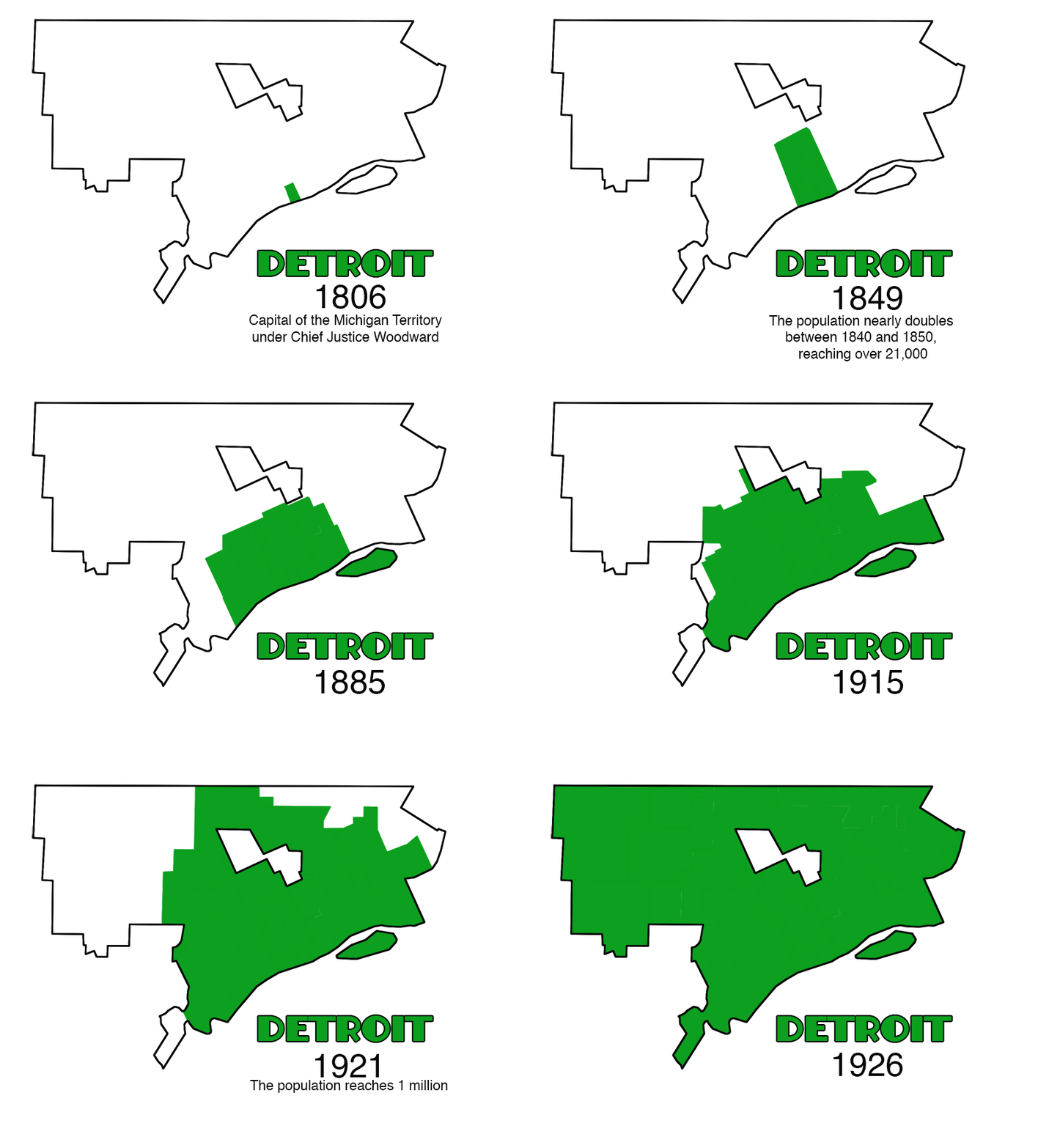
Map of Detroit Land Annexation 1806 – 1926

Alex B. Hill's avatarDETROITography

DETannex3

Source: Detroit Annexation and Land Expansion Map

It is much more interesting to look at Detroit’s land annexations in animated form. You can see how various areas of Detroit were added through the years. Looking at Detroit’s history you can see the slivered expansion northward from the River and then fanning out along the River’s edge, the city’s purchase of Belle Isle in 1879, the glory days of Grand Boulevard in 1891 when the city didn’t extend any further North, and the rapid land acquisition in the 1920s as the auto industry boomed and population swelled. Detroit’s industry, population, and services have changed drastically over the years, but the physical boundaries of the city have remained the same since 1926. Will borders be expanded further in the future to create a cohesive regional Detroit that includes the suburbs?

View original post

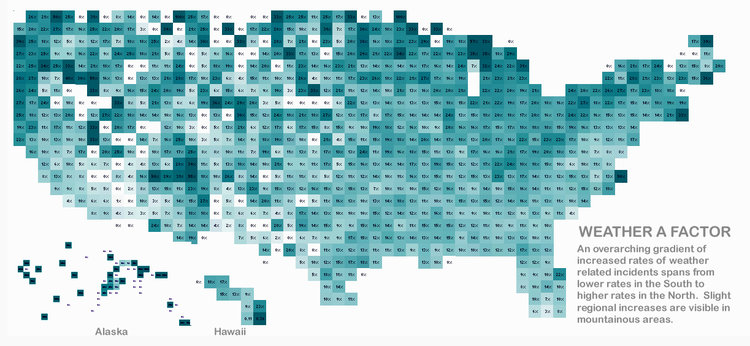
Map of the Week: People Killed in Cars Excel Map

1671469-slide-slide-5-a-brilliant-traffic-data-viz

This is an excellent map that was made all in Excel. This one shows weather related car deaths by regions (not sure what geographic unit) in the US. I’ve noticed a few projects now that really utilize the low cost Excel program for graphic design and mapping. The visualizations featured on FastCoDesign really caught my eye.

Full article and more infographic here.

The Epic Return to Fort Lauderdale

Alex B. Hill's avatarEight Twelve Eleven

320753_10103343163550264_175708949_n

A handful of people have heard the story of our Fort Lauderdale layover adventure en route to Peru. Here it is in full:

En route to our honeymoon in Peru (the country, their tourism bureau has a hilarious promotion where they visit Peru, Nebraska and share cultural traditions – very entertaining, but I’m getting off track) we had a layover in Fort Lauderdale, Florida. It’s Florida, they have beaches, it’s the summer, and we have roughly 5 hours or so to kill – why not head to the beach?

So that was our plan after we landed. We were very excited for Peru and also excited to get to the beach. We made our way down to the baggage claim area with the rest of the passengers. I thought that it made sense that transportation could be found there too. We walked all the way to the end of the…

View original post 1,120 more words

Slow Food, Social Mobility, and Whole Foods in Detroit

Anyone who follows news about Detroit hasn’t missed that Whole Foods is opening its Midtown location on June 5th. Young people are tweeting that they are already writing up their grocery lists, students are excited for the organic produce, and who out there can actually afford to shop exclusively at Whole Foods for their groceries!?

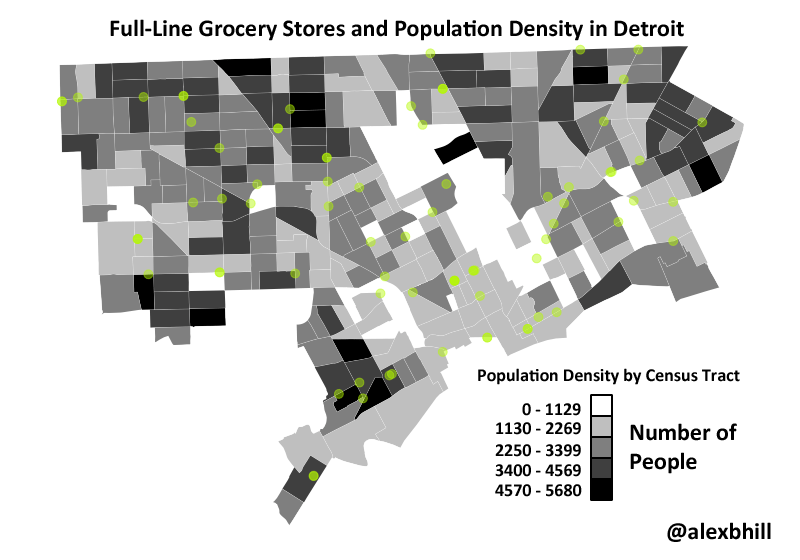
I know that I for one, cannot. It is exciting that Whole Foods is coming into Detroit when all of the chain supermarkets fled the city, but to the tune of huge tax breaks that the city could really use. It must also be noted that Whole Foods in Midtown does NOT address the scarcity or availability of healthy foods in Detroit. Rather Whole Foods taunts Detroit residents with the bright lights of an upscale chain food store, but no change to access in Detroit’s food system.

Classism in Slow Food 

“Slow Food Detroit” was founded in Clarkston, MI  –  51 Miles away from the city.

“Slow Food is an idea, a way of living and a way of eating. It is part of a global, grassroots movement with thousands of members in over 150 countries, which links the pleasure of food with a commitment to community and the environment.” (SlowFoodUSA.org)

Slow food is inherently easier for those with higher incomes. Access to better foods, organic options, and what some might call “picky” food choices favors those with extra money to spend. In Detroit income is highly correlated with race. A major reason that Detroit has limited grocery stores and high rates of diet-related diseases among African Americans is due to the fact that historically African Americans were either not considered for grocery store hiring or were hired and kept away from management positions. When the riots hit and many people left the city, there was no one with the skills to fill the grocery store void. Likewise, the supermarkets followed wealthy white populations leaving for the suburbs.

The addition of Whole Foods represents a similar imbalance in the “slow food” movement where all items are local sourced, organic, etc. with a price tag to match. Personally, my wife and I only shop at Whole Foods for wine, dessert, and food items that help manage lactose intolerance. Other than that, we would never dream of doing the bulk of our grocery shopping there. If anything Whole Foods has come into Detroit to capture the commuter market in one easy spot before they drive home outside of the city.

The Detroit Drilldown Report 2010 reported on grocery leakage (people spending grocery dollars outside of the city), that Detroit resident spend $200 Million (31% of grocery budgets) outside the city on their groceries. People may start shopping inside the city limits at Whole Foods, but I predict that the majority will take it back home outside the city.

Social Mobility & Transportation

An important aspect of slow food and access to healthy food is unfortunately transportation. Detroit residents are up against a public transit system that is broken and in serious need of repair. In Detroit healthy transportation can mean healthy food access as well. Many families that I have worked with work hard to car pool with their friends and neighbors to be able to shop at a chain grocery store or they utilize a plethora of food options: local stores, buying co-ops, gardens, etc.

When people do not have adequate transportation that also constrains their food options. If you are walking to a grocery stores that is miles away, why wouldn’t you choose the convenience store instead? If you can’t afford personal transportation, that may also limit you to low cost, high calorie food items. If you can’t often go grocery shopping that may also mean you choose items that will last much longer, which also tend to be the least healthy food items.

Social m0bility is linked to transportation, especially in economically depressed urban centers. These issues both disproportionately affect low income minority community the most.

Detroit’s Changing Food Environment

Meijer is also starting to build close to the Westside and that represents a better potential for healthy food access than Whole Food ever could, but there really needs to be tax incentives for local grocery store owners if healthy food access is going to improve. The Fair Food Network has been advocating and now “Double Up Food Bucks” for fruit and vegetables will be available in some grocery stores soon.

There are increasing food and grocery options Downtown, where the 2010 Census shows population growth, however this population growth is from new residents not residents moving from the East and West side into Downtown. Ye Olde Butcher Shoppe has called itself a grocery store, with Papa Joe’s Market coming soon thanks to Dan Gilbert, these are options on top of the new Whole Foods. The growing Downtown/ Midtown populations are not the populations of Detroit who do not have social mobility and do not face the higher prevalence rates of diet-related disease and obesity. The population dense neighborhoods on the East and West side of the city have not seen new grocery stores and in a number of cases local grocers have shut down only to be turned into Family Dollar locations.


Detroit Homicide Map 2012: Liquor, Parks, & Homicide

Alex B. Hill's avatarDETROITography

DET_homicide_map

411 homicides, 1130 active liquor licenses, 350 city parks

The goal of this map is to demonstrate the relationship between homicide, locations where alcohol is sold/ consumed, and community green spaces.

Research shows corner stores/ convenience stores don’t necessarily have a negative effect on violent crime. However in higher income neighborhoods corner stores are seen as a positive, while the opposite is true in lower income neighborhoods. I also began noticing that a number of homicides occurred at or near clubs and liquor stores.

A great deal of research has also been conducted on the benefit of turning vacant lots into parks or green spaces in order to reduce violent crime. The most important aspect of this, however, is that community parks are beneficial in reducing violent crime when they are maintained. Many city parks in Detroit are not able to be maintained.

I wonder if Greening of Detroit has…

View original post 77 more words

Critical Questions on Mental Health in America

The topic of America’s mental health system and the need to improve it has become a hot topics following the most recent gun violence at an elementary school in Connecticut. Most of what I have heard from the media and politicians is a broad “need to improve mental health.” It is always a very generalized statement without many specifics on how or where or to what end. It is likely that these pundits and politicians have no idea, but I think this leaves a critical gap in the mental health discussion.

“As soon as I’m finished speaking here, I will sit at that desk and I will sign a directive giving law enforcement, schools, mental health professionals and the public health community some of the tools they need to help reduce gun violence.

We will make it easier to keep guns out of the hands of criminals by strengthening the background check system.  We will help schools hire more resource officers if they want them and develop emergency preparedness plans.  We will make sure mental health professionals know their options for reporting threats of violence — even as we acknowledge that someone with a mental illness is far more likely to be a victim of violent crime than the perpetrator.” – President Obama 01/16/13

An article that I read noted that it was easier to buy a gun than to access mental health services in America. Why is that true?

Mental Health Services Stigma

I seems as though the mental health climate in America is very similar to the stigma associated with PTSD within military circles. With the conflicts in Afghanistan and Iraq I remember reading that soldiers wouldn’t seek out counseling  for their PTSD because it was interpreted as if the soldier was unfit for service and had serious issues. This applies in both the military and civilian settings. When a soldier leaves duty they may still face stigma related to their PTSD.

Likewise, this often plays out in the civilian world. Seeking counseling is never seen as a positive endeavor. Meeting with a psychologist is a negative event in your life that you never hope to repeat and you most definitely don’t tell anyone publicly. But why?

Why Seek Mental Health Services?

What causes people to seek out mental health services? Are individuals only referred by their family doctor or sometimes do they attend because they are required?

Many people seek out mental health services as a result of substance abuse. Dealing with addictions is probably the most well recognized aspect of mental health in the US. However, there is often a high degree of stigma even for those with mental illness and addictions. Overcoming the stigma and discrimination against those in need of mental health is a huge hurdle if President Obama and others hope that mental health will be more easily accessible among the general public.

Other well known reasons for mental health services are: depression, bipolar, anxiety, and PTSD. Nearly 80% of individuals who suffer from depression say that they experienced some form of discrimination (Mental Health America). Other studies have found that racial discrimination and an individual’s level of poverty also contribute strongly to mental health. However, a recent poll has found that stigma against depression and seeking treatment for depression is decreasing.

Where are Mental Health Services Accessed?

I know for many students being on a campus makes it fairly easy to meet with a Counselor at various locations. How would individuals without easy access find and utilize mental health services. I know that individuals can go to a hospital or an emergency room if they are in immediate need of mental health services, but that can’t be the ideal method of accessing mental health.

Most people probably have no idea that they have access to preventative mental health care with their insurance, however this goes back to the stigma associated with seeking such treatment. The other major barrier to accessing mental health services is the high cost with a minimum around $100 and extensive treatment reaching over $10,000. As a result of the cost barrier, only around 7% of all adult Americans accessed mental health services (NSDUH report).

Since the majority of mental health tends to affect poor individuals this cost barrier makes it even harder to identify and treat mental health. Mental health services is included in the “essential health benefits” piece of the Affordable Care Act, but it is left up to States as to what is included. Without some serious thinking about why, how, and where individuals access mental health services – improving access will just be more political rhetoric. If we are serious about improving the mental health system then we need to be asking serious questions.

Personal Cartography in Detroit, 2012

Alex B. Hill's avatarDETROITography

detroit_2012

Many cartographers like to take inventory of their personal cartography near the year end. I figured it would be a fun experiment to map my own personal journeys and travels of 2012 on top of my foursquare check-ins.

I had to reconstruct my travels from my Google Calendar and Foursquare check-ins after losing all my GPX data when my Garmin was stolen out of my car. I think this made the exercise that much more interesting and challenging.

Being a community health worker, I was driving all over the city and metro area every day. Data shows that I typically use I-96 and usually check-in at locations in Midtown. Sadly, my job doesn’t let me walk or bike very often. I am resolved to ride my bike more in Detroit during 2013.

Source: original post

View original post