Race, regionalism, and reconciliation are the three core issues that Dr. Peter Hammer talks about related to Detroit’s future plans and revitalization efforts. I agree with his assessment that the Detroit Future City (DFC) plan does not account for any of these frames, nor are any of them mentioned in the report. The DFC strategic framework is 319 pages of bureaucratic planning with a mere 24 pages on civic engagement. I think this speaks volumes as to the direction and focus of the foundations, administration, and others working to “revitalize” Detroit. There is a pervasive desire to forget or erase history: racial and regional.
If Detroit is to be successful again, then Detroit as its current population, as its regional namesake, and as its national brand needs to bring people together in meaningful and innovative ways to create and implement equitable plans that connect the past to the future.
#detroit
Detroit is both a marginalized city bounded by its city limits and a broad concept that has a wide geographic footprint. The largest geographic concept of “Detroit” includes a 7 county region that encompasses all of Southeast Michigan.
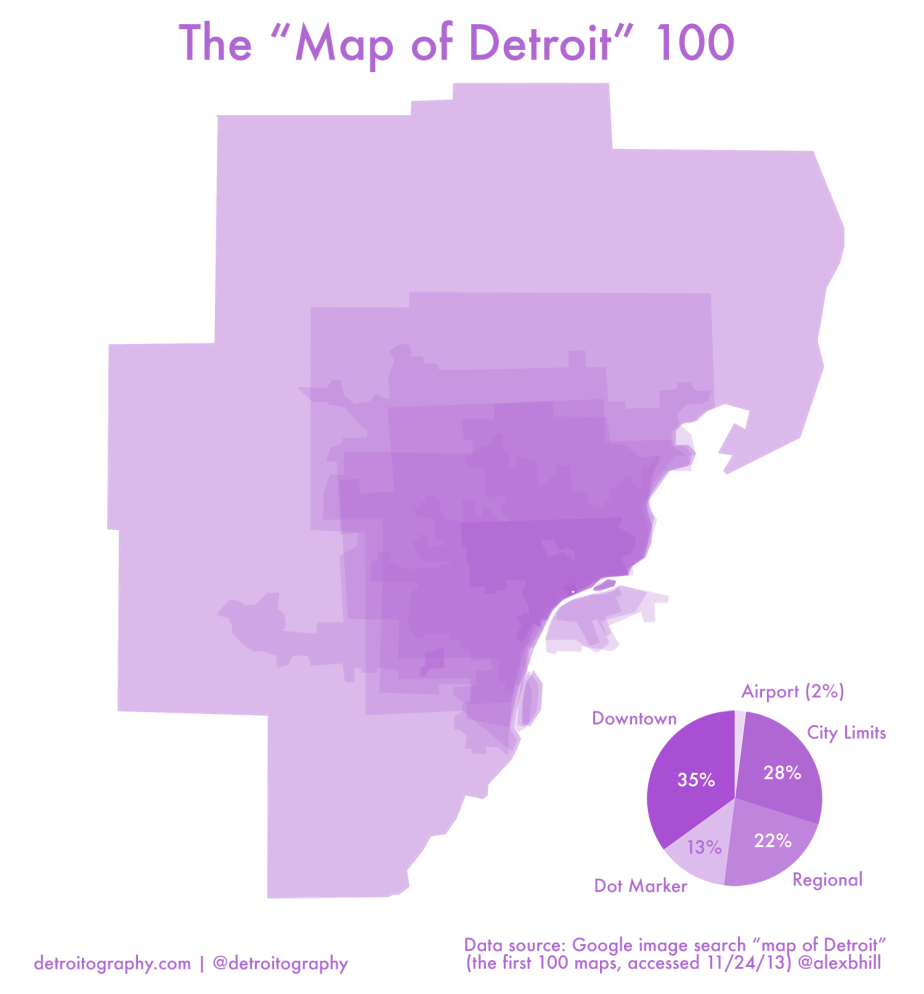
There are approximately 713,777 people who live inside the boundary lines of Detroit while there are 3,734,090 people within the Detroit Urban Area (DUA; Census Bureau 2010). Here are some more pie charts:
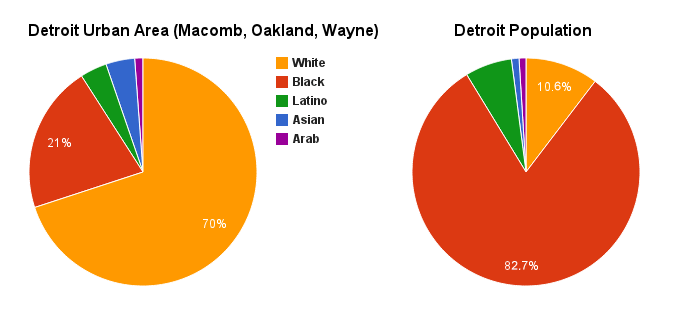
Looks familiar right? The pie chart of the left is essentially a mirror image of the pie chart that I put together showing the imbalance of “Race and Revitalization in Detroit.” I received many comments that argued that the data showed the same regional breakdown of population demographics. I also received too many “So what!” comments that demonstrated common misunderstandings related to the data that I presented. The majority of the DUA is white, the majority of Detroit is black. Many people from the DUA are moving back to Detroit with ideas and hopes for revitalization. That isn’t a problem as long as it is not creating harm for people who have been living, working, and sustaining Detroit over the last half century. Since the 1970s, migrating white families moved to the outer suburbs of Detroit, while during the same time black families were only able to move to different areas of Detroit where they were no longer restricted by racially discriminatory housing policies or to the inner-ring suburbs. In order for equitable change to occur in Detroit new residents to the city need to remember that they are outsiders to a system that has a long and charged history.
Within discussions of “two Detroits” or New and Old Detroit, there is a thread of conversations that debate, “When are you officially a Detroiter?” Beyond the disparaging comments and false urban rites of passage there is an important disconnect between those living within the city limits and those living within the idea of “Detroit.” The comments and feedback that I received seemed to fall along those same distinct lines of understanding Detroit as outsider vs. insider. “Detroit” is a broad concept that goes beyond the city limits and that is often why many people in the region feel so strongly about the city and what is happening to revitalize it.
Having an idea of Detroit versus living or experiencing the changes occurring in Detroit are completely different, compelling narratives.
Those who disagreed with my assessment were largely living outside the city limits and had a wide range of issues with black people and statistics. Those who agreed with my piece mostly lived inside the City of Detroit and had two main responses: one of support and one expressing that this problem of racial equity was nothing new.
#privilege
It was very unsettling to see the posts on my Facebook timeline flip from featured images of my data pie charts to images of my own face. It was unsettling because I quickly became concerned that my young, white, male face was becoming the story rather than the racial inequity of revitalization. I could not control who my parents were just as much as I could not control the socio-economic situation of my family. Yet, in all of this talk of racial equity, I have to accept my privilege as well as my own responsibility in working towards more equitable solutions. I can’t just say, “So what?” and pretend that I don’t have a role to play. (Read the full comic strip on understanding white privilege)

“For white people to acknowledge white privilege they’d have to acknowledge a stake, no matter how small, in the ongoing injustice.” – Herb H.
My first consideration was that data is very buzz-worthy right now. I had personally noticed racially skewed programs, but many of my data choices came out of conversations with community members. Countless Detroit residents have been watching these changes and some have experienced the lack of resources available to community groups working to improve their neighborhoods. It was readily apparent that my status as a white male in Detroit allowed my data and writing to be more easily digested and shared. Some community members reacted saying:
“If I had tried to publish the same thing, it would have come off as the ‘angry black person.'”
To that end I have been very conscious of interview requests. I am not interested in allowing the lopsided media narrative of Detroit revitalization to continue, but rather I am interested in continuing genuine conversations about racial equity in Detroit. In order for the genuine conversations to occur there needs to be many people in the room, which includes the voices of community members who have too often been excluded from these conversations.
“The idea is that only whites are getting a seat at the table of revitalization. If the pool is being pulled from elsewhere, it’s a good time to question why that decision is being made. If Detroit is what is in need of revitalization, why are we giving the help and expertise to people not from the city?” – u/FakeFaked
Detroit is at a critical moment where people have excitement, interest, and money that they want to put into the city. For Detroit’s revitalization the means need to justify the end. We can’t just hope for all “good” efforts to make a better Detroit, we must be conscious of who is at the table and most importantly who is not at the table and why they aren’t there.
“We’re not angry with them [white kids], we’re pissed that we weren’t given the same opportunities and aren’t in the game now.” – Barbara W.
“And I imagine they [foundations] haven’t the first idea what’s going on in the black community in Detroit. I’m also guessing from some of the responses here that people don’t understand the history of Detroit either.” – Sean P.
Finally, the most stand out response to my piece was that my writing had become a perfect illustration of the problem that I am trying to highlight:
“[dislike] Shit we’ve not only been saying, but ALSO been experiencing, but it’s never valid until it’s cosigned by the white guy.” – David N.
In all of the comments and conversations I have had I think it is just as important to acknowledge the privilege of being silent. Race doesn’t affect everyone in the same way and white people are often able to live their entire lifetime and not feel a need to talk about it or discuss how they fit into a racially unjust system.
#equity
Racial equity and revitalization have not gone hand in hand. As I wrote above, the DFC framework doesn’t include race or regionalism. Race is only mentioned on one of the civic engagement pages to show the breakdown of who participated in surveys. The increased use of “revitalization” by many of the programs that I researched assumes that Detroit is already not vital. This links to the concept of “Detroit as a blank canvas” and the common misperception that you can do whatever you want in Detroit because there is nothing here. Revitalization is a broad term that means different things to different people.
Currently, there is a need to better understand how different people see revitalization in their own communities.
In Detroit, “revitalization” is also a fairly new term (see also: renewal, resurgence, recovery, rebirth).
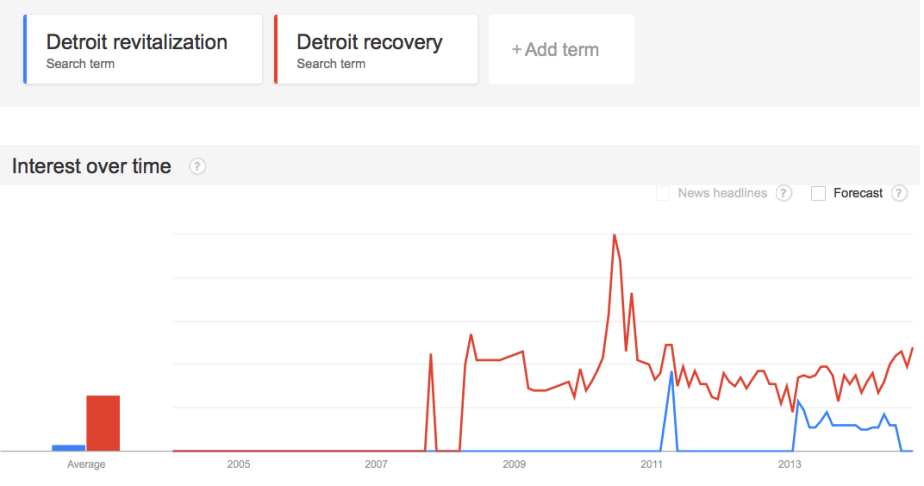 Google Trends demonstrates that “Detroit revitalization” is a term that came about in 2011, which is the same year that many of the programs I profiled began. The term has seen greater use in 2013 which has continued up until recently this summer (July 2014). The “Detroit recovery” has been discussed for much longer and likely will continue to be used by the mainstream media. Looking more closely at these terms is important in order to better understand how the narrative about Detroit’s revitalization is being constructed. (“Detroit resurgence” wasn’t significant and “Detroit rebirth” was skewed by J Dilla’s musical release with the same terms in the summer of 2012.)

Many of the programs that I evaluated have a strong focus on diversity. However, diversity does not equate to racial equity. Diversity when applied to individuals is simply a group of people with a variety of different identities and ideas. In the same vein equality is not the same as equity. Equality means that everyone gets the same, but that isn’t enough when different races of people have historically been denied opportunities and aren’t starting on a level playing field.
“[…] when you walk into a room to listen to a conversation about mass transit and the racial make up of the group is 95% white. That is inequity. When I asked the organizer why he doesn’t have more folks who actually use public transportation on the panel […] he says “he doesn’t know any,” that seems deliberate. Maybe not deliberately excluding but definitely deliberately including folks who are similar to him. It’s evidence reflected in my personal experience.” – Terietta I.
Detroit doesn’t have a problem with diversity, but there are large gaps in equity that need to be addressed.
“I agree with you. It’s about equity, giving groups what they need in order to be successful. Unfortunately, we are so stuck on equality, giving each group the same thing. I also wonder whether or not we have the political will to create race-based programs.” – Ron T.
The equity gap is one that is not new, nor is it one that many Detroiters need data to make it real.
“Don’t need a pie chart to see the deal but glad he did the research for those whose didn’t know. So now what should be done? Detroit will never fully prosper unless everybody gets a piece of the pie. Must be mindful to never repeat mistakes of the past.” – Wendy D.
#detroitfuture
Everyone has a stake in Detroit’s future, but the larger questions need to be asked about whether program constraints, organizational values, or the privilege to not care allows Detroit’s revitalization to be exclusive. It is unlikely that you would build a tool shed in your neighbor’s yard without asking. The same goes for development efforts in Detroit.
We are all neighbors within the city limits and throughout the metro region.
Let’s have some more conversations about the impacts of our actions as they relate to racial equity and Detroit’s history of racial discrimination.



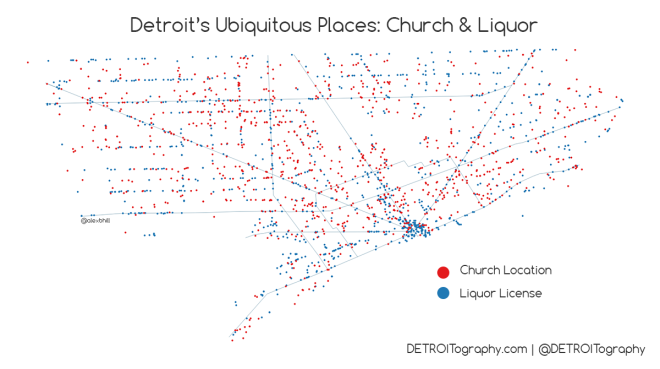 It takes forever to scrape the Michigan Liquor Control Commission (MLCC) website for active liquor licenses, so I relied on a 2012 dataset that I generated a while back. I then utilized data from Data Driven Detroit with Churches from 2011. The data is not perfect, but unless you have someone actively monitoring every liquor license and every church there is going to be significant change. Notably, the number of liquor licenses have been decreasing since 2009. The next step was to set up a grid that was generally half a square mile squares.
 There are…








 Alex B. Hill