Map: Obesity and Corner Stores in Detroit

Alex B. Hill's avatarDETROITography

DETobese_final

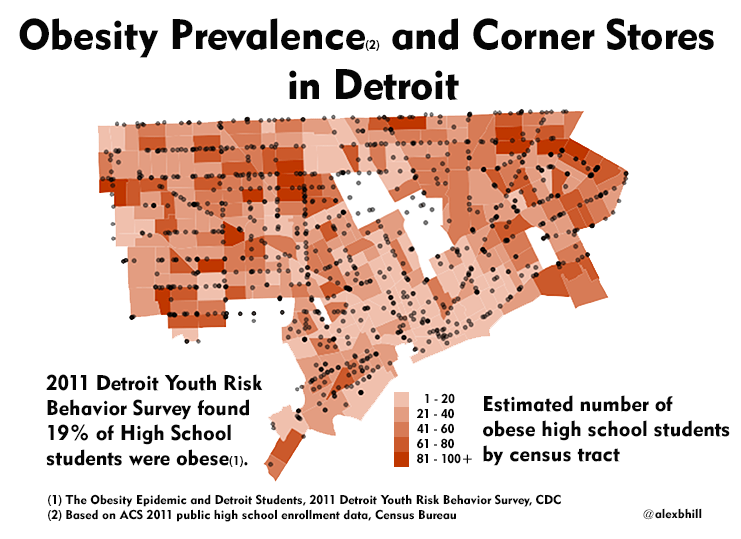
The data on enrolled public high school students maps almost exactly with population density, but there is enough of a difference to make it worthwhile to examine the interactions between social and environmental factors. Corner stores (liquor stores, gas stations) were added to demonstrate the prevalence of these food locations in relation to obesity among students, however there is no significant correlation.

View original post

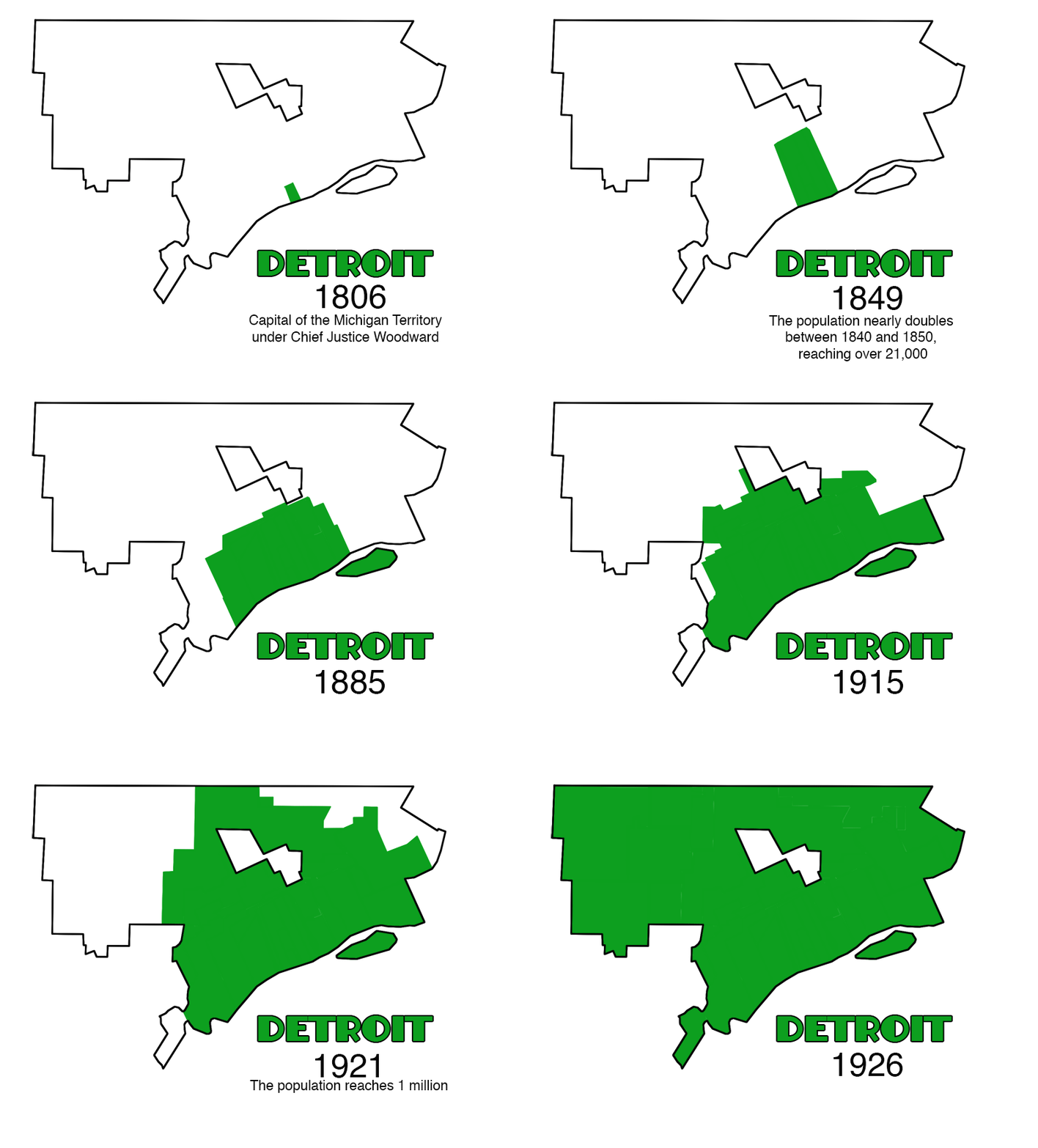
Map of Detroit Land Annexation 1806 – 1926

Alex B. Hill's avatarDETROITography

DETannex3

Source: Detroit Annexation and Land Expansion Map

It is much more interesting to look at Detroit’s land annexations in animated form. You can see how various areas of Detroit were added through the years. Looking at Detroit’s history you can see the slivered expansion northward from the River and then fanning out along the River’s edge, the city’s purchase of Belle Isle in 1879, the glory days of Grand Boulevard in 1891 when the city didn’t extend any further North, and the rapid land acquisition in the 1920s as the auto industry boomed and population swelled. Detroit’s industry, population, and services have changed drastically over the years, but the physical boundaries of the city have remained the same since 1926. Will borders be expanded further in the future to create a cohesive regional Detroit that includes the suburbs?

View original post

Slow Food, Social Mobility, and Whole Foods in Detroit

Anyone who follows news about Detroit hasn’t missed that Whole Foods is opening its Midtown location on June 5th. Young people are tweeting that they are already writing up their grocery lists, students are excited for the organic produce, and who out there can actually afford to shop exclusively at Whole Foods for their groceries!?

I know that I for one, cannot. It is exciting that Whole Foods is coming into Detroit when all of the chain supermarkets fled the city, but to the tune of huge tax breaks that the city could really use. It must also be noted that Whole Foods in Midtown does NOT address the scarcity or availability of healthy foods in Detroit. Rather Whole Foods taunts Detroit residents with the bright lights of an upscale chain food store, but no change to access in Detroit’s food system.

Classism in Slow Food 

“Slow Food Detroit” was founded in Clarkston, MI  –  51 Miles away from the city.

“Slow Food is an idea, a way of living and a way of eating. It is part of a global, grassroots movement with thousands of members in over 150 countries, which links the pleasure of food with a commitment to community and the environment.” (SlowFoodUSA.org)

Slow food is inherently easier for those with higher incomes. Access to better foods, organic options, and what some might call “picky” food choices favors those with extra money to spend. In Detroit income is highly correlated with race. A major reason that Detroit has limited grocery stores and high rates of diet-related diseases among African Americans is due to the fact that historically African Americans were either not considered for grocery store hiring or were hired and kept away from management positions. When the riots hit and many people left the city, there was no one with the skills to fill the grocery store void. Likewise, the supermarkets followed wealthy white populations leaving for the suburbs.

The addition of Whole Foods represents a similar imbalance in the “slow food” movement where all items are local sourced, organic, etc. with a price tag to match. Personally, my wife and I only shop at Whole Foods for wine, dessert, and food items that help manage lactose intolerance. Other than that, we would never dream of doing the bulk of our grocery shopping there. If anything Whole Foods has come into Detroit to capture the commuter market in one easy spot before they drive home outside of the city.

The Detroit Drilldown Report 2010 reported on grocery leakage (people spending grocery dollars outside of the city), that Detroit resident spend $200 Million (31% of grocery budgets) outside the city on their groceries. People may start shopping inside the city limits at Whole Foods, but I predict that the majority will take it back home outside the city.

Social Mobility & Transportation

An important aspect of slow food and access to healthy food is unfortunately transportation. Detroit residents are up against a public transit system that is broken and in serious need of repair. In Detroit healthy transportation can mean healthy food access as well. Many families that I have worked with work hard to car pool with their friends and neighbors to be able to shop at a chain grocery store or they utilize a plethora of food options: local stores, buying co-ops, gardens, etc.

When people do not have adequate transportation that also constrains their food options. If you are walking to a grocery stores that is miles away, why wouldn’t you choose the convenience store instead? If you can’t afford personal transportation, that may also limit you to low cost, high calorie food items. If you can’t often go grocery shopping that may also mean you choose items that will last much longer, which also tend to be the least healthy food items.

Social m0bility is linked to transportation, especially in economically depressed urban centers. These issues both disproportionately affect low income minority community the most.

Detroit’s Changing Food Environment

Meijer is also starting to build close to the Westside and that represents a better potential for healthy food access than Whole Food ever could, but there really needs to be tax incentives for local grocery store owners if healthy food access is going to improve. The Fair Food Network has been advocating and now “Double Up Food Bucks” for fruit and vegetables will be available in some grocery stores soon.

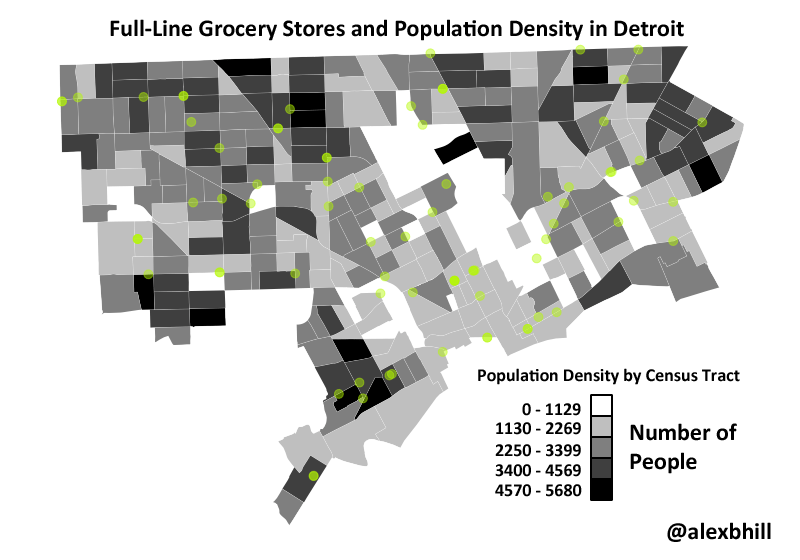
There are increasing food and grocery options Downtown, where the 2010 Census shows population growth, however this population growth is from new residents not residents moving from the East and West side into Downtown. Ye Olde Butcher Shoppe has called itself a grocery store, with Papa Joe’s Market coming soon thanks to Dan Gilbert, these are options on top of the new Whole Foods. The growing Downtown/ Midtown populations are not the populations of Detroit who do not have social mobility and do not face the higher prevalence rates of diet-related disease and obesity. The population dense neighborhoods on the East and West side of the city have not seen new grocery stores and in a number of cases local grocers have shut down only to be turned into Family Dollar locations.

Detroit Homicide Map 2012: Liquor, Parks, & Homicide

Alex B. Hill's avatarDETROITography

DET_homicide_map

411 homicides, 1130 active liquor licenses, 350 city parks

The goal of this map is to demonstrate the relationship between homicide, locations where alcohol is sold/ consumed, and community green spaces.

Research shows corner stores/ convenience stores don’t necessarily have a negative effect on violent crime. However in higher income neighborhoods corner stores are seen as a positive, while the opposite is true in lower income neighborhoods. I also began noticing that a number of homicides occurred at or near clubs and liquor stores.

A great deal of research has also been conducted on the benefit of turning vacant lots into parks or green spaces in order to reduce violent crime. The most important aspect of this, however, is that community parks are beneficial in reducing violent crime when they are maintained. Many city parks in Detroit are not able to be maintained.

I wonder if Greening of Detroit has…

View original post 77 more words

Personal Cartography in Detroit, 2012

Alex B. Hill's avatarDETROITography

detroit_2012

Many cartographers like to take inventory of their personal cartography near the year end. I figured it would be a fun experiment to map my own personal journeys and travels of 2012 on top of my foursquare check-ins.

I had to reconstruct my travels from my Google Calendar and Foursquare check-ins after losing all my GPX data when my Garmin was stolen out of my car. I think this made the exercise that much more interesting and challenging.

Being a community health worker, I was driving all over the city and metro area every day. Data shows that I typically use I-96 and usually check-in at locations in Midtown. Sadly, my job doesn’t let me walk or bike very often. I am resolved to ride my bike more in Detroit during 2013.

Source: original post

View original post

De Troit a la Mondrian

Alex B. Hill's avatarDETROITography

mondrian_detroit

While looking at the 2010 census data on population density and the percentages of change between 2000 and 2010, I kept imagining the Detroit census tract grid in the style of Dutch painter, Piet Mondrian. He began painting his primary color grid works while studying in Paris.

Then I saw this Mondrian world map and went for my own version of Detroit’s percentage of population change.

View original post

Detroit’s Per Square Mile: Inequality from Space

Firstly, this was not my idea, but I wanted to test it out in Detroit. Tim De Chant posted on Per Square Mile that inequality can be visualized from space via satellite images on Google Maps/Earth. He previously wrote about the concept that the lack of urban trees represented the absence of wealth in certain areas of a city.

“Research published a few years ago shows a tight relationship between per capita income and forest cover. The study’s authors tallied total forest cover for 210 cities over 100,000 people in the contiguous United States using the U.S. Department of Agriculture’s natural resource inventory and satellite imagery. They also gathered economic data, including income, land prices, and disposable income.” (source)

The research basically stated that with an increase in income the demand for trees increased likewise decrease in income showed a decrease in demand for trees. As De Chant writes, the authors found that trees were seen as a luxury item.

This all made the gears turn in my head about how this research and De Chant’s image grabs from Google satellite imaging applied to Detroit.

48205 Osborn (“Deadliest” Zipcode)


I choose 48205 because, “The neighborhood of 44,000 residents accounts for 6 percent of the city’s population, but was home to 15 percent of its murders and 13 percent of its shooting victims.”

48221 Palmer Woods

I used to live in this zipcode, in the University District. I would often run around the Palmer Woods neighborhood because I was fascinated by how different running south past 6 Mile Rd. and running north above 7 Mile Rd. could be such different environments. Census data pegs this zipcode as one of the highest income areas of the city.

The idea seems to work well in Detroit neighborhoods, however the Greening of Detroit is working hard to plant more trees every day in both wealthy and poor neighborhoods.

“Between 1950 and 1980, around 500,000 trees were lost in Detroit to Dutch elm disease, urban expansion and attrition. During that same time period, economic constraints prohibited the city of Detroit from replacing those trees. […] In 1989, Detroit, a typical American city, was losing an average of four trees for every one planted.”

The organization is estimated to have planted over 65,000 trees since its inception in 1989.

The History and Conflict of Food Access in Detroit

The food desert term has been readily applied to Detroit’s food system. However, the majority of academic and other research fails to take a comprehensive look at Detroit’s food system or its history. Following the New York Times article questioning whether the “food desert” term is just media buzz, I decided to share some of my initial findings in Detroit. I began researching Detroit’s food system about a year ago and started surveying grocery stores in Detroit 6 months ago because I could not believe the research coming out of the University of Michigan and other institutions that Detroit was devoid of fresh foods or healthy options. NPR recently published an article titled, What Makes a Food Desert Bloom, but fails to note the importance of food education on healthy eating to accompany increased visibility and access to healthy foods.

Detroit is a Food Desert or Food Swamp?

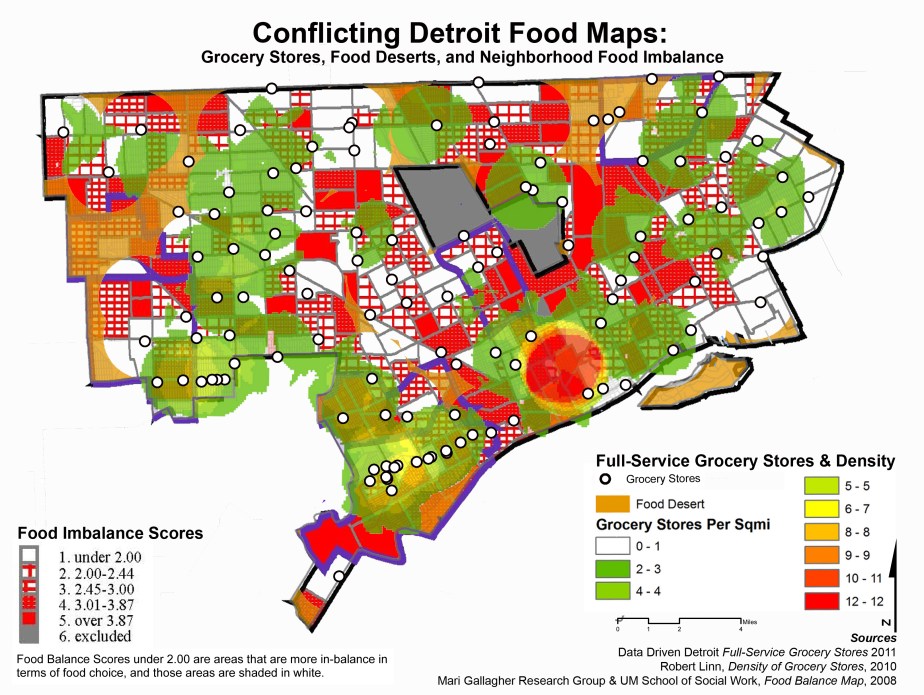
The map image accompanying this post is not the best illustration, but it is a complication of the best data sources on Detroit’s food system. The map represents the flaws and misunderstandings of outside consulting agencies and more general displays of either out-of-date or misguided information. Rob Linn has been creating some excellent maps of Detroit food stores data and now works with Data Driven Detroit. His maps are more current and show a cleaner picture of the actual data in Detroit. The surveys conducted by outside agencies have missed the mark and have published misguiding research to back up the “food desert” claim. The biggest problem with maps is that they are very “planner” focused and it is very easy to make broad claims based on maps. A recent PhD. out of the UM School of Public Health conducted research on African-American’s perceptions of food choice in Detroit and I’m very excited to read her findings. Understanding community perceptions and choices is going to be more important than placing food stores on a map.

Brief History of Detroit’s Food System

Currently, there is only one black-owned grocery store in Detroit where 4 out of 5 residents are African-American (DFPC Annual Report of Detroit Food System, 2009-2010). Detroit is a city with historic racial and economic divisions. These divisions often played out within the food system and its evolution up to today.

Small neighborhood grocery and convenience stores also hired few blacks. […] Few blacks worked where they shopped. Fewer felt any loyalty to neighborhood stores. Only a decade after the survey, inner-city grocery stores were among the most prominent targets of young looters. White-owned and -operated stores were the most prominent businesses in Detroit’s African American neighborhoods and the most convenient symbol of the systematic exclusion of blacks from whole sectors of the city’s economy. (Sugrue, Origins of the Urban Crisis, 113-114)

The title of “food desert” has been both accepted and refuted in Detroit. The majority of academic researchers lean towards labeling Detroit as a food desert, however others have come to that conclusion without adequate research into price and accessibility of foods the term is not helpful. Counting chain supermarkets and the 1 mile radius around those locations doesn’t give an accurate picture of food availability or access to quality fresh foods. Shannon Zenk (PhD ’04) while at the UM School of Public Health reported that Detroit was a food desert based on her research of “chain” supermarkets and their proximity to large numbers of residents. Her research found that, “supermarkets were farther away from African-American neighborhoods with the highest levels of poverty than they were from white neighborhoods with the highest levels of poverty (SPH Findings Spring/Summer 2009). This is an extremely inadequate picture of healthy food access and environment within the city.

Detroit has a long history of local grocers supplying neighborhoods while there have only been a few chain supermarkets to ever exist within the city limits. As of 1954-55, there were 69 supermarkets operated by Kroger, A&P, and other small local suppliers in Detroit. One of these small local suppliers was Food Fair, which in 1955 merged with Lucky Stores which operated as Food Fair markets under the Borman Food Stores Inc. In 1959, Borman bought up other smaller chains (State Super Markets, American Stores Inc., Lipson-Gourwitz Co.) and expanded to 46 stores in Detroit and Ferndale. In 1966, Borman announced the opening of three superstores under the name of Farmer Jack.

Farmer Jack was A&P’s most profitable division after the merger, but by the 2000s was having trouble competing with larger supermarkets like, Kroger, Meijer, K-mart and Walmart. Farmer Jack is recognized as the last chain supermarket to remain in Detroit before A&P put the stores up for sale and all locations closed in 2007. Kroger acquired twenty former locations while independent grocers collectively bought 21.

The flip side of the grocery and chain supermarket story in Detroit’s food system is that of community and urban gardens. Detroit Public School (DPS) student handbooks from the 1950s included a chapter on how to create a community garden. Urban farming and community gardens is a whole aspect of access to healthy food that needs its own post, so I won’t go into it here.


Detroit Food Map: access and environment

Contrary to popular belief and to oft-cited media, I have found that Detroit is not a food desert in its entirety. Detroit has a few neighborhoods and areas that lack a good number of options, but as a whole Detroit is a food swamp or as some say a “food grassland, rain forest, and jungle” (Rob Linn).

The families that I work with across Detroit tell me a similar story. They access food resources from a plethora of sources. One family told me that they try to get to Kroger whenever they can (outside Detroit), but otherwise get good fresh produce from a food bank since the Caregiver is out of work, they participate in the community garden, and visit an independent grocery store when they need to restock staple foods. Other family’s have told me similar stories of utilizing multiple food access points.

A food desert is defined as:

“any area in the industrialized world where healthy, affordable food is difficult to obtain. Food deserts are prevalent in rural as well as urban areas and are most prevalent in low-socioeconomic minority communities. They are associated with a variety of diet-related health problems. Food deserts are also linked with supermarket shortage.” (wikipedia)

Access is a key word when talking about food deserts and this is where many researchers count the number of stores and measure the distance from supermarkets to given populations. However, this often paints an inaccurate picture. There is more to access than the number of stores and how far away they are. Just because a grocery store is close by doesn’t mean that it has a huge fresh foods section or many healthy options. New research has noted that distance to healthy food may be psychological. This is where greater education on healthy food is necessary to create a more direct connection between people and healthy eating. I have been using the Nutrition Environment Measures Survey (NEMS) in order to attempt to get a more accurate picture of access to healthy foods. NEMS criteria focuses on comparing availability, price, and quality of foods between healthy food options and less healthy food options. Access is more than just distance and can include issues with the stores not stocking healthier food options, the quality of healthy foods available, and most importantly the price: is it cheaper to buy a bag of chips?

I have used the NEMS criteria to survey 20 grocery stores in Detroit (see Detroit Food Map) and what I have found has been entirely different from the large body of research that pegs Detroit as a “food desert.” All of the grocery stores had availability of fresh and healthy foods. Some produce sections were bigger than others and some carried more varieties, but all in all fresh foods were available and in good quality. The only items that were regularly low in quality were strawberries and cantaloupe. Likewise, I found in many stores that price could potentially be a hindrance for purchasing a healthier option, particularly with fruits, baked goods, meats, and juices. I spoke with a number of store owners and employees. Many said that they too have had a hard time with the “food desert” label and want people to know that they carry fresh foods. In some stores the owners noted that customers don’t regularly buy the healthier food options (i.e. ground turkey) or their fresh produce is purchased slowly, so it goes bad more quickly.

“It’s not enough. People always want more. We carry everything, many options, but people would rather shop at the super markets: Meijer, Wal-Mart. . . Is it because we don’t have the options? Look around!” – Staff Interview, Independent Grocer 02/02/12

My coworker, who has lived in Detroit her whole life and has been involved in improving the food system, has seen over the past 2 years an increase in farmer’s markets and community gardens in what she thinks is a response to food desert hype. Potentially, Detroit’s independent grocers have done the same and hopefully will continue improving their price, quality, and availability of healthy and fresh foods.

(image source)

Detroit is Not Your Blank Canvas

The rise of art as a means of revitalizing Detroit has become an exciting and controversial topic. I myself have been fairly skeptical and often view “art projects” with a certain about of disdain for their naivete and lack of real impact. Young gentrifiers and artists have called for Detroit to offer them more opportunities and good paying jobs, others have been drawn to the idea of “making” art in Detroit’s emptiness, and some artists have focused on Detroit as a place for only charity.

One well known example of art helping Detroit is the Heidelberg Project, which recently celebrated 25 years. The local artist who launched the project with his Grandfather is well known for taking vacant and litter-filled lots and turning them into “lots of art.” He has made his Eastside neighborhood more attractive with a mission to give young people a different vision of their neighborhoods and Detroit’s blight. Since the project began in it has faced demolition from the city and funding troubles. In 2011, the Center for Creative Community Development (C3D) conducted an economic impact study on the Hiedelberg project. The study found that:

[…] based on the nonprofit Heidelberg Project’s annual budget of $400,000 and an average 50,000 visitors per year, the annual economic impact in Wayne County is about $3.4 million. The exhibit also has led the creation of an estimated 40 jobs […]. The local economic impact — in areas of Detroit around Heidelberg — is about $2.8 million.

I have to be honest, I didn’t imagine that a neighborhood of art made from found objects could have had any impact bigger than the houses that it occupied. The Heidelberg Project is now in the process of building an art center to house the non-profit, its workshops, and other creative events. If anything the Heidelberg Project has shown that art can revitalize a community from the bottom-up.

However, there haven’t been any art projects that I have seen mirroring the example of the Heidelberg Project (have you? let me know in the comments). Most come from the outside; new arrivals to Detroit planning to make a mark on the “barren” city through art. The problem is that revitalizing Detroit needs more rooted efforts, art doesn’t always lead to economic impact, Detroit isn’t empty, and charity alone won’t solve the problems.

What about beautifying neighborhoods, painting houses that people do live in, or supporting community arts education programs?

The Allure of Revitalizing Detroit

Detroit has become a new kind of mecca for young people who want to make a difference and turn Michigan’s economy around. It has become “cool” to move to Detroit and work for a non-profit or other organization. This is all well and good and exciting, as long as young people who move to Detroit recognize that Detroit isn’t just about “saving” and doing whatever you want. There is a common misconception that Detroit is an empty landscape based on all the epic pictures dilapidated buildings taken by budding photographers, while the city has a lot of vacant properties and empty buildings downtown, the city is not empty or devoid of people. The people who remain in the city need to be engaged, included, and consulted on any project – citywide or neighborhood-based.

This often brings in the G-word: gentrification. I have written about my experiences living in Detroit, considering if I was a gentrifier, and calling for greater understanding of the city’s racial history and the privilege that many young artists bring into Detroit. Recently, Huffington Post Detroit, published a long article by Tommy Simon who wrote as a “young gentrifier” struggling to get by, but failed to realize that there is a large population in Detroit that has been struggling for much longer. He called for a stronger creative economy in Detroit that could provide senior level jobs for himself and his friends by noting that other young gentrifiers in other cities don’t have it this bad.

“Because I grew up in the suburbs and was mystified by the allure of being a part of the revitalization of Detroit. […] And while I hope I do not have to argue the importance of a city providing employment, I will clarify that I am not simply talking about any job, but a job that allows a young person like myself to put my education and creativity to good use.”

To me this represents the disconnect between wanting to revitalize Detroit and understanding that it isn’t a simple creative endeavor. In the name of “revitalization” artists can’t overlook existing efforts or forget to engage a neighborhood community. An excellent example of this is the fight over an “art house” in North Corktown.

“The art house people didn’t buy it, pay taxes, or intend to live in it,” said Samul. “They were just going to use it to play in.”

Often what the “Detroit is empty” misconception means for “art” is a disregard for existing Detroit efforts and communities in the name of revitalization. In this case the art house was framed as gentrification, but in the end the “art house” best represented the failure of art to connect to community. For any artists, this should be a lesson in talking to key community stakeholders before getting creative.

Art = Employment?

The Detroit Creative Corridor Center (DC3) is working on incubating and developing a creative economy in Detroit. In recent years there has been an upswing of art centers in Detroit from College for Creative Studies and the School for Creative Studies to MOCAD and Art Detroit Now  to the Detroit Design Festival (DDF) and Arts Corps Detroit, along with a long list of Detroit creative endeavors that have made art an important aspect of Detroit’s growth and image. The Knight Foundation released its list of grant winners of initiatives in Detroit that are “advancing contemporary life.” Among them were 2 groups working to advance the creative side of Detroit’s recovery, LOVELAND Technologies and the Mt. Elliot Makerspace.

But, does art and creative investment really drive jobs and economic growth?

For each dollar the state of Michigan spends on arts and culture, $51 goes back into the state economy. In Detroit alone, the 28 organizations included had total direct expenditures of more than $127 million and employed 2,657 staff. (source: about Report from ArtServe Michigan)

Art and the creative sector can no longer be ignored when talking about Detroit’s future growth. The impacts that have been measured thus far show that through programs like the Heidelberg Project the city and sometimes neighborhoods benefit from art.

“Vibrancy is probably the best proxy we have for the quality of place,” Coletta says. “Quality of place is essential for attracting and retaining human capital. And human capital is essential to the economic well-being of communities.” (source)

Art can no longer be ignored as an economic impactor, but if art can build vibrancy and revive communities it begs the question: for whom does art revive communities? For gentrifiers? For suburban weekend visitors? For the 1 million tourists who come to Detroit?

Artists need to consider their privilege, communities need to be engaged by artists interested in revitalizing Detroit, and art projects need to have a more direct impact for Detroit’s neighborhoods.

———-

From my quick and far from extensive research I have found very few instances of art and creativity benefiting Detroiters, neighborhoods, and those in need. One of my other favorite examples of a creative project that has actually impacted the Detroit community is the Empowerment Plan a versatile street coat/ sleeping bag created by a CCS student, Veronika, but developed in close cooperation with Detroit’s homeless population. As the project grew Veronika was able to employ some of the homeless individuals who helped her with the initial ideas.