Map: United Strohs of America

Alex B. Hill's avatarDETROITography

Screen Shot 2015-12-11 at 12.15.54 PM

Detroit’s iconic beer brewer has a storied past of fire brewing beer in copper kettles, switching to near-beer during Prohibition as well as ice cream to finally losing all of its billions of dollars after the company tried to take on national brands without the necessary budget.

Currently Stroh’s is distributed 126 zipcodes in 21 states. The Stroh’s brand is now under Pabst, which manages a number of small yet iconic beer brand names.

My colleague Matt Elliott and I began wondering where can you get Strohs in Detroit right now? Is it on tap anywhere?

View original post

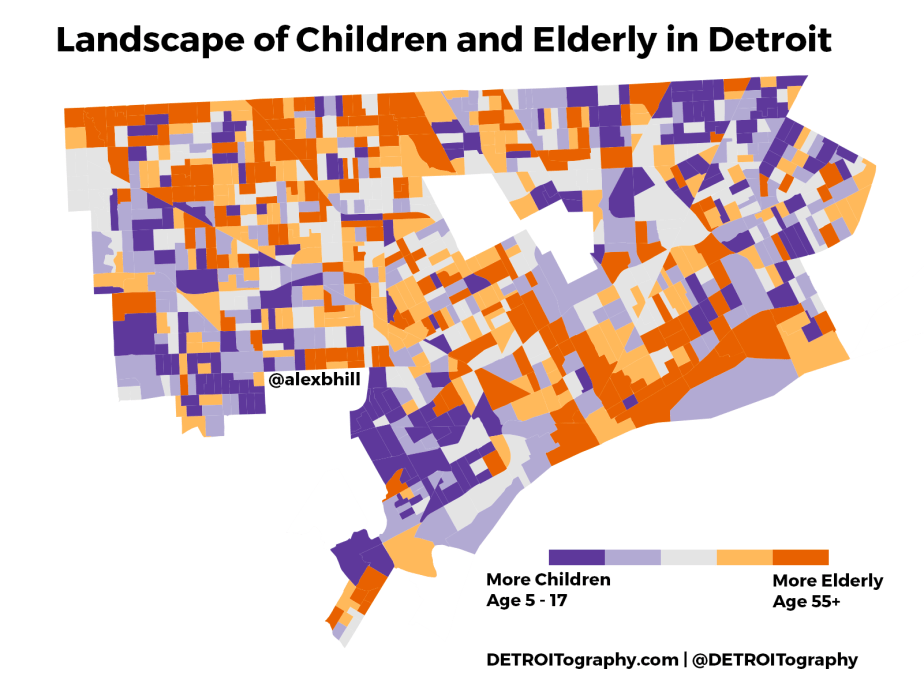
Map: Landscape of Children vs. Elderly in Detroit

Alex B. Hill's avatarDETROITography

children-elderly-det2

I’ve been interested in the impacts of various issues on children in Detroit, from traffic fatalities to areas with the most children. The flip side, focusing on the elderly, is also very important and often overlooked in current development efforts in the city.

The age balance or imbalance across the geography of Detroit results in some interesting areas where children or the elderly make up a majority. Not surprisingly many of the areas with the most children also have fewer elderly residents. The riverfront has a larger elderly population often associated with the senior apartment high rises. Grand River cuts an interesting pattern along the Westside where there are more elderly above the Avenue and more children below.

View original post

Map: Midtown or Cass Corridor? Responses from the streets of Detroit

Alex B. Hill's avatarDETROITography

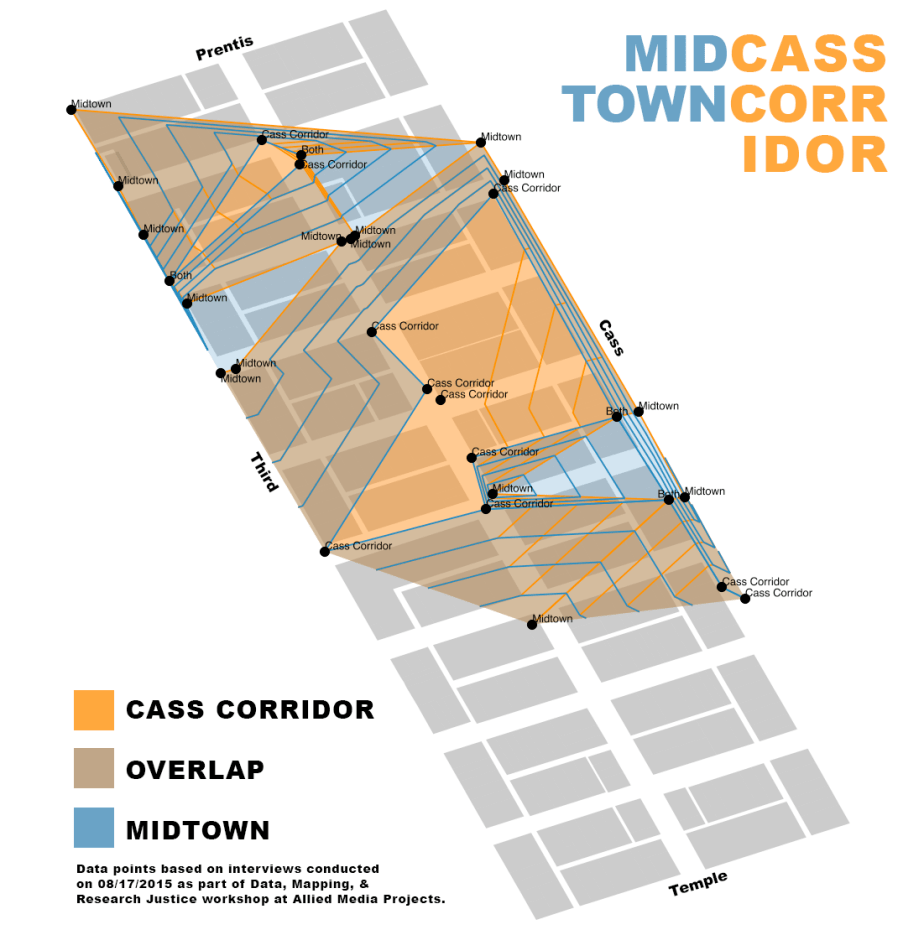
midcassDuring the Data, Mapping, and Research Justice workshop offered in August, participants conducted their own data collection based on shared research questions about the Cass Corridor. One question in particular that was brought up was what different people called the area: Cass Corridor or Midtown.

In all 30 people were rapidly interviewed along Cass Avenue, 2nd, and Third Street. Sometimes the workshop participants’ data collection clipboards made people wary, but often the clipboards invited more questions making it easy to engage people on the street, at restaurants, and waiting for the bus. The participants didn’t make it further than Peterboro Street due to time limits in the data collection.

Cass Corridor11
Both3
Midtown16

Midtown was the more commonly referenced placename, but overall the data gave a fairly even representation of the area. If anything the responses collected from people shows the well documented debate over…

View original post 173 more words

The Future Geographers of Detroit Haven’t Yet Made a Map

Alex B. Hill's avatarDETROITography

In May, I had the honor and privilege to collaborate with the Detroit Future Schools program at the Boggs School to present a series of activities about data visualization. Our main goal was to visualize and understand patterns and relationships.

I ran the mapping activity where 2nd and 3rd graders identified where they lived, how far that was from school, and if they had any classmates who lived nearby. Many of the students didn’t realize they had a classmate who lived very close or similarly, how far some of their classmates lived from the school.

My favorite response to the map was:

“That doesn’t even look like Detroit.”

It is all too easy to get wrapped up in data, boundary lines, and “accurate” depictions of reality. Children can quickly…

View original post 41 more words

Map: Detroit’s Ubiquitous Places – Church and Liquor

Alex B. Hill's avatarDETROITography

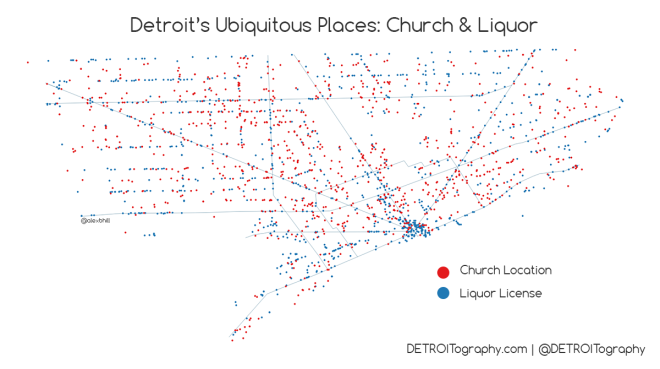
Inspired by Nathan Yau’s work at FlowingData on pizza place geography and grocery store geography, I wanted to see how Detroit’s ubiquitous locations compared. Driving along Van Dyke where there was church after church (many abandoned) interspersed with liquor stores gave me the idea of examining which type of location dominated Detroit’s landscape.

church_liquor_dotIt takes forever to scrape the Michigan Liquor Control Commission (MLCC) website for active liquor licenses, so I relied on a 2012 dataset that I generated a while back. I then utilized data from Data Driven Detroit with Churches from 2011. The data is not perfect, but unless you have someone actively monitoring every liquor license and every church there is going to be significant change. Notably, the number of liquor licenses have been decreasing since 2009. The next step was to set up a grid that was generally half a square mile squares.

church_gridThere are…

View original post 157 more words

State of Detroit – Detroit’s Food Landscape

Alex B. Hill's avatarDETROITography

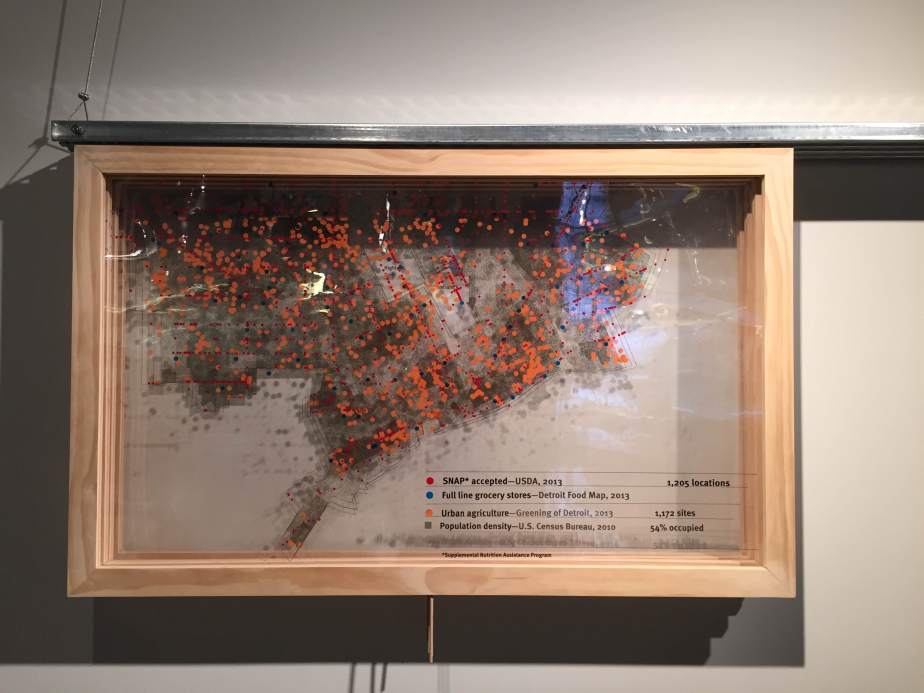
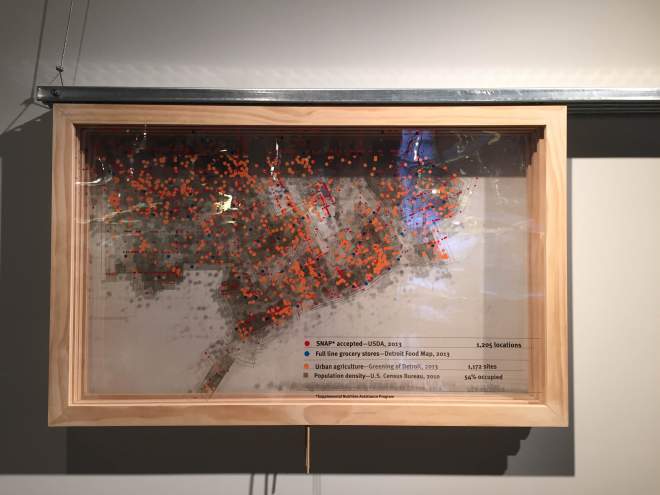
IMG_7920The team at the Chicago Design Museum approached me to contribute some maps and data visualizations to their upcoming “State of Detroit” exhibit. It grew into a collaboration that built off of my research focus on food access in Detroit while also addressing some of the “Detroit is Empty” misconceptions.

IMG_7919The installation has a cool sliding feature so you can view different map layers together.

Visit the exhibit from now until August 30th, 2015. More. . .

View original post

Map: Can Detroit Really Be Compared to Any Other City?

Alex B. Hill's avatarDETROITography

detroit-cities3

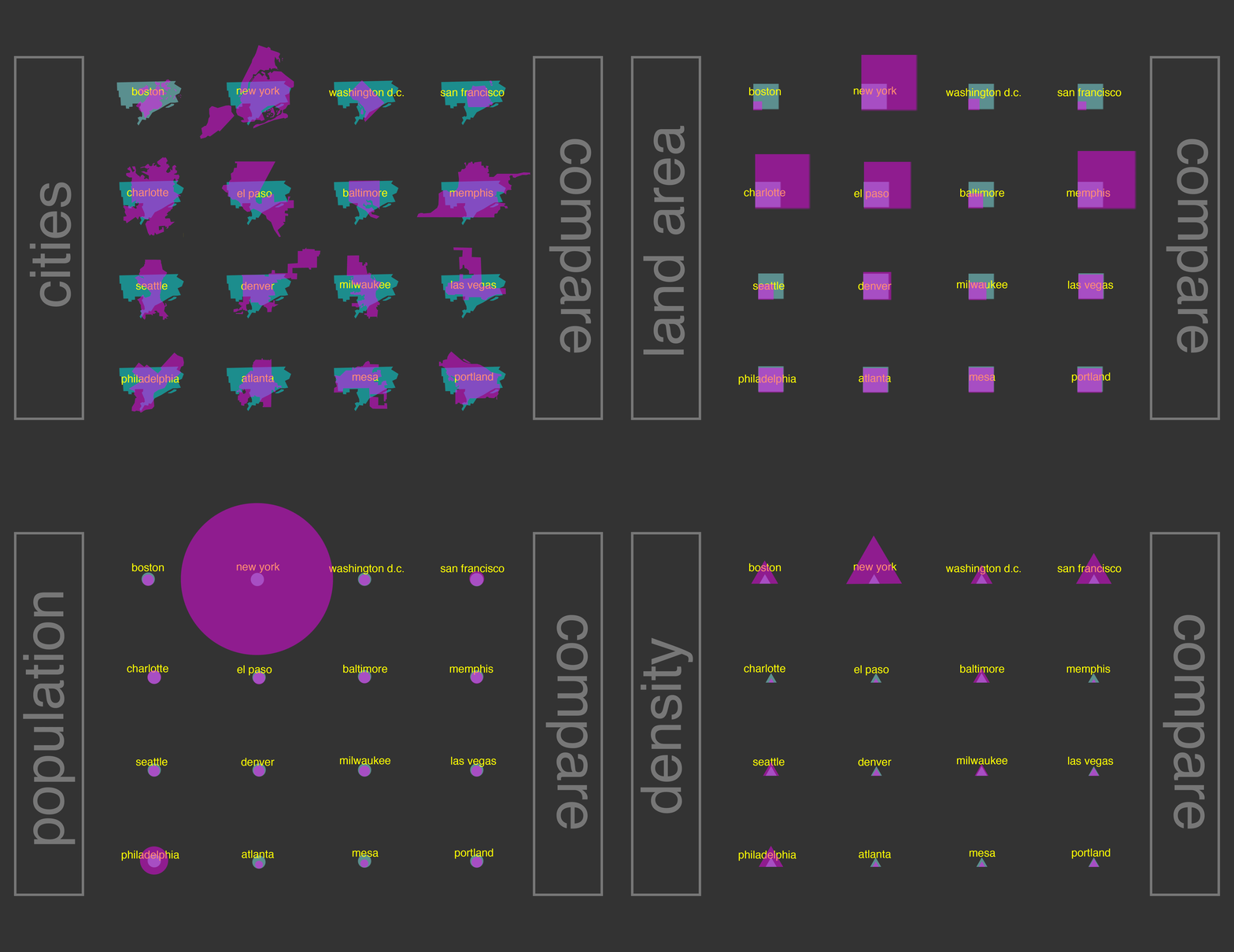
Can Detroit really be compared to any other city? No doubt everyone has tried comparing crime rates, economy, and poverty levels in Detroit with other troubled cities. A few groups have even tried fitting different city land areas into Detroit’s 139 square (land) miles. It always seems that Detroit has too much or too little of something for a city to city comparison to make much sense. Rob Linn had similar thoughts and instead of comparing land area or other commonly compared attributes he analyzed infrastructure density (feet of street per resident) as a method to debate the misguided “rightsizing” push. Rob found that Detroit had a high rate of “feet of street per resident” which caused some areas of the city to appear more vacant when in reality they had healthier infrastructure density.

The 2010 Census population for Detroit was 713,777, closer to San Francisco’s. Imagine San Francisco’s southern edge…

View original post 391 more words

Map: Detroit’s Second Great Fire

Alex B. Hill's avatarDETROITography

mcm-fire

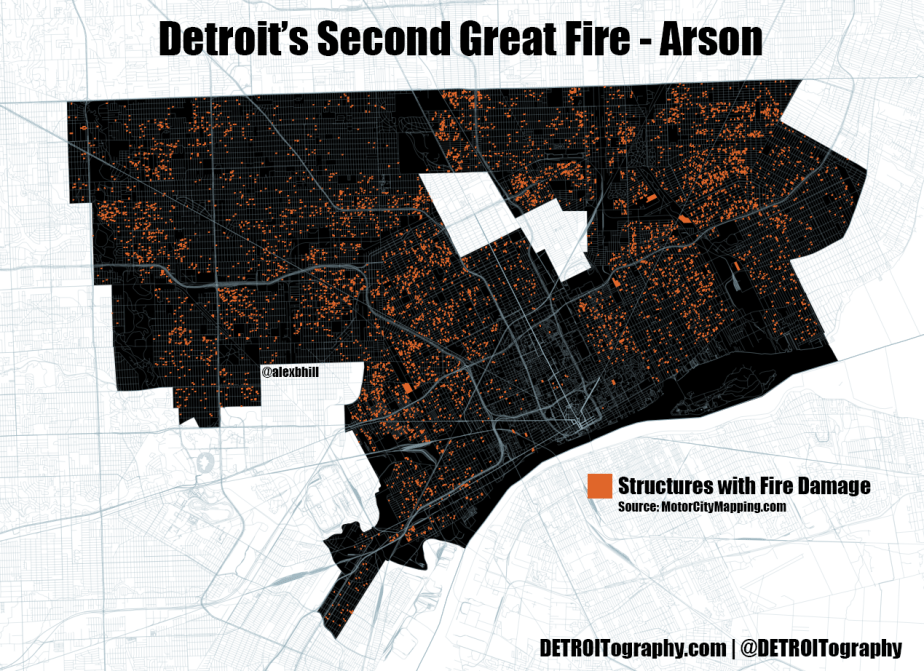
Detroit’s “Great Fire” of 1805 is solidified in the history books as a defining moment for the city. With only the brick chimneys remaining, Detroit residents dug in and rebuilt their city. Justice Woodward drew up his inspired hub-and-spoke street plans (1806) to bring Detroit on par with cities like Paris and Washington D.C. Following the “Great Fire” Detroit saw continued progress and became one of the most well-known cities in the world for its industry.

However, Detroit has had a more recent “Great Fire,” one that began in the 1970s and is most often seen on display during Devil’s Night. As Detroit’s population declined and crime increased, both dedicated residents and criminals took to setting abandoned homes on fire. A news segment from 1975 features an interview with two Detroit residents talking about how they decided to torch an abandoned house on their block because it…

View original post 133 more words

Map: Where Are All the People in Detroit – Occupancy and Foreclosure

Alex B. Hill's avatarDETROITography

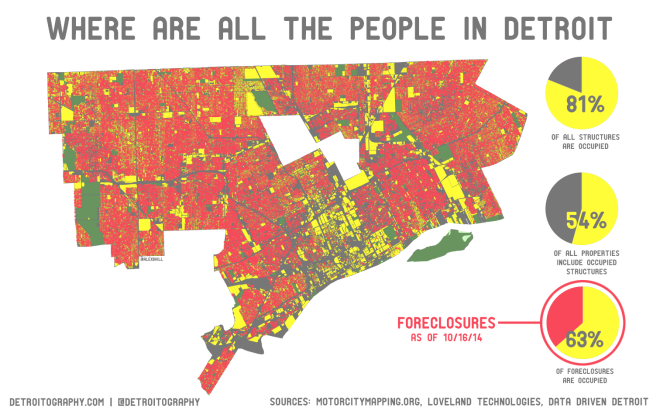
det-occupied2There is a common media narrative that Detroit is empty, a blank slate, a blank canvas where anything can be done. However, this false narrative doesn’t account for the nearly 700,000 people who do live in the city. I pulled all of the “occupied, partially occupied, and possibly occupied” properties out of the Motor City Mapping (MCM) data and the above map is the result.

I found 203,723 occupied structures, which is an 81% structure occupancy rate and a total of 54% of properties with occupied structures. This doesn’t necessarily account for parks or large unused former industrial properties. The map however gives a far different picture than the common media narrative of an empty Detroit.

det-occupied-foreclosures2This year the Wayne County Treasurer identified 61,912 properties in Detroit for foreclosure in 2015. Loveland Technologies found that 35,669 of these properties (63%) are occupied according to the MCM survey data. More from…

View original post 116 more words